A quality guru named Philip Crosby defined quality as fitness for use.
Answer:
Strategic sourcing is the development and management of supplier relationships to
acquire goods and services in a way that aids in achieving the immediate needs of the
business.
Answer:
When evaluating capacity, managers need to consider both resource inputs and product
outputs.
Answer:
A favorable business climate in facility location decision-making might include local
government providing basic skill training for prospective members of the workforce.
Answer:
Supply networks cannot be constructed for every product or service.
Answer:
Facility location decisions are made using analytical techniques that are able to weigh a
large number of different variables equally.
Answer:
The product-process matrix shows the relationship between process structures and
product volume and variety characteristics.
Answer:
Yield management is an important tool that can be used to shape demand patterns.
Answer:
An order qualifier is a set of screening criteria that permits a firm’s products to be
considered as possible candidates for purchase.
Answer:
In exponential smoothing, it is desirable to use a higher smoothing constant when
forecasting demand for a product experiencing high growth.
Answer:
Design quality refers to the inherent value of the product in the marketplace.
Answer:
The service-system design matrix identifies six forms of service encounters.
Answer:
The mathematical results of Business Analytics are used to automate decision-making
and eliminate the decision maker.
Answer:
Lot-for-lot (L4L) is the most common lot sizing technique.
Answer:
Attempting to balance the desire to efficiently use resources while providing a highly
effective service may create conflict between the two goals.
Answer:
Yield management is the process of allocating the right type of capacity to the right type
of customer at the right prices at the right time to maximize revenue or yield.
Answer:
The basic notion of economies of scale is that as a plant gets larger and volume
increases, the average cost per unit of output drops.
Answer:
Applying lean concepts to logistics is difficult unless either the manufacturer or the
customer owns the logistics activities.
Answer:
A modular bill of materials includes items with fractional options.
Answer:
Two common measures to evaluate supply-chain efficiency are the consumer price
index and the beta flow system.
Answer:
The probability associated with rejecting a high quality lot is denoted in acceptance
sampling with the Greek letter alpha.
Answer:
Which of the following forecasting methodologies is considered a time series
forecasting technique?
A. Delphi method
B. Exponential averaging
C. Simple movement smoothing
D. Weighted moving average
E. Simulation
Answer:
Which of the following is not an analytical tool used in six-sigma quality improvement
programs?
A. Run charts
B. Pass charts
C. Cause-and-effect diagrams
D. Flowcharts
E. Pareto charts
Answer:
Which of the following forecasting methodologies is considered a causal forecasting
technique?
A. Exponential smoothing
B. Weighted moving average
C. Linear regression
D. Historical analogy
E. Market research
Answer:
Various financial data for SunPath Manufacturing for 2012 & 2013 follow.
Answer:
Which of the following refers to the physical presence of the customer in a service
system?
A. Creation of the service
B. Customer contact
C. Intermittent production
D. Continuous production
E. None of the above
Answer:
Below are the data for a Time-Cost CPM Scheduling analysis. The time is in days and
the costs include both direct and indirect costs.
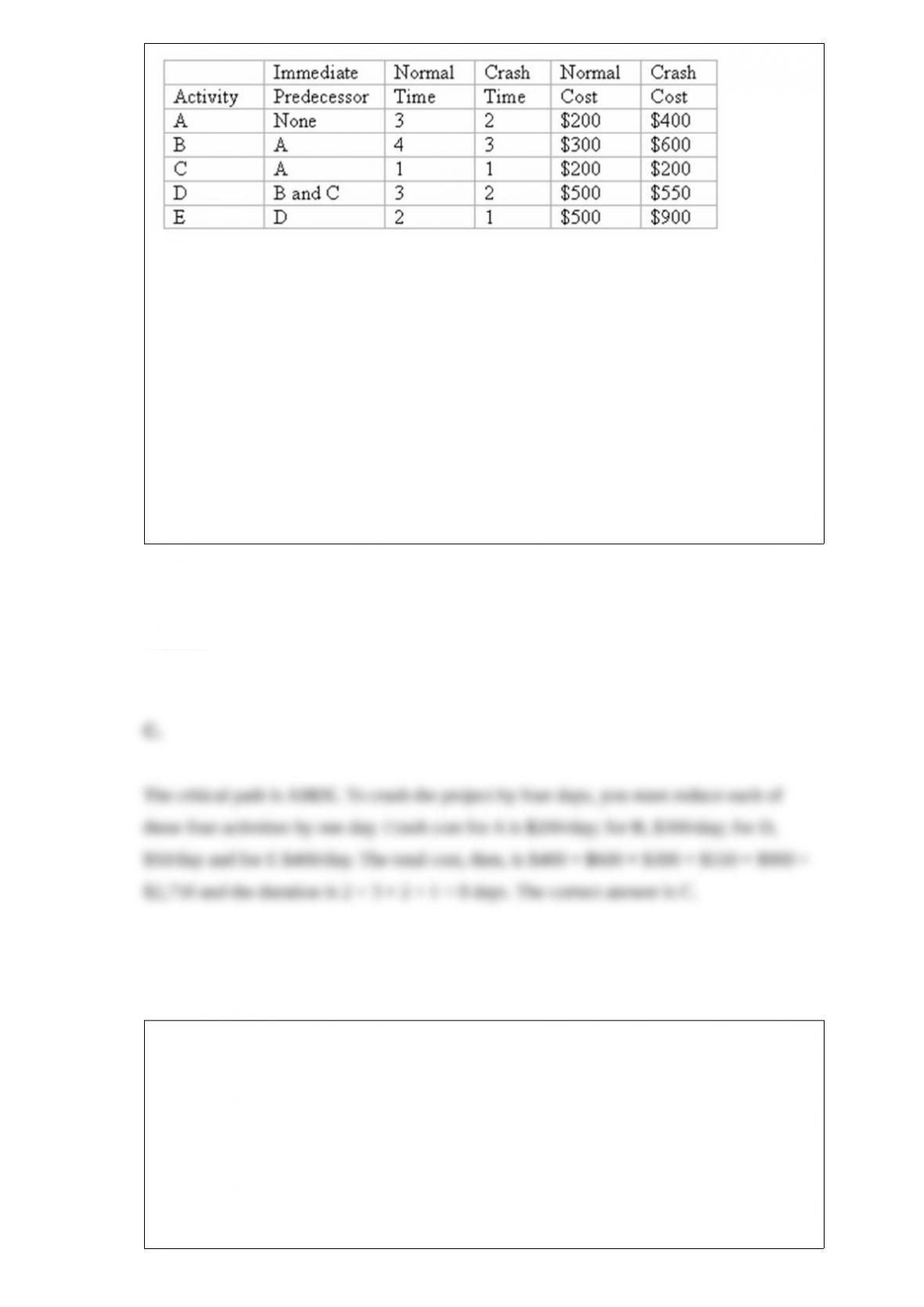
If you crash this project to reduce the total time by four days, what is the total time of
the project and total cost?
A. Total time is 10 days, total cost is $2500
B. Total time is 9 days, total cost is $2300
C. Total time is 8 days, total cost is $2750
D. Total time is 8 days, total cost is $1850
E. Total time is 9 days, total cost is $2350
Answer:
To take into consideration demand uncertainty in reorder point (R) calculations, what
do we add to the product of the average daily demand and lead time in days when
calculating the value of R?
A. The product of average daily demand times a standard deviation of lead time
B. A “z” value times the lead time in days
C. The standard deviation of vendor lead time times the standard deviation of demand
D. The product of lead time in days times the standard deviation of lead time
E. The product of the standard deviation of demand variability and a “z” score relating
to a specific service probability.
Answer:
A company wants to determine its reorder point (R). Demand is variable and they want
to build a safety stock into R. If the average daily demand is 12, the lead time is 5 days,
the desired “z” value is 1.96, and the standard deviation of usage during lead time is 3,
which of the following is the desired value of R?
A. About 6
B. About 16
C. About 61
D. About 66
E. About 79
Answer:
The philosophical leaders of the quality movement, Philip Crosby, W. Edwards
Deming, and Joseph M. Juran had the same general message about what it took to
achieve outstanding quality. Which of the following was part of that message?
A. Fourteen steps for quality management
B. Quality is free
C. Customer focus
D. Zero defects
E. Six-sigma
Answer:
Larry’s Auto Body Repair Shop had revenues that averaged $60,000 per week in April
and $50,000 per week in May. During both months, the shop employed six full-time (40
hours/week) workers. In April the firm also had four part-time workers working 25
hours per week but in May there were only 2 part-time workers and they only worked
10 hours per week. What is the percentage change in labor productivity from April to
May for Larry’s Auto Body Repair?
A. -20.00%
B. -15.82%
C. 8.95%
D. 2.3%
E. -25.00%
Answer:
A Pareto chart as part of a six-sigma quality improvement process might be found in
which DMAIC category?
A. Define
B. Measure
C. Analyze
D. Improve
E. Control
Answer:
A difference between project and continuous flow categories of process flow structures
is which two of the following?
A. The size and bulk of the product
B. Discrete parts moving from workstation to workstation
C. Degree of equipment specialization
D. Being a “Virtual Factory”
E. Profit per unit
Answer:
Which of the following is not a category reported in applying for the Baldrige Award?
A. Corporate leadership
B. Use of statistical quality control tools
C. Business results
D. Consumer and market focus
E. Strategic planning
Answer:
Getting an autograph from a famous person might involve standing in which type of
queuing line structure?
A. Single channel, single phase
B. Single channel, multiphase
C. Multichannel, single phase
D. Multichannel, multiphase
E. None of the above
Answer:
Which of the following is usually included as an inventory holding cost?
A. Order placing
B. Breakage
C. Typing up an order
D. Quantity discounts
E. Annualized cost of materials
Answer:
You have just performed a CPM analysis and have found that more than one path
through the project network has zero slack values. What can you conclude?
A. You have incorrectly performed the analysis
B. You have multiple critical paths
C. Only one path is optimal
D. More than one path is optimal
E. The project will not be completed by the desired time
Answer:
Which of the following is a suggestion for managing queues that is mentioned in the
textbook?
A. Put up a serpentine lane to keep people from jumping ahead in line
B. Use humor to defuse a potentially irritating situation
C. Segment the customers
D. Assure customers that the wait is fair and inform them of the queue discipline
E. Tell people in the queue that each will be served as soon as possible
Answer:
Which of the following costs are relevant to aggregate operations planning?
A. Sunk costs
B. Transaction costs
C. Backordering costs
D. Legal costs
E. Fixed costs
Answer:
From an operational perspective yield management is least effective under which of the
following circumstances?
A. Demand can be segmented by customer
B. The product can be sold in advance
C. Demand is highly variable
D. Fixed costs are high and variable costs are low
E. Demand is stable and close to capacity
Answer:
You have collected the data for a Time-Cost CPM Scheduling model analysis. The time
is in days and the project “direct costs” are given below.
The indirect costs for the project are determined on a daily duration basis. If the project
lasts 16 days the total indirect costs are $400, 15 days they will be $250, 14 days they
will be $200, and 13 days they will be $100. If you crash this project by one day what is
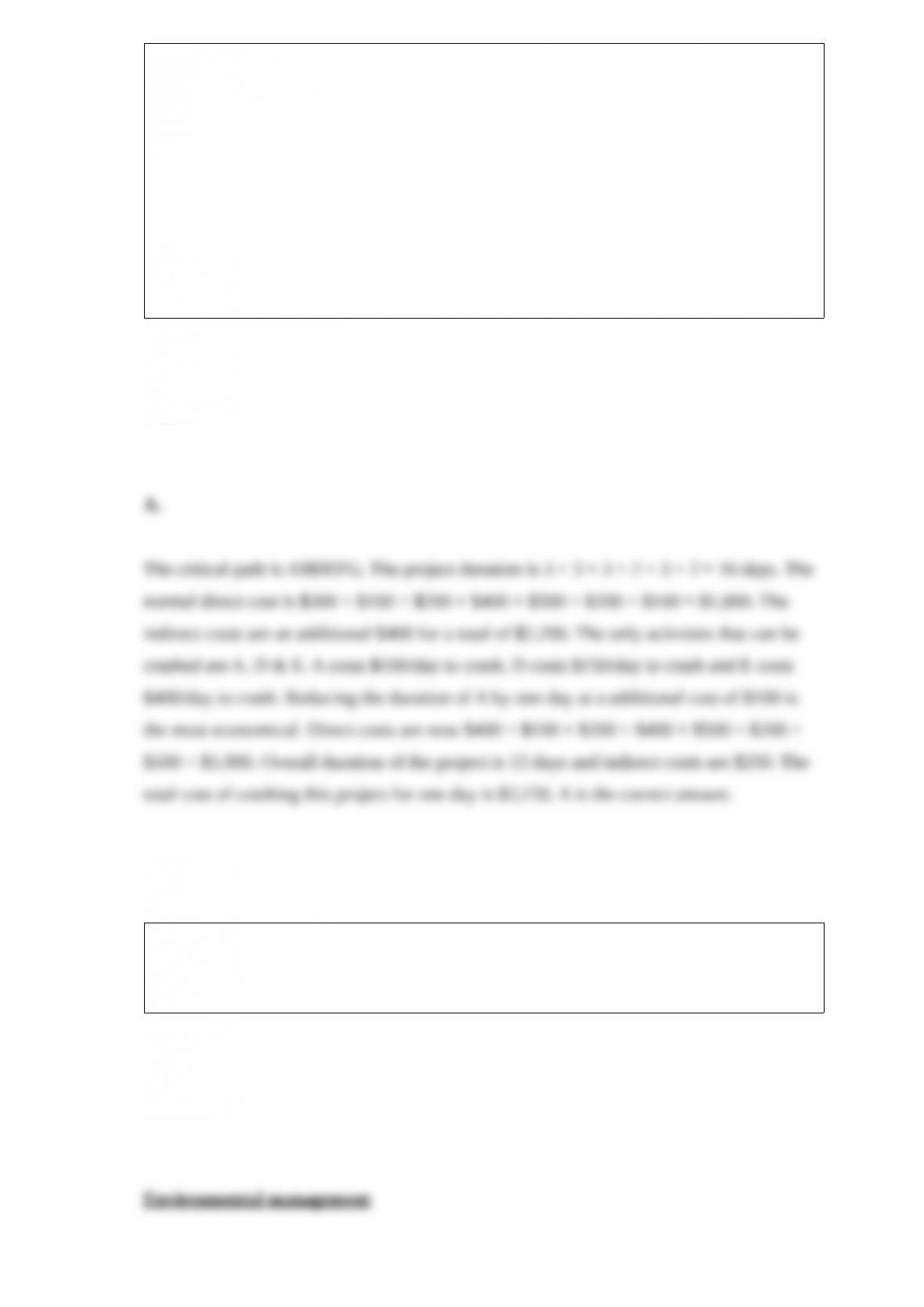
the total (i.e., direct and indirect) project cost?
A. $2,150
B. $2,300
C. $2,400
D. $2,450
E. $2,500
Answer:
ISO 14000 is primarily concerned with what?
__________________________________________
Answer:
Three distribution centers, A, B, and C, are located at the following (X, Y) coordinates:
A, (20, 130); B, (180, 0); and C, (200, 200). A factory is to be constructed to distribute a
new product through these warehouses. The expected annual volumes expected to be
shipped through the three warehouses is forecast to be 20 million units through A, 100
million through B and 50 million through C. Using the centroid method, approximately
what should the coordinates of the new factory be? _________________
Answer:
You are developing an “X-bar” chart based on sample means. You know the standard
deviation of the sample means is 4, the desired confidence level is 99.7 percent, and the
average of the sample means is 24. What is your UCL?
________________________________________
Answer:
What is the most basic requirement of an EVM system?
_____________________________________________________________
Answer:
If the best operating level of a piece of equipment is at a rate of 400 units per hour and
the actual output during an hour is 300 units, what is the capacity utilization rate?
____________________
Answer:
Buying items at a department store where there are a large number of checkout counters
features which type of queuing system line structure?
______________________________________________
Answer:
If the fraction defective is 0.12 based on a sample size of 16, what is the standard
deviation to be used when constructing a “p” chart?
___________________________________
Answer:
The ability to maintain balance in a system is referred to as _______________.
Answer:

Name five common measures of operations and supply management efficiency used by
Wall Street.
1> _____________________
2> _____________________
3> _____________________
4> _____________________
5> _____________________
Answer: