By convention, the top level in a bill of material is
A) level 0
B) level 1
C) level T
D) level 10
E) level 100
Each R requires 2 of component S and 1 of part T. The lead time for assembly of R is 3
days. The lead time for the manufacture of S is 5 days. The lead time for the
manufacture of T is 10 days. The cumulative lead time for R is __________ days.
A) 6
B) 9
C) 13
D) 17
E) cannot be determined
The second unit of production took 9 hours. If the learning curve is 90% how long did
the first unit take?
A) 9 hours
B) 10 hours
C) 8.1 hours
D) 8.5 hours
E) none of the above
Which of the following is not one of the major categories of costs associated with
quality?
A) prevention costs
B) appraisal costs
C) internal failures
D) external failures
E) None of the above; they are all major categories of costs associated with quality.
Which of the following correctly describes all iso-profit lines for an LP maximization
problem?
A) They all pass through the origin
B) They are all parallel.
C) They all pass through the point of maximum profit.
D) Each line passes through at least 2 corners.
E) All of the above
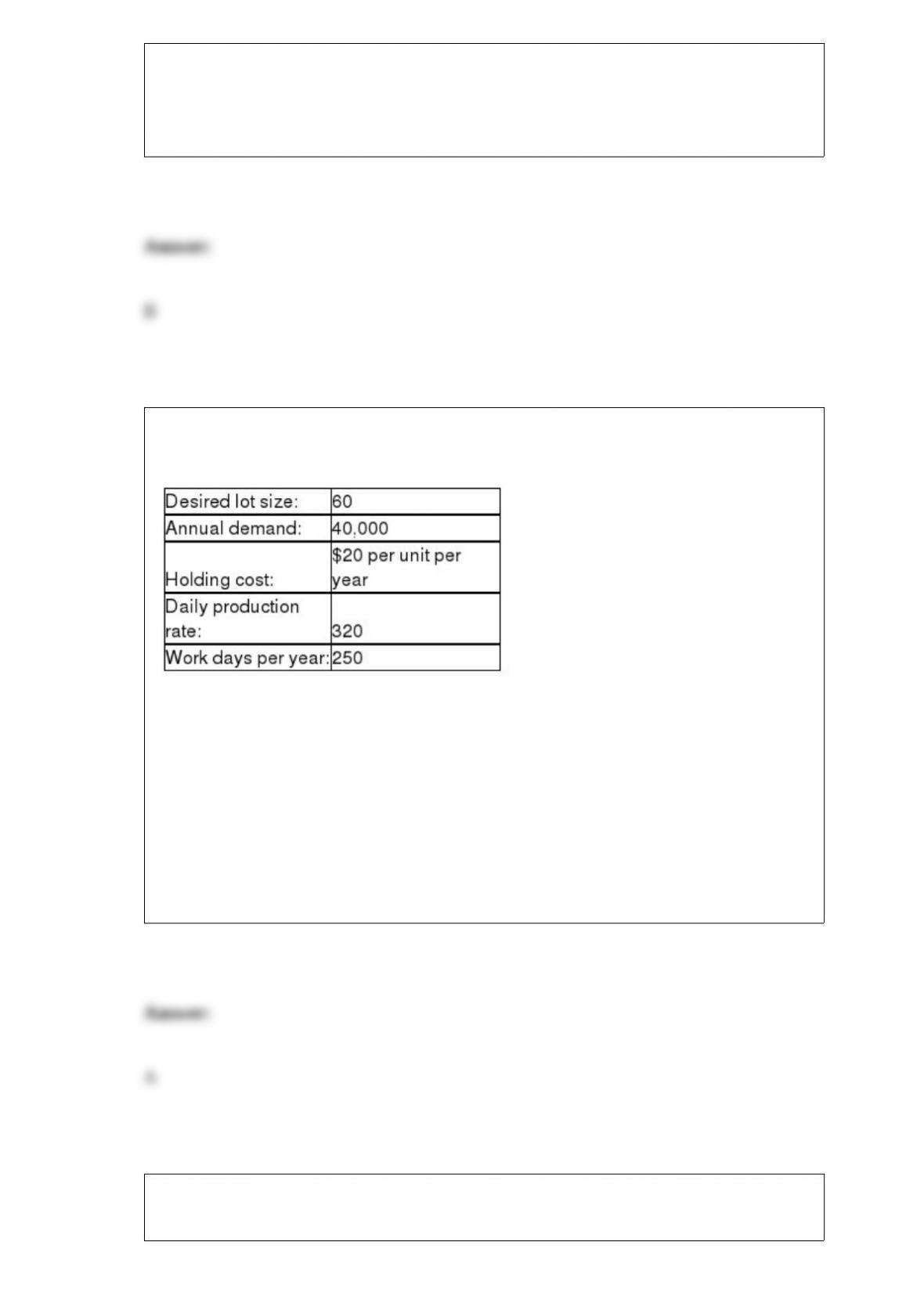
A firm wants to develop a level material use schedule based on the following data.
What should be the setup cost?
A) $0.45
B) $4.50
C) $45
D) $450
E) $500
In assembly line balancing, cycle time (the ratio of available production time to
scheduled production) is the
A) minimum time that a product is allowed at each workstation
B) maximum time that a product is allowed at each workstation
C) inverse of the minimum number of workstations needed
D) sum of all the task times divided by the maximum number of workstations
E) equivalent of the maximum task time among all tasks
A manager is applying the transportation model of linear programming to solve an
aggregate planning problem. Demand in period 1 is 100 units and in period 2 demand is
150 units. The manager has 125 hours of regular employment available for $10/hour
each period. In addition, 50 hours of overtime are available for $15/hour each period. If
holding costs are $2 per unit each period, how many hours of regular employment
should be used in period 1 (assume demand must be met in both periods 1 and 2 for the
lowest possible cost and that production is 1 unit per hour)?
A) 100
B) 125
C) 150
D) 50
E) none of the above
Ten high-technology batteries are tested for 200 hours each. One failed at 20 hours;
another failed at 140 hours; all others completed the test. FR(%) is __________ and
MTBF is __________.
A) 20%; 880 hours
B) 10%; 1980 hours
C) 20%; 1760 hours
D) cannot calculate from information provided
E) 80%; 920 hours
Which one of the following statements is true about the kanban system?
A) The quantities in the containers are usually large to reduce setup costs.
B) It is associated with a push system.
C) It is useful to smooth operations when numerous quality problems occur.
D) The supplier workstation signals the customer workstation as soon as a batch is
completed.
E) The customer workstation signals to the supplier workstation when production is
needed.
What are the components in a waiting-line system?
Not only customers, but stockholders, suppliers, and others, are among the __________
whose values must be protected in making ethical decisions concerning the quality of
products.
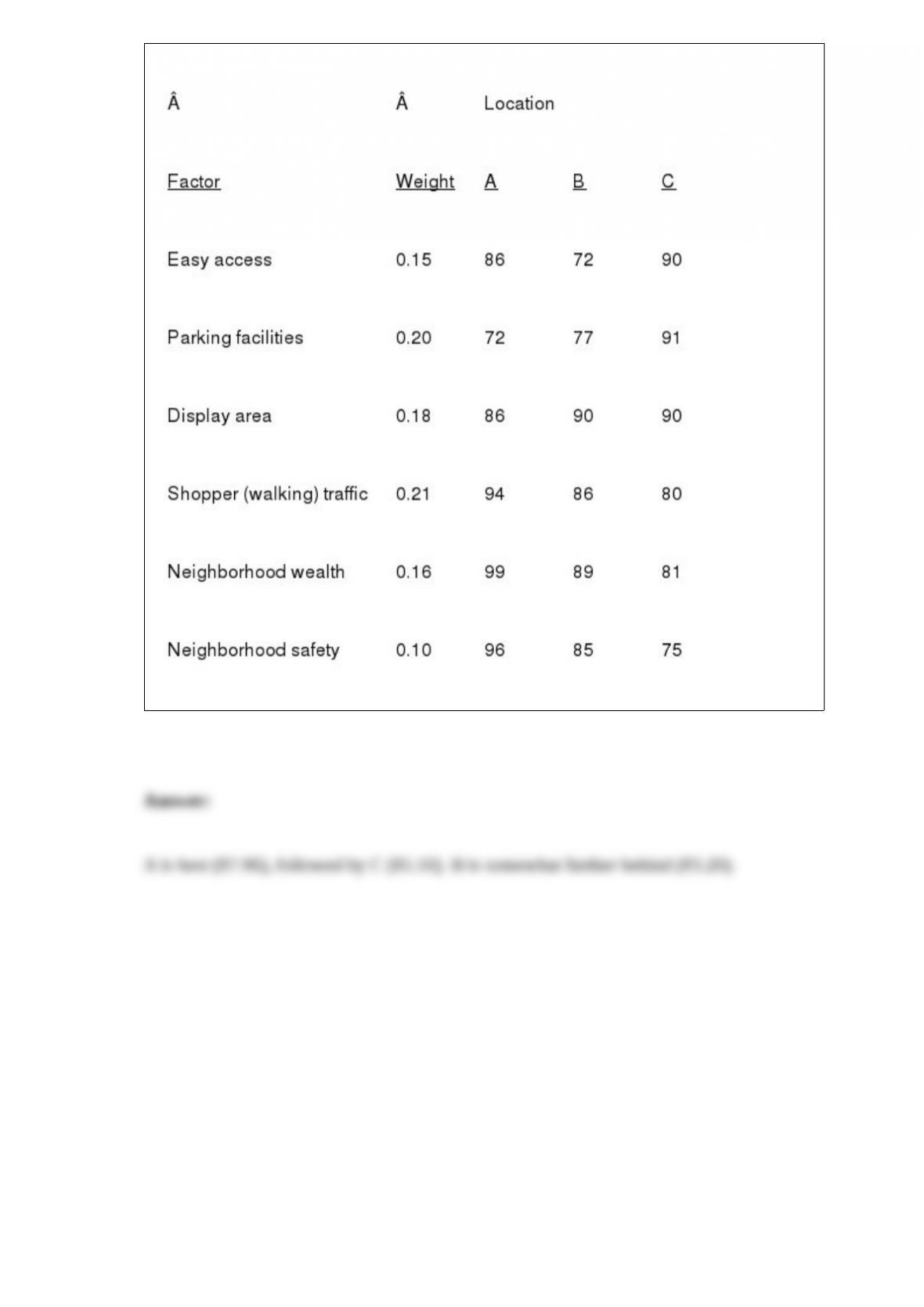
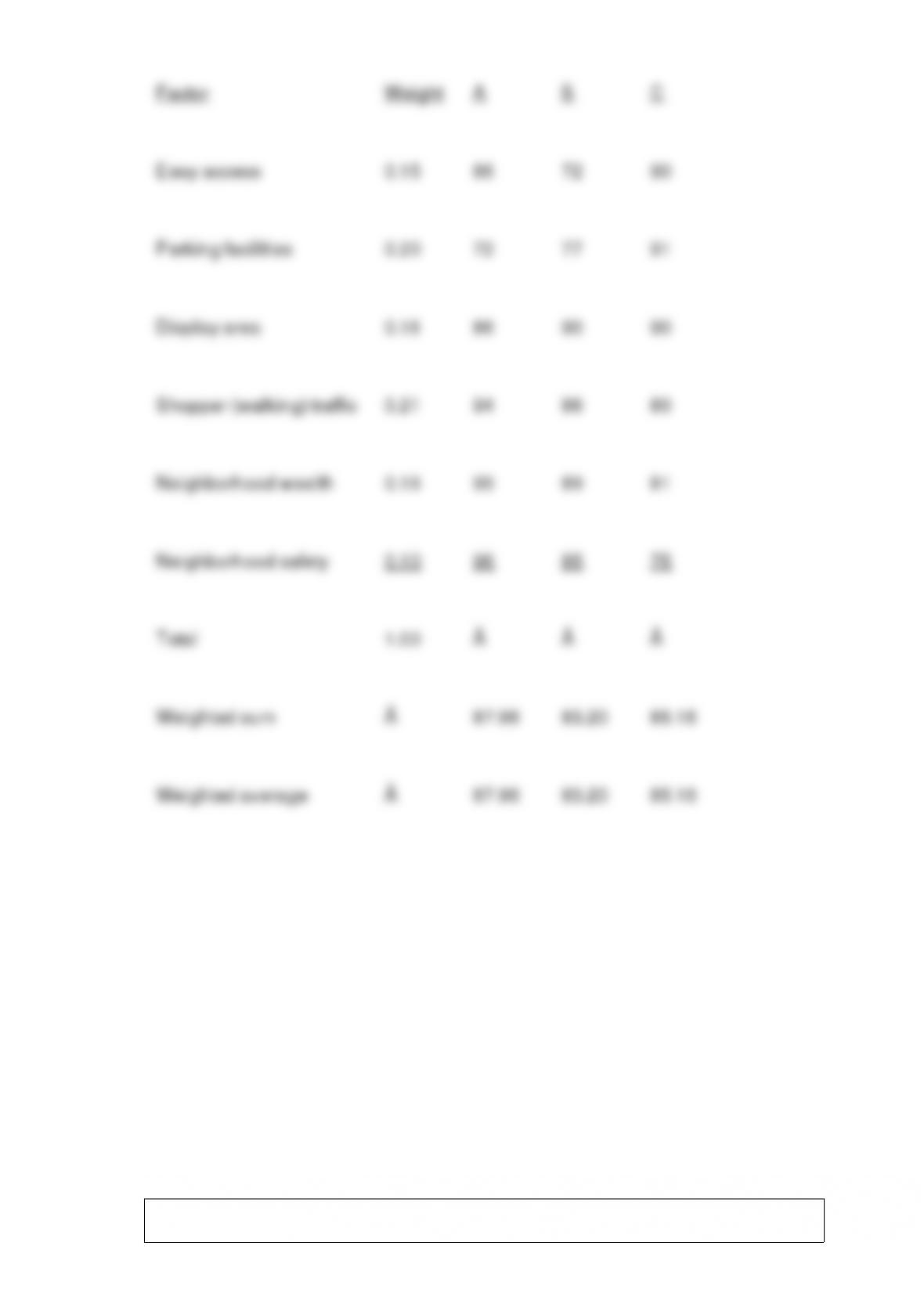
Using the factor ratings shown below, determine which location alternative should be
chosen on the basis of maximum composite score.
A firm has established a distribution network for the supply of a raw material critical to
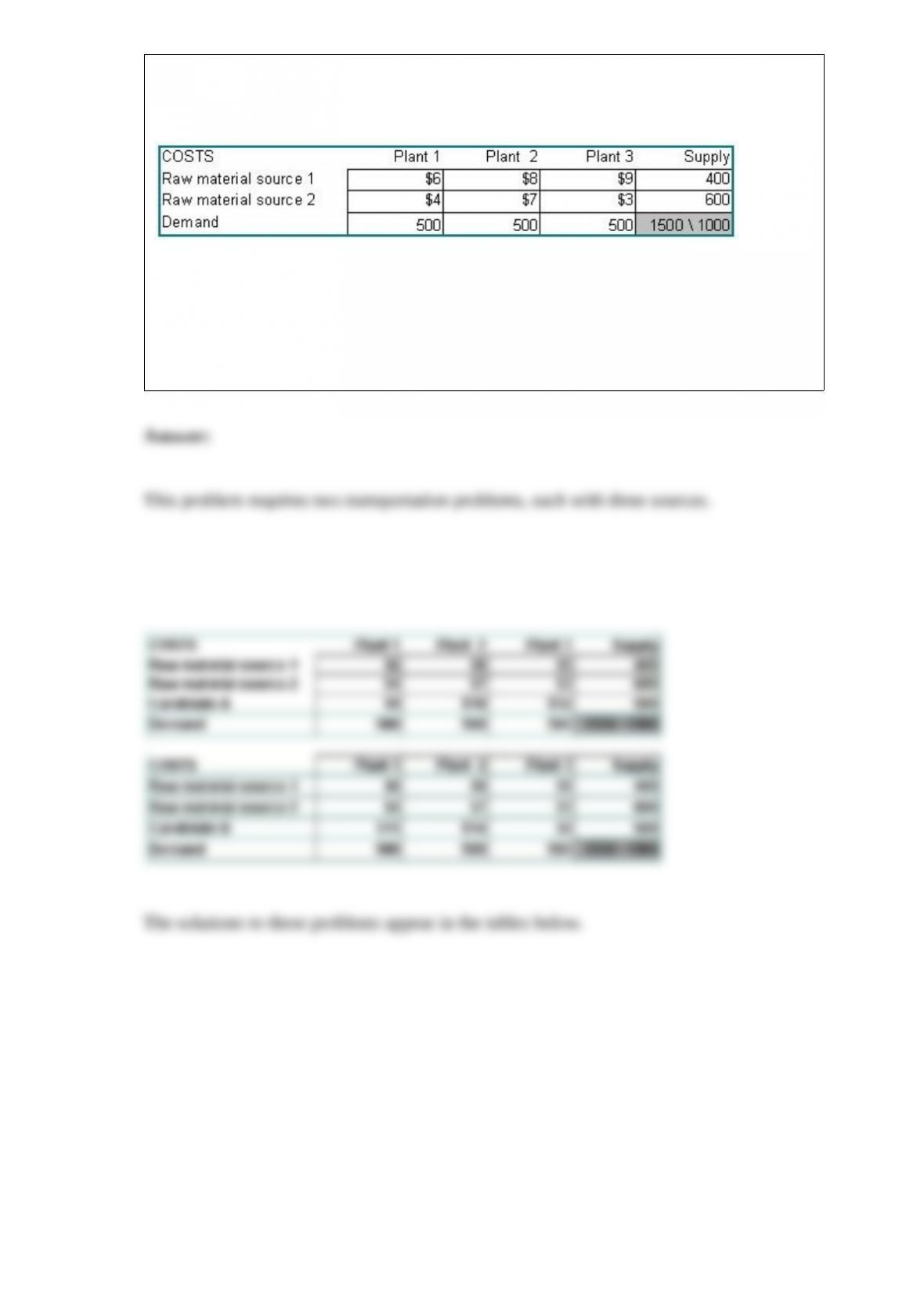
its manufacturing. Currently there are two origins for this raw material, which must be
shipped to three manufacturing plants. The current network has the following
characteristics:
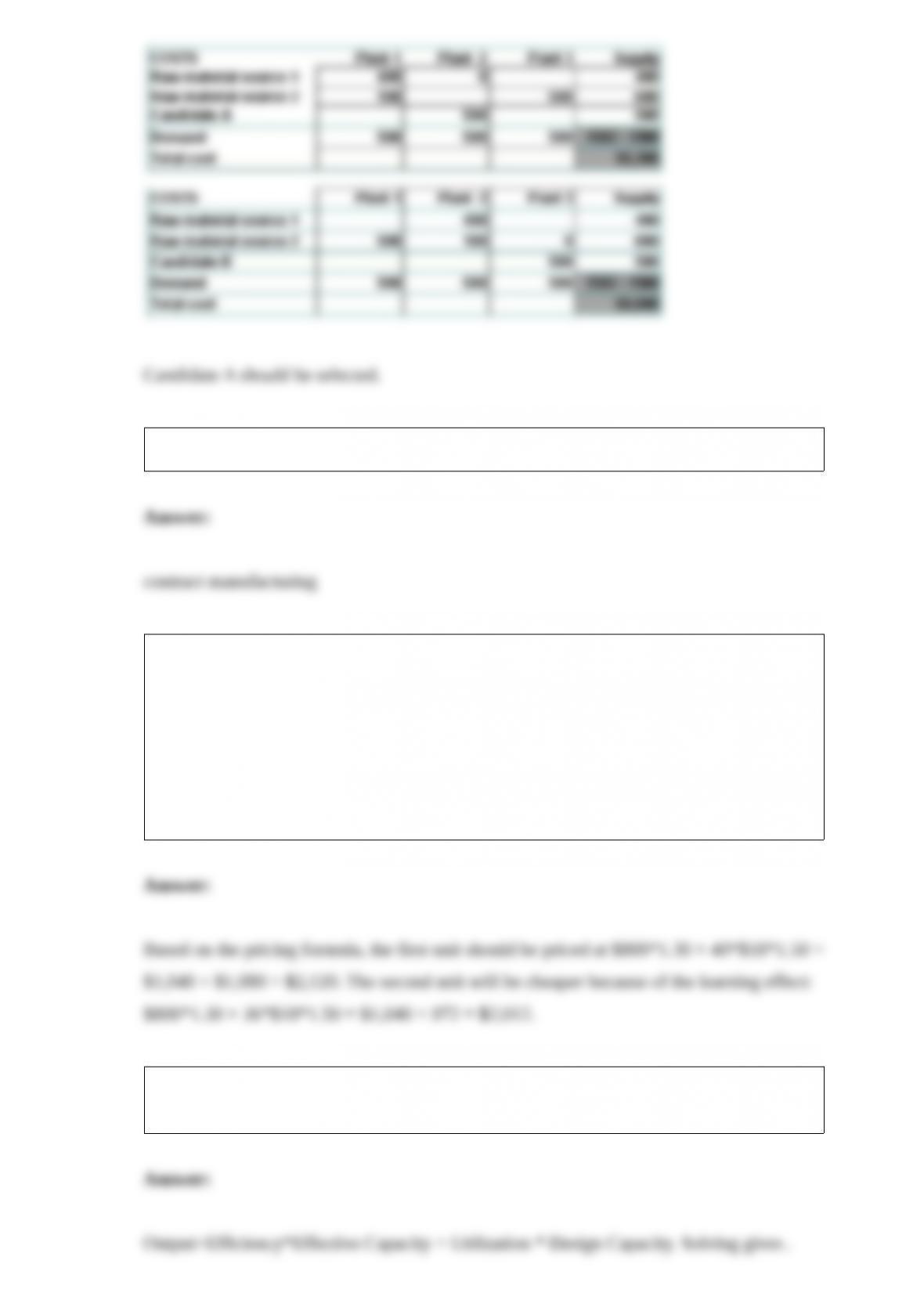
The firm has identified two potential sites for a third raw material source; these are
identified as Candidate A and Candidate B. From A, the costs to ship would be $9 to
Plant 1, $10 to Plant 2, and $12 to Plant 3. From B, these costs would be $11, $14, and
$8. The new source, wherever it is located, will have a capacity of 500 units. Solve with
the transportation method. Which site should be selected?
Outsourcing manufacturing is also known as __________.
A metal works fabricator is about to release a new model of his firm’s copper sculpture
and fountain. The operations manager estimates that this product is subject to a 90
percent learning rate on labor only€the material bill is not affected by experience. The
firm prices its work based on cost€the sum of materials plus 30 percent and labor plus
50 percent. (This allows the firm to practice a little “demand management” for its very
popular works.) The first item has already been finished; the material bill was $800 and
labor totaled 40 hours. The firm pays its metalworking artisans an average of $18 per
hour. What should be the asking price of the first unit? The second?
The efficiency of a factory is 75% and its utilization 50%. If effective capacity is 1000
find design capacity.