Evergreen Air Center in Marana, Arizona, is the world’s biggest parking lot for
unwanted commercial aircraft. Airlines pay from $750 to $5,000 a month for its storage
service. The warm, dry air where the operation is located serves as a cheap and effective
airplane preservative. Which organizational segmentation variable might Evergreen use
to segment the market?
a. NAICS sector, such as manufacturers, or retailers, or lawyers
b. number of locations
c. “who buys,” such as individual buyer or buying groups
d. metropolitan statistical area
e. number of employees
Answer:
Figure 1.
Figure 1. above represents the six steps in setting price. “E” represents the step at which
a firm would
a. set list or quoted price.
b. select an approximate price level.
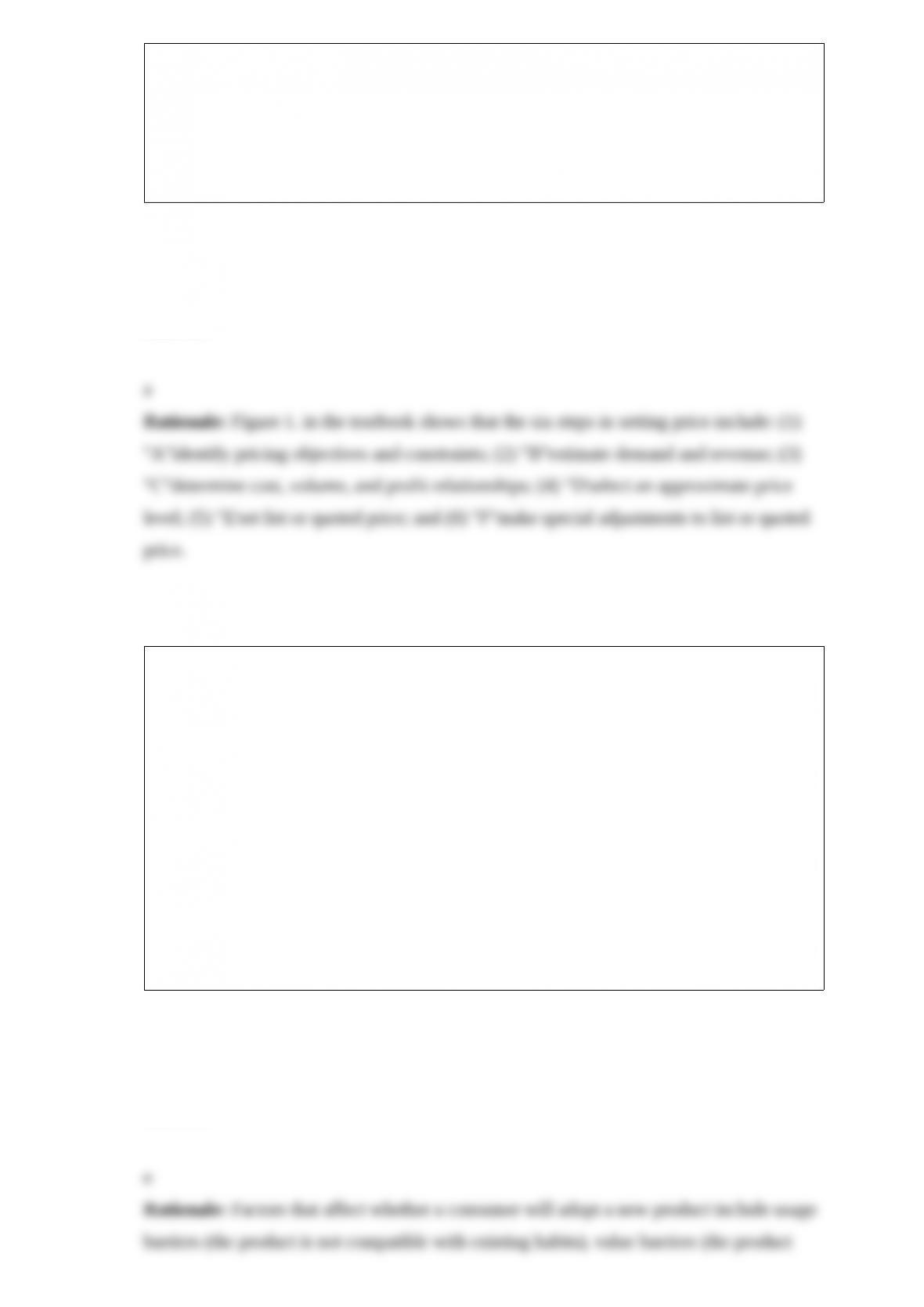
c. scan competitors for prices of similar products or services.
d. determine cost, volume, and profit relationships.
e. establish the price range.
Answer:
There are several reasons why a consumer would be reluctant to purchase a new
product. For example, a consumer might be reluctant to adopt a new product because of
e a psychological barrier, which occurs when __________.
a. there is no incentive to change
b. there are physical, economic, or social risks
c. the product is not consistent with existing habits
d. the financial commitment is too great
e. it affects one’s image
Answer:
A demand curve graph typically appears as
a. a parabola with the apex representing the highest price that can be charged without
losing customers.
b. a diagonal line going from upper left to lower right demonstrating that as price goes
down, demand goes up.
c. an inverted parabola with the lowest point representing the lowest price that can be
charged and still meet the company’s profit objectives.
d. a diagonal line going from lower left to upper right demonstrating that as prices go
up, demand goes up proportionately.
e. two intersecting lines that identify the point at which supply and demand are exactly
the same.
Answer:
Two unique capabilities of Internet technology, __________ and __________, promote
and sustain customer relationships.
a. choice; control
b. cost; convenience
c. interactivity; individuality
d. communication; information
e. choiceboards; collaborative filtering
Answer:
An organization’s mission refers to
a. the target goal it sets for current profits.
b. the target objective it projects for future market share.
c. the fundamental, passionate, and enduring principles that guide its conduct over time.
d. specific strategies and tactics that will be used to counteract any advantages of
competitors.
e. a statement of the organization’s functions in society that identifies its customers,
markets, products, and technologies.
Answer:
All of the following are responsibilities of a product or brand manager EXCEPT:
__________.
a. engaging in extensive data analysis related to their products and brands
b. developing new products
c. managing existing products through the stages of their life cycles
d. developing and implementing strategies at the corporate level
e. developing and executing a marketing program described in an annual marketing
plan for the product line
Answer:
Forever Quilting is a small company that makes quilting kits priced at $120. The costs
of the materials that go into each kit are $45. It costs $5 in labor to assemble a kit. The
company has monthly expenses of $1,000 for rent and insurance, $200 for heat and
electricity, $500 for advertising, and $4,500 for the monthly salary of its owner. Forever
Quilting’s unit variable cost for its kits is
a. $5.
b. $45.
c. $50.
d. $120.
e. $170.
Answer:
Ron had a craving for sushi so he searched yellowpages.com for the name of a
restaurant in his vicinity that serves this type of food. When he arrived at his
destination, he was impressed with the menu posted outside the door and decided to go
in. He was greeted with a smile by a hostess and then immediately seated at a
well-appointed table where he was given a warm cloth for his hands. A waiter
beautifully presented the food, the rice was the perfect texture and temperature, and the
fish was fresh and delicious. Halfway thought the meal, he excused himself to go to the
restroom. It was clean, but unfortunately was out of paper towels. He returned to his
table, finished his meal, and paid his check. The hostess said goodbye and asked him to
return. Which of the following statements about this scenario is MOST accurate?
a. Reading the menu posted outside the door was Ron’s first point of interaction in the
customer contact audit because if he hadn”t liked the selections, he wouldn”t have gone
into the restaurant.
b. Being greeted by the hostess was the first point of interaction in the customer contact
audit because it was the first encounter with the actual service providerthe restaurant.
c. The first point of interaction in the customer contact audit wasn”t written, it was
implied. The real first point in the customer contact audit should have been between
Ron and the waiter, not Ron and the hostess.
d. The lack of paper towels in the restroom was the first point of interaction in the
customer contact audit because it was the first time his expectations weren”t met.
e. The yellowpages.com ad, the menu on the door, the hostess’s greeting, the waiter, the
quality and presentation of food, and even the restroom were all important points of a
contact.
Answer:
The three commonly used terms to describe levels of service are
a. self-service, limited-service, and full-service.
b. self-service, sales-service, and customer-service
c. self-service, automated service, and online-service.
d. limited-service, full-service, and automated-service.
e. wholesaler-service, retailer-service, and customer-service.
Answer:
Figure 1.
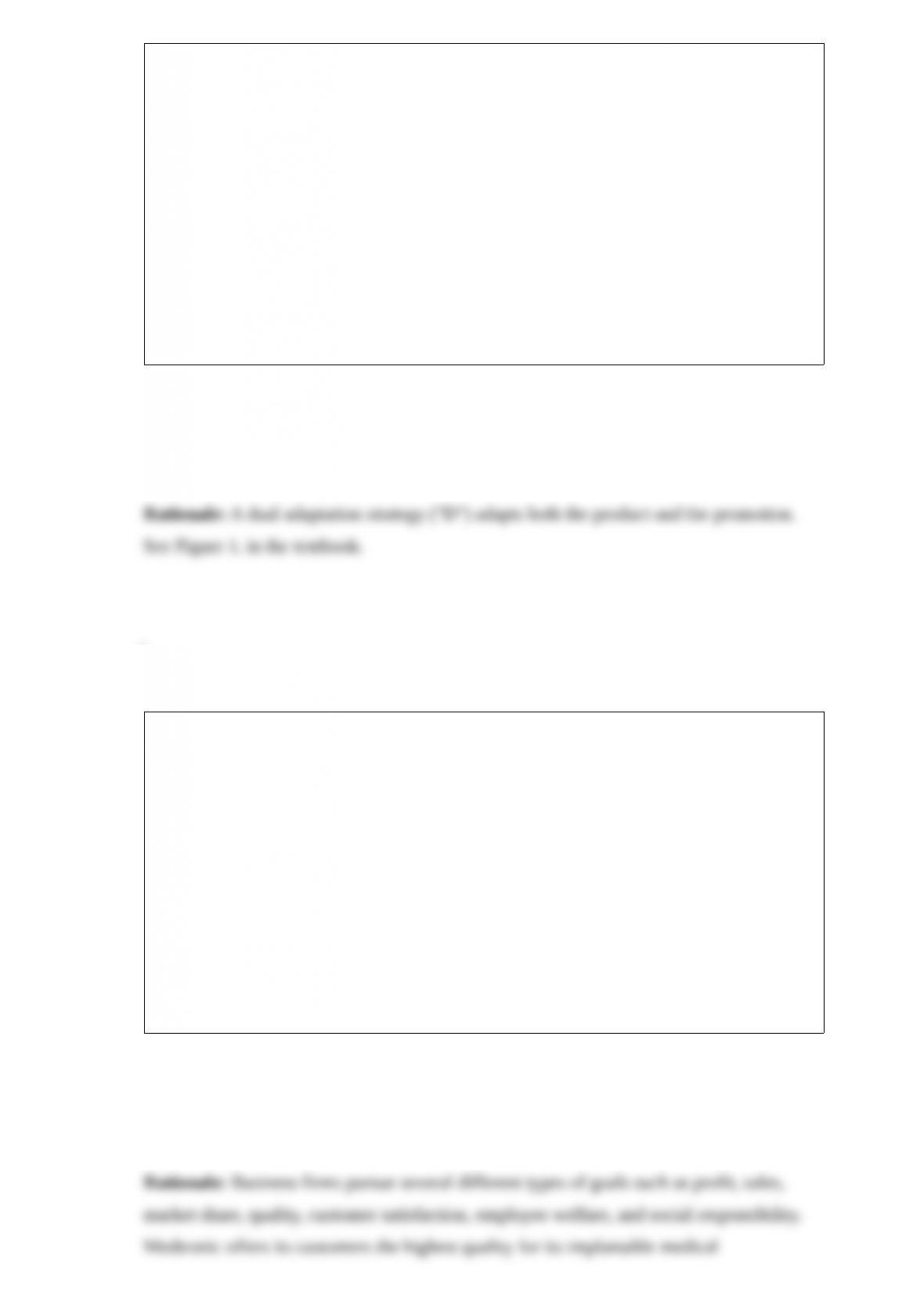
Global companies have five strategies for matching products and their promotion
efforts to global markets. According to Figure 1. above, “D” refers to which type of
strategy?
a. product extension strategy
b. product adaptation strategy
c. dual adaptation strategy
d. product invention strategy
e. communication adaptation strategy
Answer:
A firm may have a goal to offer its customers the highest _________, as Medtronic does
with its implantable medical devices.
a. innovation
b. quality
c. service
d. value
e. warranty
Answer:
When a retailer owns a manufacturing operation, it is referred to as
a. forward integration.
b. lateral integration.
c. a joint venture.
d. horizontal integration.
e. backward integration.
Answer:
The services market sells diverse services such as legal advice, auto repair, and dry
cleaning. Along with finance, insurance, and real estate businesses, and transportation,
__________ and public utility firms, and not-for-profit organizations; These firms
represent about 75 percent of all industrial firms.
a. wholesalers
b. retailers
c. government units
d. communication
e. educational institutions
Answer:
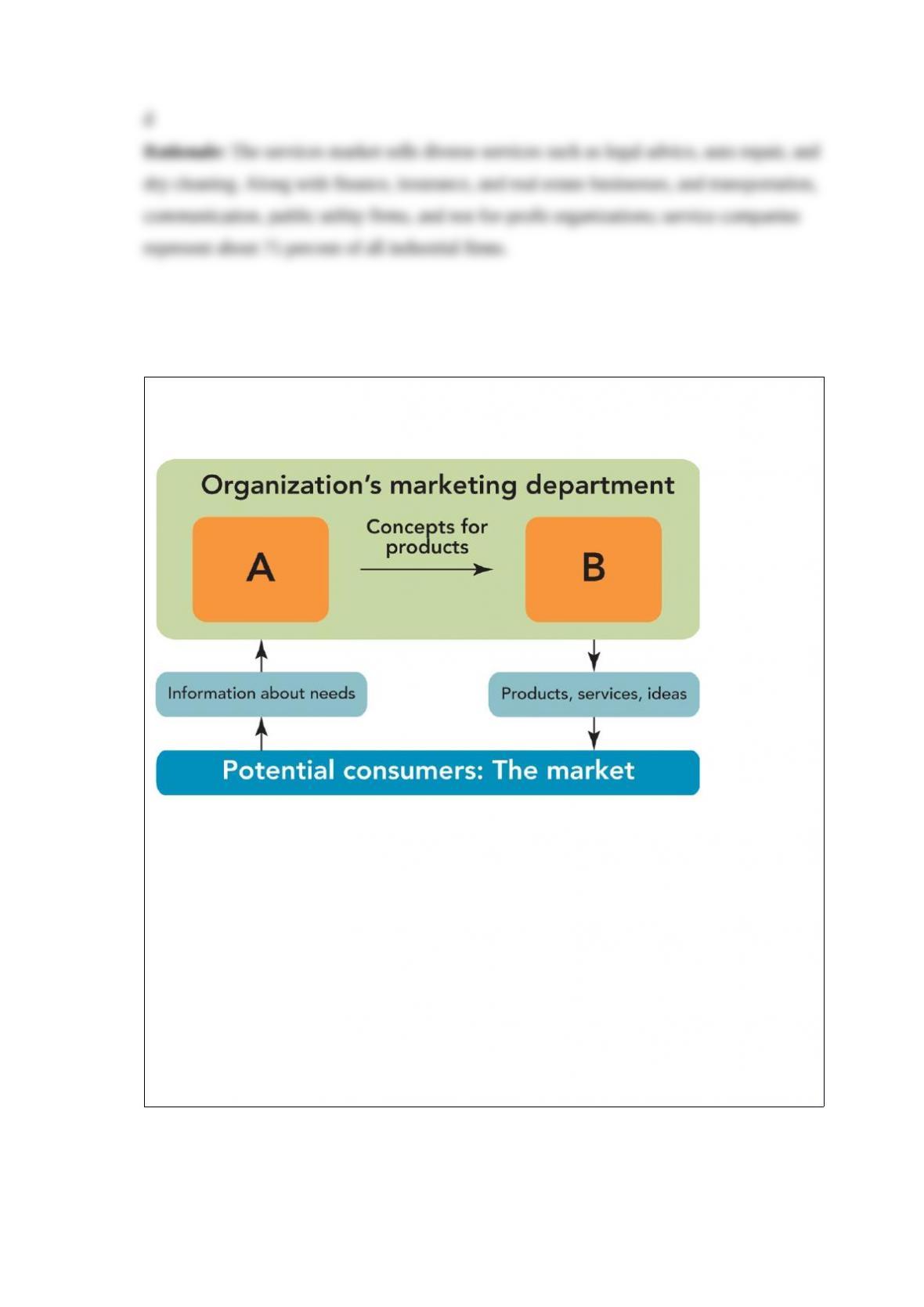
Figure 1.
In Figure 1. above, “A” represents __________ and “B” represents __________.
a. management; shareholders
b. employees; stakeholders
c. sales; manufacturing
d. R&D; customers
e. discovering consumer needs; satisfying consumer needs
Answer:
Which type of product has equally rapid introduction and decline stages of the product
life cycle?
a. high-learning products
b. low-learning products
c. fashion products
d. generalized products
e. fad products
Answer:
Quantitative assessments of sales performance may be based on input-related objectives
set forth in the sales plan, such as those involving __________.
a. new sales, new lead generation, and customer billing
b. sales calls, selling expenses, and account management policies
c. selling expenses, profits generated, and account management policies
d. new lead generation, sales quotas, and sales increases over the previous evaluation
period
e. recruitment, selection, and training of new sales representatives
Answer:
In 2010, Fortune magazine named Trader Joe’s “America’s hottest retailer” for its
outstanding __________.
a. customer value proposition
b. relationship marketing
c. customer experience
d. internal marketing
e. customer relationship management
Answer:
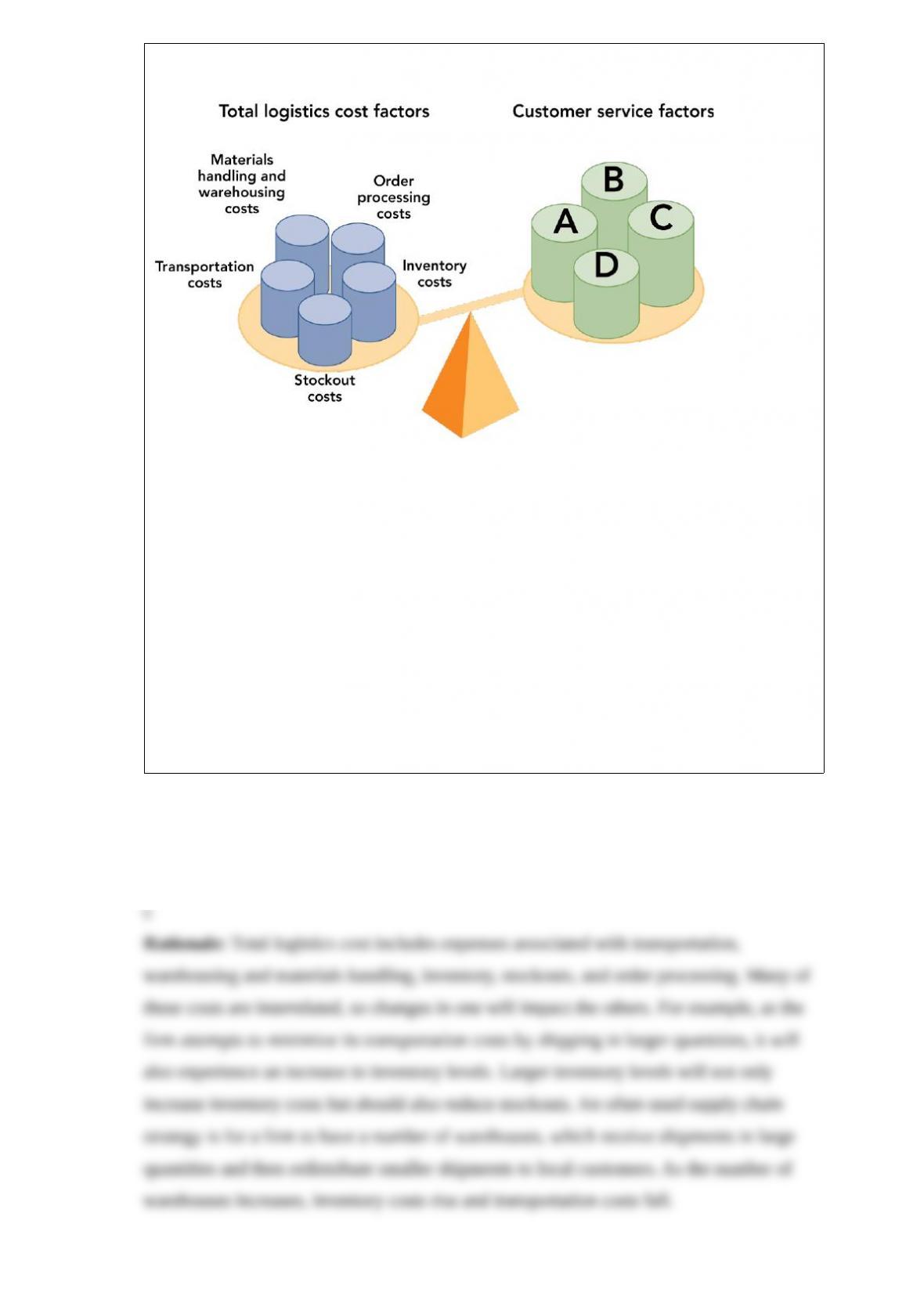
Figure 1.
Which of the following best describes the goal of a firm’s combination of inventory and
transportation costs?
a. minimize required inventory costs
b. minimize required transportation costs
c. minimize the sum of inventory and transportation costs
d. maximize the difference between required inventory and transportation costs
e. set a level of transportation costs and minimize the required inventory costs
Answer:
The BCG has given specific names and descriptions to the four resulting quadrants in
its growth-share matrix based on the amount of cash they generate for or require from
the organization. “Question marks” are SBUs that are classified as having
a. high market growth rates and high relative market shares.
b. low market growth rates but high relative market shares.
c. low market growth rates and low relative market shares.
d. high market growth rates but low relative market shares.
e. medium market growth rates and medium relative market shares.
Answer:
The Ford Escape Hybrid SUV was the first of its kind on the market to use both
electricity and gasoline to power this vehicle. Ford has targeted not only people who are
excited about technology but also those who want to contribute to cleaner air. Ford set a
goal to attract 20,000 buyers a year for this SUV. Ford is trying to change consumer
attitudes by
a. changing beliefs about the extent to which a brand has a specific attribute.
b. changing the perceived importance of a specific attribute.
c. adding a new attribute.
d. reducing the perceived risk of the product.
e. providing stimulus generalization to prospective buyers.
Answer:
Lands’ End ships each order within 48 hours and its guarantee is the best in the world,
as exemplified by its tagline “Guaranteed. Period.” These marketing actions by Lands’
End are MOST LIKELY examples of __________ goals.
a. profit
b. market share
c. employee welfare
d. social responsibility
e. customer satisfaction
Answer:
Google is the dominant provider of online search requests and receives more than
__________ of the search advertising revenue.
a. 30 percent
b. 40 percent
c. 50 percent
d. 60 percent
e. 70 percent
Answer:
Another term sometimes used interchangeably with ‘social media” is __________.
a. net platforms
b. Web 3.0
c. Web functionalities
d. Web 2.0
e. peer-to-peer networking
Answer:
The best approach to budgeting is objective and task budgeting, whereby the company
determines its promotion objectives, outlines the tasks to accomplish these objectives,
and
a. asks the ad agency for an estimate.
b. asks the media to propose a program.
c. determines the promotion cost of performing these tasks.
d. determines what spending level top management will allow for the proposed
program.
e. surveys customers to determine what spending levels they think are appropriate.
Answer:
Reverse auctions
a. are buyer-initiated.
b. benefit the sellers significantly more than the buyers.
c. have an increasing number of buyers as the auction progresses.
d. do not have sequential bidding.
e. have many buyers at the start of the auction.
Answer:
Field of Dreams and Million Dollar Baby are examples of successful movies that could
have failed because
a. too little money was spent on promotion.
b. they were targeting the wrong target market segments.
c. there was too little similarity between the original book and the screenplay.
d. their original titles did not convey the correct message to their prospective audiences.
e. too much time lapsed between their promotions and their releases.
Answer:
The five major environmental forces in a marketing decision are
a. climate change, natural resources, pollution, natural disasters, and global conflict
(war).
b. social, technological, economic, competitive, and regulatory.
c. corporate ownership, internal management, supplier relations, manufacturing
capabilities, and consumer demand.
d. product, price, promotion, place, and people.
e. ethics, sustainability, cultural awareness, diversity, and values.
Answer:
Technology refers to
a. any device or process based on scientific discoveries that are less than one year old.
b. any mechanical device used in the production or distribution of a product.
c. only those inventions or innovations from applied science that are used to generate a
profit.
d. ideas or concepts that will one day be translated into useable devices, mechanisms, or
processes.
e. the inventions or innovations from applied science or engineering research.
Answer:
Generally, as the proportion of middle-income households in a country __________, the
__________ a nation’s purchasing power.
a. increases; greater
b. increases; less
c. decreases; greater
d. levels off; greater
e. There is no relationship between middle-income households and the nation’s
purchasing power.
Answer:
The American Red Cross uses social marketing tools such as Facebook, Twitter, and
e-mail to increase donations. The __________ campaign raised more than $32 million
in response to the Haiti earthquake.
a. All for one and 1% for All
b. Text-to-Donate
c. In for a Penny
d. It All Makes Cents
e. Time for Change
Answer:
A technique that helps a firm search for growth opportunities from among current and
new markets as well as current and new products is referred to as __________.
a. diversification analysis
b. synergy analysis
c. a market-product grid framework
d. Porter’s generic business strategy assessment
e. market segmentation
Answer:
Figure 1.
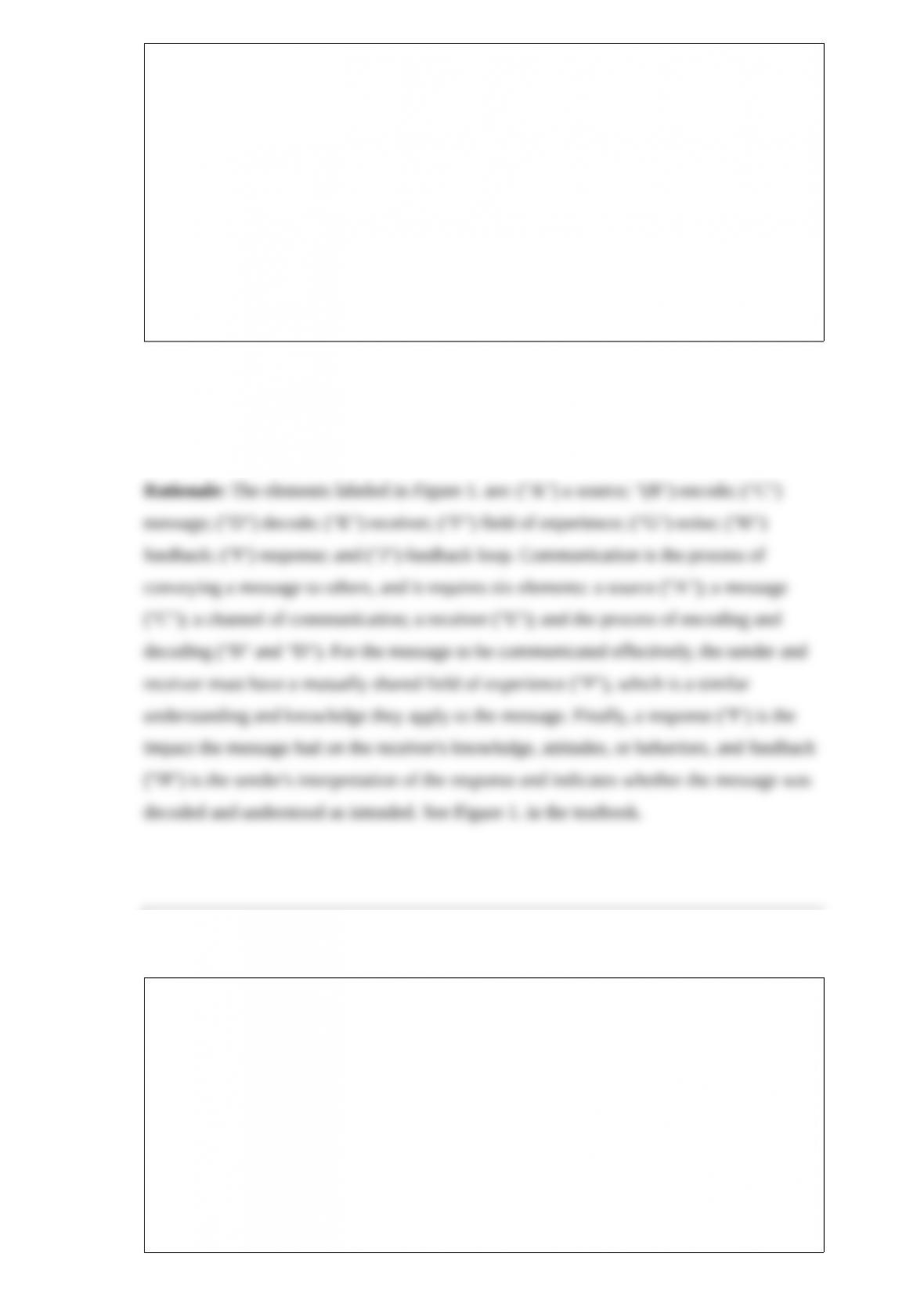
Figure 1. above depicts the communication process, which consists of 10 key elements
(“A” through “J”). The position labeled “B” is referred to as __________.
a. the source
b. the message
c. the receiver
d. encoding
e. feedback
Answer:
There are three general forms of retail ownership: contractual system, corporate chain,
and __________.
a. dual ownership
b. industry consortium
c. retailing cooperative
d. independent retailer

e. multi-national cartel
Answer: