Which of the following statements best describes a whistle-blower?
a. An employee is unhappy because his company is downsizing.
b. An employee tells the Consumer Product Safety Commission his company falsified
safety reports on a child’s car seat.
c. A salesperson for a hardware wholesaler tries to sell insurance to his regular
customers in order to earn some extra income.
d. An employee loses his/her retirement fund due to a downturn in the stock market.
e. An employee spends the afternoon studying at work for her test rather than counting
inventory as she was supposed to be doing.
Answer:
The organizational foundation sets the “__________” of organizations; the organization
direction sets the “__________;” and organizational strategies are concerned with the
“__________.”
a. when; why; what
b. why; what; how
c. what; how; why
d. what; where; how
e. how; where; what
Answer:
All of the following are environmental forces EXCEPT:
a. economic.
b. customers.
c. social.
d. regulatory.
e. technological.
Answer:
The six reasons why consumers shop and buy online are
a. interest, entertainment, cost, control, flexibility, and customization.
b. customization, customerization, price, service, entertainment, and convenience.
c. content, context, utility, entertainment, communication, and cost.
d. cost, convenience, customization, communication, control, and choice.
e. control, utility, interest, personalization, choice, and flexibility.
Answer:
Collaborative relationships are becoming a common way to meet the demands of global
competition. Global __________ are agreements between two or more independent
firms to cooperate for the purpose of achieving common goals such as a competitive
advantage or customer value creation.
a. compacts
b. collaborative treaties
c. strategic alliances
d. free trade agreements
e. economic coalitions
Answer:
Price ranges, store layouts, and breadth and depth of merchandise lines are considered
to be __________ of a store’s image.
a. functional qualities
b. sociological qualities
c. psychological attributes
d. lifestyle attributes
e. atmospheric elements
Answer:
Salespeople for Timex watches use their laptop computers to process orders, plan time
allocations, forecast sales, and communicate with Timex personnel and customers. The
use of __________ helps the Timex salesforce provide customer service.
a. time management
b. order processing
c. technology
d. proposal generation
e. WebEx
Answer:

The objective attributes of the supplier’s products and services and the capabilities of
the supplier itself are collectively referred to as
a. the supplier consideration set.
b. derived demand factors.
c. evaluative criteria.
d. performance metrics.
e. organizational buying criteria.
Answer:
When developing marketing programs for new offerings, marketing may provide staff
to serve as part of a(n) __________, which consists of a small number of people from
different departments who are mutually accountable to accomplish a task or a common
set of performance goals.
a. cross-functional team
b. department
c. strategic business unit
d. organization
e. business consortium
Answer:
During the first stage of the new-product process, two important activities take place.
They are
a. SWOT analysis and environmental scanning.
b. open innovation and business analysis.
c. concept testing and product forecasting.
d. R&D and operations set-up.
e. environmental scanning and open innovation.
Answer:
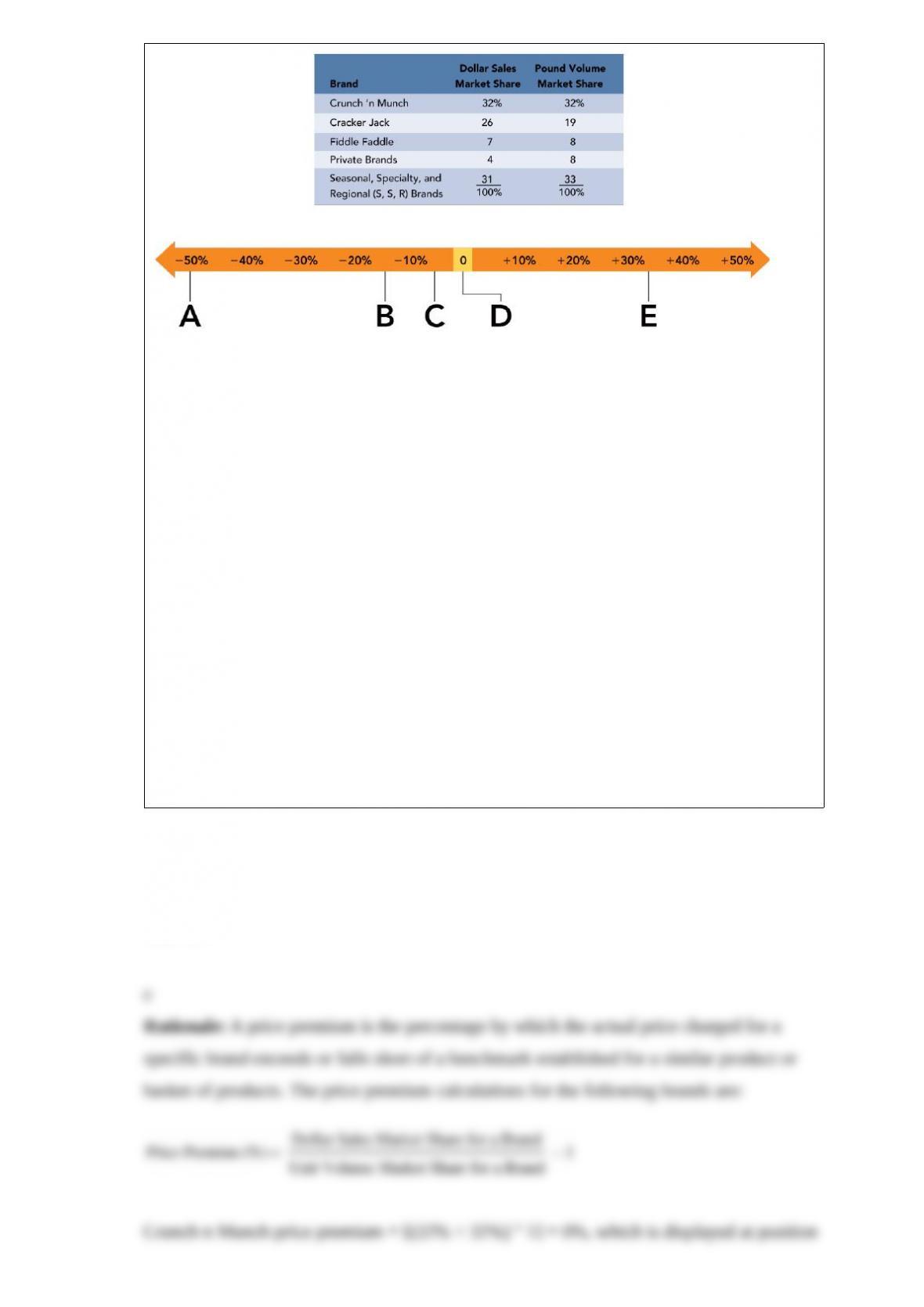
Figure 14-A
Frito-Lay is considering whether to buy the Cracker Jack brand of caramel popcorn
from Borden, Inc. Frito-Lay research shows that Cracker Jack has a strong brand equity.
But Cracker Jack’s dollar sales market share and pound (a surrogate for unit) volume
market share have declined recently and trailed the Crunch n Munch brand as shown in
the Figure 14-A marketing dashboard above. Borden’s management used an
above-market, premium pricing strategy for Cracker Jack. As a Frito-Lay marketer
studying Cracker Jack, calculate Cracker Jack’s price premium. What position in Figure
14-A above represents the price premium of Cracker Jack?
a. “A”
b. “B”
c. “C”
d. “D”
e. “E”
Answer:
The purpose of market segmentation is to respond more effectively to the wants of
groups of potential buyers in order to
a. maintain market share.
b. increase sales and profits.
c. assume social responsibility.
d. use the firm’s resources most efficiently.
e. provide the best quality products on the market.
Answer:
An action item list refers to an aid to implement a marketing plan that consists of four
columns: (1) the task, (2) __________, (3) the date to finish the task, and (4) what is to
be delivered.
a. the budget
b. the product or service
c. the points of difference
d. the promotional message
e. the person responsible for completing the task
Answer:
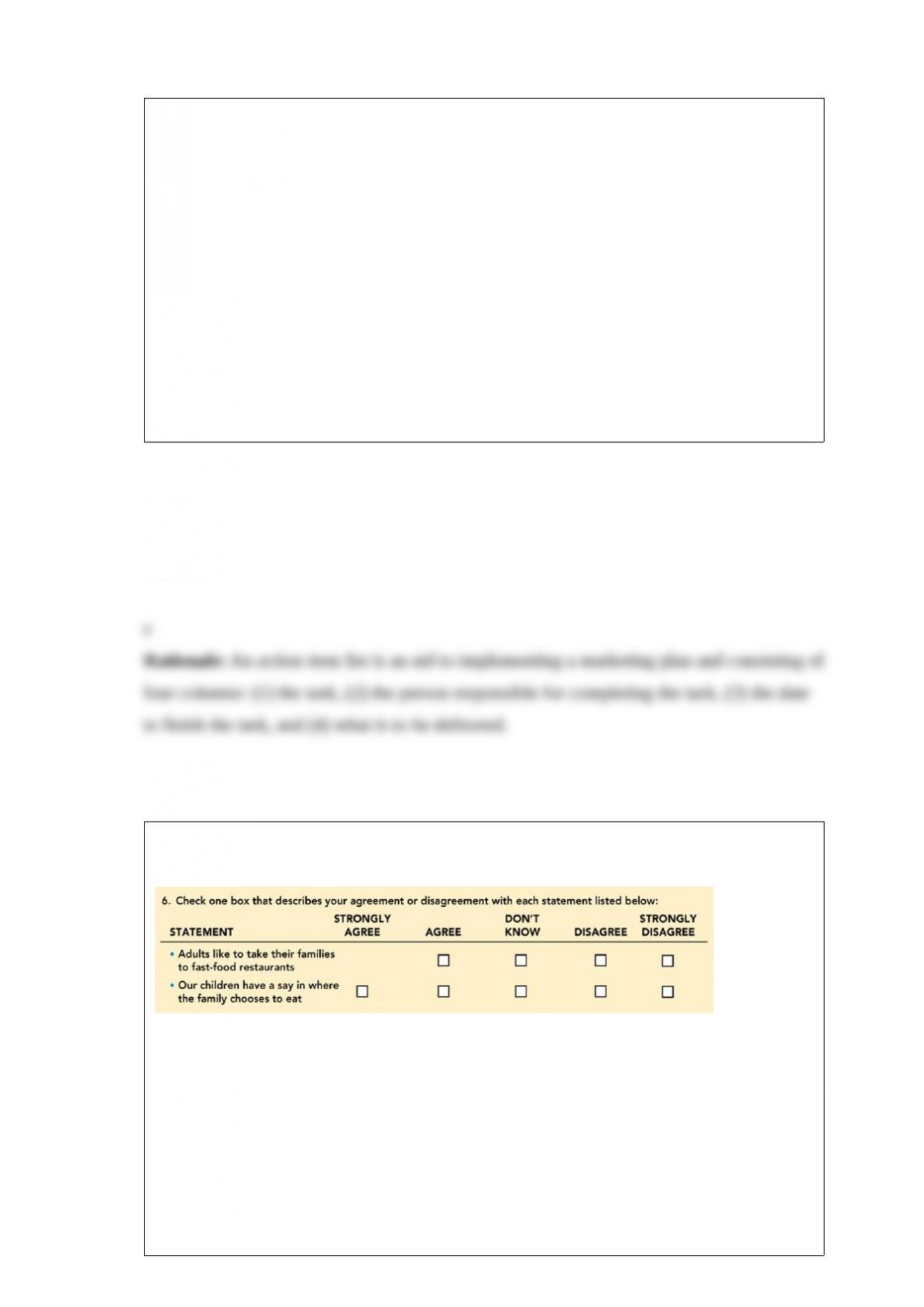
Figure 1.: Question 6
Consider Figure 1.: Question 6 above, which is part of a Wendy’s survey that assessed
fast-food restaurant preferences among present and prospective consumers. Question 6
illustrates which type of question format?
a. dichotomous
b. open-ended
c. Likert
d. attitudinal
e. semantic differential
Answer:
Like discounts, reductions from list or quoted prices to buyers for performing some
activity are referred to as
a. allowances.
b. subsidies.
c. remittances.
d. noncumulative deductions.
e. list price deductions.
Answer:

Allowances, like discounts, refer to
a. rewards given to retailers to encourage early payment.
b. payment extensions given to cash-strapped consumers during the current recession.
c. list price deductions based on surges in consumer demand.
d. list price deductions based on sudden drops in consumer demand.
e. reductions from list or quoted prices to buyers for performing some activity.
Answer:
A differentiation focus strategy refers to one of Porter’s generic business strategies that
a. involves controlling expenses and, in turn, lowering product prices targeted at a
narrow range of markets segments.
b. focuses on reducing expenses and, in turn, lowers product prices, while targeting a
broad array of market segments.
c. requires products to have significant points of difference to target one or only a few
market segments.
d. requires products to have significant points of difference to charge a higher price
while targeting a broad array of market segments.
e. seeks opportunities by finding the optimum balance between marketing efficiencies
versus R&D”manufacturing efficiencies.
Answer:
A testimonial ad for a carbon monoxide detector features parents who are discussing the
dangers of CO2 poisoning. In the ad, the homeowners tell the target audience how
purchasing and using the advertised product can avert disaster. Such advertisements use
_________.
a. compassionate appeals
b. guilt appeals
c. family appeals
d. fear appeals
e. coercive appeals
Answer:
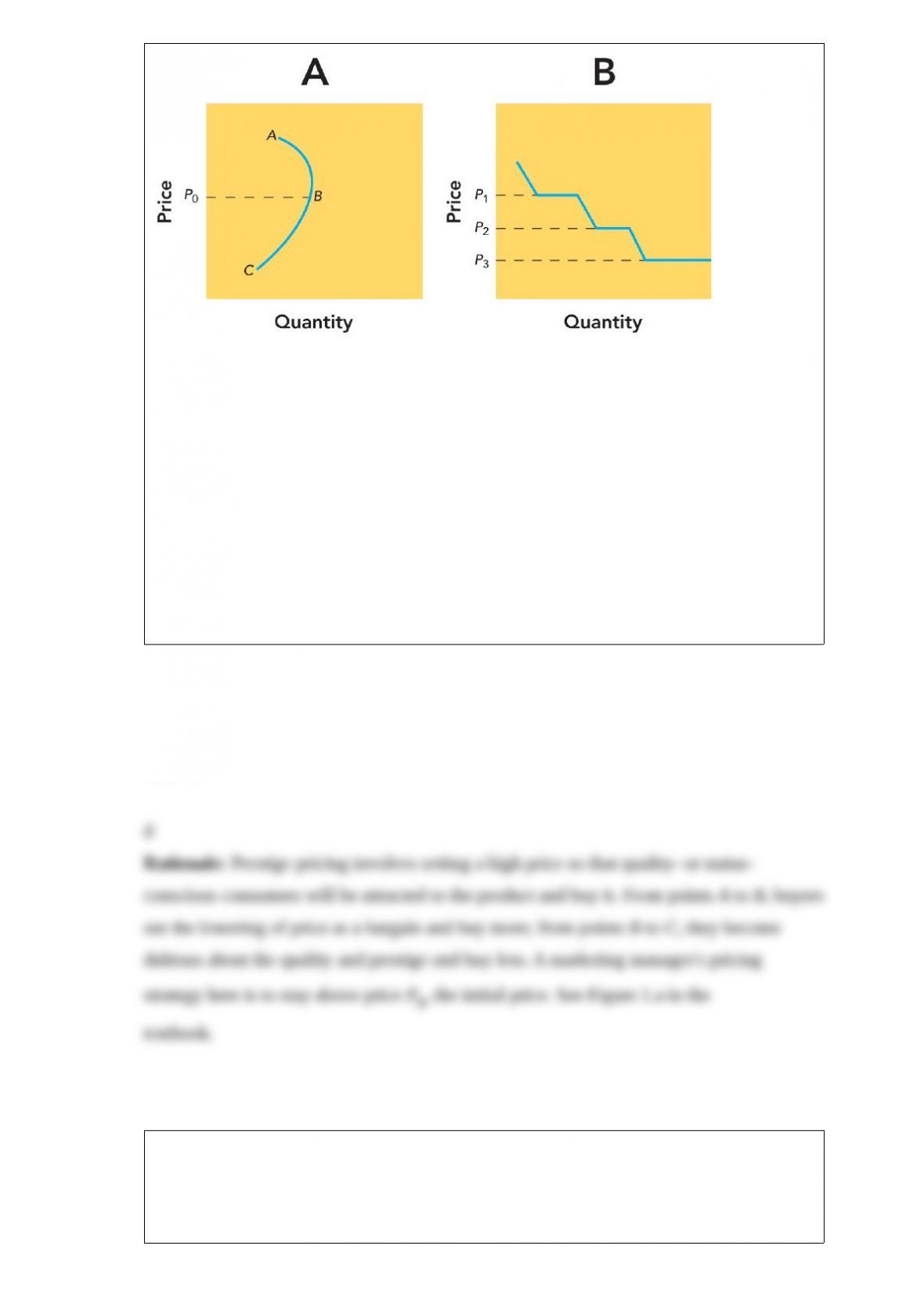
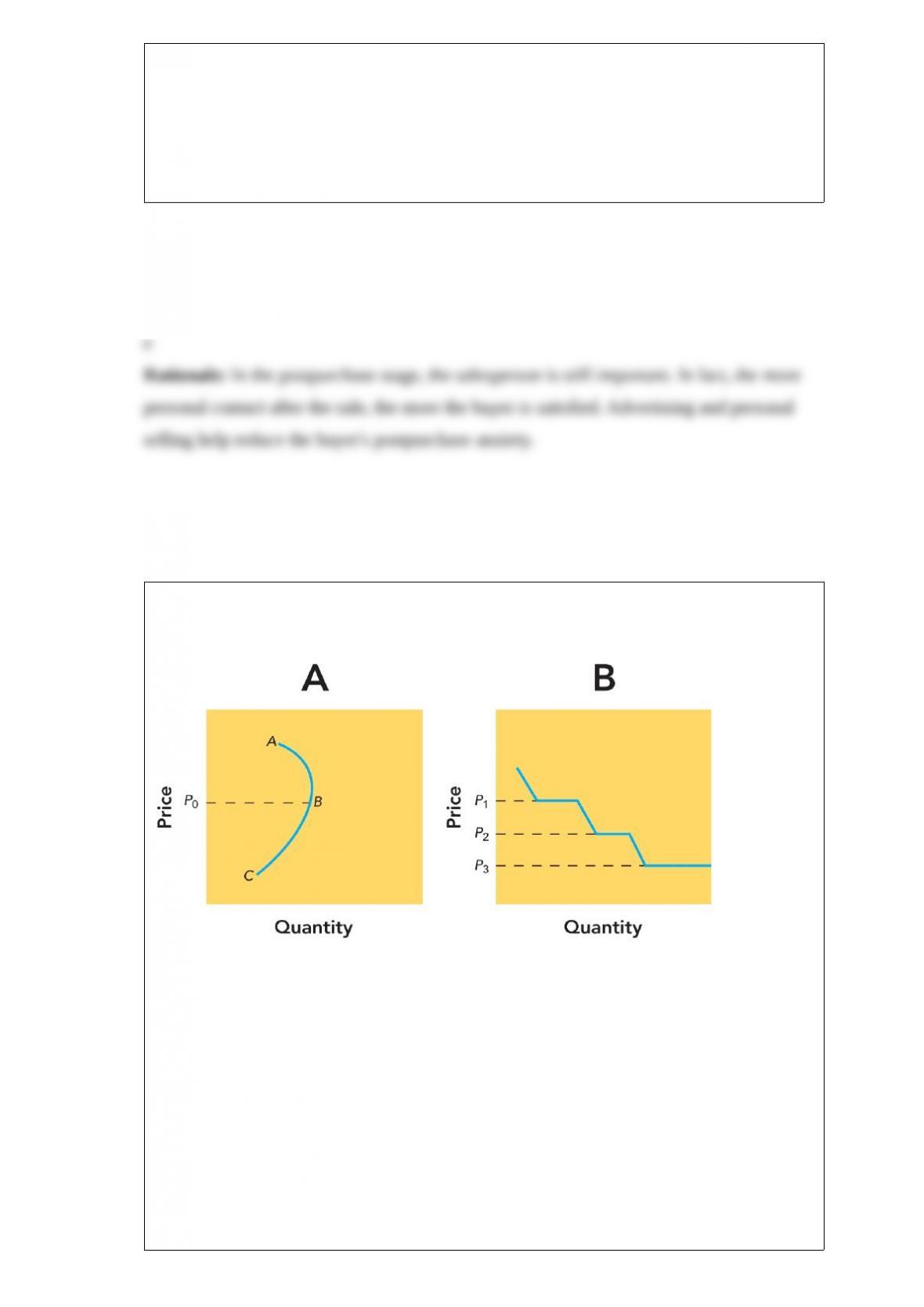
Figure 1.A
The movement from point B to point C in Figure 1.A above shows
a. an increased demand for the product at a lower price.
b. derived demand.
c. that buyers see the product as a bargain and buy more.
d. that buyers become dubious about the quality and prestige and buy less.
e. a downturn in the economy.
Answer:
A field of experience refers to
a. the unique set of terms, expressions, or jargon that carries a specific meaning within a
specific field (i.e., the medical profession, legal profession, etc.).
b. the designation given to different elements in the communications channel based
upon their specific area of expertise (i.e., advertising, publicity, etc.).
c. a similar understanding and knowledge between the manufacturer or service provider
and department or firm handling its IMC campaign so there is no incorrect decoding of
the sender’s message.
d. a mutually shared understanding and knowledge between the manufacturer or service
provider and department or firm handling its IMC campaign so there is no incorrect
encoding of the sender’s message.
e. a similar understanding and knowledge that the sender and receiver apply to the
message so that it can be communicated effectively during the communication process.
Answer:
__________ is a VALS group that is most likely to read automotive magazines.
a. Believers
b. Makers
c. Experiencers
d. Achievers
e. Innovators
Answer:
The proper blend of elements in the promotional mix depends on the type of product.
The three specific characteristics to be considered are __________, risk, and ancillary
services.
a. complexity
b. adaptability
c. durability
d. accessibility
e. acceptability
Answer:
Uniform delivered pricing refers to
a. the price the seller quotes that includes all transportation costs.
b. the price the seller quotes excluding all transportation costs.
c. the price the seller quotes including a fixed allowance whereby the buyer pays any
additional costs.
d. the price the seller quotes includes a fixed percentage of transportation costs for
which they will be responsible.
e. the guarantee that a retailer will be charged the same transportation fee for all of their
outlets regardless of where they are located.
Answer:
A publicity tool that is heavily relied on by nonprofit organizations, and which involves
free space or time donated by the media, is referred to as a __________.
a. public service announcement
b. cooperative advertisement
c. cause-related publicity
d. news conference
e. news release
Answer:
Social class refers to
a. groups of people to whom an individual looks as a basis for self-appraisal or as a
source of personal standards.

b. a mode of living that is defined by how people choose to spend their discretionary
income and leisure time.
c. subgroups within the larger, or national, culture with unique values, ideas, and
attitudes.
d. relatively permanent, homogenous divisions in a society in which people sharing
similar values, interests, and behavior can be grouped.
e. a mode of living that is identified by how people spend their time and resources, what
they consider important in their environment, and what they think of themselves and the
world around them.
Answer:
Vending machines are popular with consumers; recent consumer satisfaction research
indicates that __________ percent of consumers believe purchasing from a vending
machine is equal to or superior to a store purchase.
a. 15
b. 27
c. 49
d. 63
e. 82
Answer:
Customer convenience is an important consideration when choosing a marketing
channel. A commonly held view among website developers is the “__________” where
consumers will abandon their efforts to enter or navigate a website if download time
exceeds this amount of time.
a. five second rule
b. six second rule
c. seven second rule
d. eight second rule
e. ten second rule
Answer:
The generation of children born to baby boomers is sometimes referred to as
a. echo busters.
b. baby busters.
c. the lost generation.
d. baby boomerangs.
e. baby boomlets.
Answer:
The greatest marketspace opportunity for marketers lies in its potential for creating
__________.
a. form utility
b. time utility
c. price utility
d. possession utility
e. place utility
Answer:
During the introduction stage of the product life cycle, the strategy that discourages
competitive entry by charging a low price for a new product is referred to as
__________ pricing.
a. penetration
b. cost-plus
c. target ROI
d. below-market
e. skimming
Answer:
Suppose the following: The cost of a full-page color ad in the U.S. national edition of
The Wall Street Journal (newspaper) is $312,286 and its U.S. audience size is
1,613,062. The cost of a full-page color ad in the U.S. national edition of USA Today
(newspaper) is $207,720 and its U.S. audience size is 1,778,934. The cost of a full-page
color ad in the U.S. national edition Bloomberg Businessweek (magazine) is $156,900
and has an audience size of 980,000. The cost of a full-page color ad in the U.S.
national edition Sports Illustrated (magazine) is $238,000 and has an audience size of
3,150,000. The cost of a 30-second ad on the most recent Super Bowl (television) is
$3,250,000 and has an audience size of 112,500,000. Using this information, which has
the HIGHEST CPM of the five alternatives?
a. The Wall Street Journal
b. USA Today
c. Bloomberg Businessweek
d. Sports Illustrated
e. Super Bowl
Answer:
A __________ would be most likely to use truck jobbers to distribute its products.
a. a clothing manufacturer
b. manufacturer of electric generators
c. a leather goods importer
d. pharmaceutical company
e. meat processing plant
Answer:
During the postpurchase stage of the consumer purchase decision process, marketers
want to reduce postpurchase anxiety for their customers. Which of the following would
be most useful for accomplishing this objective?
a. advertising only
b. personal selling only
c. sales promotion and advertising
d. publicity and advertising
e. advertising and personal selling
Answer:
Figure 1.A
The movement from point A to point B in Figure 1.A above shows
a. skimming demand.
b. penetration demand.
c. that buyers see the product as a bargain and buy more.
d. that buyers become dubious about the quality and prestige and buy less.
e. a downturn in the economy.

Answer:
Setting a high price so that quality- or status-conscious consumers will be attracted to
the product and buy it is referred to as
a. skimming pricing.
b. status pricing.
c. price lining.
d. value pricing.
e. prestige pricing.
Answer: