The __________ focuses on performing services that provide a unique experience.
a. intangibility economy
b. experience economy
c. virtual economy
d. magic of marketing
e. authentic economy
Answer:
In the communication process, _________ ensure(s) that messages are decoded
properly.
a. responses
b. replies
c. feedback
d. pretesting
e. looping
Answer:
The process by which people acquire the skills, knowledge, and attitudes necessary to
function as consumers is referred to as __________.
a. consumer assimilation
b. consumer socialization
c. consumer lifestyle
d. purchasing socialization
e. purchasing enculturation
Answer:
Moral idealism refers to a personal moral philosophy that
a. believes that goodwill always triumph over evil.
b. follows the “Golden Rule,” which is “One should treat others as one would like
others to treat oneself.”
c. all human beings are basically good.
d. considers individual rights or duties as universal, regardless of the outcome.
e. believes in “the greatest good for the greatest number.”
Answer:
A list of firms believed to be qualified to supply a given item is referred to as a
a. bidder’s list.
b. make-buy list.
c. supplier’s sheet.
d. vendor-rating sheet.
e. e-marketplace.
Answer:
A survey of buyers’ intentions forecast involves
a. starting with the last known value of the item being forecast, listing the factors that
could affect the forecast, assessing whether they have a positive or negative impact, and
making the final forecast.
b. making decisions without any intervening steps.
c. asking prospective customers if they are likely to buy the product during some future
time period.
d. asking the firm’s salespeople to estimate sales during a coming period.
e. selecting the forecasting alternative that would allow a firm to survive financially
even if the forecasts were totally incorrect.
Answer:
Bundle pricing is considered to be a __________ pricing practice.
a. demand-oriented
b. cost-oriented
c. profit-oriented
d. competition-oriented
e. product line-oriented
Answer:
A currency exchange rate refers to
a. the unit equivalency of all international currency.
b. the ratio of a nation’s basic unit of currency relative to the price of silver.
c. the ratio of a nation’s basic unit of currency relative to the price of gold.
d. the price of one country’s currency expressed in terms of another country’s currency.
e. the unit of wealth (gold, oil, diamonds, etc.) upon which a nation bases its national
currency.
Answer:
Most people already know that Tums, a popular antacid, contains calcium. Today, Tums
antacid stresses both the benefits of the antacid itself and the fact that Tums can be used
as a calcium supplement. The new promotion involves changing consumers’ attitudes
toward Tums by
a. changing beliefs about the extent to which Tums has a specific attribute.
b. changing the perceived importance of a specific attribute.
c. adding a new attribute.
d. reducing the perceived risk.
e. providing stimulus generalization to prospective buyers.
Answer:
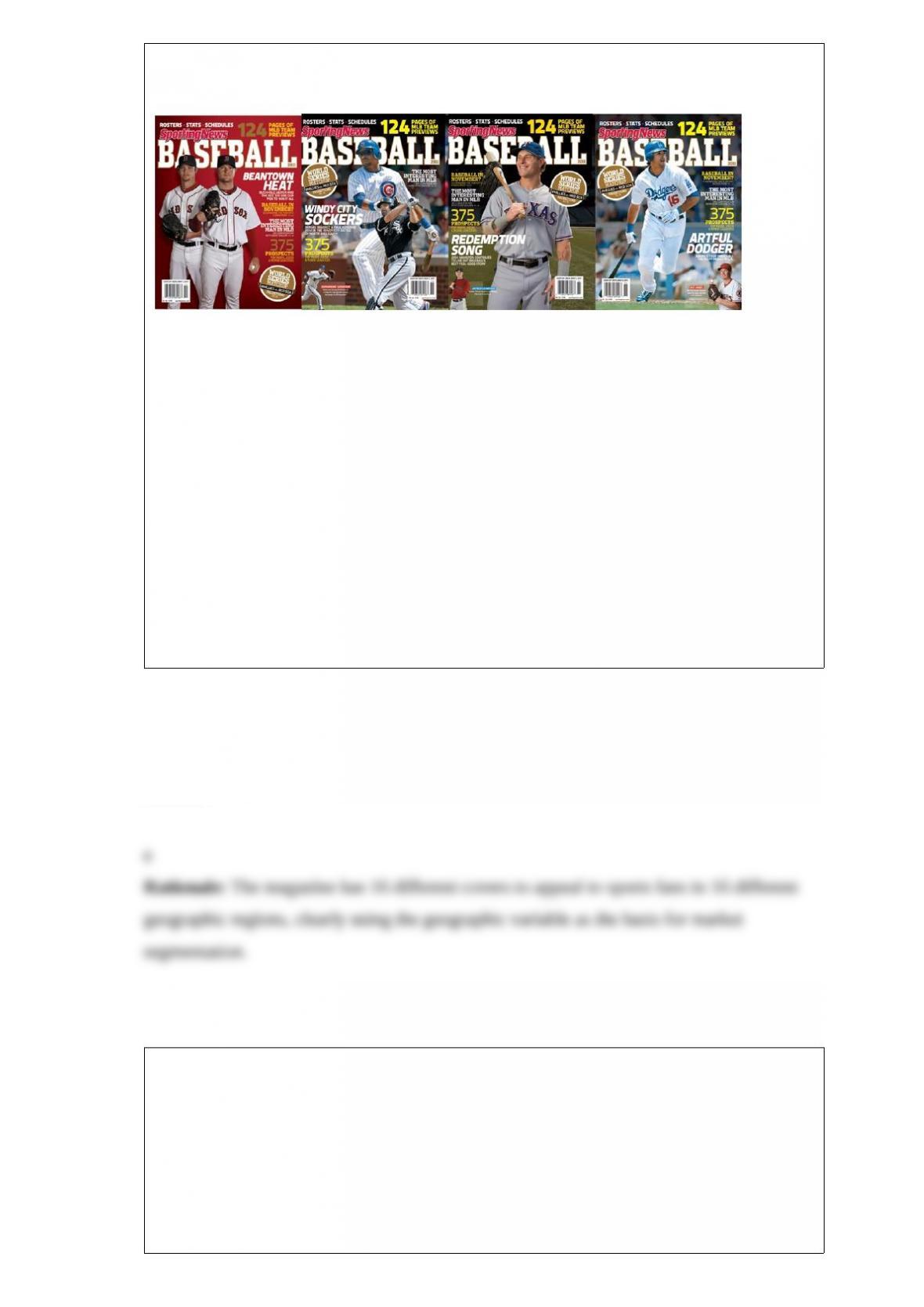
Sporting News Baseball Yearbook Covers
Street & Smith publishes its Sporting News Baseball Yearbook with exactly the same
stories but with 16 different covers to appeal to baseball fans in 16 different regions of
the U.S. What is its market segmentation strategy?
a. psychographic segmentation
b. retail outlet segmentation
c. demographic segmentation
d. behavioral segmentation
e. geographic segmentation
Answer:
Ten general product and service categories dominate online consumer buying today and
in the foreseeable future. One category includes items such as computer software, travel
and lodging reservations and confirmations, financial brokerage services, and electronic
ticketing, for which
a. prepurchase trial is critical.
b. digital delivery is the single most important factor.
c. audio or video demonstration is important.
d. price and delivery time are not key factors.
e. price and speed of delivery are the determinant sales factors.
Answer:
The marketing objective for a product in the __________ stage of the product life cycle
is to create consumer awareness and stimulate trial.
a. introduction
b. growth
c. maturity
d. decline
e. accelerated development
Answer:

The concept underlying Bitter Girls was developed because the AOI team wanted to
a. empower tween and teen girls who do not fit into the
most-popular-girl-in-high-school model.
b. bring out the sullenness of this age group.
c. encourage tween and teen girls to turn from bitter to sweet.
d. downplay a message that is uplifting and empowering for girls.
e. support the least-popular-girl-in-her-high-school-class model.
Answer:
China, Japan, and South Korea combine for about _________ percent of the total U.S.
balance of trade deficit.
a. 30
b. 50
c. 65
d. 80
e. 95
Answer:
One of the primary benefits of branding for consumers is that branding __________.
a. identifies products of highest quality
b. guarantees lowest prices
c. makes decision making easier for consumers
d. indicates that products have more features
e. makes advertising unnecessary
Answer:
According to Ian Wolfman, “Brands that thrive will be those, like Pizza Hut, that can
efficiently build sustainable relationships with peoplerelationships that have both high
__________ and high __________.”
a. trust; transactions
b. levels of communication; brand awareness
c. customer loyalty; consumer expectations
d. customer interaction; product awareness
e. customer value; mutual respect
Answer:
Which of the following is NOT a benefit of using the Activeion Ionator?
a. safety
b. sustainability
c. fun
d. simplicity of use
e. cost of the Ionator unit itself
Answer:
Which of the following statements about service failures is MOST accurate?
a. Only 5-10% of dissatisfied customers choose to complain to the company.
b. Once customers complain, they expect all of their demands to be met.
c. Only 20% of consumers will give a company a second chance if they are not fully
satisfied during the first encounter.
d. People are twice as likely to share good service experiences as bad experiences.
e. Monitoring social media websites such as YouTube, Twitter, and Facebook are a
waste of time since the complaints presented are usually isolated instances and are not
indicative of the actual service delivered.
Answer:
Another name for competitive parity budgeting is __________ budgeting.
a. linear forecast
b. all-you-can-afford
c. share of market
d. comparative
e. matched media
Answer:
Competitive advantage for global firms grows out of continuous improvement,
__________, and change.
a. product quality
b. employment of a multicultural or multinational staff
c. membership in a formalized trade organization
d. market research
e. innovation
Answer:
Value-pricing refers to
a. the ratio of perceived benefits to price.
b. is the money or other considerations exchanged for the ownership or use of a product
or service.
c. the practice of simultaneously increasing product and service benefits and
maintaining or decreasing price.
d. the ratio of price to perceived benefits.
e. list price minus incentives and allowances plus extra fees.
Answer:
One disadvantage of using the yellow pages as an advertising medium is
a. there is no similar competition.
b. they are facing increasing public concern about the environmental impact of their
paper-based print versions.
c. the ads are perishable.
d. few households with telephones have them.
e. advertisers must create extensive databases for delivery .
Answer:
Toyota employs all of the following business practices as part of “The Toyota Way”
EXCEPT:
a. to continuously improve business operations, always striving for innovation and
evolution.
b. to maximize individual and team performance.
c. to always go to the source to find the facts and make correct decisions.
d. to build trust and take responsibility.
e. to contribute to society and the economy by producing high-quality products and
services.
Answer:
One of the advantages associated with radio as an advertising medium is that it
a. can target specific audiences.
b. has a long exposure time.
c. has a perishable message.
d. has an unlimited amount of advertising time available.
e. is relatively simple to convey complex messages.
Answer:
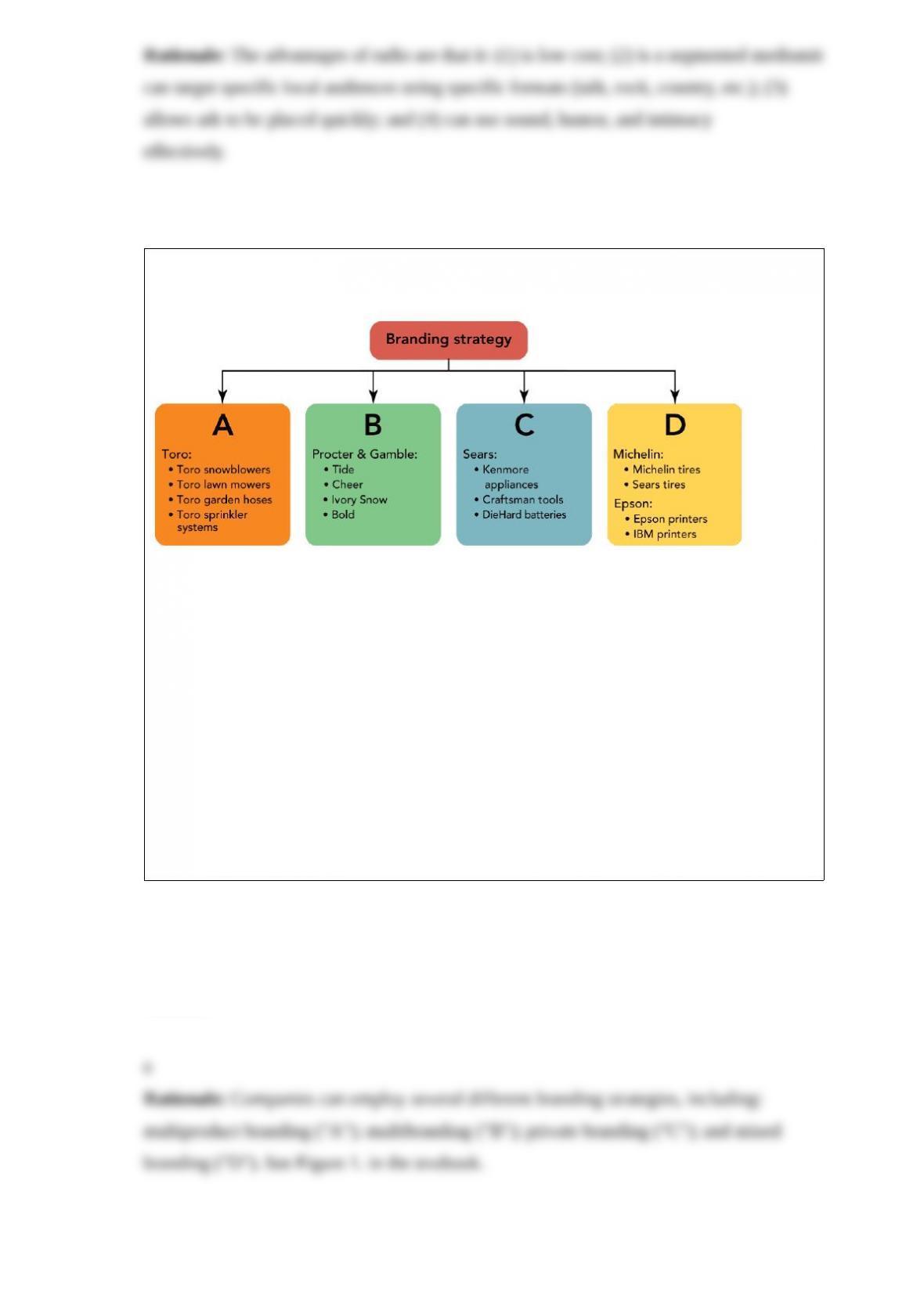
Figure 1.
Companies can employ several different branding strategies. In Figure 1. above, “D”
represents a __________ strategy.
a. retailer branding
b. multiproduct branding
c. multibranding
d. private branding
e. mixed branding
Answer:
When Home Depot entered the Quebec market, two percent of the population were
aware of the retail chain. To determine how effective its advertising was in the first 18
months of its presence in Quebec, the firm conducted awareness research for a second
time. Prior to conducting the research, it was decided that if at least 50 percent of the
population were aware of the Home Depot brand, it would continue its present
advertising program. This is an example of a(n)
a. objective.
b. constraint.
c. assumption.
d. measure of success.
e. barrier to entry.
Answer:
A person’s consistent behaviors or responses to recurring situations is referred to as
a. motivation.
b. core values.
c. culture.
d. perception.
e. personality.
Answer:
Reductions in unit costs for a larger order are referred to as
a. promotional allowances.
b. quantity discounts.
c. economic order discounts.
d. penetration pricing.
e. case allowances.
Answer:
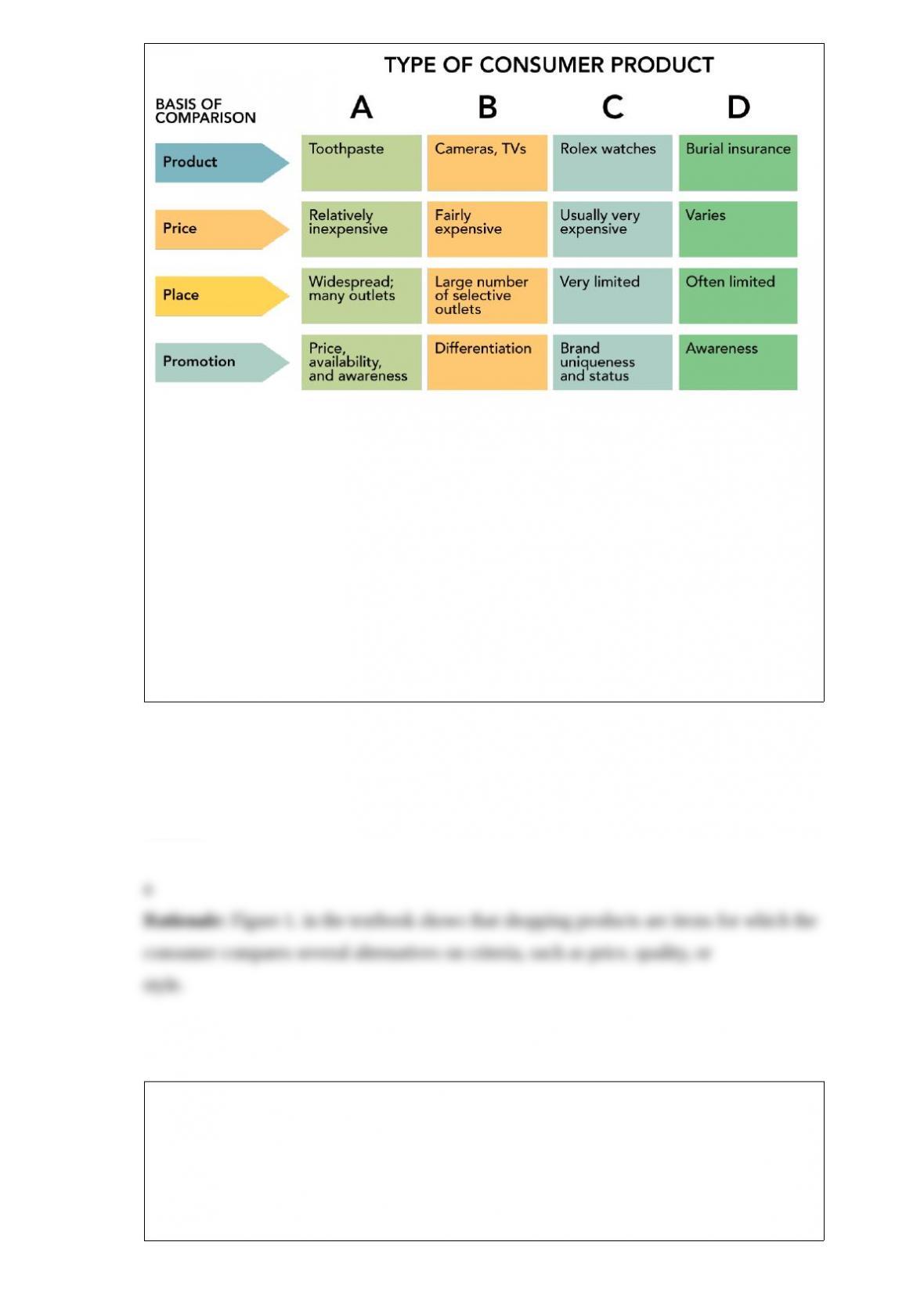
Figure 1.
According to Figure 1. above, column “B” would represent what type of product?
a. shopping
b. convenience
c. specialty
d. prestige
e. unsought
Answer:
Warranties that assign responsibility for product deficiencies to the manufacturer are
called __________ warranties.
a. guaranteed
b. quality control
c. implied
d. strict-liability
e. express
Answer:
The European Union (EU) in mid-2012 consisted of 27 countries with more than 500
million consumers. The EU has eliminated most barriers to the free flow of goods,
services, capital, and labor across its borders. Which of the following countries is NOT
a member of the EU as of mid-2012?
a. Latvia
b. Greece
c. Ireland
d. Switzerland
e. England
Answer: