Specialized functions such as marketing and finance are generally referred to as
__________.
a. teams
b. groups
c. divisions
d. departments
e. business units
Answer:
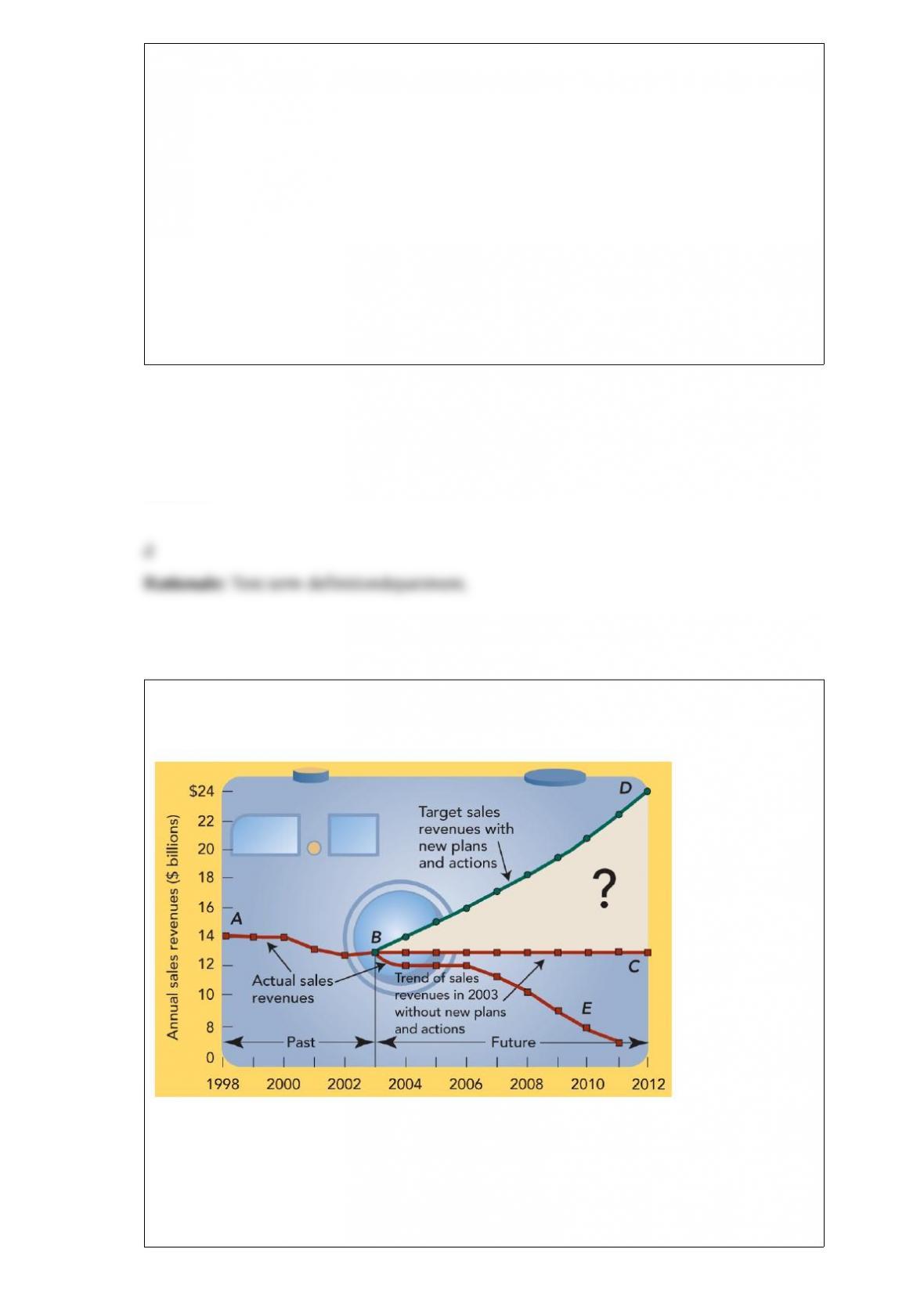
Figure 1.
Based on the information in Figure 1. above, the planning gap between 2003 and 2012,
as represented by the wedge DBC, __________.
a. is widening
b. is narrowing
c. is staying the same
d. cannot be determined
e. actually began in 1998
Answer:
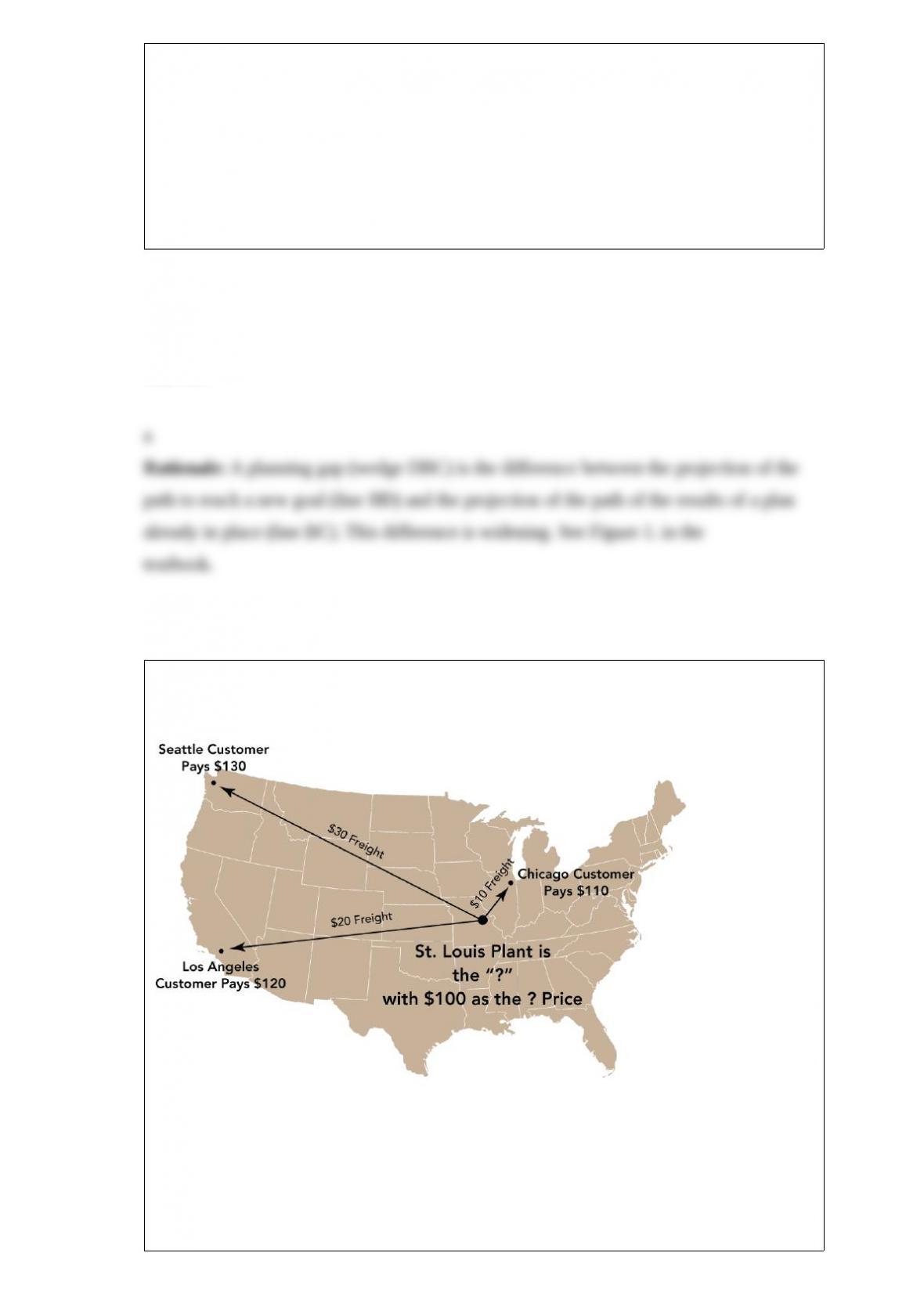
Geographical Pricing Map C
Suppose a firm selects its plant in St. Louis as the location from where it will ship its
products to all of the identified cities shown in Geographical Pricing Map C above. The
MSRP of the product is $100 but the firm adds a freight surcharge to cover
transportation/freight. This surcharge will vary according to the distance between the
origin of the shipmentin this case St. Louisand the destination or customer’s location.

What is the most likely pricing method this firm is using?
a. FOB origin pricing
b. multiple-zone pricing
c. single-zone pricing
d. basing-point pricing
e. FOB destination pricing
Answer:
What is the primary disadvantage of employing a full coverage strategy?
a. Gaining market distribution will be costly.
b. The organization may be spread too thin.
c. The organization achieves neither marketing nor manufacturing synergies.
d. R&D-manufacturing has the difficulty of producing multiple new lines.
e. The organization cannot take advantage of marketing or manufacturing synergies
available to it through market or product specialization.
Answer:
The North American Industry Classification System (NAICS) permits a firm to
a. find the NAICS codes of its present customers and then obtain NAICS-coded lists for
similar firms.
b. learn the names of the purchasing agents of all prospective customers.
c. sell to any company within North America as long as it is not a monopoly.
d. engage in benchmarking with companies manufacturing and/or marketing similar
products.
e. conduct an industry-wide SWOT analysis to determine internal strengths and
weaknesses of current and prospective competitors.
Answer:
The Florida Department of Citrus developed the “To Your Health” campaign to show
the benefits of orange juice. The goal of these ads is to increase demand for orange
juice as compared to other beverages. This is an example of a __________
advertisement.
a. competitive product
b. product advocacy
c. competitive institutional
d. pioneering product
e. pioneering institutional
Answer:
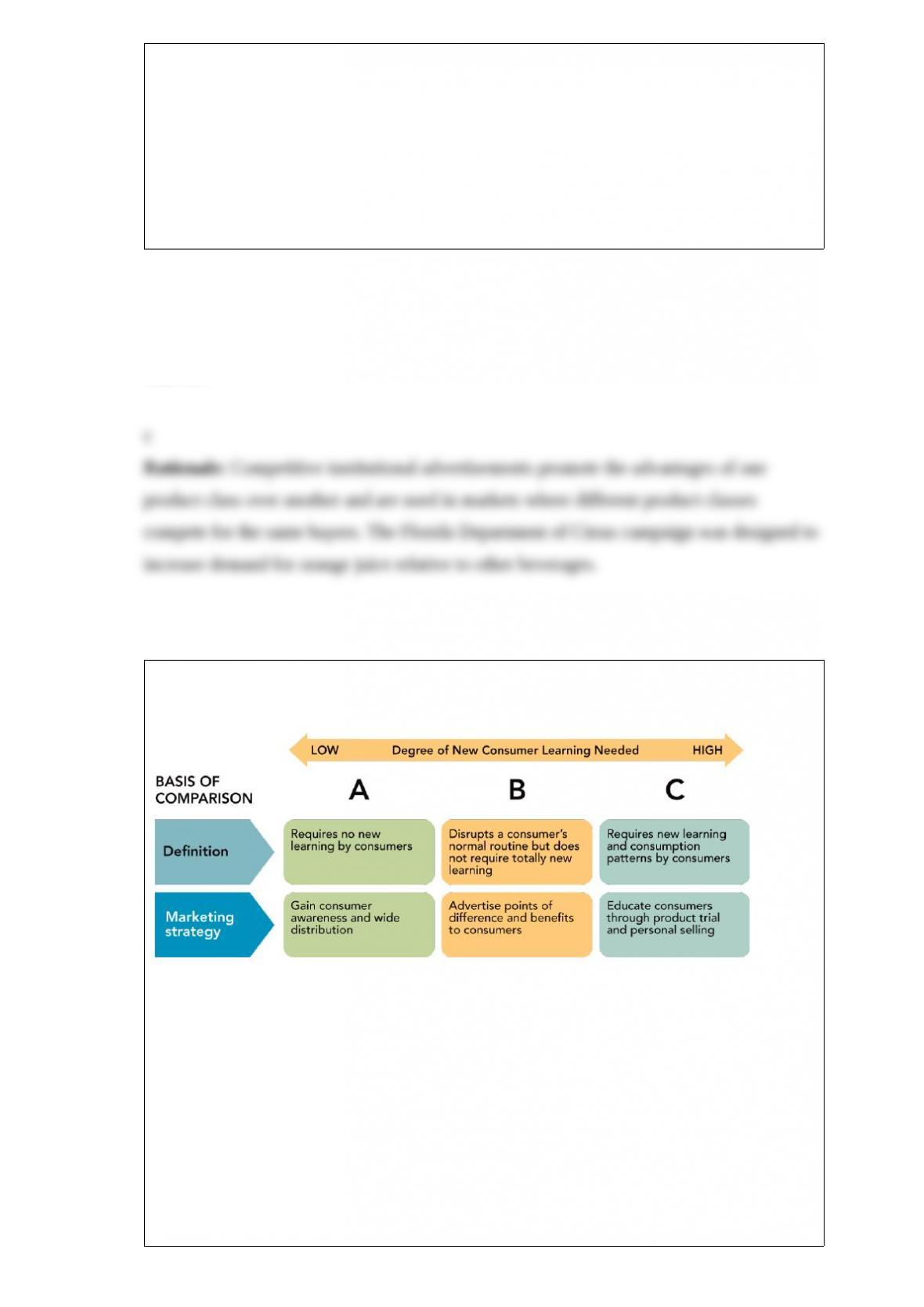
Figure 1.
According to Figure 1. above, column “A” represents a
a. spontaneous innovation.
b. continuous innovation.
c. discontinuous innovation.
d. dynamically continuous innovation.

e. evolutionary innovation.
Answer:
A method of pricing where the price the seller quotes includes only the cost of loading
the product onto the vehicle and specifies the name of the location where the loading is
to occur is referred to as
a. FOB origin pricing.
b. FOB destination pricing.
c. geographical allowance.
d. uniform delivered pricing.
e. mode of transportation pricing.
Answer:
A unique strength relative to what competitors are doing now and like to do in the
future is referred to as __________.
a. a point of difference
b. a competitive advantage
c. sustainable dominance
d. strategic competency
e. market dominance
Answer:
Architectural firms that specialize in designing and constructing one-of-a-kind custom
homes often use which price policy to set prices?
a. cost-plus pricing
b. experience curve pricing
c. standard markup pricing
d. yield management pricing
e. price lining
Answer:
Which of the following statements concerning ethnographic research is most accurate?
a. Ethnographic research was specifically designed to use in global markets to help
marketers understand cultural diversity.
b. Ethnographic research employs the use of genealogical data to track purchase
behaviors through family lines.
c. Ethnographic research relies on physiological responses such as heart rate, breathing
rate, and stress levels to obtain objective data.
d. Ethnographic research uses anthropologists and other trained researchers to observe
consumers in their “natural use environment.”
e. Ethnographic researchers use videotapes to eliminate miscues of subtle emotional
reactions that can skew market research results.
Answer:
John Deere manufactures and distributes industrial and farm equipment. These types of
equipment are considered to be specialty products. Which type of market coverage does
John Deere likely use?
a. intensive distribution
b. extensive distribution
c. selective distribution
d. exclusive distribution

e. private label distribution
Answer:
An action item list refers to an aid to implement a marketing plan that consists of four
columns: (1) the task, (2) the person responsible for completing the task, (3) the date to
finish the task, and (4) __________.
a. the budget
b. the points of difference
c. what is to be delivered
d. the promotional message
e. the product or service
Answer:
The seven stages an organization goes through to identify business opportunities and

convert them into salable products or services is referred to as the __________.
a. commercialization process
b. SWOT process
c. new-product process
d. new-product business development
e. new-product stage gate sequence
Answer:
Interpreting information so that it is consistent with one’s attitudes and beliefs is
referred to as
a. selective retention.
b. selective comprehension.
c. selective exposure.
d. selective analysis.
e. stimulus discrimination.
Answer:

Every product manufactured by the maker of Slim-Fast carries the Slim-Fast brand
name. This company uses __________.
a. multibranding
b. uniform branding
c. co-branding
d. family branding
e. agent licensing
Answer:
OceanSpray.com has a website that describes the company’s products. The website also
includes nutritional information and recipes featuring Ocean Spray products. Since
Ocean Spray products are available at nearly all supermarkets, there was no need to
include dealer information. Ocean Spray uses a(n) __________ website.
a. choiceboard
b. conventional
c. transactional
d. promotional
e. intermediary
Answer:
The increasing effort by advertising agencies, trade associations, and marketing
associations to impose standards upon themselves that reflect the values of society is
referred to as
a. legislation.
b. self-regulation.
c. business practice.
d. business ethics.
e. government regulation.
Answer:
Retail outlets vary by their merchandise lines, the key distinction being the __________
and __________ of the items offered to customers.
a. breadth; span
b. breadth; depth
c. breadth; line
d. scope; inventory

e. range; span
Answer:
There are more than 100 companies that manufacture natural and artificial flavorings
used to enhance the taste of food before it is sold to consumers. Many of these
manufacturers are regional operations. Many differentiate themselves from the
competition in their advertising by specializing in one or two types of foods for which
they provide flavorings. Some use their distribution strategies as a means of
differentiating themselves from their competition. This industry is most likely an
example of
a. pure monopoly.
b. oligopoly.
c. monopolistic competition.
d. bilateral monopoly.
e. monopolistic oligopoly.
Answer:
Public watchdog groups are critical of ad campaigns for some video games that use sex
appeals and glamorize violence. How should an ad agency respond to these critics if it
wishes to avoid the enactment of additional laws limiting its creativity?
a. Express strong support for First Amendment freedom and stand its ground.
b. Develop an infomercial for its product that is relevant, useful to its customer, and
entertaining.
c. Produce a public service announcement in support of its current, successful approach.
d. Take advantage of the publicity and run the ads in question more frequently.
e. Take steps toward self-regulation, imposing standards on its promotional activities
that reflect the values of society.
Answer:
The Belsen interview is a means of pretesting media surveys. It gathers facts and
figures by asking people about their attitudes, beliefs, and awareness of various media.
With this technique, a respondent is interviewed twicefirst by an interviewer using the
proposed survey and then by a different interviewer, who asks questions about the
survey itself. The Belsen interview uses __________ data.
a. questionnaire
b. secondary
c. intercept
d. observational

e. synergistic
Answer:
To increase value, marketers may __________, decrease price, or do both.
a. decrease benefits
b. increase benefits
c. increase price
d. increase advertising
e. do nothing and let the perceived value of the item increase as it matures in the life
cycle
Answer:
The pricing component of the marketing mix is the focus of regulation from two
perspectives:
a. quantity discounts and price gouging.

b. price fixing and price discounting.
c. promotional allowances and trade allowances.
d. selling and bartering.
e. competitive pricing and illegal bartering.
Answer:
A firm’s profit objective is often measured in terms of ROI. The acronym ROI stands
for __________.
a. risk opportunity investment
b. revised organizational incentives
c. return on investment
d. regulated organizational investments
e. replenishment of organizational inventories
Answer:

A recent study by the Aberdeen Group analyzed which segmentation bases were used
by the top 20 percent of 220 organizations surveyed. Which segmentation base did
these organizations use most?
a. behavioral
b. psychographic
c. geographic
d. demographic
e. product
Answer:
A marketing strategy that alters a product’s characteristic such as its quality,
performance, or appearance to increase its value and sales to customers is referred to as
__________.
a. market modification
b. product modification
c. product repositioning
d. market-product synergy
e. product management
Answer:
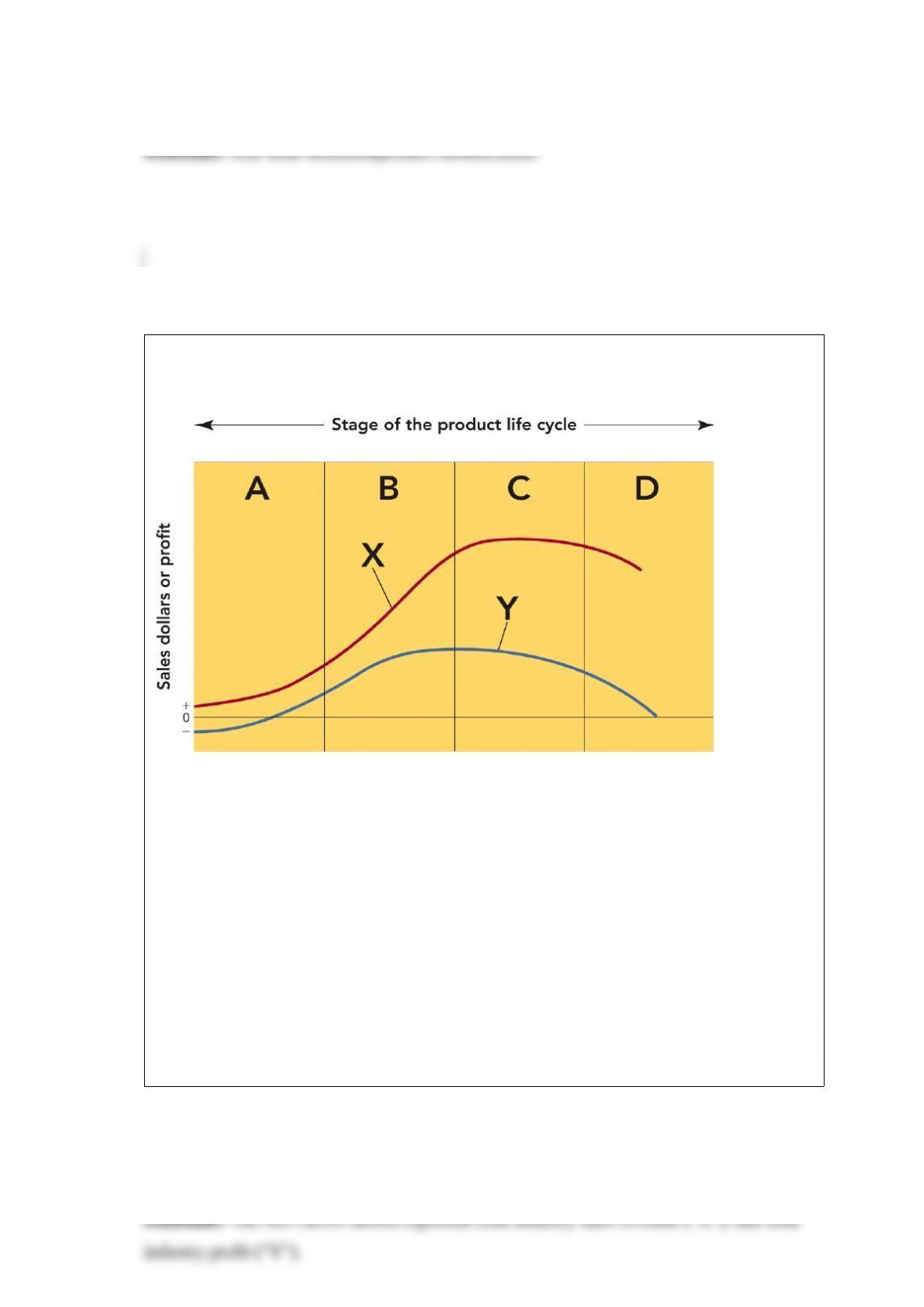
Figure 1.
Figure 1. above represents the stages of the product life cycle. What does the curve
labeled “X” represent?
a. total variable costs
b. total fixed costs
c. total industry profit
d. total industry sales revenue
e. total research and development costs
Answer:

Prestige pricing is considered to be a __________ approach to pricing.
a. demand-oriented
b. cost-oriented
c. profit-oriented
d. competition-oriented
e. service-oriented
Answer:
The blending of different communication and delivery channels that are mutually
reinforcing in attracting, retaining, and building relationships with consumers who shop
and buy in traditional intermediaries and online, is referred to as __________.
a. direct marketing
b. indirect marketing
c. intensive marketing
d. multichannel marketing
e. electronic marketing

Answer:
The term marketing strategy is used to address both the __________ and the
__________.
a. product groupings; target market
b. target market; marketing program
c. subjective; objective
d. revenues generated; market share achieved
e. feasibility; time required to implement
Answer: