
Most specialty stores and department stores, which provide many services to their
customers, are considered to be __________.
a. exclusive-service retailers
b. limited-service retailers
c. full-service retailers
d. full-domain retailers
e. upscale-retailers
Answer:
The first Mountain Dew Dewmocracy campaign asked consumers to choose the next
Dew’s flavor, color, name, and graphics. How many people participated in the process
that resulted in Voltage being introduced to the market?
a. 100,000,000
b. 10,000,000
c. 1,000,000
d. 100,000
e. 10,000
Answer:
A hardware store owner placed an advertisement for Sylvania LED light bulbs in the
local newspaper. Sylvania provided the storeowner with several high-quality,
camera-ready sample advertisements and also paid 50 percent of the cost to place the ad
in the paper. Sylvania was using __________ to promote its products.
a. strategic channel partnership
b. cooperative advertising
c. retail publicity
d. reseller consumer promotion
e. manufacturer incentive advertising
Answer:
Which of the organizations listed below has the lowest inventory carrying cost?
a. railroad
b. hotel
c. long-term care facility
d. amusement park
e. insurance companies
Answer:
Reverse logistics refers to
a. the collection of used goods donated from to nonprofit organizations by ultimate
consumers to be restored, cleaned, repaired, and resold back to ultimate consumers.
b. deconstructing products that failed to pass quality inspection standards on the
production line and reusing workable parts instead of throwing out the entire unit.
c. the process of reclaiming recyclable and reusable materials, returns, and reworks
from the point-of-consumption or use for repair, remanufacturing, redistribution, or
disposal.
d. organizing a cost-effective flow of raw materials, in-process inventory, finished
goods, and related information from point of origin to point of consumption to satisfy
customer requirements.
e. the donation of old or broken automobiles to nonprofit organizations that can be
recycled or turned into scrap with the profits applied to the organization’s operating
expenses.
Answer:

The question “How long is the warranty for this new Frigidaire dishwasher?” would be
asked during the __________ stage in the consumer purchase decision process.
a. problem recognition
b. alternative evaluation
c. information search
d. purchase decision
e. comparison
Answer:
A business firm goes to the trouble and expense of segmenting its markets when
a. it changes its advertising campaign.
b. competitors enter the marketplace.
c. the environment becomes uncertain.
d. it expects that this will increase its sales, profit, and return on investment.
e. there is a recessionary economic environment.
Answer:
The proper blend of elements in the promotional mix depends on the type of product.
The three specific characteristics to be considered are complexity, __________, and
ancillary services.
a. durability
b. adaptability
c. risk
d. accessibility
e. acceptability
Answer:
A major fallacy of __________ budgeting is that by tying a promotion budget to sales, a
company may reduce the amount it spends on promotion when it actually needs to
spend more.
a. competitive parity
b. all-you-can-afford
c. objective and task
d. linear forecast
e. percentage of sales
Answer:
Manufacturers or and even wholesalers make geographical adjustments to list or quoted
prices to reflect
a. warehouse inventory carrying and loading costs.
b. the cost of transportation of the products from seller to buyer.
c. changes in price due to tariffs the Federal Trade Commission imposes on the
transport of goods from the U.S.
d. changes in price due to fuel excise taxes on inefficient diesel trucks.
e. the need some firms have of recouping the costs of developing different versions of
their products for different global markets.
Answer:

A brand marketed under the same name in multiple countries with similar and centrally
coordinated marketing programs is referred to as a
a. transnational brand.
b. international brand.
c. multinational brand.
d. global brand.
e. meganational brand.
Answer:
Barter refers to
a. a reciprocity agreement stipulating that if company “A” purchases services from
company “B,” then company “B” must purchase similar services from company “A.”
b. a tying agreement stipulating that if company “A” purchases a product from company
“B,” it must also purchase its services.
c. the practice of exchanging products and services for other products and services
rather than for money.
d. the practice of exchanging services for products of equal or greater value.
e. the practice of exchanging products and services for money.
Answer:
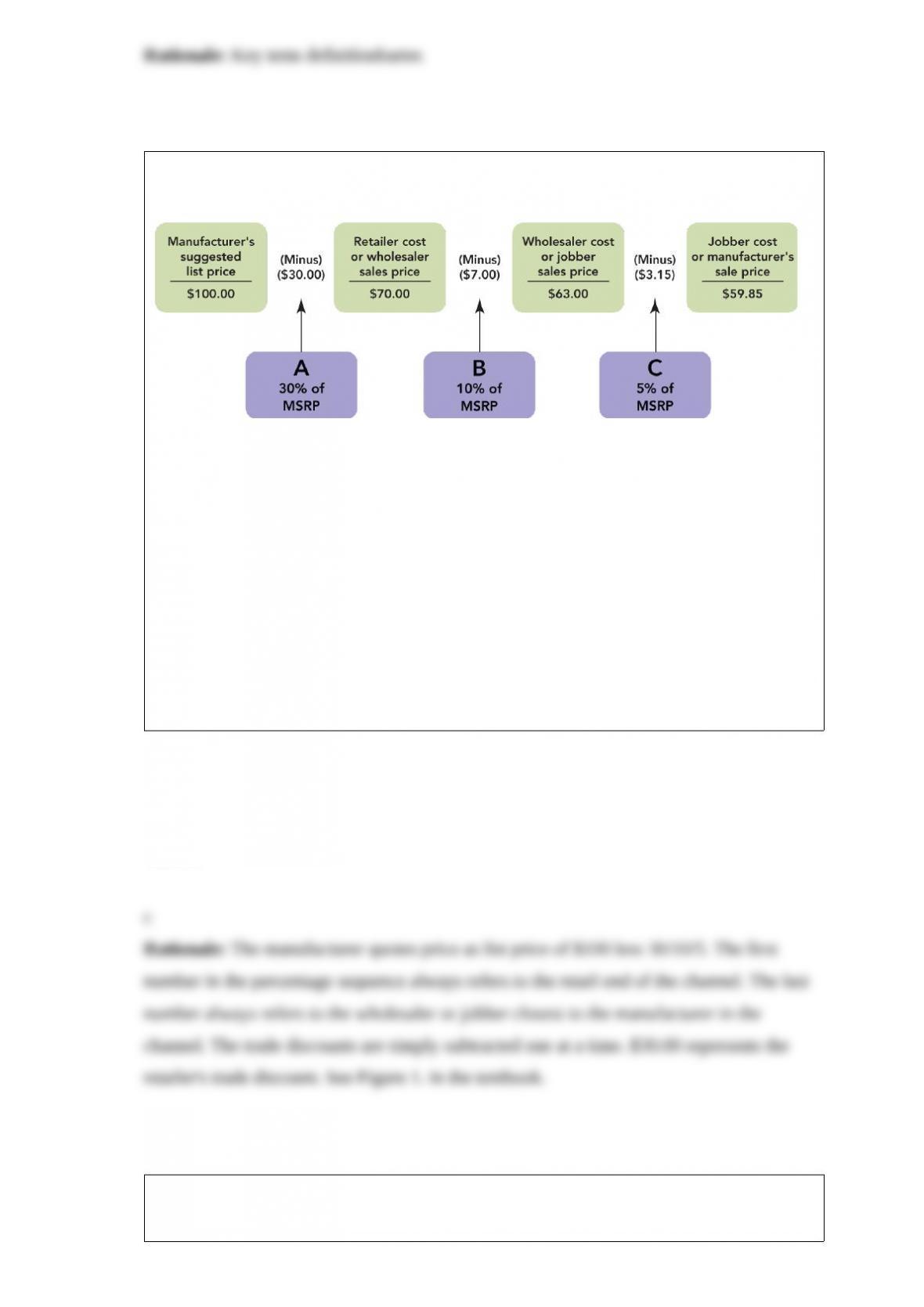
Figure 1.
According to Figure 1. above, how much is the retailer trade discount?
a. $3.15
b. $7.00
c. $30.00
d. $63.00
e. $70.00
Answer:
Functional groupings refer to organizational groupings

a. that group specific customer segments.
b. in which sales territories are subdivided according to geographic location.
c. that represent the different departments or business activities within a firm.
d. in which a unit is responsible for specific product offerings.
e. that combine both market-based groupings with product groupings.
Answer:
Which statement regarding responsive supply chains is most accurate?
a. Responsive supply chains use slower modes of transportation but faster order
processing.
b. Responsive supply chains often rely on more expensive express transportation.
c. Responsive supply chains always use the least expensive mode of transportation
possible.
d. Responsive supply chains rely on large inventory warehouses.
e. Responsive supply chains achieve economies of scale by having all inventory stored
and sorted at a central location.
Answer:
The North American Industry Classification System (NAICS) provides common
industry definitions to facilitate the measurement of economic activity for the member
countries of the
a. European Union (EU).
b. United Nations (UN).
c. North American Free Trade Agreement (NAFTA).
d. North Atlantic Treaty Organization (NATO).
e. USCANMEX.
Answer:
A formula selling presentation refers to a format that __________.
a. emphasizes probing and listening by the salesperson to identify the needs and
interests of prospective buyers
b. focuses on problem identification, in which the salesperson serves as an expert on
problem recognition and resolution
c. consists of information that must be provided in an accurate, thorough, and
step-by-step manner to inform the prospect
d. assumes that given the appropriate stimulus by a salesperson, the prospect will buy
e. relies on exhibits at trade shows, professional meetings, and conferences
Answer:
Some specialty-toy retailers pursue a __________ pricing objective to generate cash to
ward off bankruptcy.
a. market share
b. survival
c. sales revenue
d. single product line
e. profit
Answer:
Cannibalization would most likely occur if
a. Dell adds high-end speaker systems to its line.
b. General Mills launches Chocolate Cheerios.
c. General Motors markets a sport coupe similar to the BMW Z4.
d. Pillsbury adds boxed sugar to its product line.
e. Procter & Gamble adds a new line of baby clothing to its product mix.
Answer:
A social audit is a systematic assessment of a firm’s objectives, strategies, and
performance in terms of social responsibility. The five steps of the audit are: (1)
recognition of a firm’s social expectations and the rationale for engaging in social
responsibility endeavors; (2) identification of social responsibility causes or programs
consistent with the company’s mission; (3) determination of organizational objectives
and priorities for programs and activities it will undertake; (4) specification of the type
and amount of resources necessary to achieve social responsibility objectives; and (5)
a. identification of environmental forces that could interfere with the firm’s plans.
b. evaluation of possible benefits both tangible and intangible to the firm’s triple-bottom
line.
c. evaluation of social responsibility programs and activities undertaken and assessment
of future involvement.
d. selection of a team leader and assignment of tasks and task deadlines for team
members.
e. creation or selection of a theme, slogan, spokesperson, etc. for marketing
cohesiveness.
Answer:
Sealy, the self-proclaimed largest manufacturer of mattresses in the U.S., recently set
out to redefine its place in the bedrooms of America. No longer was it going to be
known as simply a mattress company. Now the name Sealy was going to be known as
the world’s leading ‘sleep wellness provider.” This is an example of __________.
a. reverse marketing
b. demarketing
c. repositioning
d. resegmenting
e. positioning
Answer:
All of the following are economic indicators EXCEPT:
a. inflation
b. barriers to entry
c. unemployment
d. GDP
e. deflation
Answer:
In 2008, Kodak’s ink-jet printer could be considered a “question mark” because the
market dramatically changed as consumers shifted from single-purpose to multifunction
machines designed to print photos, make copies, scan images, and send faxes. Today,
Kodak now offers only multifunction printers. If Kodak can double or triple unit sales
soon, this SBU “question mark” could become a “__________;” if online printing and
sharing steal market share, this SBU could become a “__________.”
a. cash cow; star
b. cash cow; dog
c. star; dog
d. star; hedgehog
e. in either scenario, the inkjet printer will remain a question mark
Answer:
Which of the products listed below would be the best candidate for full-scale market
testing?
a. totally free checking account from Bank One
b. household frequent flyer program from Delta Airlines
c. mid-priced luxury sedan made in America by Mazda
d. new iced coffee beverage from Starbucks
e. low-cost iMac computer
Answer:
VALS groups of consumers motivated by __________ are those who desire social or
physical activity, variety, and risk.
a. ideals
b. rewards
c. achievement
d. self-expression
e. success
Answer:
When you buy a used car from a CarMax dealership, you are offered the car at a “no
haggle” price. You can buy it or not, but there is no negotiating the published price
because of the seller’s
a. customary pricing strategy.
b. one-price policy.
c. uniform pricing policy.
d. flexible-price policy.
e. dynamic pricing strategy.
Answer:
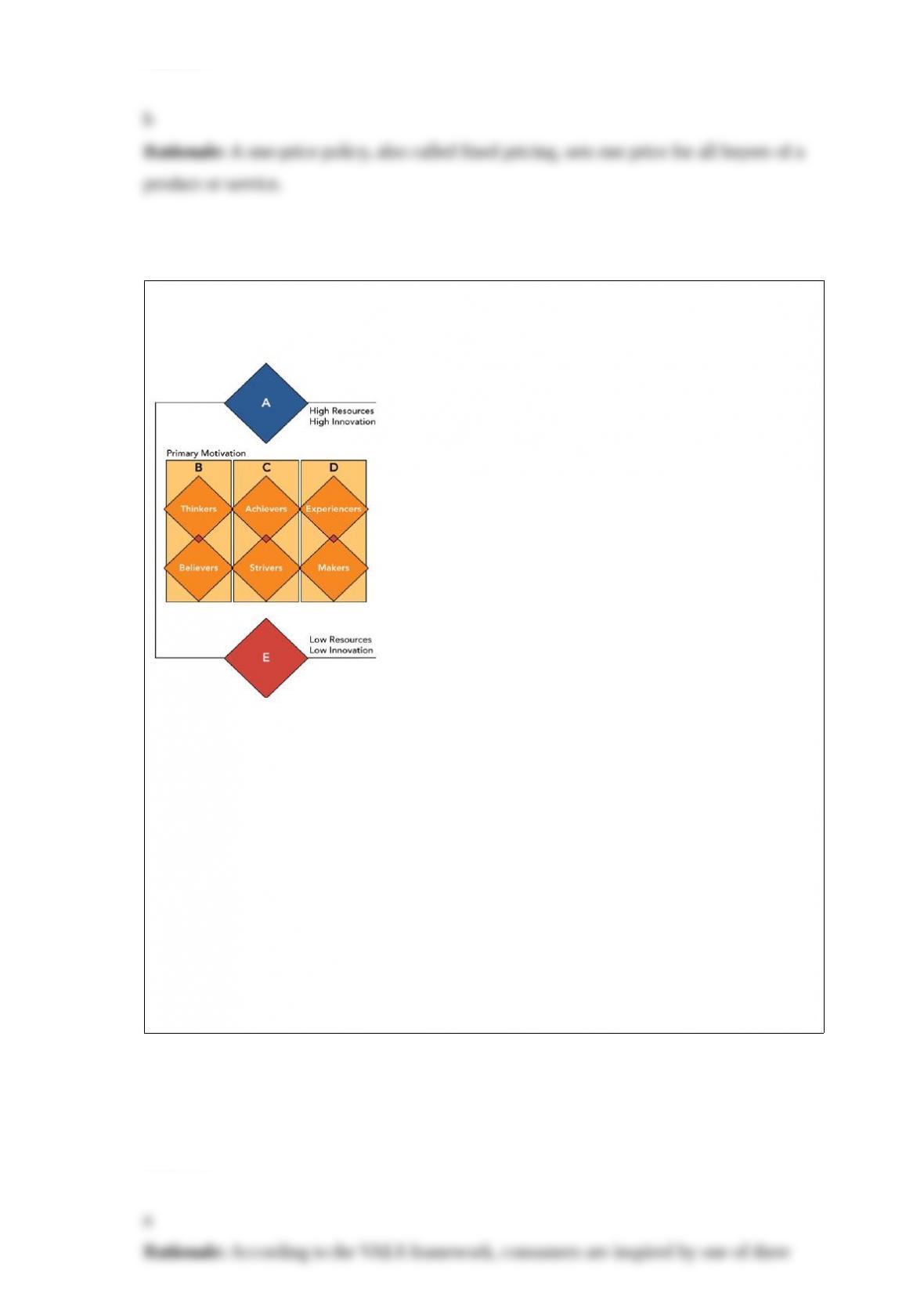
VALS Framework
VALS creates profiles of people based on their primary motivation and resources. In the
VALS framework above, “B” refers to
a. Ideals.
b. Achievement.
c. Self-Expression.
d. Survivors.
e. Innovators.
Answer:
Kraft produces Lunchables, a prepackaged meal usually consisting of several crackers,
small slices of meat, and small slices of cheese. Some items in the product line contain
Capri Sun drinks, water, or a small portion of Dole fruit. The box is bright yellow and
the quantity of food contained within it is small. The target market for Kraft Lunchables
is MOST LIKELY:
a. moms with school-age children who pack a simple healthy lunch for them.
b. business people looking for a fulfilling breakfast at the office.
c. business travelers on the run.
d. teenagers who are hungry for an after-school snack.
e. baby boomers who are trying to lose weight.
Answer:
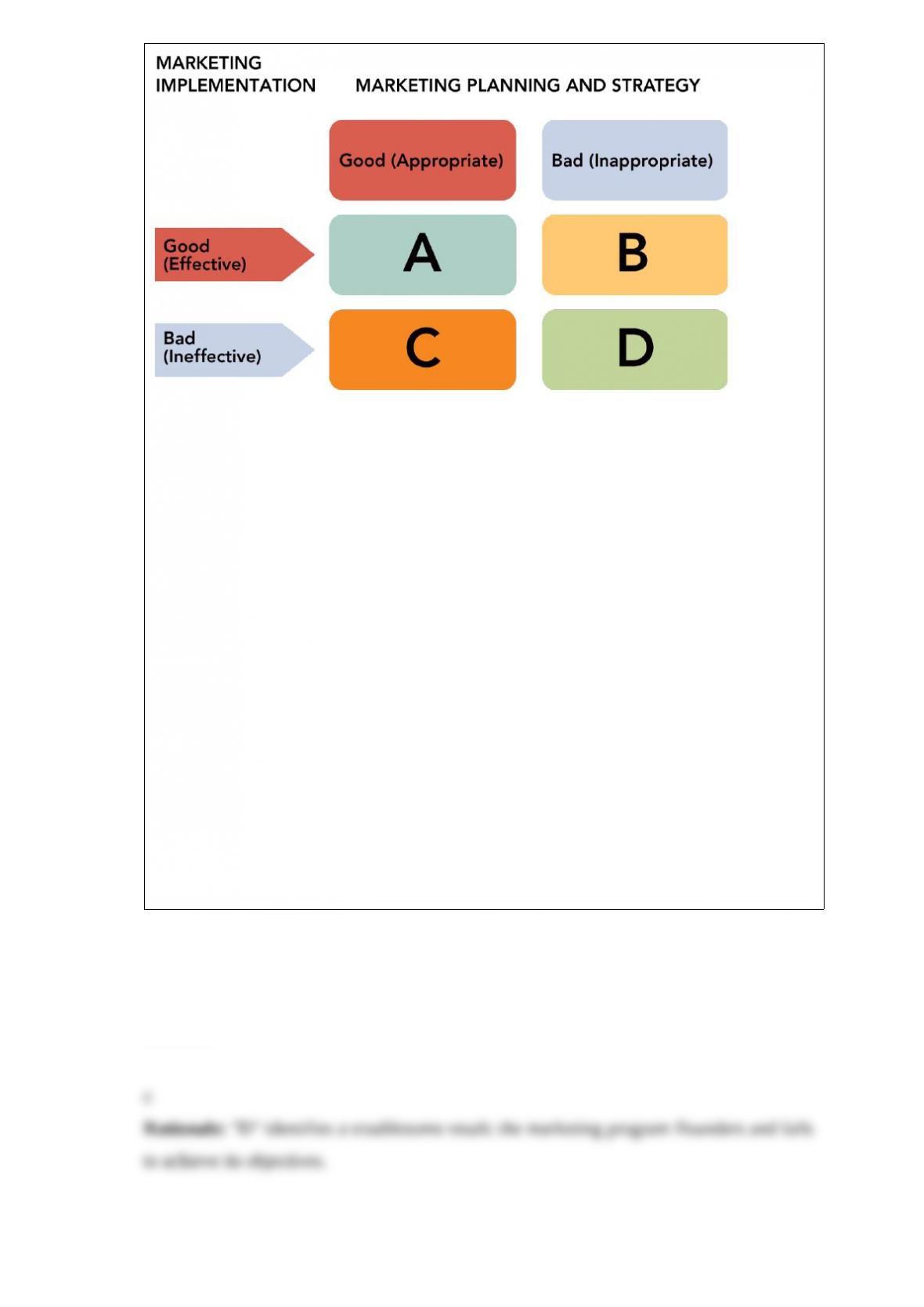
Figure 22-A
Consider Figure 22-A above. Effective managers track the progress of their marketing
plans to identify problems that need to be corrected. Sometimes, the problems are with
the marketing plan and its strategies; at other times, they may be due to their
implementation; and at still other times, they may be due to both. Recall that research
on what really works shows that successful firms have excellence on both the planning
and strategy side and the implementation or execution side. As Figure 22-A shows,
marketers can develop and implement strategies that have four possible results. For
“D,” identify the likely result of the planning and implementation of the marketing plan
and its strategies for a product or service.
a. Trouble: The solution is to recognize that only implementation is at fault and to
correct it.
b. Success: The marketing program achieves its objectives.
c. Failure: The marketing program flounders and fails to achieve its objectives.
d. Trouble: The solution is to recognize that only the strategy is at fault and to correct it.
e. Cannot be determined with the information provided.
Answer:
Global companies have five strategies for matching products and their promotion
efforts to global markets. Changing a product in some way to make it more appropriate
for a country’s climate or preferences is an example of which type of strategy?
a. product extension
b. product customization
c. product adaptation
d. product invention
e. product integration
Answer:
Figure 1.
According to Figure 1. above, “implement marketing actions” occurs during which step
of the five-step marketing research approach?
a. “A”
b. “B”
c. “C”
d. “D”
e. “E”
Answer:
All of the following are market segmentation strategies EXCEPT:
a. build-to-order
b. multiple products, multiple market segments
c. one product, multiple market segments
d. multiple products, one segment
e. mass customization
Answer: