
During the evaluation phase of an IMC program, a firm will __________ and make
needed changes.
a. posttest the promotion
b. design the promotion
c. state the mission
e. carry out the promotion
d. identify possible advertising or promotional firms
Answer:
One of the advantages associated with television as an advertising medium is that it
a. has a short exposure time.
b. can reach extremely large audiences.
c. is a low-cost medium.
d. has an unlimited amount of advertising time available.
e. can be used to convey complex messages.
Answer:
The first step of the marketing research approach is to __________.
a. develop findings
b. define the problem
c. take marketing actions
d. collect relevant information
e. develop the research plan
Answer:

Figure 1.
Consider Figure 1. above. A small family owns gelato business in the town’s favorite
place where parents and children stop on their way home from work to relax or school
to play. However, the business owner is barely making ends meet. He is beginning to
think that he will not be able to support his family if things don”t improve, but he
doesn”t want to give up his store. Instead, he experiments by selling handmade flies on
the Internet for professional sports fishermen. This is an example of a __________
strategy that would be found in quadrant __________.
a. market penetration; “A”
b. product development; “B”
c. market development; “C”
d. product-market expansion; “D”
e. diversification; “D”
Answer:
A product that establishes new consumption patterns among consumers is a

a. continuous innovation.
b. discontinuous innovation.
c. dynamically continuous innovation.
d. evolutionary innovation.
e. disruptive innovation.
Answer:
The marketing strategy of selling new products to current markets is referred to as
__________.
a. product penetration
b. product development
c. market development
d. diversification
e. market penetration
Answer:

The purpose of copyright law is to
a. provide incentives for increased competition.
b. give inventors the right to exclude others from making, using, or selling products that
infringe the patented invention.
c. level the playing field between inventors who work for large corporations and those
who work on their own.
d. guarantee the quality and safety of any product produced or distributed in the United
States.
e. give an author of a literary, dramatic, musical, or artistic work the exclusive right to
print, perform, or otherwise copy that work.
Answer:
The emphasis of a marketing strategy for a discontinuous innovation would most likely
be to
a. generate awareness among consumers.
b. advertise benefits to consumers, stressing points of differentiation.
c. educate consumers about entirely new consumption patterns through product trial and
personal selling.
d. obtain widespread distribution in multiple channels.
e. stress price differentials from competitors’ products.
Answer:
A commercial depicts a young son asking his mother why they have to move. The
mother’s response indicates because Americans are buying products made in other
countries, the boy’s father has lost his job. This commercial reflects an attitude of
a. cultural semiotics.
b. the trade feedback effect.
c. protectionism.
d. cultural ethnocentricity.
e. consumer ethnocentrism.
Answer:
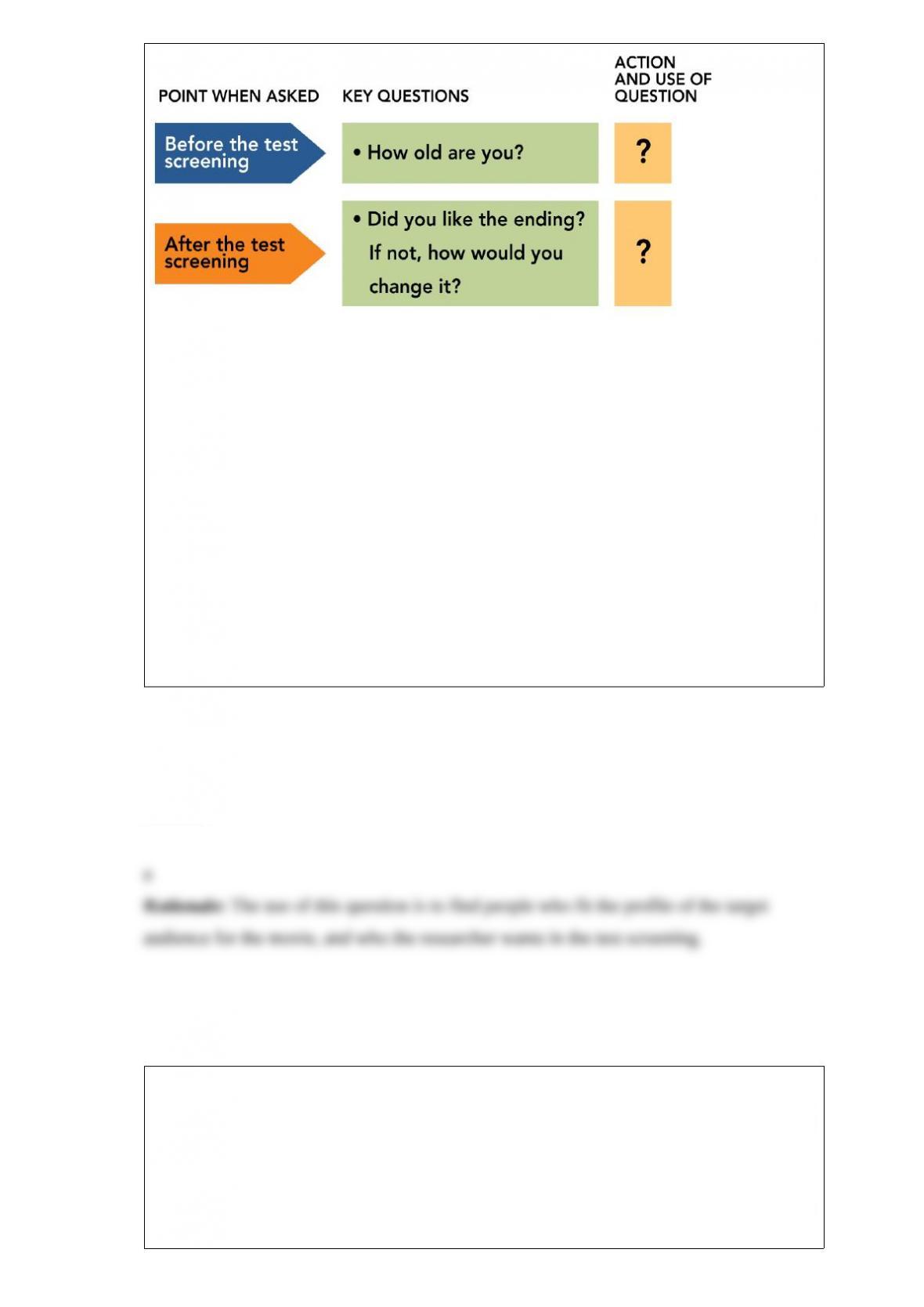
Figure 8-A
According to Figure 8-A above, when conducting marketing research, why would you
ask the question, “How old are you?” before the test screening of a movie?
a. to identify people who fit the profile of the target audience for the movie
b. to identify people who frequently attend movies
c. to make sure the respondent meets recommended age requirements for being
admitted to the movie (G, PG, R, etc.)
d. to determine if the respondent is old enough to relate to the characters
e. to determine if the respondent is mature enough to provide valuable input when
critiquing the elements of the movie
Answer:
A customer contact audit refers to
a. the initial contact between a service provider and the ultimate consumer.
b. a flowchart of the points of interaction between a consumer and a service provider.

c. a method of consumer evaluation of service quality and consistency.
d. an estimation of demand based on service forecasting techniques.
e. is a systematic assessment of a service provider’s objectives, strategies, and
performance in terms of social responsibility.
Answer:
The five stages a buyer passes through in making choices about which product and
service to buy is called the _________.
a. information decision process
b. purchase decision process
c. alternative evaluation process
d. postpurchase behavior process
e. problem recognition process
Answer:
The personal moral philosophy of utilitarianism underlies the economic tenets of
a. existentialism.
b. moral idealism.
c. communism.
d. socialism.
e. capitalism.
Answer:
There are five alternative marketing strategies that can be identified by market-product
grids: market-product concentration, market specialization, product specialization,
__________, and full coverage.
a. selective distribution
b. market development
c. product reorientation
d. new product specialization
e. selective specialization
Answer:

For marketers, the primary objective of a sweepstakes is to
a. generate store traffic.
b. retaliate against competitors’ actions.
c. encourage present customers to buy more and minimize brand-switching behavior.
d. build goodwill.
e. encourage retailer support.
Answer:
Reflecting on the research study of over 200 management tools and techniques, which
of the following companies is used as an example of a firm that excels based on a
performance-oriented culture?
a. Costco
b. Smucker’s
c. Coca-Cola
d. Kodak
e. Toyota
Answer:
The screening and evaluation stage of the new-product process involves
a. internal and external evaluations of new-product ideas.
b. product selection and budgeting projections.
c. business and cost analyses.
d. patent searches and environmental scanning.
e. idea selection and prototype development.
Answer:
Meijer is a chain of hypermarkets headquartered in Michigan, which means it
a. engages in no intertype competition.

b. is a disintermediator.
c. uses scrambled merchandising.
d. can also be referred to as a category killer.
e. uses dual distribution.
Answer:
All of the following are behavioral segmentation variables EXCEPT:
a. needs
b. usage rate
c. product features
d. intentions
e. user status
Answer:

If the CEO of the Clorox Company were to say, “We want to control 60 percent of the
bleach market within the next five years,” he would have set a __________ pricing
objective.
a. profit
b. sales
c. unit volume
d. market share
e. social responsibility
Answer:
Evaluative criteria refer to
a. the objective and subjective attributes of a brand consumers use to compare different
products and brands.
b. those attributes of a brand that are based exclusively on objective criteria in order to
make an unbiased purchase decision.
c. those attributes of a brand that are based exclusively on subjective criteria in order to
avoid postpurchase anxiety.
d. the attributes of a product that a manufacturer wishes to promote to a specific target
market.
e. a list of product attributes from which a customer will not waver regardless of
additional incentives.

Answer:
Five situational influences have an impact on a consumer’s purchase decision process.
They are: purchase task, social surroundings, __________, temporal effects, and
antecedent states.
a. competitive offerings
b. physical surroundings
c. core values
d. motivation
e. economic effects
Answer:
The social media website open to anyone age 13 and over, where users keep family and
friends up to date on what they are thinking, doing, and feeling; chat with friends; and
create and join common-interest groups organized by workplace, high school, college,
and Pages is
a. Twitter.
b. Vimeo.

c. Facebook.
d. YouTube.
e. LinkedIn.
Answer:
You are president of a manufacturer of small electric appliances. You want to reduce
your break-even quantity. All things being equal, you can do this by
a. increasing the quantity sold, while keeping price unchanged.
b. reducing marginal revenue.
c. reducing unit variable cost.
d. increasing fixed cost.
e. increasing total cost.
Answer:

Seiko makes watches. It markets its higher quality watches under the Seiko or LaSalle
brand name, and its lower-priced watches are sold under the Pulsar brand. Seiko uses a
__________ strategy.
a. multibranding
b. product differentiation branding
c. multiproduct branding
d. segmentation branding
e. private branding
Answer:
Consumers are no longer content with affordable, high quality purchases; they want
__________.
a. offerings that reflect their self-image
b. consistent quality
c. to be treated as special one-of-a-kind buyers
d. total customer satisfaction
e. to feel as if they are in control of the entire purchasing process
Answer:
The purpose of the Robinson-Patman Act is to
a. outlaw price discrimination for purchasers of the same product.
b. encourage pure competition.
c. protect inventors from having their intellectual property stolen.
d. repeal the Sherman Antitrust Act.
e. provide incentives for interstate commerce.
Answer:
To help consumers assess and compare its airline service, Frontier Airlines uses
personable animal characters in its advertising to announce and describe benefits, such
as leather seats and ‘stretch” seating, to help deal with the
a. intangibility of the service.
b. incongruity of the service.
c. inseparability of the service.
d. inflexibility of the service.
e. interdependence of the service.
Answer:
A __________ is a brand strategy designed to counteract or confront competitors’
brands.
a. co-brand
b. private brand
c. fighting brand
d. brand extension
e. subbrand
Answer:

Mall of America has verbalized its __________ strategy with the slogan, “A place for
fun!”
a. retail mix
b. wheel of retailing
c. retail life cycle
d. distribution
e. retail positioning
Answer:
Social networks can be classified based on (1) __________ and (2) __________.
a. web browsers; apps
b. user generated content (UGC); organization-sponsored content (OSC)
c. blogs; wikis
d. textual; visual
e. media richness; self-disclosure.
Answer:

A matrix organization
a. combines a product line structure with a geographical structure.
b. combines a geographical structure with a market-based structure.
c. combines market-based groupings with product groupings.
d. turns a horizontal organizational structure into a vertical one.
e. groups products according to the distribution system that is used.
Answer: