LG Electronics recently introduced the Fridge-TV with a 15″ television screen mounted
in the right side refrigerator door. This is an example of which type of innovation?
A. inventive innovation
B. continuous innovation
C. discontinuous innovation
D. dynamically continuous innovation
E. continuous invention
Answer:
The wholesalers most prevalent in the hardware, drug, and clothing industries would be
__________.
A. specialty wholesalers
B. full-line wholesalers
C. cash and carry wholesalers
D. limited-line wholesalers
E. universal wholesalers
Answer:
Merrill Lynch and Thompson Financial had a three-year, $1 billion project that put
workstations on the desks of 25,000 of Merrill Lynch’s brokers. These machines put the
world of investing information at brokers’ fingertips. Thompson, the supplier, was
obligated to not only deliver technology and services on time and on budget, but also
constantly improve customer-satisfaction levels among Merrill’s brokers and customers.
This is an example of
A. a reciprocity agreement.
B. exclusive dealing.
C. supplier alliance.
D. a buyer-seller relationship.
E. a tying arrangement.
Answer:

In behavioral learning, a __________ is the reward that is given to a consumer.
A. cue
B. stimulus
C. motivator
D. response
E. reinforcement
Answer:
Those characteristics of a product that make it superior to competitive substitutes are
referred to as __________.
A. core benefit propositions
B. marketing mix elements
C. points of difference
D. marketing attributes
E. product protocols
Answer:
There are five stages in the consumer purchase decision process. The third stage is
__________.
A. information search
B. purchase decision
C. alternative evaluation
D. opportunity testing
E. problem recognition
Answer:
DLS Cosmetics is trying to create brand awareness by sending households free samples
of its products. These free samples are examples of __________.
A. free advertising
B. personal selling
C. sales promotions
D. free publicity
E. direct sales
Answer:
The five stages a buyer passes through in making choices about which products and
services to buy is called the __________.
A. information decision process
B. purchase decision process
C. alternative evaluation process
D. postpurchase behavior process
E. problem recognition process
Answer:
Vizio, Inc. is the largest contender in the North American __________ market.
A. designer eyewear
B. virtual media
C. Smart TV
D. 3D video game
E. exotic travel
Answer:
Employing the Internet to make products and services available for consumption or use
by consumers or organizational buyers is referred to as __________.
A. electronic distribution channels
B. virtual marketing channels
C. World Wide Web networks
D. Internet marketing channels
E. Web 3.0 marketing channels
Answer:

A target market refers to
A. customers who have already purchased a firm’s product at least once, have been
satisfied, and are likely to be repeat purchasers.
B. both existing and potential customers who have used a competitor’s product, are
dissatisfied, and who now seek a different product or service to satisfy their needs.
C. a specific group of current consumers toward which an organization directs its
advertising.
D. one or more specific groups of potential consumers who are seeking a product for
which there are no current substitutes.
E. one or more specific groups of potential consumers toward which an organization
directs its marketing program.
Answer:
The recognition of the need for organizations to improve the state of people, the planet,
and profit simultaneously if they are to achieve sustainable, long-term growth is
referred to as
A. social responsibility.
B. the triple-bottom line.
C. the marketing concept.
D. sustainability.
E. social entrepreneurship.
Answer:
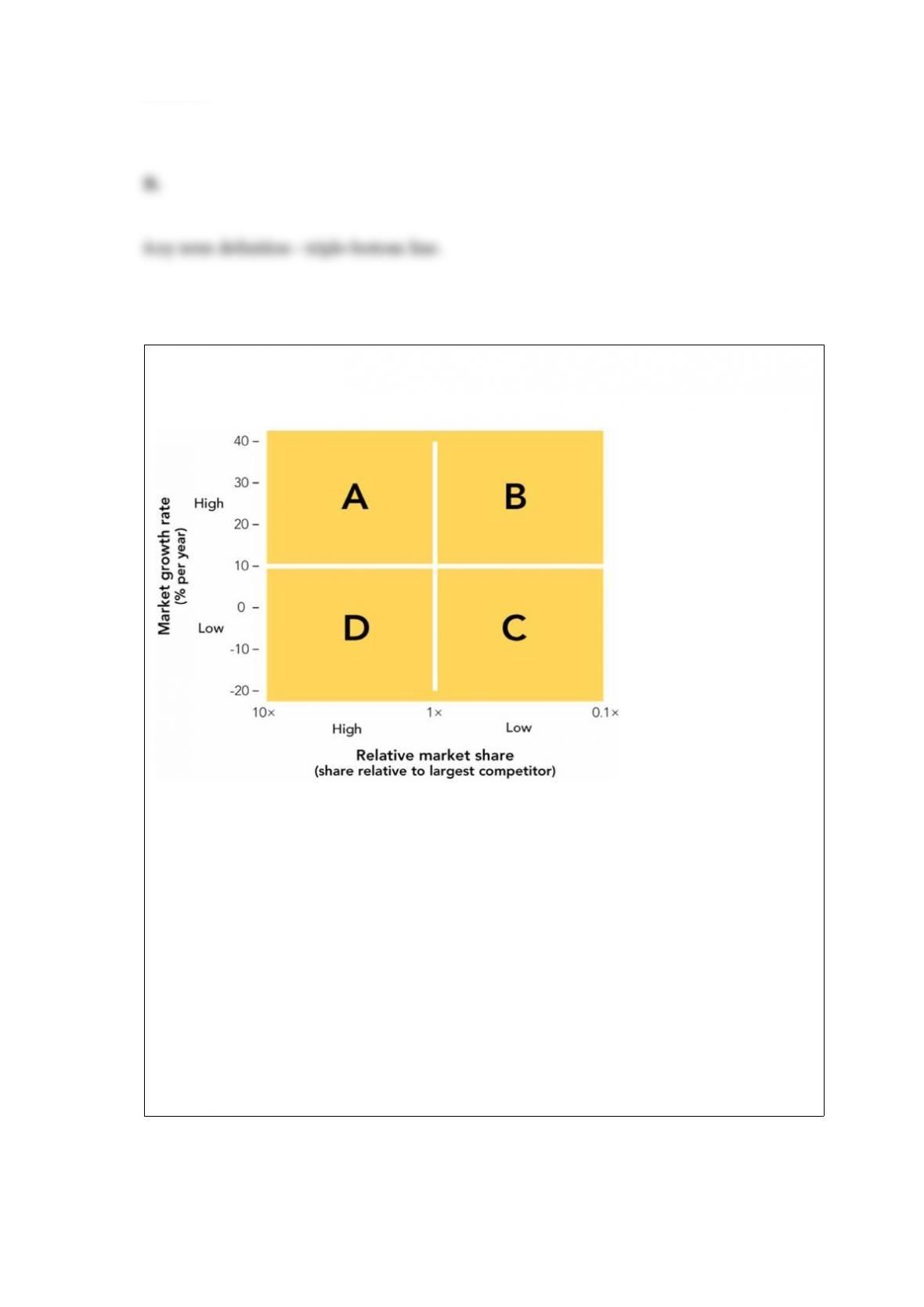
Figure 2-4
In Figure 2-4 shown above, SBUs found in quadrant D would be called __________.
A. cash cows
B. stars
C. question marks
D. dogs
E. hedgehogs
Answer:
Business marketing refers to
A. the marketing of goods to companies, governments, or ultimate consumers for use in
the creation of goods and services.
B. the marketing of products to not-for-profit organizations at a reduced fee or nominal
cost for use in the creation of goods and services that they can produce and market to
others.
C. the marketing of goods and services to companies, governments, or not-for-profit
organizations for use in the creation of products that they can produce and market to
others.
D. the marketing of services in the area of intellectual property such as legal, financial,
or creative consulting.
E. the marketing of an idea to create interest or generate goodwill, not just for an
individual brand but also for an entire industry or product class.
Answer:
A buy class situation affects buying center tendencies in different ways. If there are
many people involved, the problem definition is uncertain, and the time required for a
decision is long, the buy class situation is most likely a
A. standard buy.
B. straight rebuy.
C. conditional rebuy.
D. modified rebuy.
E. new buy.
Answer:
A Tokyo shopkeeper would have been wise to use __________ to verify the accuracy of
the new sign in English he purchased for his dry cleaning business. The sign read,
“Drop your pants here for best results,” which he did not know had another suggestive
meaning to native speakers.
A. cultural symbolism
B. dialect transformation
C. semantic analysis
D. linguistic exchange
E. back translation
Answer:

In marketing experiments, the independent variables of interest, sometimes called the
marketing __________, are often one or more of the marketing mix elements.
A. factors
B. drivers
C. forces
D. actions
E. causalities
Answer:
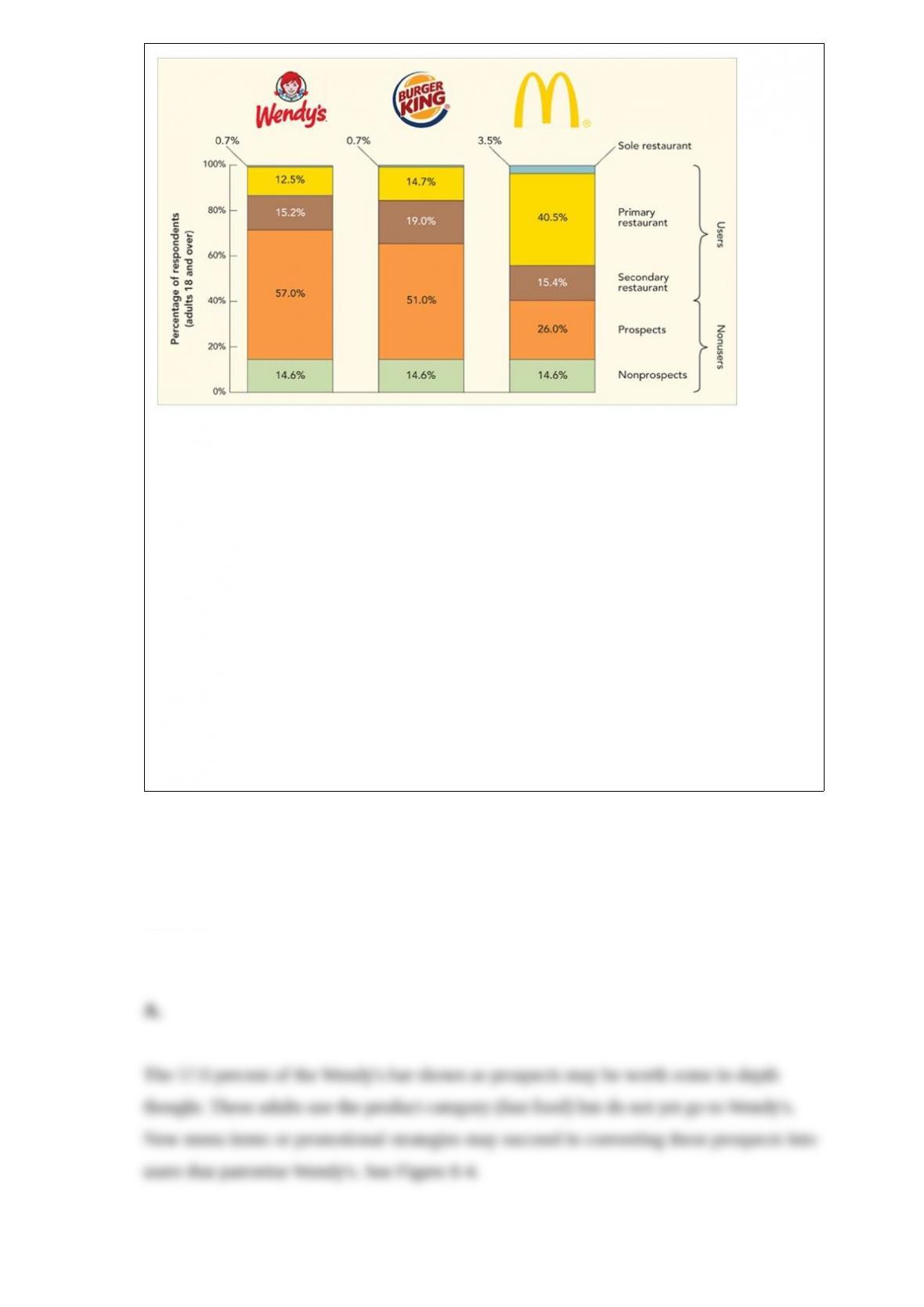
Figure 8-4
To the owner of a Wendy’s fast-food restaurant, the information in Figure 8-4 above
suggests
A. new menu items or promotional strategies may be needed to convert prospects into
users.
B. most of the respondents think of Wendy’s as their primary fast food restaurant.
C. McDonald’s has fewer “exclusively loyal” customers than does Wendy’s.
D. Burger King is closing in on your market share.,
E. a need to devise a marketing program to change the minds of nonprospects.
Answer:
When Callaway Golf opened its online store, it wanted to be sensitive to its retail
channel. It did this by
A. offering its retail partners greater trade allowances.
B. offering its retail partners Callaway stock options.
C. creating a platform with original content that helps consumers, whichever channel
they use.
D. offered incentives for retailers if they encouraged their store customers to shop
online.
E. discounted merchandise in retail outlets but not online.
Answer:
Most stores today are near several others in one of four settings: the central business
district, the regional shopping center, the strip mall, or the __________.
A. rural micromall
B. urban megacenter
C. power center
D. exurb value center
E. suburban downtown
Answer:
At the end of her sales presentation, the salesperson asks, “Do you want to make
monthly payments of $75 with a 10 percent down payment or will you be writing a
check for the full amount today?” She has just made a(n) __________.
A. assumptive close
B. consultative close
C. proactive close
D. urgency close
E. adaptive close
Answer:
Rent, executive salaries, and insurance are typical examples of

A. variable costs.
B. fixed costs.
C. unit costs.
D. marginal costs.
E. total costs.
Answer:
Many nonprofit organizations use PSAs in their media planning. What does the
acronym “PSA” stand for?
A. public stakeholder agreement
B. promotional service amendment
C. public sustainability amendment
D. promotional setting announcement
E. public service announcement
Answer:
From a marketing viewpoint, __________ is the money or other considerations
(including other products and services) exchanged for the ownership or use of a product
or service.
A. value
B. price
C. barter
D. currency
E. a tariff
Answer:
Break-even analysis refers to
A. a process that investigates the difference between marginal revenue and marginal
cost.
B. a method of determining just how much a consumer is willing to pay for a product or
service.

C. a technique that analyzes the relationship between total revenue and total cost to
determine profitability at various levels of output.
D. the process of determining the quantity of product consumers will buy relative to the
quantity produced by the firm.
E. the graph that shows the maximum number of products consumers will buy at a
given price.
Answer:
Direct marketing refers to
A. individualized communications programs specifically designed with a single
customer in mind because the item being sold is unique to that customer.
B. a promotion alternative that uses direct communication with consumers to generate a
response in the form of an order, a request for further information, or a visit to a retail
outlet.
C. communication between a seller and a prospective buyer that can include
face-to-face, telephone, and interactive electronic communication.
D. a sales strategy whereby the exchange takes place at the time of engagement, such as
selling produce at a local farmer’s market.
E. a form of communication management that seeks to influence the feelings, opinions,
or beliefs held by customers, prospective customers, stockholders, suppliers,
employees, and other publics about a company and its products or services.

Answer:
A few years ago, Benetton delivered new styles to its worldwide stores once a month.
Today, it replenishes its racks once a week. Getting the fashions to its retailers more
quickly means that effectively using logistics has increased Benetton’s market share by
providing
A. larger lots of available inventory for its retailers.
B. time and place utility for its customers.
C. increased steps in the value proposition creation process.
D. technological advances leading to greater customer information.
E. increased customer traffic.
Answer:
In 1990, a 30-second ad during the Super Bowl cost $700,000. By 2014, the cost had
soared to $4 million for a 30-second spot. The most likely reason for the escalating cost

is that
A. the number of TV viewers for the Super Bowl since 1990 has grown substantially.
B. the ads are much more elaborate and therefore more expensive to produce.
C. the NFL knows advertisers will pay anything it wants.
D. the ad agencies have dramatically increased their creative and production fees.
E. the companies that create Super Bowl ads do not have to run any other ads all year
long.
Answer:
The North American Industry Classification System (NAICS) permits a firm to
A. find the NAICS codes of its present customers and then obtain NAICS-coded lists
for similar firms.
B. learn the names of the purchasing agents of all prospective customers.
C. sell to any company within North America as long as it is not a monopoly.
D. engage in benchmarking with companies manufacturing and/or marketing similar
products.
E. conduct an industry-wide SWOT analysis to determine internal strengths and
weaknesses and external opportunities and threats of current and prospective
competitors.
Answer:
For high-involvement purchases, consumers typically do all of the following EXCEPT:
A. spend considerable time evaluating criteria for the consideration set.
B. participate in word-of-mouth communication.
C. evaluate a single product attribute, such as price.
D. consider many brands.
E. use both internal and external sources in information search.
Answer:
Which of the following possible characteristics of consumer buying is LEAST likely to
enter into an organizational buying decision?
A. comparison of product performance with expectations
B. purchase decisions based on the highest overall evaluation
C. alternatives evaluated on important criteria
D. information gathered from internal and external searches
E. problem recognition triggered by self-actualization motives
Answer:
Which of the following statements best illustrates geographic segmentation?
A. GE builds a downsized microwave oven to hang under kitchen cabinets.
B. Del Monte offers a line of canned fruit with no added sugar or artificial sweeteners.
C. In China, KFC sells a spicier chicken the farther away its restaurants are from the
coastal areas.
D. A fast food hamburger restaurant is only open for breakfast on weekdays and
Saturdays but not Sundays.
E. A gourmet grocer advertises its services on a small-audience classical music station
even though there is a much larger-audience rock station in the area.
Answer:
Describe Chobani’s distribution (place) strategy.
Answer:
List the four things that research suggests will produce a motivated salesperson.
Answer:
Which generational cohort is also known as the baby bust? Describe the interests and
lifestyles of this cohort and explain why it is important to marketers.
Answer:
Identify the three different approaches used to schedule advertising.
Answer:
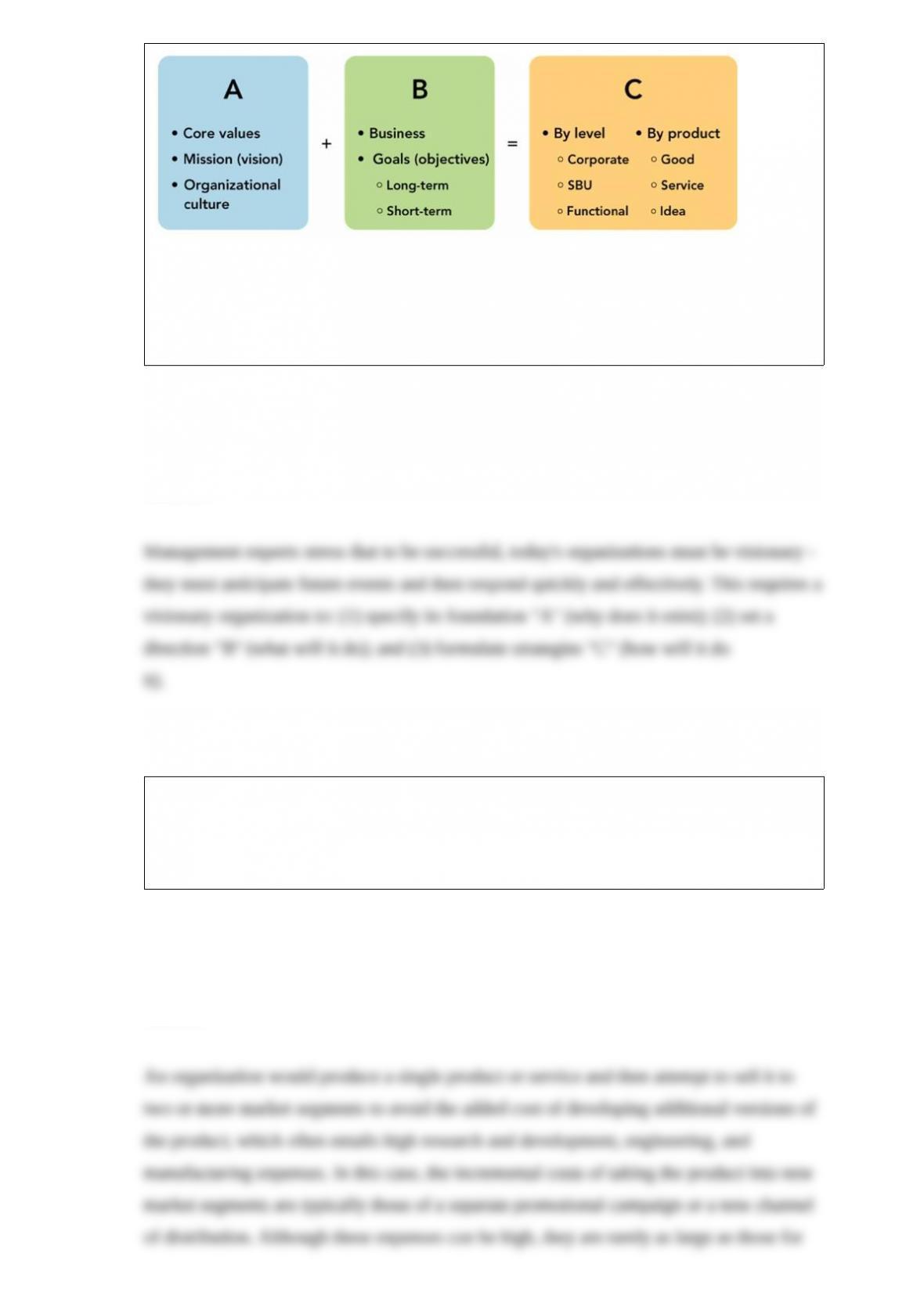
Figure 2-2
According to Figure 2-2 above, what are the three elements that today’s visionary
organization must do to be forward looking and successful within its marketing
environment?
Answer:
Why would an organization produce a single product or service and then attempt to sell
it to two or more market segments?
Answer:
One of the most recognized approaches to business portfolio analysis is the Boston
Consulting Group’s growth-share matrix. Describe this tool and the four quadrants of
the matrix.
Answer:
Discuss the differences between traditional print media and social media with regard to
audience reach, expense and access, training, delivery, permanence, credibility, and
social authority.
Answer:
Explain what an unsought product is and give some examples.
Answer:
Harley-Davidson is well known for the HOG or Harley Owners Group that it has
developed. Harley-Davidson encourages owners to visit its website to find out about
events, races, and membership chapters. The website visitor can play
motorcycle-inspired games, plan motorcycle trips, and even investigate how to finance
a bike. Visitors can view the entire line of bikes as well as find out where the closest
dealer is located. You can contact Harley-Davidson by clicking on the “Contact Us” tab.
The visitor can either create a wish list of Harley products and accessories or view
another’s list. Using the six reasons why consumers shop and buy online, explain how
Harley-Davidson uses the Internet to stay connected with its target market.
Answer:
Explain how attitudes are shaped by our values and beliefs.
Answer:
Define motivation and personality and how they impact marketing.
Answer:
What is the difference between a coupon and a deal?
Answer:
Channels are typically designed to satisfy one or more of four consumer interests. What
are they and why are they important?
Answer:
What is market segmentation and why is it important?
Answer:
What are the strengths/advantages and weaknesses/disadvantages of using direct
marketing in the promotional mix?
Answer:
Compare push and pull strategies as alternative promotional methods for moving a
product through a channel of distribution.
Answer:
Explain the marketing program 3M used to reach the office worker segment with its
Post-it Flag Pen.
Answer: