
Which of the following is a postconsumption reactions theory?
a. Need hierarchy theory
b. Theory X and Theory Y
c. Self-determination theory
d. Equity theory
e. Situational theory
Which of the following types of social power gives an individual authority to sanction
members or revoke membership of those who do not conform to group rules?
a. Referent power
b. Expert power
c. Value-expressive power
d. Persuasive power
e. Legitimate power
_____ rules allow consumers to select products that may perform poorly on one
attribute by compensating for the poor performance by good performance on another

attribute.
a. Conjunctive
b. Disjunctive
c. Compensatory
d. Lexicographic
e. Ordinate
A form of publicity in which an ostensibly objective outsider (neither the customer nor
business) provides publicly available purchase recommendations is known as _____.
a. community marketing
b. comparative advertising
c. a cross-promotion
d. a 3rd party endorsement
e. cooperative marketing

LOUIS VUITTON SCENARIO
Carla purchased a Louis Vuitton Fantaisie handbag for $1,430 when she was in New
York City last weekend. She had always fancied this brand but had never purchased
anything of this brand before. In fact, many of her friends purchased counterfeit Louis
Vuitton handbags, wallets, and scarves. But Carla was very particular about using only
genuine goods. While the counterfeit products looked just as good as the real brand,
they weren”t of the same quality as the legitimate branded products. When she visited
the store to purchase the bag, she was very skeptical about spending so much money for
a handbag, but the sales lady was so kind and explained the benefits of the brand to her
and made her feel very welcome in the store. She explained that consumers could only
purchase true Louis Vuitton products at Louis Vuitton stores or from its website. She
also explained that if she ever encountered a problem with her handbag, she could
return it to the store for repair or a replacement. All things considered, Carla’s
experience at the store and her purchase far exceeded anything she had expected. Her
initial feeling of skepticalness on splurging on a handbag gave way to a feeling of
satisfaction and pride. This feeling was further strengthened when her friend who
bought a counterfeit Louis Vuitton handbag for a few hundred dollars expressed dismay
over her own purchase decision after she saw Carla’s authentic Louis Vuitton bag with a
superior finish.
Refer to Louis Vuitton Scenario. Many of Carla’s friends purchased counterfeit Louis
Vuitton handbags, wallets, and scarves. However, Carla was very particular about using
only genuine goods. This indicates that Carla is most concerned with the _____ of the
product.
a. canonicity
b. periodicity
c. authenticity
d. historicity
e. stability
Which of the following is true about PRIZM?
a. It combines demographic and behavioral information in a manner that enables

marketers to better understand and target their customers.
b. It classifies consumers into eight distinct segments based on resources available to
the consumer as well as three primary motivations.
c. It was developed and marketed by Strategic Business Insights.
d. It is based on the premise that people with similar backgrounds and means
disassociate themselves from each other’s behaviors and lifestyles.
e. It is based on the premise that people with similar backgrounds tend to live away
from one another.
The degree to which consumers feel a sense of belonging to the culture of their ethnic
origins is known as ethnic _____.
a. polarization
b. internalization
c. fractionalization
d. acculturation
e. identification
Marian is a working mother with two sons. On weekdays, Marian is hard pressed for

time and squeezes just enough time to grab some groceries on her way back from work.
This is an example of _____ shopping.
a. acquisitional
b. epistemic
c. experiential
d. impulsive
e. hedonic
The mental path by which some thought becomes active is known as _____.
a. memory trace
b. mental script
c. activation node
d. memory tag
e. mental schema
Risk associated with the safety of the product as well as its consumption is referred to
as _____ risk.

a. financial
b. performance
c. social
d. physical
e. time
PROM NIGHT SCENARIO
Sara had been very excited thinking about her approaching senior prom. She had been
flipping through many fashion journals for “the dress”. She had almost zeroed in on a
gold dress. However, believing it to be too expensive, she did not even bother to check
the price, even though, the advertisement said “affordable elegance”. Finally, she chose
an orange chiffon dress. As she tried the dress on, a sequence of events began to play in
her mindhow Jake, her date, will come to pick her up in a limousine, and will tie a
corsage around her wrist, how her parents will click a picture, and how they will zoom
away to the prom venue and dance the night awayimages that have been playing on her
mind for days now. On the night of the prom, as she was dancing with Jake, she thought
to herself, “Everything is just the way it should be.” She was so happy when she was
dancing the waltz thatthe crowd, the noise, the musiceverything drowned out. When
they finally sat down for dinner, they were served by butlers. These butlers were
efficient, tactful and mannerly, exactly the way Sara and her friends had always
imagined butlers would be like. It was perfect. The night was very special for Sara and
she thought that she will remember it for the rest of her life as one of her happiest
memories. Refer to Prom Night Scenario. The night was very special for Sara and she
thought that she will remember it for the rest of her life as one of her happiest
memories. Sara’s memory of her prom night is an example of a(n) _____ memory.
a. haptic
b. iconic
c. episodic

d. procedural
e. echoic
_____ involves screening out most stimuli and exposing oneself to only a small portion
of stimuli.
a. Selective neutrality
b. Selective exposure
c. Selective filtration
d. Filtered exposure
e. Exposure distortion
Some consumers get very upset when they are served “bad food” in a restaurant. They
lose control and start yelling at the server. Sometimes, they even demand to see the
manager. This lack of emotional control on the part of consumers suggests that such
consumers have low emotional _____.
a. tolerance
b. contagion
c. intelligence

d. expressiveness
e. regulation
Jenny is shy and afraid to speak to other people. She avoids going out with her friends
and colleagues, preferring to read a book on her own rather than interacting with others.
These emotions and behaviors that Jenny exhibits comprise her _____.
a. brand personality
b. personality
c. demographic characteristics
d. self-awareness
e. self-esteem
Rodeo, a popular animal-riding sport in Texas, draws huge crowds every time it is
organized. However, there are others among them who view the sport as encouraging
animal cruelty and hence they stage protests to ban this sport. These people come
together and form groups to further the cause of safeguarding animals. Such groups are
an example of a(n) _____.
a. universal culture

b. macroculture
c. subculture
d. collective culture
e. mainstream culture
FordTech is a software company whose clients are based in France. The company has
formed a team to decide the direction the organization should take over the next five
years. The focus of this team is to increase their clientele in Europe. The company is
keen on taking advantage of the opportunities and avoiding threats in the changing
environment. This team is involved in developing the _____ for the organization.
a. architecture
b. layout
c. schema
d. blueprint
e. strategy
Anne is extremely thrifty with her household expenses. Before buying anything, she
makes sure that she is well-informed about all the best deals. This way Anne ensures
that she gets more value from any purchasing activity. Which of the following types of

consumer involvement is exemplified by Anne?
a. Shopping involvement
b. Momentary involvement
c. Associative involvement
d. Emotional involvement
e. Situational involvement
Refer to the Attitude Scenario. Serena sees an advertisement for Philips Model A which
states that it has the least energy consumption compared to the other models. According
to the elaboration likelihood model (ELM), she is most likely to be influenced by the
_____ route to persuasion.
a. central
b. peripheral
c. secondary
d. sentiment
e. unit

WEEKEND SHOPPING SCENARIO
The Smiths do their groceries every weekend. These are elaborately planned with Mrs.
Smith making a list of requirements for the entire family over the week. She never
forgets to replenish their stock of Caribbean coffee as her husband, a writer, generally
feels groggy and sleepy after lunch in the afternoon. The coffee keeps him awake at
such times. Fruits are a “must-buy” for the family. Everyone including their three
children loves apples. However, Mrs. Smith refrains from buying apples when they are
not in season as they tend to be more expensive. This weekend, she bought a new brand
of pasta that her children insisted on buying as they were tempted by its commercial
that comes on TV everyday at dinnertime. She also bought a packet of cocoa powder
even though it was not on the list. She realized she needed it as she was attending
chocolate-making classes. She has a weakness for milk chocolates and cannot resist the
temptation to buy them. The Smiths don”t have a strict budget for these shopping trips.
More often than not, Mrs. Smith relies on her memory to keep a tab on their
expenditure. What matters most to them is that everyone in the family should get what
they want. Refer to Weekend Shopping Scenario. The Smiths don”t have a strict budget
for these shopping trips. More often than not, Mrs. Smith relies on her memory to keep
a tab on their expenditure. This is an example of _____ budgeting.
a. formal
b. programmed
c. mental
d. performance-based
e. participatory
CHRISTMAS SHOPPING SCENARIO
Many consumers wait until the weekend before Christmas to do their gift shopping, and
Lanny is one of those consumers. She did not want to go to a crowded mall as she only
had a Saturday to do all of her shopping. She saw an advertisement that morning in the
newspaper for a new store that claims to be the “right destination for all kinds of
Christmas shopping.” She decided to go there instead of the mall in order to avoid the

crowd in the mall. While she was in the new store, she was trying to keep a track of her
purchases in her head in an attempt to avoid going overboard and winding up with a
huge credit card bill next month. In just two hours, Lanny was able to purchase all the
gifts she needed and even found a cute bracelet for herself though the bracelet was not a
part of the shopping list that she had made earlier. Refer to Christmas Shopping
Scenario. Lanny bought a cute bracelet for herself, though it was not a part of the
shopping list she had made earlier. This spontaneous purchase is best described as
_____ shopping.
a. epistemic
b. impulsive
c. utilitarian
d. affective
e. adaptive
When Carl migrated to England, he decided to stay in a cottage in Goodwood,
Leicester, even though he had the option of staying in a better place. He opted to stay in
Goodwood as the rent was reasonable and the neighborhood culture suited him well.
Which of the following activities in the decision-making process best represents Carl’s
decision to stay in Goodwood?
a. Need recognition
b. Search for information
c. Evaluation of alternatives
d. Choice
e. Postchoice evaluation

Which of the following best describes semiotics?
a. It refers to the study of symbols and their meanings.
b. It refers to the study of human psychology.
c. It refers to the study of human behavior.
d. It refers to the study of organizational behavior.
e. It refers to the study of cognitive development.
Some consumers tend to be very possessive about their possessions, and may not be
willing to share them with others. Which trait does this best describe?
a. Innovativeness
b. Value consciousness
c. Materialism
d. Frugality
e. Trait vanity

The positivity of an individual’s self-concept is called _____.
a. id
b. body esteem
c. extended self
d. self-congruence
e. self-esteem
The extent to which a consumer shows outward behavioral signs and otherwise reacts
obviously to emotional experiences is called emotional _____.
a. expressiveness
b. flow
c. focus
d. attachment
e. contagion

According to the functional theory of attitudes, the _____ function of consumer
attitudes enables a consumer to protect him- or herself from information that may be
threatening.
a. utilitarian function
b. value-expressive function
c. ego-defensive function
d. hedonic function
e. cognitive function
When Henry’s mother was on the phone, she called out a phone number to him asking
Henry to remember it. He tried to remember the number by repeatedly thinking of it.
This process of remembering something by repeatedly thinking of it is known as _____.
a. tagging
b. retrieval
c. rehearsal
d. dual coding
e. chunking
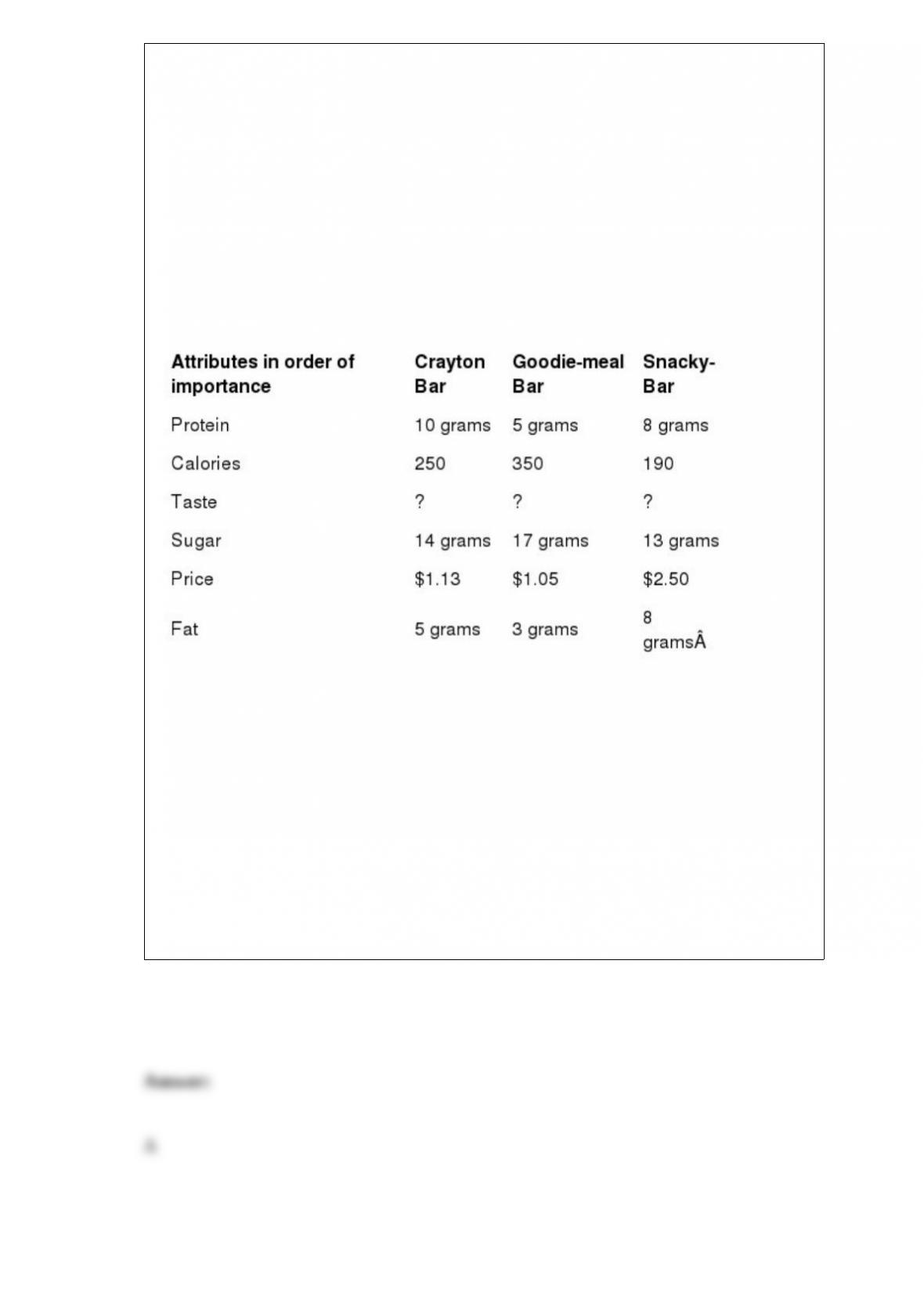
ENERGY BAR SCENARIO
Nutrition labels on products provide considerable information for consumers. For
example, a consumer deciding among the many brands of energy bars might compare
three offerings: Crayton Bar, Goodie-meal Bar, and Snacky-Bar. The most important
attribute for this consumer is protein content, followed by calories, taste, sugar, price
and fat content. This consumer would like an energy bar with high-protein content but
low in calories, sugar, fat, and price, and also one that tastes good. Information for all
the attributes is found on the product nutrition label except for the taste attribute. This
information is summarized in the following table:
Refer to Energy Bar Scenario. According to product categorization, energy bars are an
example of _____ categories.
a. subordinate
b. primary
c. ordinate
d. tertiary
e. secondary

When Carl arrived in England, he compared four different options for accommodation,
keeping in mind the budget as well as the neighborhood culture that would suit him.
Which of the following activities in the decision-making process best represents Carl’s
comparison?
a. Need recognition
b. Search for information
c. Evaluation of alternatives
d. Choice
e. Postchoice evaluation
Sam recently bought a new cologne just because his favorite football star had endorsed
it. In doing so, which of the following traits did Sam display?
a. High innovativeness
b. High frugality
c. Low need for cognition
d. High materialism
e. Low competitiveness

Businesses dealing with planned retirement communities have become profitable as the
Baby Boomer population becomes older. Identify the trend affecting consumer behavior
in this scenario.
a. Declining birthrates
b. Declining consumer affluence
c. Increasing life expectancy and the aging consumer
d. Increasing population
e. Increasing cultural diversity
MNC SCENARIO
Mr. Adam Smith works as a senior executive for Corebiz Corp., a multinational
company with subsidiaries in many Asian countries. The firm believes in a marketing
strategy that strongly resonates the essence of the local culture in its implementation.
The company relocates Mr. Smith to Beijing to handle their operations in China. A few
months into his stay, Mr. Smith begins to learn the ways of life and appropriate
behavior in China. When Mr. Smith was invited for tea by his colleagues, he observed
people around him and learned the right way to tap his finger and fold a napkin. He also
learned that the Chinese revere their elders and treat them with respect. Even when
there is no kinship involved, an older person should never be addressed with his/her
name. Any show of disrespect, especially “name calling,” is shunned upon by society;
and the person found doing so, risks being ridiculed by everyone. Though these
learnings can sometimes be inconvenient for Mr. Smith owing to the vast cultural
difference between the United States and China, Mr. Smith thinks that it is worth all the
trouble. Refer to MNC Scenario. A few months into his stay, Mr. Smith begins to learn
the ways of life and appropriate behavior in China. This learning is referred to as
_____.
a. acculturation
b. enculturation
c. adaptation

d. acclimatization
e. externalization
Consumer behavior is the set of value-seeking activities that take place as people go
about addressing realized needs.
Positive mood states lead to positive evaluations of products while negative mood states
lead to negative evaluations of products.
A consumer’s desire to be a member of an aspirational group is motivated by the need to
assert the consumer’s actual self.
Advertising themes in a collectivist culture tend to emphasize separate themes.
Going to a new, trendy restaurant is most likely driven by hedonic motivations.
Competitive intensity refers to the number of firms competing for business within a
specific category.
Moral equity represents beliefs regarding an act’s fairness or justness.
Belgium is categorized as a BRIC nation.
Explain how motivation drives human behavior and describe the two key groups of
behaviors around which human motivations are oriented.
Consumers have unlimited ability to process all the information that’s available in the
environment.
The term subculture is often used to capture much the same idea as microculture.
Attitude auditing refers to the extent to which a company actively monitors its
customers’ attitudes over time.
Hal is a computer enthusiast and knows a lot about desktops and laptops. He even fixes
hardware and software problems for his friends. It can be said that Hal exhibits
situational involvement with computers.
The confirmatory bias works in conjunction with the self-perception theory.
Emotional involvement drives one to consume generally through relatively strong
utilitarian motivations.
Public criticism of marketing strategies tends to be most intense when a marketer
targets vulnerable consumer groups with harmful products.
Ideal points on a perceptual map represent each marketer’s product offering.
In classical conditioning, behavior is conditioned through reinforcement.