To lower costs and reduce manufacturing time, Michelin has people work together on
important purchases. These people include individuals in the roles of buyers, deciders,
gatekeepers, and others, as needed. This type of cross-functional group is known as a(n)
a. purchasing committee.
b. sustainable procurement panel.
c. buying center.
d. supply partnership.
e. purchasing task force.
Answer:
Office Max provides low product prices for office supplies. In terms of Porter’s generic
business strategy, Office Max uses a __________ strategy.
a. differentiation focus
b. cost focus
c. differentiation
d. revenue leadership
e. profit enhancement
Answer:
Competition refers to
a. identical products that perform identical functions.
b. any for profit organization that targets the customers of other organizations.
c. alternative firms that could provide a product to satisfy a specific market’s needs.
d. any product or service that vies for a portion of a customer’s discretionary income.
e. the set of firms that operate in a given geographic region, regardless of product or
service.
Answer:

Marketing Research Method Photo C
Consider the Marketing Research Method Photo C above. What type of marketing
research method is MOST LIKELY being represented with observers behind a
one-way mirror watching a discussion among people about topics of interest to
marketers?
a. individual interview
b. questionnaire data
c. social network
d. information panel
e. focus group
Answer:
The Greenpeace campaign against Nestl using social media was effective because
a. Greenpeace quickly agreed that Nestl appeared to be acting in a socially responsible
manner with a commitment to global sustainability.
b. by using social media instead of traditional media, Greenpeace was saving trees.
c. Greenpeace effectively used a variety of media, both traditional and social, for its
‘shock campaign.”
d. the attention Greenpeace garnered helped to promote the sales of Nestl’s Kit Kat
candy bars.
e. Nestl immediately apologized and pledged to end its use of nonsustainable palm oil.
Answer:
Predatory pricing refers to
a. the practice of charging a very low price for a product with the intent of driving
competitors out of business.
b. a conspiracy among firms to set prices for a product.

c. using price differentials when charging different prices on the basis of race, religion,
or ethnic affiliation.
d. using price differentials when charging the original price for refurbished goods that
have been damaged or used and returned but repaired according to company
specifications.
e. controlling agreements between independent buyers and sellers whereby sellers are
required to not sell products below a minimum retail price.
Answer:
When the Lorillard Tobacco Company places ads discouraging teenagers from
smoking, the firm is using which type of advertising?
a. pioneering
b. competitive
c. reminder
d. comparative
e. advocacy
Answer:
List and describe the three types of pretests that can be conducted before advertising is
placed in the media.
Answer:
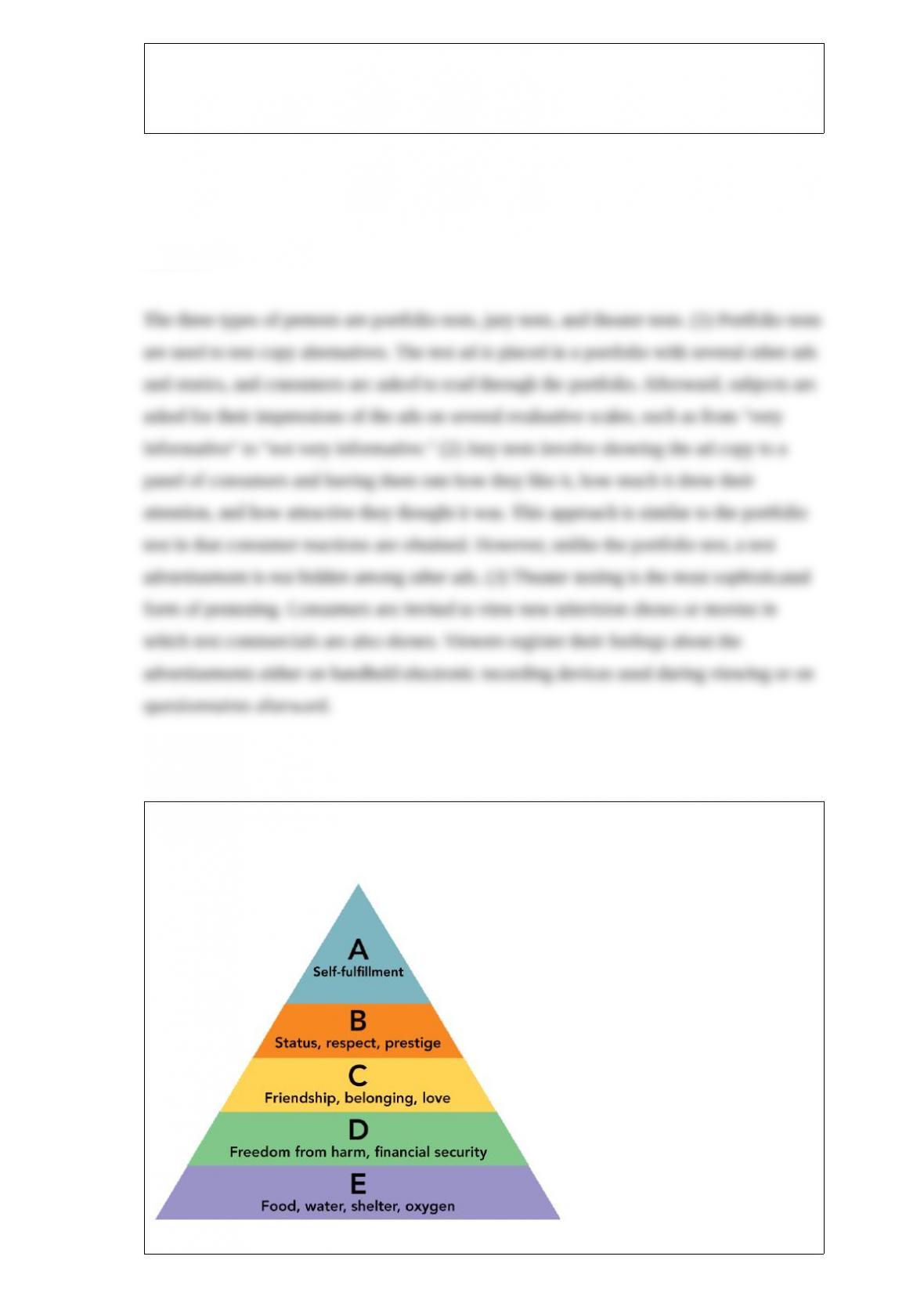
Figure 1.

According to Figure 1. above, the need for status, respect, and prestige would be found
in what level of the hierarchy of needs?
a. “A”
b. “B”
c. “C”
d. “D”
e. “E”
Answer:
In keeping with its business mission, Ben & Jerry’s
a. created a children’s TV program with cat and mouse cartoon characters “Ben” and
“Jerry” to teach about the importance of good nutrition and Fair Trade sustainable
business practices.
b. offered to buy out any failing family-owned ice cream parlor and turn it into a
ScoopShop franchise.
c. invested in research to create genetically engineered cows that will produce more
hypoallergenic milk.
d. committed to buying its milk and cream from one dairy cooperative whose members
guarantee the supplies are bovine growth hormone free.
e. donated free ice cream coupons to all children who get good grades in school.
Answer:
Amazon.com, a successful online retailer, manages an extensive database that includes
customers’ names and their tastes in books, among other products. This information is
used to determine which products are suggested to each customer. This is an example of
how Amazon.com uses
a. advertising.
b. sales promotion.
c. direct marketing.
d. publicity.
e. personal selling.
Answer:
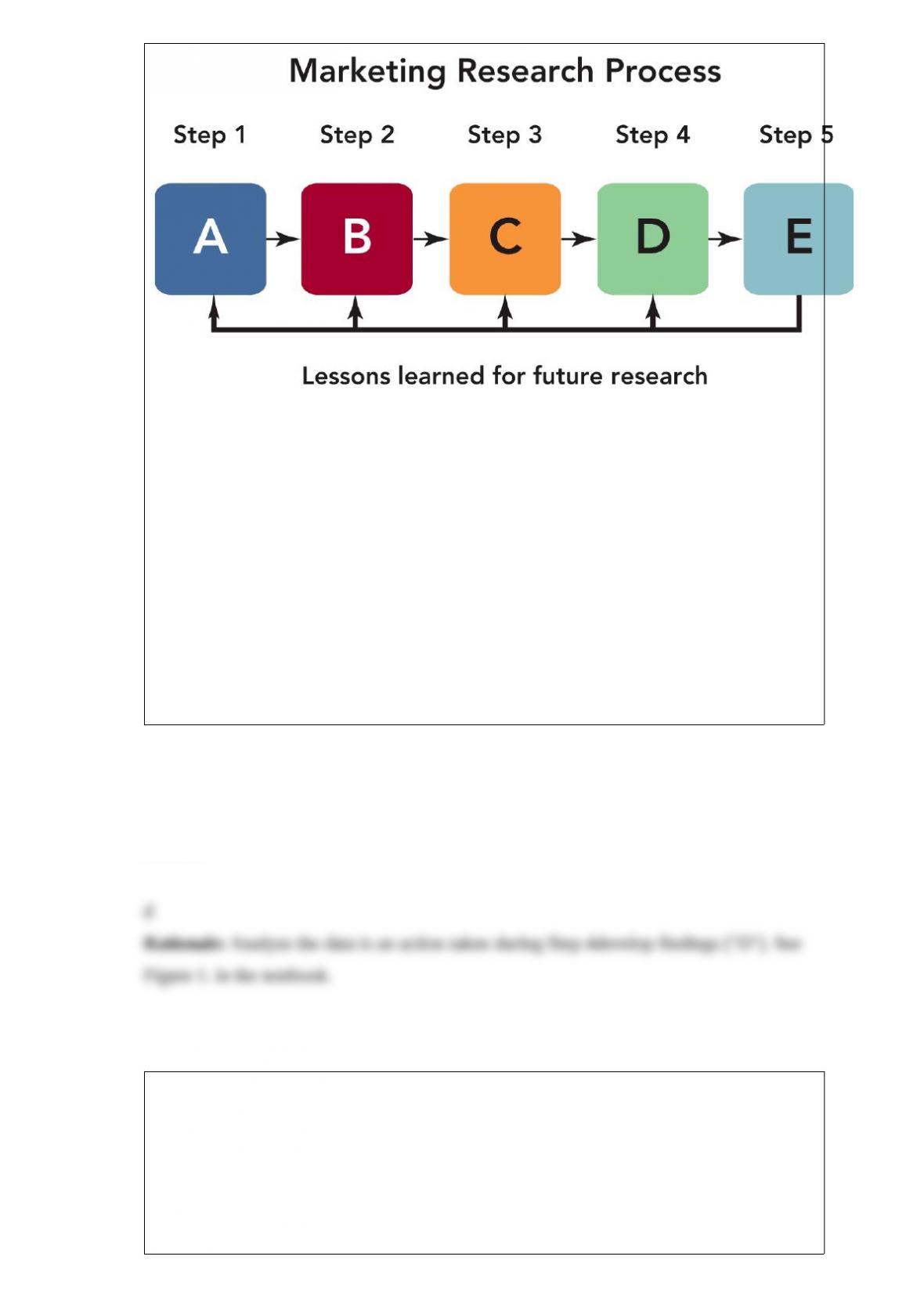
Figure 1.
According to Figure 1. above, “analyze the data” occurs during which step of the
five-step marketing research approach?
a. “A”
b. “B”
c. “C”
d. “D”
e. “E”
Answer:
Which of the following organizational buyers purchases raw materials and parts to
reprocess into the finished goods they sell?
a. retailers
b. wholesalers
c. manufacturers’ agents
d. manufacturers
e. ultimate consumers
Answer:
Interactive ads that have drop-down menus, built-in games, or search engines to engage
viewers are referred to as __________.
a. rich media
b. banner ads
c. interactive media
d. pay-per-click ads
e. infotainment ads
Answer:
A notable trend of the U.S. population is the changing racial and ethnic composition.
__________, who may be from any race, currently make up 16 percent of the U.S.
population.
a. Hispanics
b. African Americans
c. Asian Americans
d. Caucasians
e. American Indian and other native populations
Answer:
On a recent shopping excursion at a local Target store, Jim Krause went from aisle to
aisle selecting the products he needed. He bought a variety of products, including
shampoo, toothpaste, a green plant for his office, and several pair of socks.
Interestingly, the only salesperson Krause encountered was the person at the checkout
counter. The checkout person at Target is an example of a(n) __________.
a. inside order getter
b. outside order getter
c. temporary order getter
d. inside order taker
e. outside order taker
Answer:
Both market share and profit achieve their greatest growth rates during which stage of
the retail life cycle?
a. decline
b. maturity
c. introduction
d. early growth
e. accelerated development
Answer:
A contractual vertical marketing system refers to an arrangement whereby
a. privately owned distributors and retailers integrate their efforts, on a contractual
basis, to obtain greater functional economies and marketing impact than they could
achieve alone.
b. independent production and distribution firms integrate their efforts, on a contractual
basis, to obtain greater functional economies and marketing impact than they could
achieve alone.
c. a manufacturer offers a limited number of franchise licenses to restrict the number of
franchisees within a given geographical region.
d. a firm reaches different buyers by employing two or more different types of channels
for the same basic product.
e. a firm formally designates by contract one channel memberwhether producer,
wholesaler, or retailerto coordinate, direct, and support all other channel members.
Answer:
The actions taken during market product focus and goal setting, Step 2 of the planning
phase, include: (1) set market and product goals, (2) select target markets, (3)
__________, and (4) position the product.
a. find points of difference
b. identify industry trends
c. research customers
d. develop the program’s marketing mix
e. develop the budget by estimating revenues, expenses, and profits
Answer:
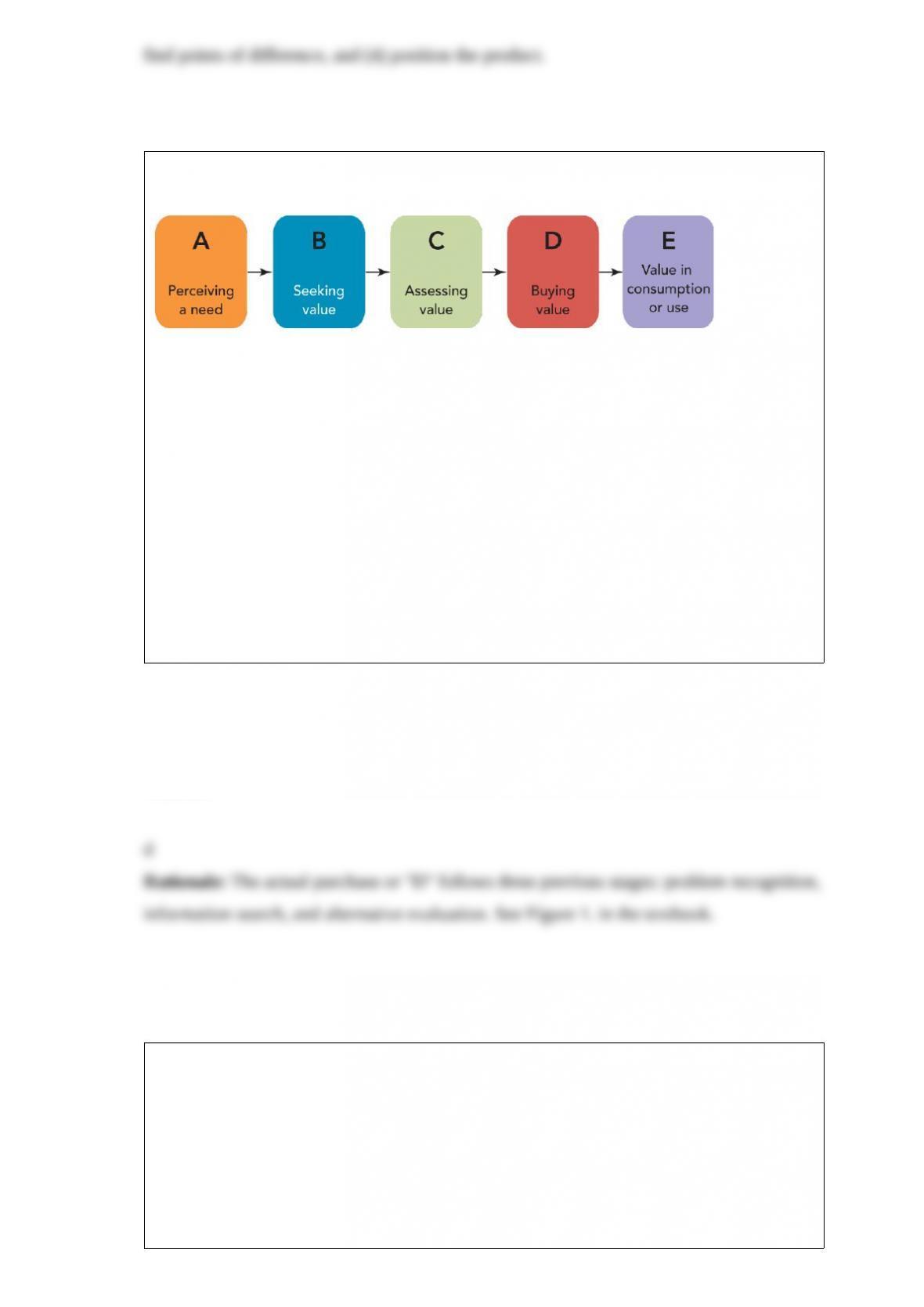
Figure 1.
According to Figure 1. above, the point at which you would exchange money for your
sandwich of corned beef on rye would be found in stage __________.
a. “A”
b. “B”
c. “C”
d. “D”
e. “E”
Answer:
Selective exposure is most likely to occur during which stage of the consumer purchase
decision process?
a. information search
b. purchase decision
c. alternative evaluation
d. postpurchase behavior
e. problem recognition
Answer:
With respect to price and availability, shopping products are likely to be
a. relatively inexpensive and widely available.
b. relatively inexpensive but very limited availability.
c. very expensive and available at a large number of selective outlets.
d. very expensive with very limited availability.
e. fairly expensive and available at a large number of selective outlets.
Answer:

The process of managing the entire customer experience with the company is referred
to as
a. services marketing.
b. internal marketing.
c. customer experience management.
d. relationship marketing.
e. gap analysis.
Answer:
Pricing objectives refer to
a. reconciling the prices charged by an organization to the values set forth in its
business mission.
b. taking specific steps to capitalize on an organization’s internal strengths as they apply
to price.
c. specifying the role of price in an organization’s marketing and strategic plans.
d. taking specific steps to compensate for an organization’s weaknesses as they apply to
price.
e. subjectively setting intrinsic values to all products and services offered by an
organization.
Answer:
The three basic types of contractual systems are:
a. retailer-sponsored cooperatives, wholesaler-sponsored voluntary chains, and
franchises.
b. dual ownership agreements, industry consortiums, and non-binding cooperatives.
c. wholesaler-sponsored voluntary chains, non-binding cooperatives, and franchises.
d. dual ownership agreements, industry consortiums, and multi-national cartels.
e. non-binding, binding, and in perpetuity.
Answer:
The __________ element of the marketing mix includes channels and coverage.
a. product
b. price
c. promotion
d. place
e. people
Answer:
Business practices or conditions that make it difficult for new firms to enter the market
are referred to as __________.
a. market obstructions
b. barriers to entry
c. switching costs
d. import-export firewalls
e. preemptive practices
Answer:
Microsoft, Sony, and Nintendo are the three principal firms in the video game console
market. Using Figure 1., how much price competition is most likely for video game
makers?
a. There is almost none; the market sets the price.
b. There is some competition within a range of prices.
c. There is generally a price leader that sets the price.
d. Each firm is aware of each other’s prices and may adjust them based on the prices of
the other two firms.
e. Price is set by the seller but regulated by the government.
Answer:
Word-of-mouth behavior in marketspace is referred to as __________.
a. tweets
b. buzz
c. instant messaging
d. blogging
e. viral marketing
Answer:
Mary was offended by the brand name of a new product for women. She believes the
name of the product is demeaning and that it must reflect a negative attitude of the

manufacturer towards women in general. Although this may simply be the result of
__________, if other women interpret the name choice the same way, there is a strong
likelihood this product could fail.
a. selective retention
b. selective comprehension
c. selective exposure
d. selective analysis
e. stimulus discrimination
Answer:
Sandy needs to have her car repaired. She is a member of the American Automobile
Association (AAA) and knows that they evaluate car repair shops. Furthermore, the
shop she is considering displays the AAA seal of approval. It also is clean and
organized. She believes this is a good way to predict the quality of the service she will
receive. Sandy bases her opinion of car repair shops on the basis of which service
quality dimension?
a. assurance
b. tangibility (tangibles)
c. reliability
d. responsiveness
e. empathy

Answer:
The top reasons cross-channel shoppers research items online before buying in stores
include: (1) the desire to compare products among different retailers; (2) the need for
more information than is available in stores; and (3) the ease of _________.
a. reducing geographical barriers
b. finding products that are restricted in their area
c. finding products that are more customized to their needs
d. finding products that are out of season
e. comparing their options without having to trek to multiple retail locations
Answer: