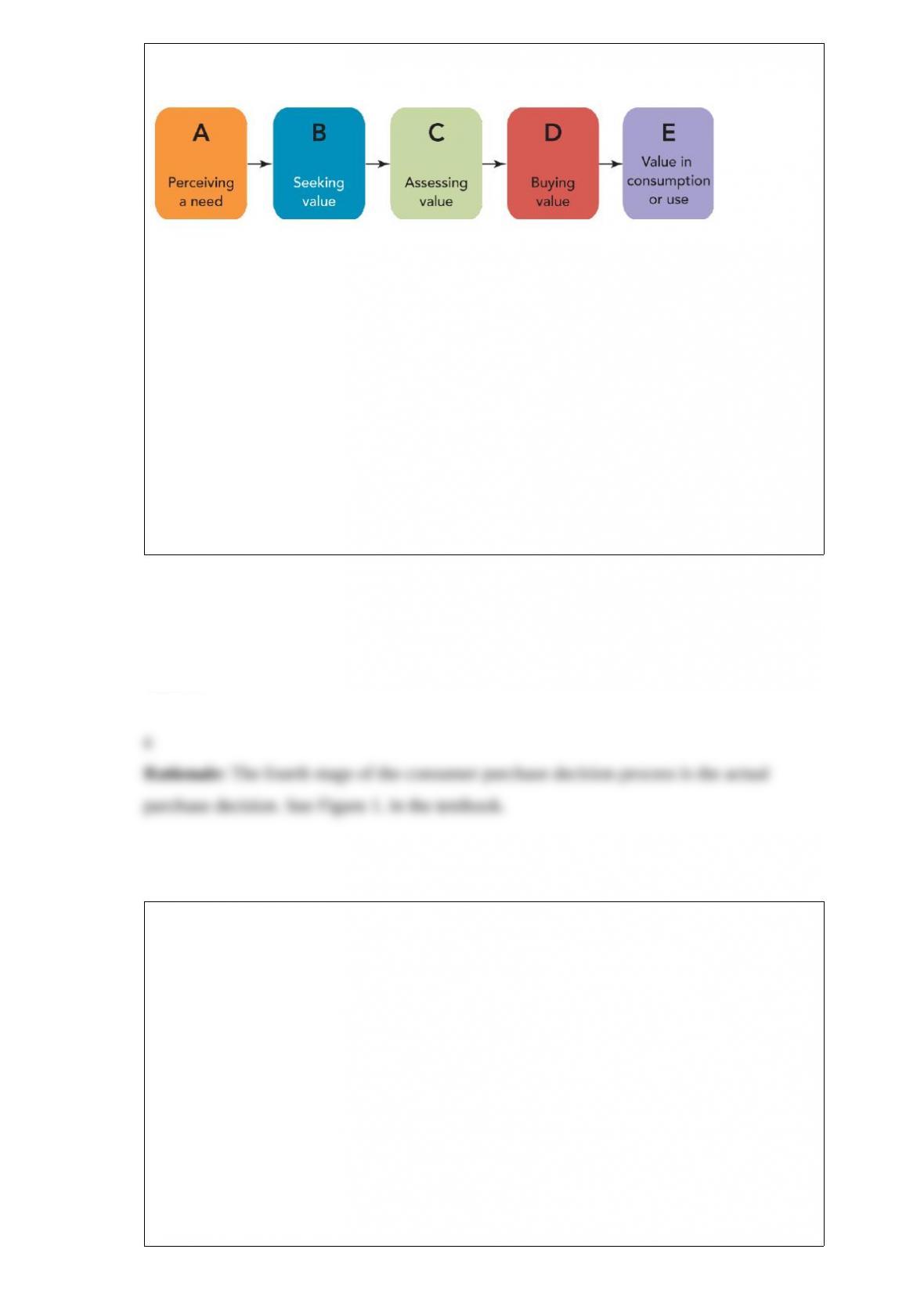
Figure 1.
In Figure 1. above, “D” represents which stage of the consumer purchase decision
process?
a. purchase decision
b. information search
c. problem recognition
d. alternative evaluation
e. postpurchase behavior
Answer:
Recall the famous experiment when Dr. Pavlov presented salivating dogs with food at
the same time he rang a bell. Eventually, when Pavlov only rang the bell, the dogs
would still salivate even though food was not presented. What consumer behavior
principle was involved in this research?
a. cognitive learning
b. the scientific method
c. behavioral learning
d. attitude formation
e. cognitive dissonance
Answer:
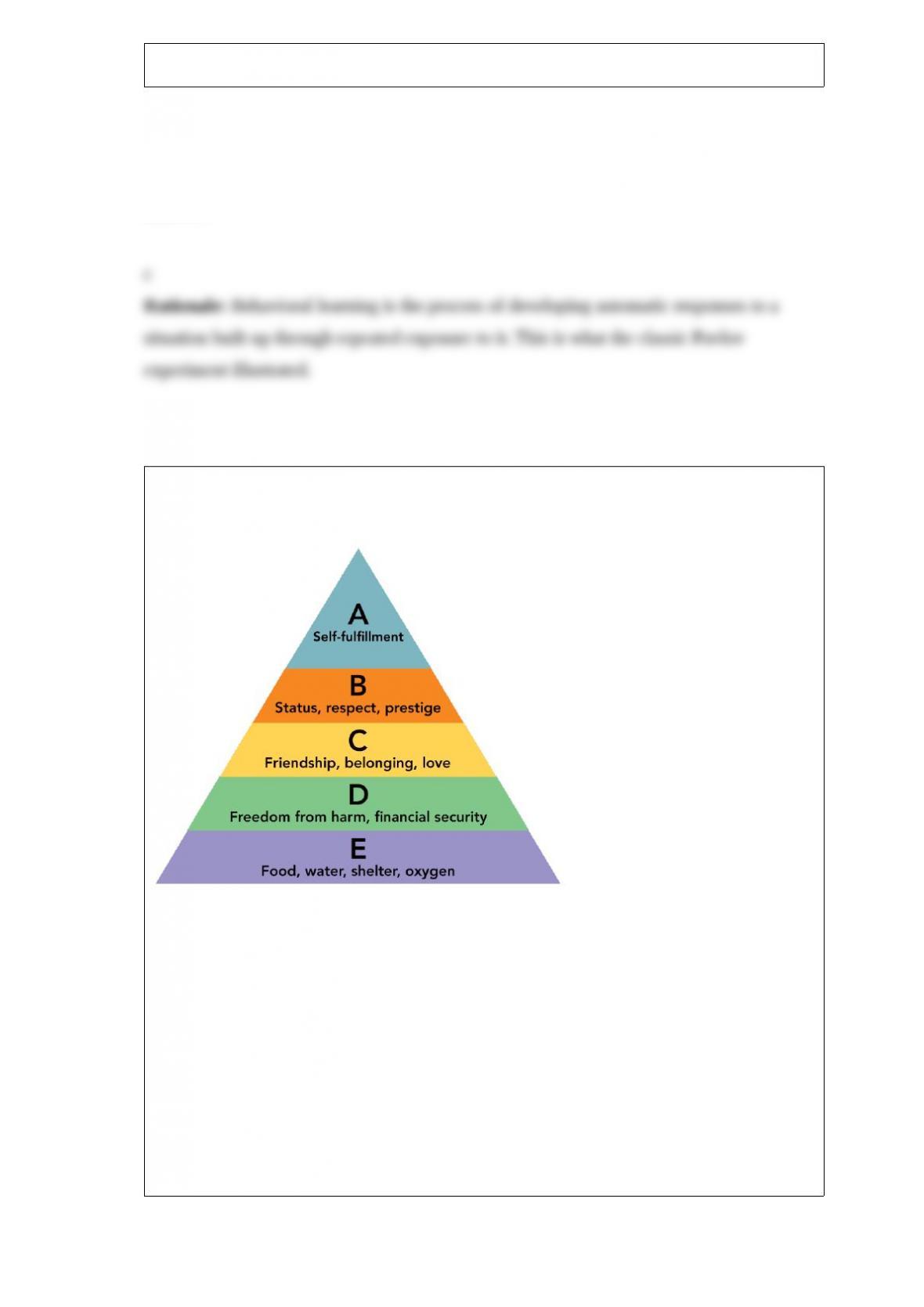
Figure 1.
According to Figure 1. above, “B” defines what level in the hierarchy of needs?
a. self-actualization
b. personal
c. social
d. safety
e. physiological
Answer:
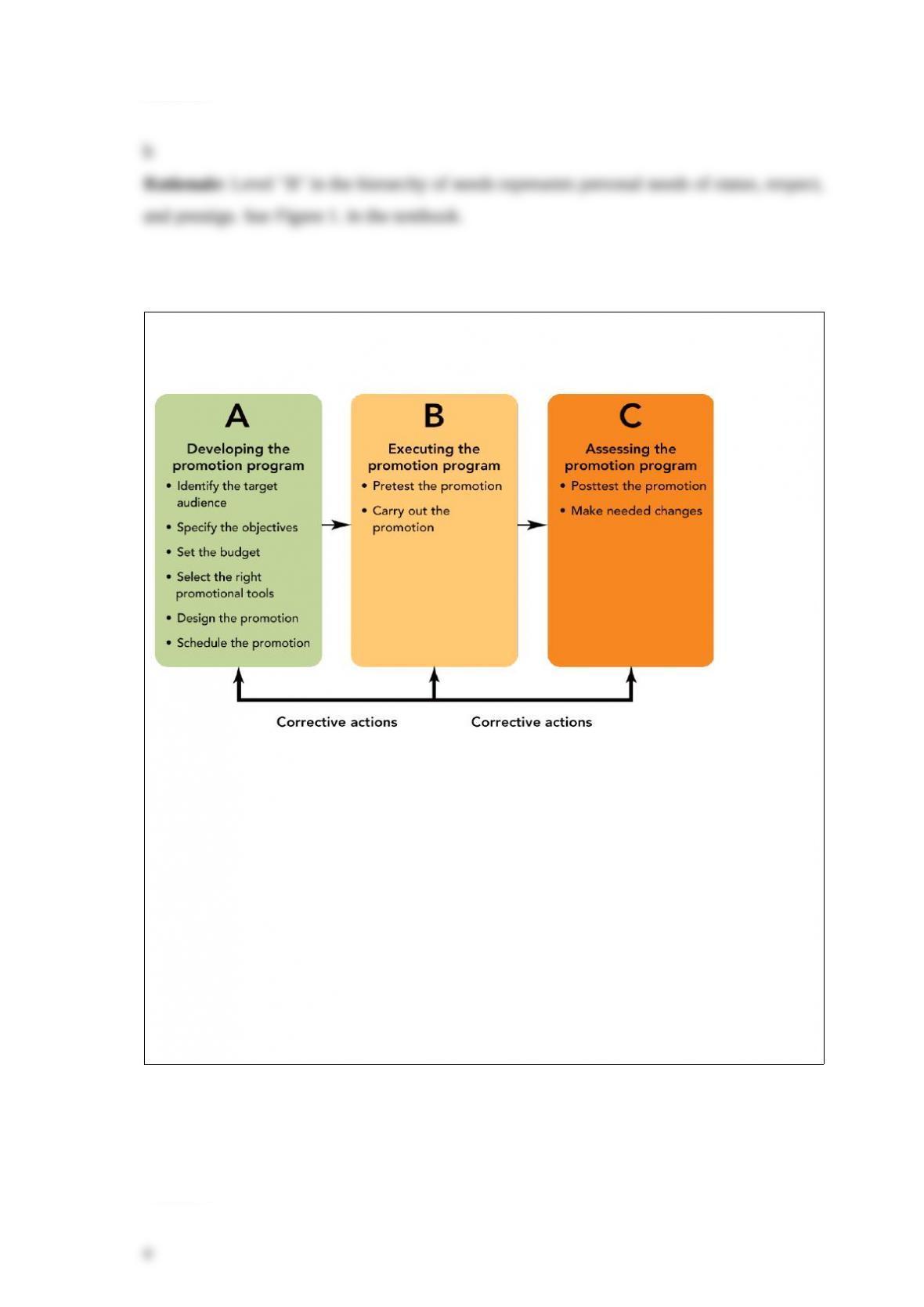
Figure 1.
The promotion decision process is divided into three phases. In Figure 1. above, “A”
refers to the _________ phase.
a. planning
b. forecasting
c. evaluation
d. realization
e. implementation
Answer:
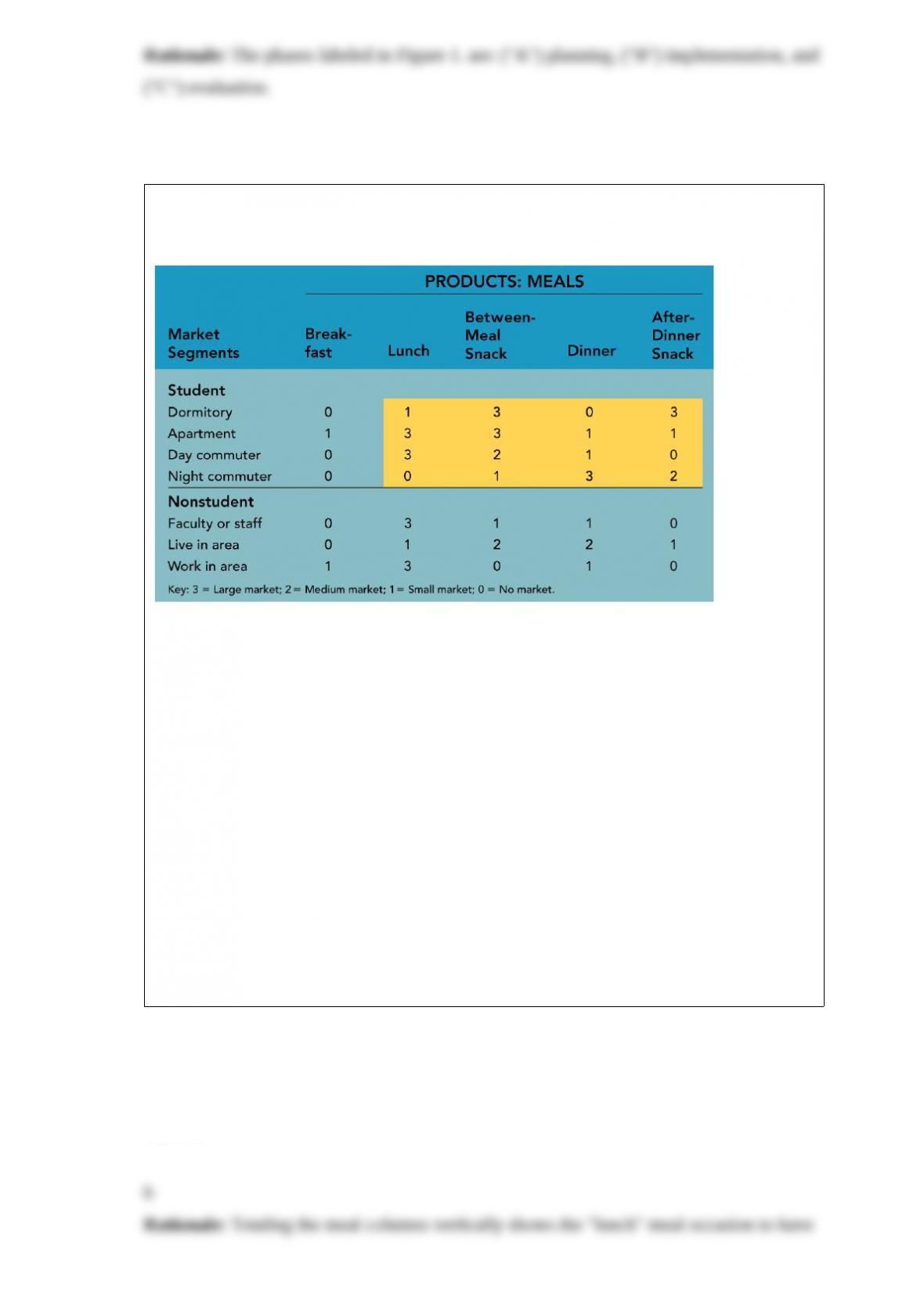
Figure 1.
Figure 1. above shows the market-product grid for a Wendy’s restaurant next to a large
urban university campus. Assume a large market (shown by a “3”) is three times the
size of a small market (shown by a “1”). Similarly, assume a medium market (shown by
a “2”) is twice the size of a small market. The meal occasion (product grouping) that
comprises the largest market is
a. breakfast.
b. lunch.
c. between-meal snack.
d. dinner.
e. after-dinner snack.
Answer:
If you followed the suggestions of Robert M. McMath, which of the following provides
the best advice for a marketer, such as Colgate, when launching a new consumer
product, such as toothpaste?
a. Anticipate the future five years out in terms of product form, ingredients, and
packagingto invent the “toothpaste of tomorrow!”
b. Give the product a mysterious name that is unrelated the product’s benefits but
provokes consumer curiosity.
c. Initiate a Facebook campaign against beverages sweetened with high fructose corn
syrup, which can contribute to tooth decay.
d. Create unusual packaging that has special shelving requirements.
e. Study past toothpaste product failures and learn from them.
Answer:
Which of the following is NOT part of the physical surroundings of a retail store that
can influence how purchase decisions are made?
a. decor
b. crowding
c. lighting
d. music
e. time of day
Answer:
Consumerism refers to
a. a movement of conspicuous consumption that began when the World War II ended.
b. conducting business in a way that protects the natural environment while making
economic progress.
c. a collaborative effort between buyers and sellers to create an exchange where each
benefit.
d. the recognition of the need for organizations to improve the state of people, the
planet, and profit simultaneously if they are to achieve sustainable, long-term growth.
e. the grassroots movement started in the 1960s to increase the influence, power, and
rights of consumers in dealing with institutions.
Answer:
Value analysis is a systematic appraisal of the design, quality, and performance of a
product in order to
a. maintain quality assurance.
b. offer the lowest possible price.
c. increase the price of the offering.
d. reduce purchasing costs.
e. ensure customer satisfaction.
Answer:
Green marketing refers to
a. the purchasing of products from producers whose farming practices are Fair Trade
certified.
b. the marketing efforts taken by new and smaller companies that lack both the
experience and resources of their major competitors.
c. the marketing efforts to produce, promote, and reclaim environmentally sensitive
products.
d. the marketing of products that have in no way been altered or reprocessed by
artificial means.
e. the marketing of those products made exclusively from recycled materials.
Answer:
A marketing channel relies on __________ to make products available to consumers
and industrial users.
a. logistics
b. strategic distribution
c. strategic marketing planning
d. supply chains
e. value chain optimization
Answer:
Introducing new-products sequentially into geographic areas of the U.S. to allow
production levels and marketing activities to build up gradually to minimize the risk of
new-product failure is referred to as
a. limited rollouts.
b. phased rollouts.
c. market-product expansion.
d. regional rollouts.
e. phased commercialization.
Answer:
Which of the following is an inherent weakness of advertising?
a. extremely high expense per exposure
b. difficult to get media cooperation
c. high absolute costs
d. easily duplicated
e. can easily lead to promotion wars
Answer:
A book on how to invest in collectibles spends several weeks on The New York Times
bestseller list. The paperback book was originally released for $9.99. A reduction of the
price to $9.79 had no effect on total revenue, which remained the same. This is due to
the book having
a. inelastic demand.
b. elastic demand.
c. null elasticity.
d. unitary demand.
e. subsidized elasticity.
Answer:
When a man picks up a teddy bear in a toy store and tells the clerk, “This is for my
son’s first birthday,” which situational influence is being demonstrated?
a. purchase task
b. social surroundings
c. physical surroundings
d. temporal effects
e. antecedent states
Answer:
All of the following comprise the seven (7) Ps of services marketing EXCEPT:
a. product.
b. process.
c. profitability.
d. people.
e. physical environment.
Answer:
The buildings, landscaping, vehicles, furnishings, signage, brochures, and equipment
comprise which of the seven Ps of services marketing?
a. process
b. place
c. physical environment
d. productivity
e. product
Answer:
Which of the following is considered one of the major factors that influences ethical
behavior?
a. organizational structures
b. societal culture and norms
c. national and local legislation
d. the U.S. Supreme Court
e. a nation’s moral philosophy
Answer:
In the communication process, printing mistakes that affect the meaning of a newspaper
advertisement, or using words or pictures that fail to communicate the message clearly,
are referred to as
a. noise.
b. clutter.
c. feedback.
d. distortions.
e. annoyances.
Answer:
Which of the following statements is most accurate?
a. Racial and ethnic groups are equally dispersed throughout the United States.
b. Racial and ethnic groups do not respond to multicultural marketing programs since
they are similar to Caucasians in terms of their attitudes and behaviors.
c. Organizations that target racial and ethnic groups tend to separate their multicultural
marketing efforts from their regional marketing activities.
d. Racial and ethnic groups tend to be concentrated in geographic regions in the United
States.
e. Due to the “melting pot” effect, racial and ethnic groups in the United States tend to
have very similar attitudes, communication preferences, and lifestyles because they
have been effectively assimilated within the population.
Answer:
A retailer refers to
a. an intermediary who sells only to other intermediaries.
b. any intermediary between a manufacturer and industrial markets.
c. an intermediary who sells to other distributors.
d. an intermediary who takes possession of a product, alters it in some way, and then
sells it to the ultimate consumer.
e. an intermediary who sells to consumers.
Answer:
One of Porter’s four generic business strategies requires that products have significant
points of difference to target one or only a few market segments is referred to as a
__________ strategy.
a. cost focus
b. differentiation
c. cost leadership
d. profit enhancement
e. differentiation focus
Answer:
Much of Google’s success is based on the ten guidelines of its corporate philosophy.
Guideline 6 states, “You can make money without __________.”
a. an MBA
b. doing evil
c. compromising ethics
d. cheating the other guy
e. working 24/7
Answer:
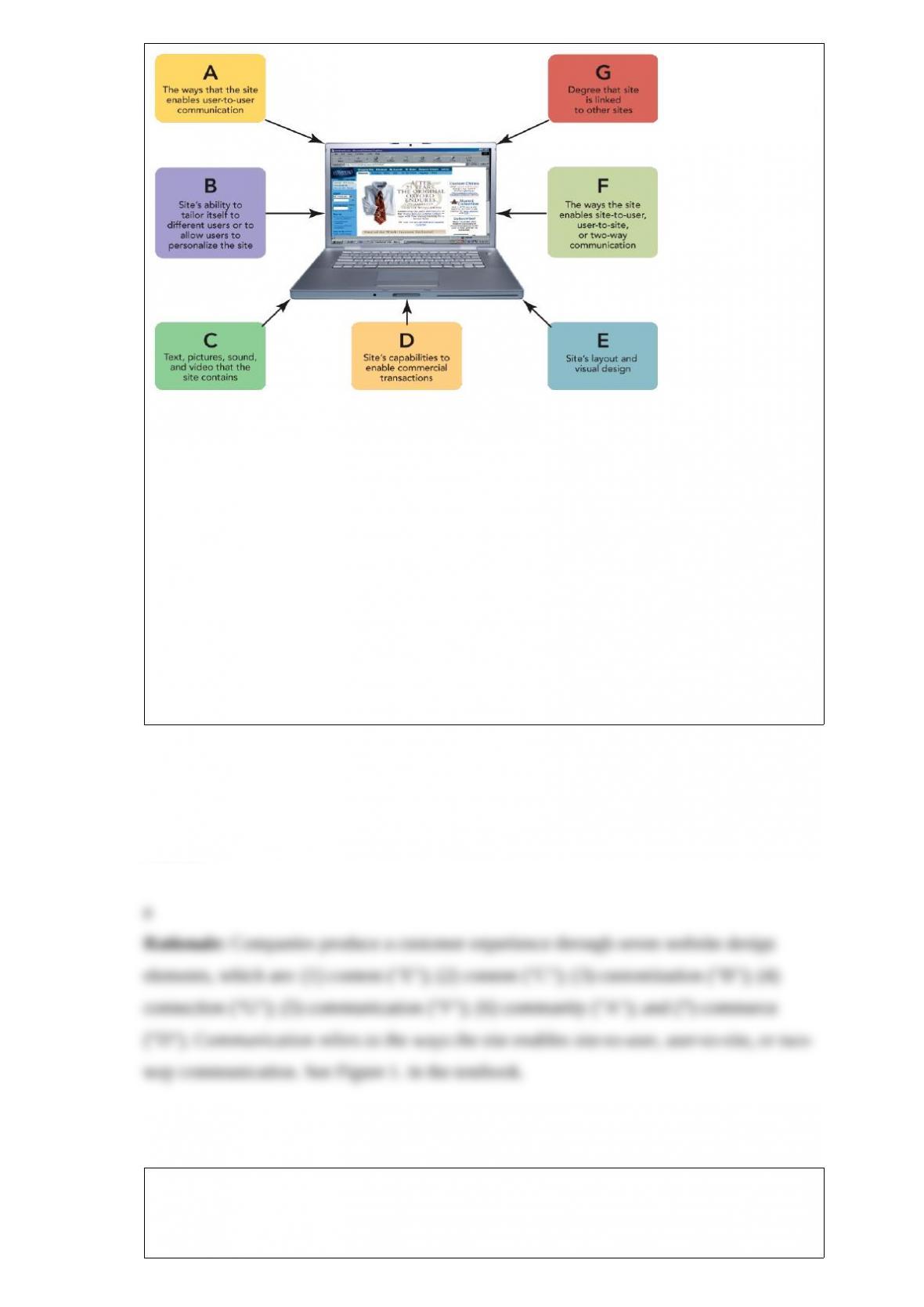
Figure 1.
Consider Figure 1. above. “F” refers to which of the following website design
elements?
a. communication
b. commerce
c. customization
d. connection
e. context
Answer:
Industrial products are also referred to as __________ products.
a. manufacturing
b. merchandise
c. organizational
d. resale
e. business
Answer:
Figure 1.
According to Michael Porter’s diamond in Figure 1. above, quadrant “D” represents
a. factor conditions.
b. related and supporting industries.
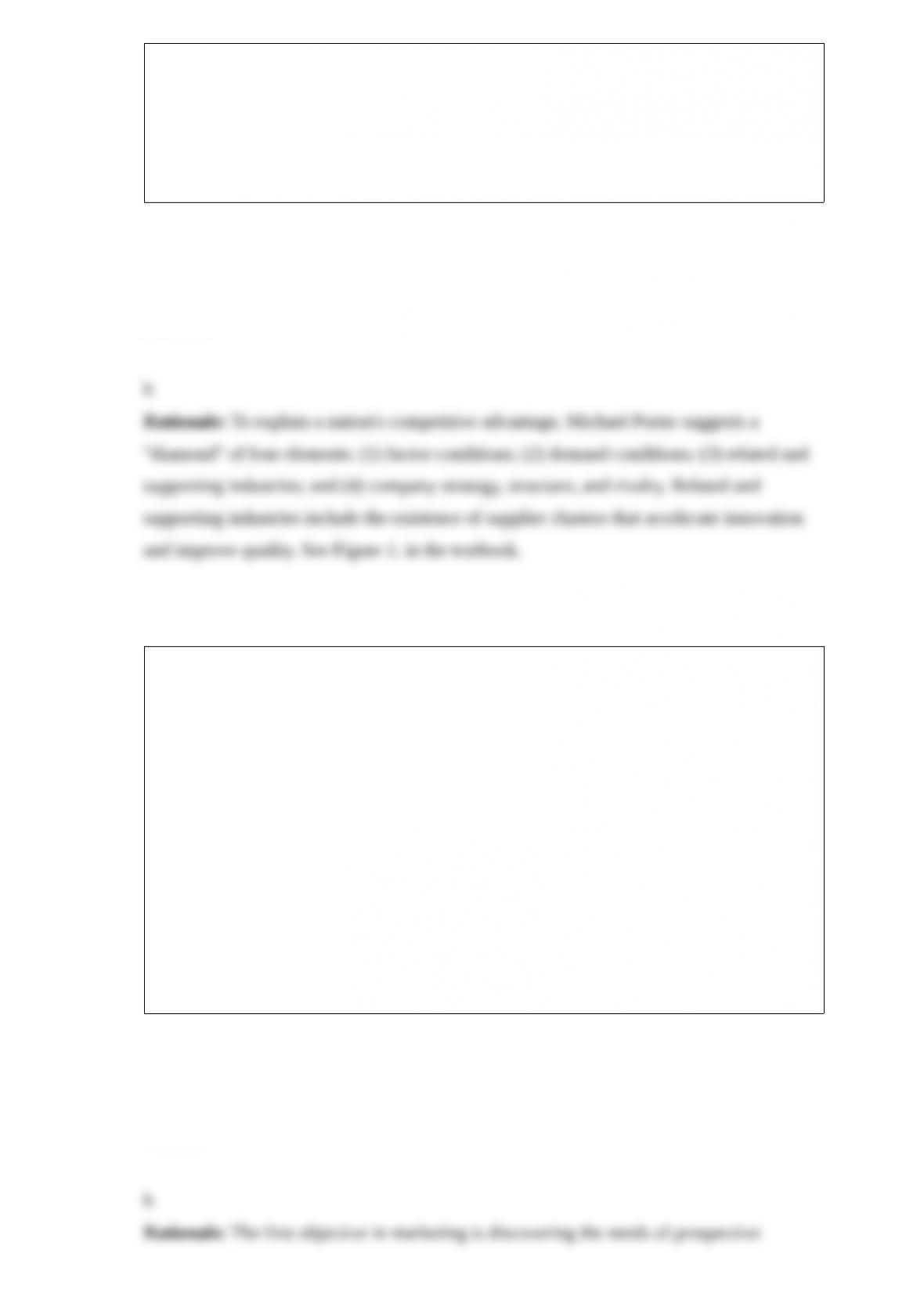
c. demand conditions.
d. managerial conditions.
e. company strategy, structure, and rivalry.
Answer:
If other companies applied the same strategy David Windorski used at 3M, they would
most likely
a. avoid the use of mock-ups and working models to speed up the new-product
development process and get the product out to the market faster.
b. search continuously to discover customers’ needs.
c. copy 3M’s “5% Rule” to do unfunded research.
d. avoid excessive attention to customers’ demands because they cannot always
differentiate between their needs and their wants.
e. focus on the shareholders of the company and know the strategy will follow.
Answer:
The trade feedback effect is one argument for
a. decreasing a nation’s exports.
b. free trade agreements.
c. increased tariffs and quotas.
d. international trade associations.
e. decreasing a nation’s imports.
Answer:
Which of the following activities are accomplished during the development stage for
services?
a. developing off-peak pricing strategies
b. using fast prototyping to improve the initial design
c. ensuring that employees have the commitment and skills to meet customers’
expectations and sustain their loyalty
d. using capacity management models to match service availability with consumers’
needs
e. analyzing the sequence of service encounters
Answer:
A potential difficulty with a test market is that outside factors, such as actions of
competitors, can distort the results by affecting __________, such as sales.
a. independent variables
b. marketing drivers
c. dependent variables
d. causality variables
e. probability variables
Answer:
Objectives refer to
a. the means by which a marketing goal is to be achieved, usually characterized by a
specified target market and a marketing program to reach it.
b. criteria or standards used in evaluating proposed solutions to a marketing problem.
c. statements of an accomplishment of a task to be achieved, often by a specific time.
d. a road map for the marketing activities of an organization for a specified future time
period, such as one year or five years.
e. the detailed day-to-day operational decisions essential to the overall success of
marketing strategies.
Answer:
The department secretary orders ink cartridges for the department printer from the
Corporate Express catalog each month. This is an example of a
a. new buy.
b. straight rebuy.
c. modified rebuy.
d. make-buy.
e. standard reorder.
Answer:
As more competitors launch their own products and the product progresses along its life
cycle, company attention is focused on creating __________ demand, or the preference
for a specific brand.
a. selective
b. primary
c. derived
d. generic
e. secondary
Answer:
The “Little Dragons,” in relation to the Asian free trade agreements, are composed of:
a. Hong Kong, Singapore, South Korea, and Taiwan.
b. Hong Kong, Shanghai, Singapore, and Bangkok.
c. Beijing, Hong Kong, Shanghai, and Singapore.
d. Beijing, Tokyo, Taiwan, and Singapore.
e. Beijing, Hong Kong, Taiwan, and Bangkok.
Answer:
There are seven commonly used organizational buying criteria. One of them is
__________.
a. production facilities and capacity
b. consumer demand
c. flexibility and adaptability
d. adherence to government policies
e. senior management directives
Answer: