There are five common approaches to posttests: aided recall, unaided recall,
__________, inquiry tests, and sales tests.
a. exposure tests
b. attitude tests
c. performance tests
d. jury tests
e. comparison tests
Answer:
Research indicates that publicity followed by advertising with the same message
a. undermines the credibility of the first message and therefore lessons its effect.
b. increases the positive response to the message.
c. increases the positive response to the message when it is delivered by a well-known
spokesperson.
d. is less effective than publicity followed by a sales promotion with a similar theme.
e. is no more or less effective than when used alone.
Answer:
To increase profits on digital music downloads, Amazon has
a. raised its prices to appear more exclusive than Apple iTunes.
b. lowered its prices to try to lure customers from Apple iTunes.
c. added a download fee to the price of each song.
d. made its prices the same as those of Apple iTunes.
e. kept its prices the same but increased the number of available songs.
Answer:
The VALS framework segments consumers based on
a. their primary motivation for buying certain products and services and levels of
resources.
b. their demographics.
c. their product usage.
d. where they live.
e. their media usage.
Answer:
The best-known self-regulatory group is the __________, which is a voluntary alliance
of companies whose goal is to help maintain fair practices.
a. U.S. Department of Justice
b. National Chamber of Commerce
c. Better Business Bureau
d. Federal Trade Commission
e. National Federation of Independent Business
Answer:
Filmmakers want movie titles that use the same factors that make a good brand name.
Ideally, they should __________.
a. have no legal restrictions
b. create a sense of mystery
c. use devices such as alliteration or rhyme
d. create a sense of familiarity
e. be creative
Answer:
Which of the following statements about sales tests is MOST accurate?
a. With sales tests, additional product information, product samples, or premiums are
offered to an ad’s readers or viewers, and ads generating the cost inquiries are presumed
to be the most effective.
b. With sales tests, a question such as, “What ads do you remember seeing yesterday?”
is asked of respondents without any other prompting to determine whether they saw or
heard advertising messages.
c. Sales tests involve studies such as controlled experiments and consumer purchase
tests to measure actual purchases.
d. In a sales test, respondents are asked questions to measure changes in their attitudes
after an advertising campaign, such as whether they had a more favorable attitude
toward the product advertised.
e. In a sales test, respondents are first shown an ad and then asked whether their
previous exposure to it was through reading, viewing, or listening.
Answer:
Which of the following statements would most likely be spoken during Step 3 in the
price-setting process?
a. “In order to break even, we will need to sell at least 500,000 units.”
b. “We have to try to achieve an 8 percent profit share.”
c. “The starting price should be $4.99 and we can raise the price again in six months.”
d. “But, if we increase the price even by one dollar, how many customers will we lose?”
e. “We should probably price the extra large version somewhere between $600 and
$650.”
Answer:
Since 1963, Mary Kay, Inc.’s guiding principle has been based on __________.
a. the Consumer Bill of Rights
b. the Golden Rule
c. caveat emptor
d. the American Marketing Association Statement of Ethics
e. maximizing profits so long as the firm ‘stays within the rules”
Answer:
A vendor-managed inventory system refers to an
a. inventory supply system that operates with very low inventories and requires fast
on-time delivery.
b. inventory management system whereby the supplier determines the product amount
and assortment a retailer needs and automatically delivers the appropriate items.
c. inventory management system that is designed to reduce the retailer’s lead time for
receiving merchandise, which then lowers a retailer’s inventory investment, improves
customer service levels, and reduces logistic expenses.
d. inventory supply system that relies on the “judgment” of individual warehouse
managers based on daily reports from its retailer customers.
e. inventory system that guarantees delivery within 48 hours, and grants price
reductions of 1 percent per hour if a shipment is delayed.
Answer:
Services provided by specialized professionals such as medical diagnoses and legal
services have certain properties or characteristics that the consumer may find
impossible to evaluate even after purchase and consumption. What are these properties
called?
a. customer contact properties
b. credence properties
c. capacity properties
d. contract properties
e. relationship properties
Answer:
Four of the 30 largest businesses in the United States are retailersWalmart, Costco,
Home Depot, and _________.
a. Sears
b. Target
c. Best Buy
d. JC Penney
e. Bloomingdale
Answer:
Mars, Inc. sells Snickers, Milky Way, Twix, Skittles, Dove, Starburst, M&Ms, and

Three Musketeer candy. This variety of brand names is typical of a __________
strategy.
a. co-branding
b. multibranding
c. multiproduct
d. mixed brand
e. private branding
Answer:
In a five-year study, researchers Nohria, Joyce, and Roberson conducted an in-depth
analysis of 160 companies and more than 200 management tools and techniques. What
was their principal finding?
a. Supply chain management was the most critical element in stellar business
performance.
b. Customer relationship management was more effective than product development.
c. The Internet was more effective in terms of long-term sales success than the use of
retail outlets or direct marketing tactics such as catalogs.
d. Three major management tools, supply chain management, customer relationship
management, and the use of an intranet, were equally beneficial in terms of business
performance.
e. Individual management tools and techniques had no direct relationship to superior
business performance in the companies that were studied.
Answer:
A personal moral philosophy that considers individual rights or duties as universal,
regardless of the outcome, is referred to as __________.
a. social responsibility
b. moral idealism
c. utilitarianism
d. hedonism
e. religion
Answer:
A manufacturer estimates that consumers will accept a price of $275 for a snowboard. If
the manufacturer expects to offer trade discounts of 35/15/5 to retailers, wholesalers,
and jobbers, respectively, what price will the manufacturer receive for the snowboard?
a. $275.00
b. $178.75
c. $151.
d. $144.34
e. $100.00
Answer:
Parallel development, involving the simultaneous development of both the product and
the production process, is the responsibility of __________.
a. cross-functional teams
b. the marketing department
c. research and development engineers
d. product managers
e. top management
Answer:
Michael Smolensky is CEO of Lifeway Foods, Inc., based in Skokie, IL. The company
sells kefir, a cultured milk product popular in Smolensky’s native Russia. Recently,
Smolensky, who had developed his own secret recipe, got a call from his supplier,
saying, “Michael, someone is trying to steal your secrets.” Smolensky discovered later
that a prospective rival had called to ask the supplier for certain ingredients by their
secret codes, known only to Smolensky and the supplier. The rival had picked them out
of Lifeway’s refuse. This is an example of
a. corporate shadowing.
b. economic espionage.
c. clandestine trade secrets.
d. industrial sleuthing.
e. competitive surveillance.
Answer:
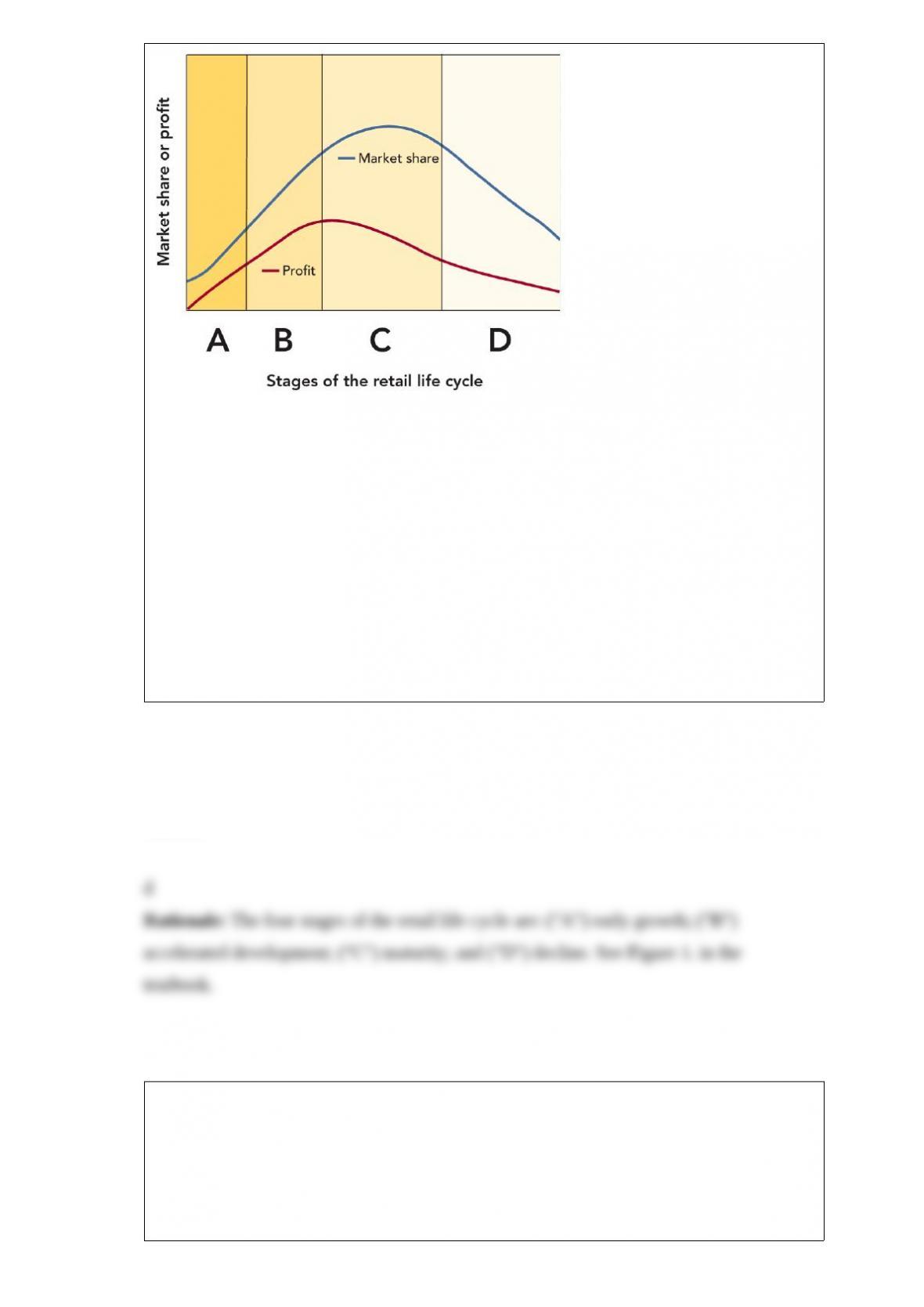
Figure 1.
According to Figure 1. above, “C” represents which stage of the retail life cycle?
a. introduction
b. early growth
c. accelerated development
d. maturity
e. decline
Answer:
When using an account management policy grid, an account would receive a high level
of sales calls if the account opportunity level assessment is
a. high, and the sales organization has a weak competitive position.
b. low, and the sales organization has a strong competitive position.
c. high, and there is likelihood that a strong competitive position can be achieved.
d. low, and the sales organization has a low competitive position.
e. high, and the sales organization has strong competitive position.
Answer:
Intangible concepts and thoughts about products, actions, or causes are called
a. utilities.
b. products.
c. values.
d. ideas.
e. services.
Answer:

Walmart is a channel captain because of its strong image, number of outlets, and
purchasing volume. The source of Walmart’s power is its
a. economic influence.
b. expertise.
c. identification with a particular channel member.
d. legitimate rights through contracts.
e. political connections.
Answer:
The trade of things of value between buyer and seller so that each is better off after the
trade is referred to as __________.
a. financial remuneration
b. exchange
c. countertrade
d. barter
e. marketing
Answer:

The energizing force that stimulates behavior to satisfy a need is referred to as a(n)
a. personality.
b. antecedent state.
c. motivation.
d. cognitive dissonance.
e. perception.
Answer:
If a new grocery product does not achieve a predetermined sales target, some retailers
require a penalty payment by the manufacturer to compensate them for sales that its
valuable shelf space failed to make. What is this type of payment called?
a. an opportunity cost charge
b. lost sales fee
c. shelf space allowance
d. product displacement fee
e. a failure fee
Answer:
An analysis of the pillow market using a market-product grid suggests that the most
important segment to target is
a. side sleepers.
b. sleepers with sleep disorders, such as sleep apnea.
c. sleepers with annual incomes of $50,000 and over.
d. back sleepers.
e. stomach sleepers.
Answer:
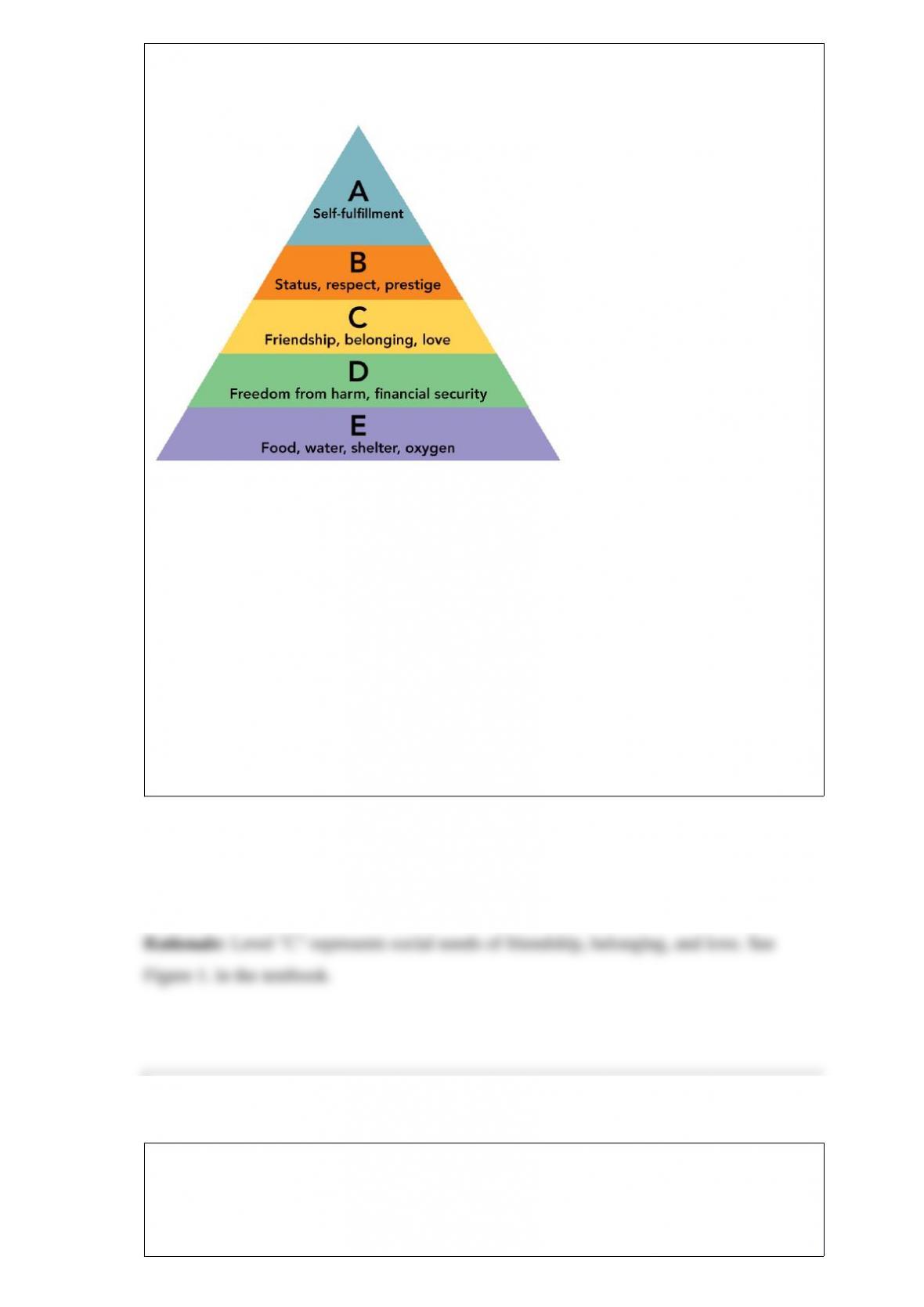
Figure 1.
According to Figure 1. above, the need for friendship, belonging, and love would be
found in what level of the hierarchy of needs?
a. “A”
b. “B”
c. “C”
d. “D”
e. “E”
Answer:
A business traveler joined the Starwood Preferred Guest Program in order to earn points
each time he stayed overnight in a Westin or Sheraton hotel. Once he has accumulated
enough points, he can trade his points in for a free night’s stay. As a member of this

program, the traveler receives periodic updates on new hotels and learns of ways to earn
additional points. The marketing term that best describes this scenario is
a. relationship marketing.
b. customer satisfaction promotion.
c. customer relationship management.
d. customer valuation.
e. supplier-consumer partnership.
Answer:
The disadvantage of product sales organization is that __________.
a. it increases the number of salespersons in the salesforce since most product sales
organizations are based around standard rebuys
b. there is a larger cost for sales since this method is chosen for products that inherently
have little or no product variation
c. it significantly maximizes travel time, expenses, and duplication of selling effort
from one territory to another
d. it increases the requirement for more sales managers since the salesforce is paid
strictly on commission, which acts as a significant self-motivator
e. it produces high administration costs and duplication of selling effort because two
company salespeople may call on the same customer

Answer:
There are two general types of franchises: business-format franchises and __________
franchises.
a. product-distribution
b. general service
c. manufacturing
d. distribution
e. venture
Answer:
Fluctuations in the __________ among the world’s currencies have direct impact on the
sales and profits made by global companies.
a. design
b. transportation
c. reciprocity
d. exchange rates
e. numismatic value
Answer:
One of the disadvantages associated with television as an advertising medium is that it
a. requires a long exposure time.
b. cannot target specific audiences.
c. must use print for effect.
d. cannot be used to convey complex messages.
e. has an unlimited amount of advertising time available.
Answer:
The stylized blue and white waves that appear in an oval shape on every package of
Ocean Spray brand products is an example of a __________.
a. copyright
b. trade name
c. trade mark
d. brand name
e. label
Answer:
Why would Dr. Pepper select the rock and roll band KISS to appear in an ad campaign?
How would the group be a sociocultural influence on consumer behavior?
Answer:
What is a channel captain? What is its function when there is channel conflict?
Answer:
As the level of customer service increases, what happens to total logistics costs?
Answer:
It is said that goods, services, and ideas are marketed. Define goods, services, and ideas
and give at least one example of each.
Answer:
In recent years, a number of countries with similar economic goals have formed
transnational trade groups or signed trade agreements for the purpose of promoting free
trade. Describe the best-known three.
Answer:
Several methods can be used to set the promotion budget. Identify and discuss four
methods.
Answer:
What are two approaches to product positioning? Give an example of each approach.
Answer:
Identify and describe the functions of agents and brokers.
Answer:
What is the difference between fixed costs and variable costs?
Answer:
What actions does the Federal Trade Commission have the power to implement when
dealing with deceptive or misleading advertising and unfair business products?
Answer:
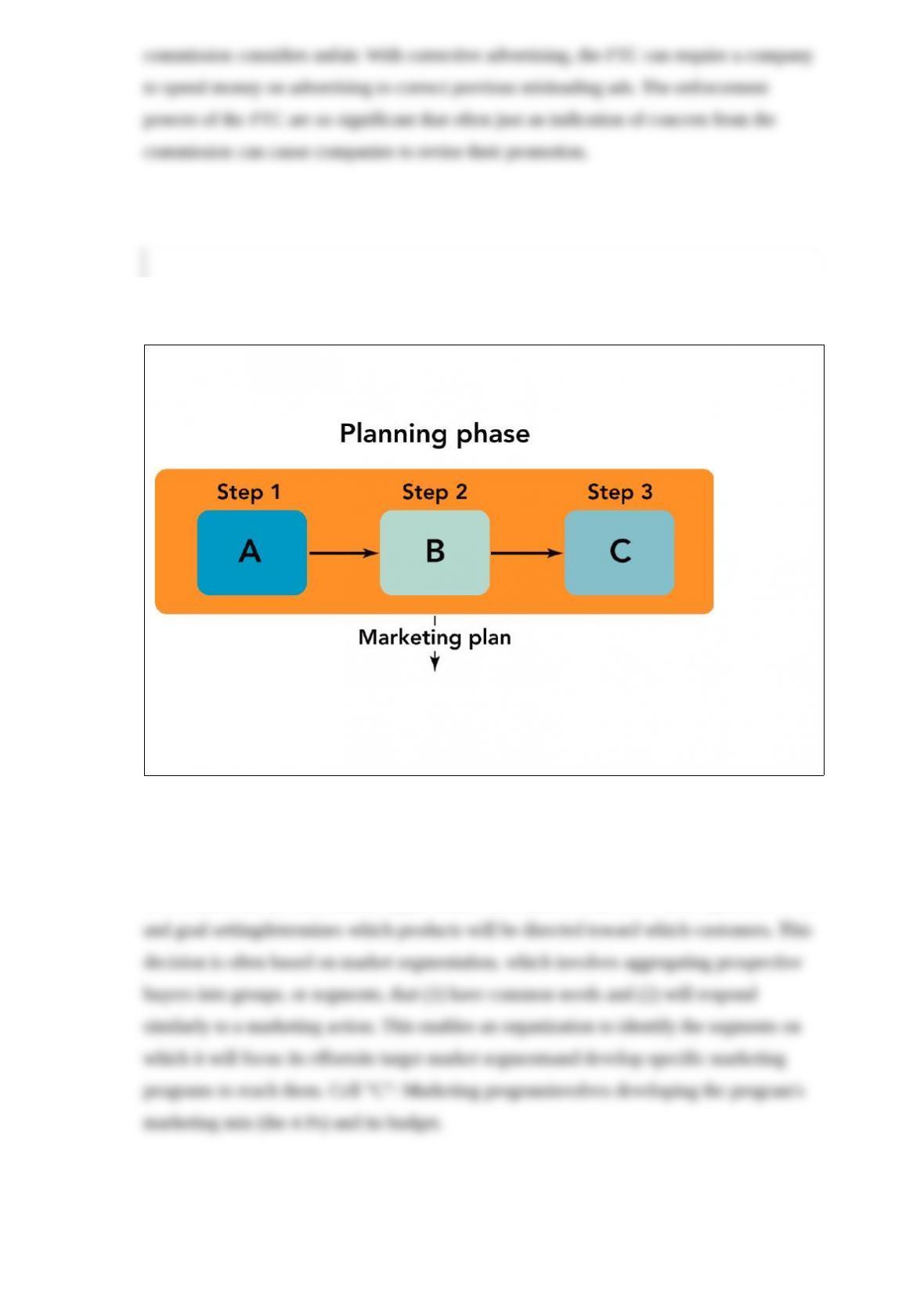
Figure 1.
Using Figure 1., identify and describe the three steps (“A,” “B,” and “C”) of the
planning phase of the strategic marketing process.
Answer:
Explain how Anheuser-Busch acts with societal responsibility.
Answer:
What is the difference between marketing strategies and marketing tactics?
Answer:
There are four common approaches to selecting an approximate price level. List and
provide a brief description for each one.
Answer:
One of the most recognized approaches to business portfolio analysis is the Boston
Consulting Group’s growth-share matrix. Describe this tool and the four quadrants of
the matrix.
Answer:
List the three steps of the planning phase of the strategic marketing process. Briefly
describe what goes on during each of the three steps.
Answer:
Most people would assume that in marketing the only thing of value to “exchange”
would be monetary (check, credit/debit, currency, and/or coin transactions). What else
can be exchanged? Provide an example of a nonmonetary transaction that still fits the
criteria of exchange.
Answer:
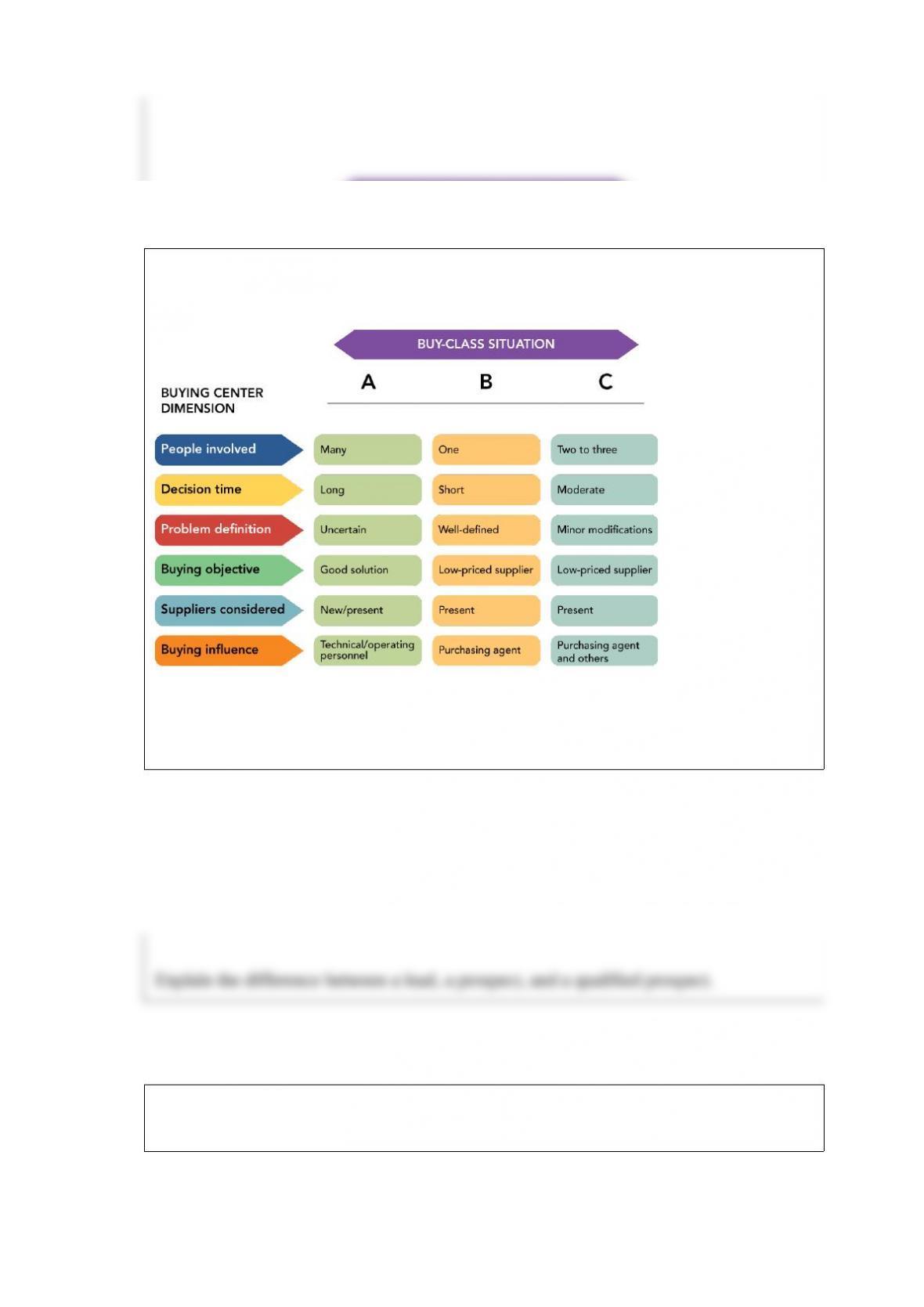
Figure 1.
Figure 1. above summarizes how buy classes affect buying center tendencies in
different ways. Identify the buy-class situations “A,” “B,” and “C.”
Answer:
Explain the difference between a lead, a prospect, and a qualified prospect.
Answer: