Dell Inc. learned that the lithium-ion batteries in its notebook computers posed a fire
hazard to consumers. The company recalled 2.7 million batteries and gave consumers a
replacement before any personal injuries resulted. Dell was most likely concerned with
consumers’ right to
a. choose.
b. be informed.
c. safety.
d. be heard.
e. happiness.
Answer:
The text, pictures, sound, and videos that are found on a website are referred to as
__________.
a. content
b. context
c. creativity
d. communication
e. connection
Answer:
According to Michael Porter’s diamond of national competitive advantage, both the
number and sophistication of domestic customers for an industry’s product are examples
of
a. structural conditions.
b. demand conditions.
c. sociocultural conditions.
d. competitive conditions.
e. factor conditions.
Answer:
The four steps in the sequential process of building the brand equity pyramid include:
(1) developing positive brand awareness; (2) establishing a brand’s meaning in the
minds of consumers; (3) eliciting the proper consumer responses to a brand’s identity
and meaning; and (4) __________.
a. easing consumers’ decision making
b. forming a brand personality
c. creating a consumer-brand connection
d. rewarding loyal customer behavior
e. developing brand licensing criteria
Answer:
A __________ is a sample of consumers or stores from which researchers take a series
of measurements.
a. representative group
b. jury of executive opinion
c. panel
d. survey of experts
e. focus group
Answer:
When a new product or a new chain steals customers and sales from older existing
ones, it is referred to as
a. cannibalization.
b. amortization.
c. product appropriation.
d. product pilfering.
e. marketing Darwinism.
Answer:
Marketing synergies often come at the expense of product synergies because
a. product synergies are more effective for penetrating a market rather than creating
one.
b. multiple market segments usually require multiple products.
c. it is easier to change a product than to completely develop a new marketing plan.
d. a single customer segment will likely require a variety of products.
e. no company can afford to do both at the same time.
Answer:
A supplier’s attempt to stipulate to whom distributors may resell the supplier’s products
and in what specific geographical areas or territories they may sell is referred to as
__________.
a. full-line forcing
b. exclusive dealing
c. a refusal to deal
d. a resale restriction
e. a tying arrangement
Answer:
As a result of __________, consumers do not remember all the information they see,
read, or hear, even minutes after exposure to it.
a. selective retention
b. selective comprehension
c. selective exposure
d. selective perception
e. subliminal discrimination
Answer:

A salesperson who processes routine orders or reorders for products that were already
sold by the company is referred to as a(n) __________.
a. order getter
b. missionary salesperson
c. order taker
d. sales engineer
e. order processor
Answer:
SBUs with a low share of high-growth markets that may require large cash injections of
cash just to maintain market share are referred to as __________.
a. dogs
b. cash cows
c. question marks
d. stars
e. hedgehogs
Answer:
Which of the following weaknesses is associated with sales promotions?
a. They have high absolute costs.
b. Messages differ between the sales promotion tools.
c. It is difficult to get media cooperation.
d. They can easily lead to promotion wars.
e. Their effectiveness diminishes when used continuously.
Answer:
Advertising that promotes a specific brand’s features and benefits is referred to as
__________ advertising.
a. competitive
b. institutional
c. differentiation
d. pioneering
e. reminder
Answer:
The promotional mix includes advertising, __________, sales promotion, public
relations, and direct marketing.
a. publicity
b. personal selling
c. merchandising
d. branding
e. people
Answer:
The sale of two or more separate products in one package is referred to as __________.
a. a two-for-one deal
b. product modification
c. product repositioning
d. product bundling
e. product differentiation
Answer:
Inspecting, testing, or judging products and assigning them quality grades would be an
example of a __________ function.
a. transactional
b. logistical
c. storing
d. facilitating
e. risk taking
Answer:
Which type of compensation plan provides the maximum amount of selling incentive?
a. sales response
b. market share
c. combination
d. straight sales
e. straight commission
Answer:
Idea generation refers to
a. the stage of the new-product process when concepts are converted to prototypes.
b. the stage of the new-product process that develops a pool of concepts as candidates
for new-products.
c. the stage of the new-product process where possible promotional campaigns and
advertising themes are created.
d. the techniques used to screen and reject those ideas that have no merit.
e. the discussion and decision of which as target market segments will be selected.
Answer:
Segmentation based on what product features are important to different customers is
known as
a. demographic segmentation.
b. psychographic segmentation.
c. geographic segmentation.
d. behavioral segmentation.
e. socioeconomic segmentation.
Answer:
The use of displays, coupons, product samples, and other brand communications to
influence shopping behavior in a store is referred to as
a. functional qualities
b. level of service
c. shopper marketing
d. lifestyle attributes
e. psychographic elements
Answer:
A firm’s profit equation demonstrates that profit equals __________.
a. Total cost + Total revenue
b. Total revenue − Total cost
c. Marginal revenue − Marginal cost
d. Price x Quantity
e. Total revenue + Total cost
Answer:
A reference value involves comparing the costs and benefits of __________.
a. substitute items
b. items of equal or greater value
c. products with which a consumer is familiar and items the consumer has not seen or
used before
d. items from one particular distributor
e. intangible items
Answer:
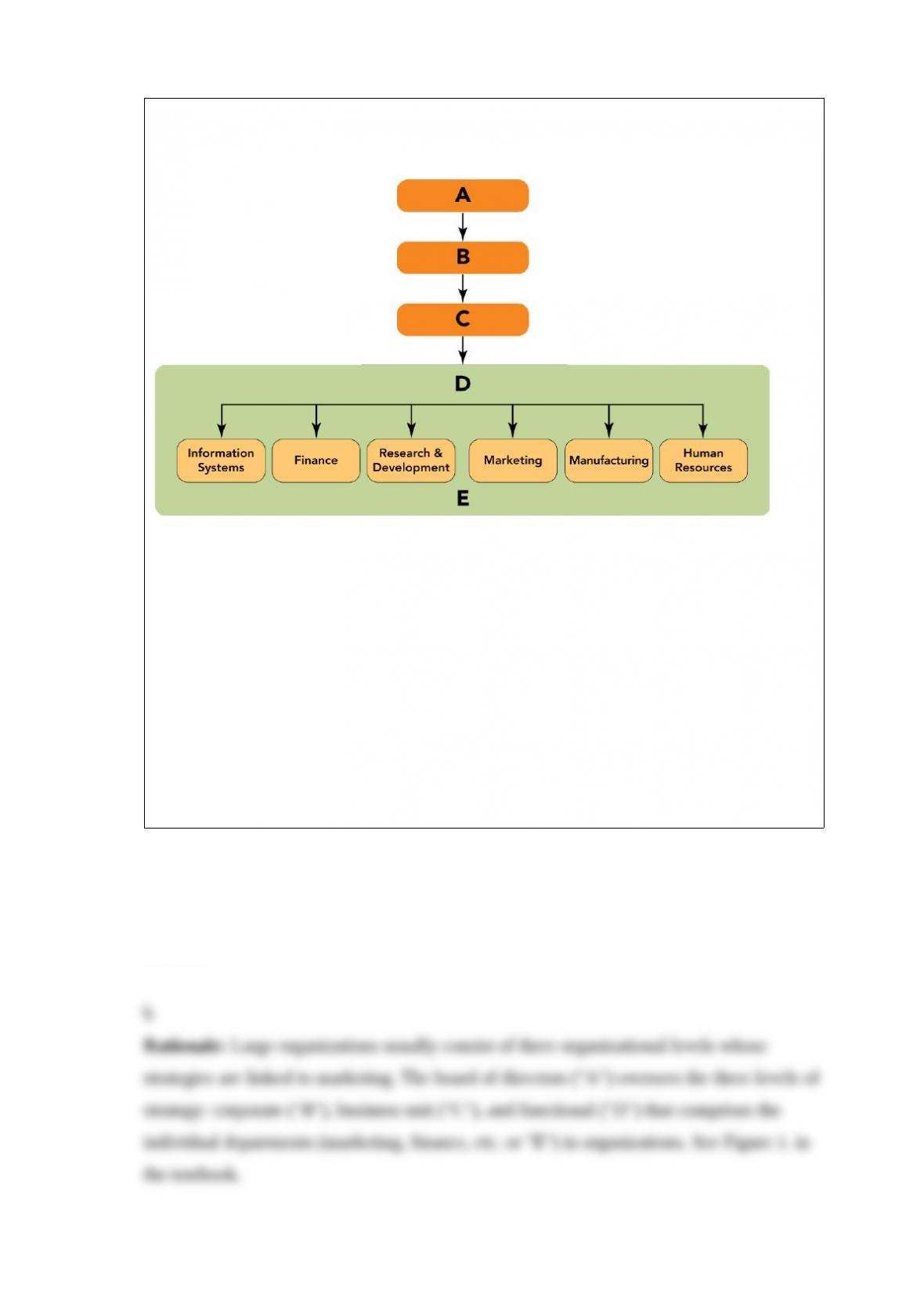
Figure 1.
In Figure 1. above, “D” represents the
a. strategic business unit level.
b. functional level.
c. corporate level.
d. board of directors.
e. CMO.
Answer:

Which of the following methods is commonly used in software development to speed
up the development process?
a. expedited time to market
b. fast prototyping
c. parallel development
d. a “design it, fix it, try it, and do it” approach
e. concept testing
Answer:
Setting an annual target of a specific dollar volume of profit is referred to as
__________.
a. target profit pricing
b. target return-on-investment pricing
c. loss leader pricing
d. at-, above-, or below-market pricing
e. yield management pricing
Answer:
The __________ specifically prohibits exclusive dealing and tying arrangements when
they lessen competition or create monopolies.
a. Sherman Act
b. Robinson-Patman Act
c. Federal Trade Commission Act
d. Clayton Act
e. Consumer Goods Pricing Act
Answer:
Goods can be divided into __________ goods and __________ goods.
a. functional; aesthetic
b. required; desired
c. tactile; conceptual
d. durable; nondurable
e. product; service
Answer:
In the hierarchy of needs, a burglar alarm would satisfy a __________ need.
a. physiological
b. safety
c. social
d. personal
e. self-actualization
Answer:
Recent Bayer ads stating, “We cure more headaches than you think,” are intended to
inform consumers that the company produces many products in addition to aspirin.
What type of ad is this?
a. pioneering institutional advertisement
b. competitive institutional advertisement
c. advocacy institutional advertisement
d. reminder institutional advertisement
e. subliminal institutional advertisement
Answer:
Culture includes values, which vary with age groups. Consumers under 20 years old
rank __________ as the third most important cultural value.
a. honesty
b. protecting the family
c. friendship
d. self-esteem
e. health and fitness
Answer:
C&R Research, in their research for Disney Online, identified four segments of mothers
based on their Internet usage. The first three segments, which accounted for 77 percent
of online moms, were composed of
a. Yes Mom, Mrs. Net Skeptic mom, and Tech Nester mom.
b. Mrs. Net Skeptic mom, Tech Nester mom, and Passive Under Pressure mom.
c. Yes Mom, Mrs. Net Skeptic mom, and Passive Under Pressure mom.
d. Yes Mom, Tech Nester mom, and Passive Under Pressure mom.
e. Mrs. Net Skeptic mom, Passive Under Pressure, and Yes Mom.
Answer:
All of the following are roles in a buying center EXCEPT:
a. developers
b. deciders
c. buyers
d. influencers
e. users
Answer:
A mother of two toddlers would most likely use an internal search of her prior
experiences with products and brands when purchasing
a. a gift for her babysitter.
b. an iPhone.
c. disposable diapers.
d. a swing set.
e. a weekend getaway.
Answer: