The second step of the marketing research approach is to __________.
a. develop findings
b. define the problem
c. take marketing actions
d. develop the research plan
e. collect relevant information
Answer:
Warranties, money-back guarantees, extensive usage instructions, demonstrations, and
free samples are all ways in which companies attempt to overcome barriers to product
adoption during the __________ stage of a product’s life cycle.
a. accelerated development
b. maturity
c. growth
d. introduction
e. decline
Answer:
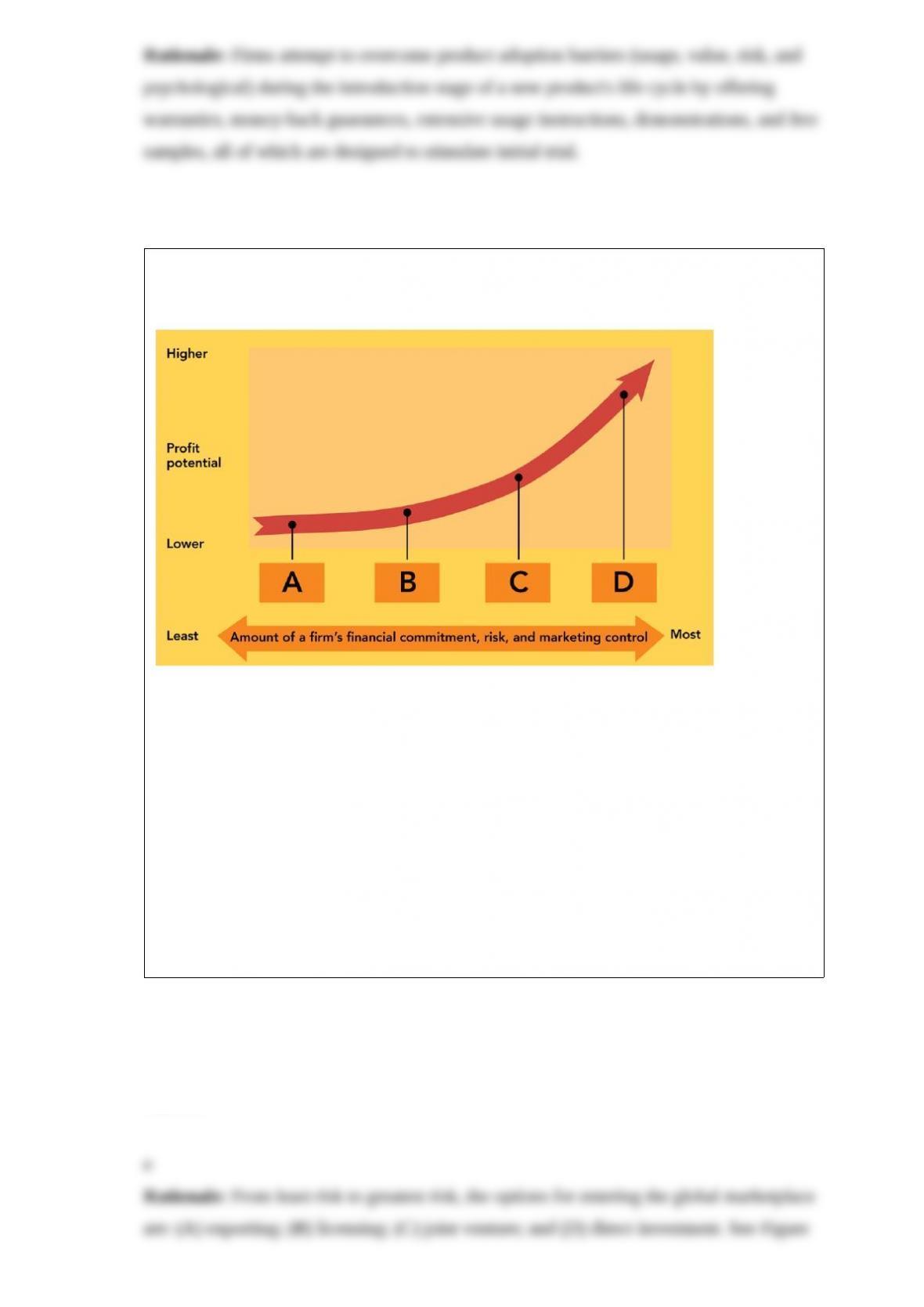
Figure 1.
According to Figure 1. above, point “B” would most likely be __________.
a. exporting
b. joint venture
c. direct investment
d. franchising
e. licensing
Answer:
Retailing’s economic value is represented by the annual sales of retailers and
__________.
a. the price asked for any one item
b. the cost of goods sold
c. the people employed in retailing
d. the net return on capital
e. the elimination of global boundaries
Answer:
Which of the following pieces of information is used in the implementation phase of the
strategic marketing process?
a. marketing return on investment
b. marketing research
c. revenues associated with each point of market share
d. trends for industry and competitors
e. possible cannibalization effects on other products in the line
Answer:
You are a consumer electronics manufacturer and will introduce a new high-quality
Internet-capable, 3D LED HDTV during the next six months. In the past, you have had
success using lifestyle analysis, particularly the VALS system, to help you profile your
customers. Which of the following VALS profiles would be the most logical target
market for your new product?
a. Survivors
b. Believers
c. Experiencers
d. Achievers
e. Innovators
Answer:
The concept of the diffusion of innovation shows how a product “diffuses” or spreads
through the population over time. The consumer population is divided into five
categories of product adopters based on when they adopt (i.e., first buy) a new product.
Each product adopter category has a unique profile. Consumers who are leaders in
social settings and have slightly above average educations are called __________.
a. innovators
b. early adopters
c. early majority
d. late majority
e. laggards
Answer:
Making connections between two or more ideas or simply observing the outcomes of
others’ behaviors and adjusting one’s own behavior accordingly is known as what type
of learning?
a. stimulus discrimination
b. cognitive learning
c. attitudinal learning
d. stimulus generalization
e. behavioral learning
Answer:
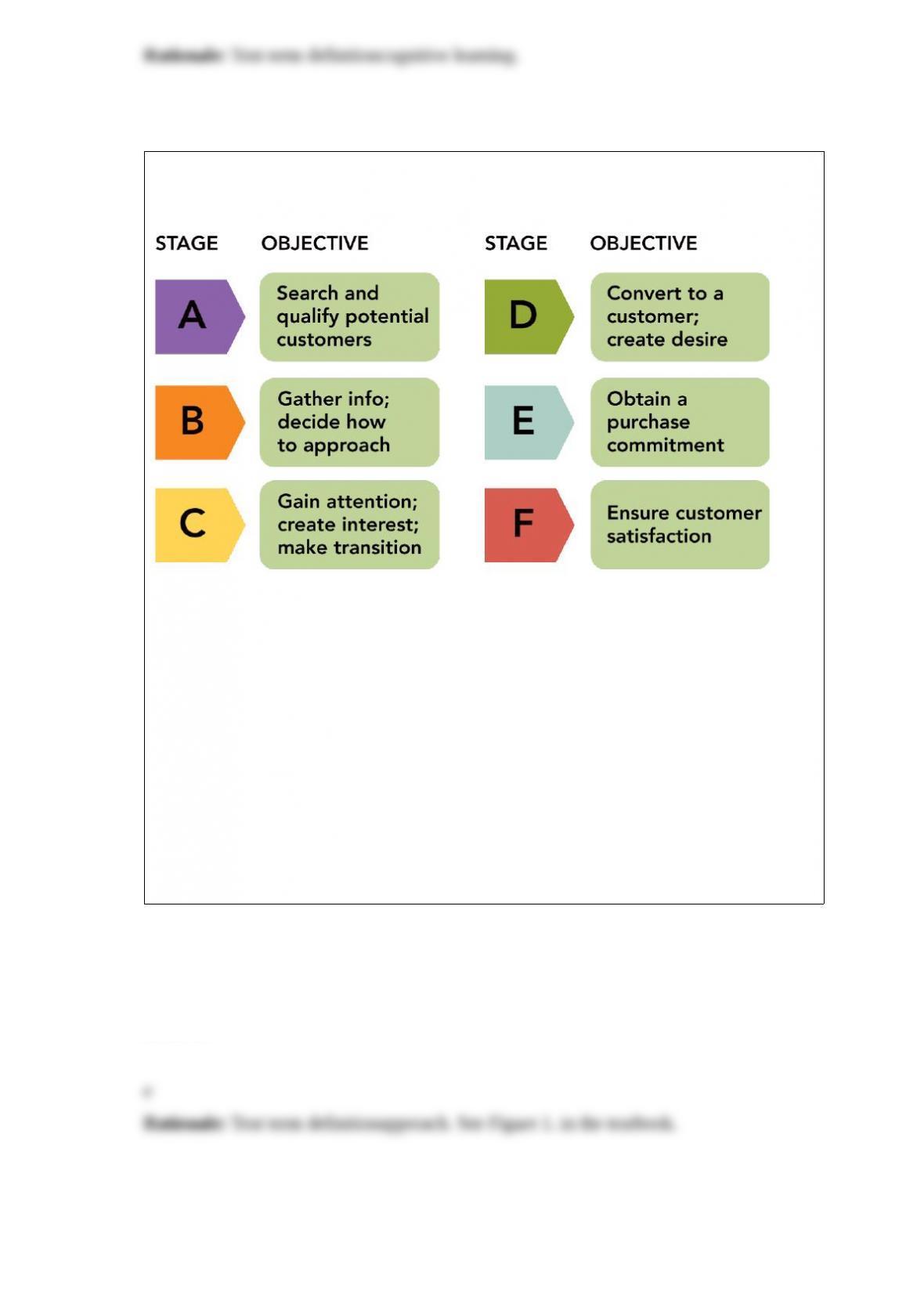
Figure 1.
As shown in Figure 1. above, “C” is the__________ stage in the personal selling
process.
a. presentation
b. follow-up
c. prospecting
d. preapproach
e. approach
Answer:
If a company chooses to employ its own salesforce, there are three basic organizational
salesforce structures from which to choose. They are ______.
a. dollar volume, unit volume, and market share
b. NAICS, market size, and geography
c. geography, customer, and product/service
d. market size, market share, and market type
e. dollar volume, unit volume, and profit
Answer:
When selecting a brand name, it should (1) suggest product benefits; (2) be memorable,
distinctive and positive; (3) __________; (4) have no legal or regulatory restrictions;
and (5) be simple and emotional.
a. never have a humorous connotation
b. be easy to spell and pronounce
c. fit the company or product image
d. not be easily imitated
e. be patented
Answer:
Eastman Kodak accused Japanese rival Fuji Photo Film of selling photographic paper in
the United States for 25 percent below what it charges in Japan. In other words,
Eastman Kodak accused Fuji of __________.
a. tariff avoidance
b. countertrade
c. surplus marketing
d. dumping
e. underbidding
Answer:
Program-length (30-minute) advertisements that take an educational approach to
communication with potential customers are referred to as __________.
a. advertorials
b. infomercials
c. advermercials
d. edutainment ads

e. extended advertising messages
Answer:
Corporate culture manifests itself in many different ways: the ethical behavior of top
management, expectations for ethical behavior present in formal codes of ethics, and
a. contracts and agreements between members of the same industry.
b. state and local laws regarding ethical business behavior.
c. the dress codes, manner of work, and sayings of its employees.
d. the socially responsible behaviors of its customers.
e. the involvement of shareholders with an organization’s day-to-day marketing
decisions.
Answer:
As a franchisor, Radio Shack would assist a franchisee in selecting the store location,
setting up the store, advertising, and __________.
a. developing the marketing program
b. training personnel
c. offering performance bonuses
d. ordering and restocking inventory
e. paying insurance and legal fees
Answer:
Which of the following statements regarding billboards is MOST accurate?
a. Billboards offer opportunities for lengthy advertising copy.
b. Billboards are not a good supplemental reinforcement for well-known products.
c. Billboards are well-suited for pioneering advertising.
d. Billboard sites depend on traffic patterns and sight lines.
e. Billboards are often too expensive for small local firms and are better suited for
national campaigns.
Answer:

The Terrafugia Transition is a 19-foot, two-seater road-drivable, light-sport aircraft with
an anticipated price of $250,000. The most likely prospective customers for this flying
car would include
a. students interested in science fiction.
b. retired seniors receiving social security.
c. executives for whom time is extremely important.
d. teens who like to try new things.
e. All of the people above are likely prospective customers of the Transition.
Answer:
The information needed for the marketing program, Step 3 of the planning phase,
includes: (1) __________ and (2) detailed plans to execute the marketing program.
a. positioning studies
b. marketing mix actions
c. market-product grids with target segments and product groupings
d. projected future sales, expenses, and profits
e. market potential studies
Answer:
Intangible activities or benefits that an organization provides to satisfy consumers’ need
in exchange for money or something else of value are referred to as __________.
a. virtual experiences
b. intangible benefits
c. intangible goods
d. product concepts
e. services
Answer:
The residents of Alaska and people throughout the world were outraged when the
Exxon Valdez crashed into a shoal and dumped millions of gallons of crude oil into the
pristine waters of Prince William Sound. People were upset with Exxon’s response to
the disaster. The company was slow to admit its mistake and even slower to implement
cleanup activities. Exxon was criticized for acting in a manner that would benefit the
organization but not society. In short, Exxon did not demonstrate
a. social responsibility.
b. value consciousness.
c. green marketing.
d. profit responsibility.
e. cause marketing.
Answer:
The actions taken in a situation (SWOT) analysis or Step 1 of the planning phase
include: (1) identify industry trends, (2) analyze competitors, (3) assess own company,
and (4) __________.
a. set market and product goals
b. research customers
c. select target markets
d. find points of difference
e. position the product
Answer:
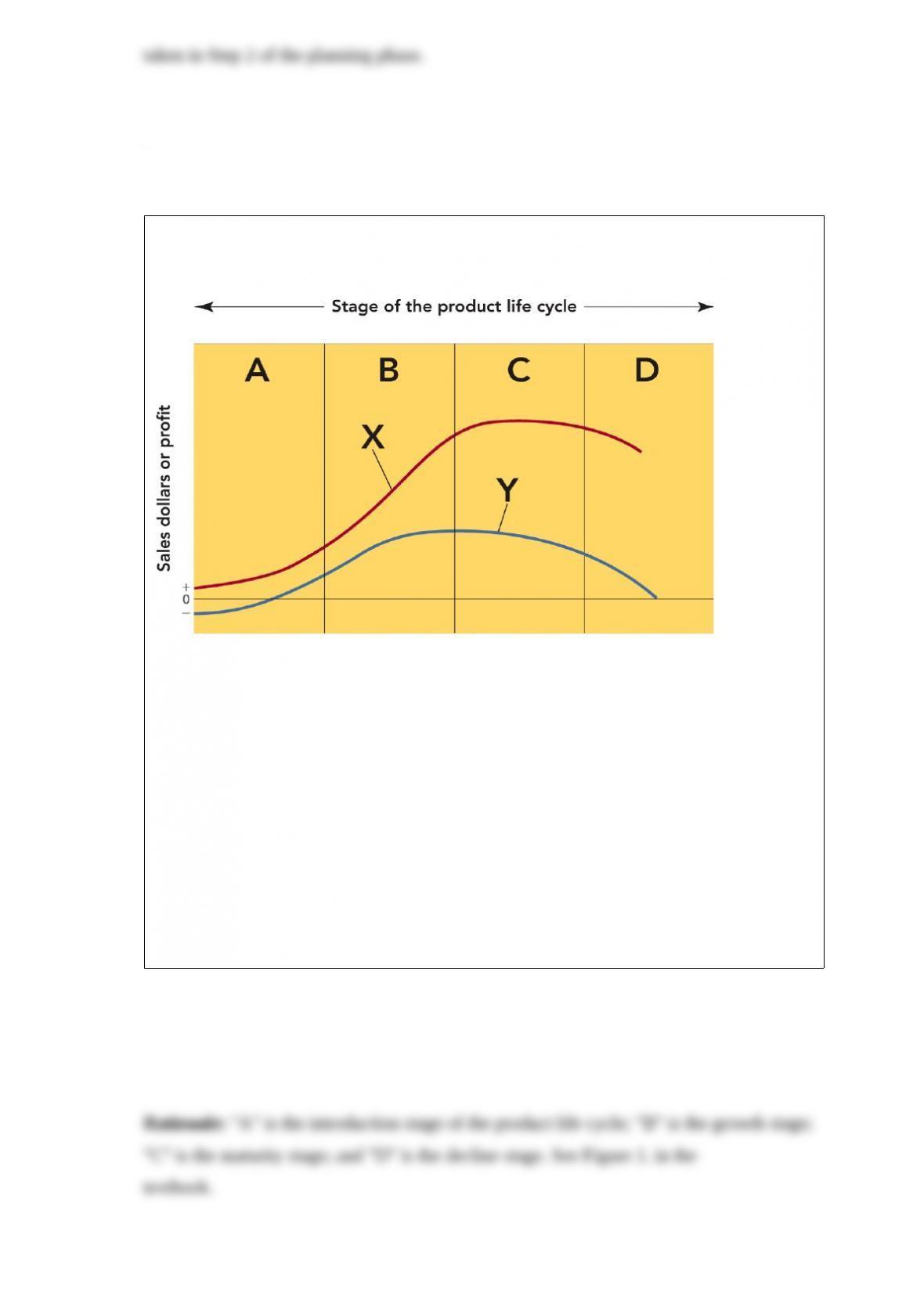
Figure 1.
Figure 1. above represents the stages of the product life cycle. What does the portion of
the curve labeled “D” represent?
a. introduction
b. maturity
c. growth
d. accelerated development
e. decline
Answer:
With a __________ compensation plan, a salesperson’s earnings are directly tied to
sales or profits generated.
a. sales response
b. combination
c. straight sales
d. straight commission
e. market share
Answer:
A test market is an example of which type of marketing research?
a. descriptive
b. explanatory
c. exploratory
d. causal
e. concrete
Answer:
Promotion represents the fourth element in the marketing mix. The promotional element
consists of communication tools, including sales promotion, public relations, personal
selling, direct marketing, and __________.
a. people
b. advertising
c. social media
d. branding
e. merchandising
Answer:
Market segments refer to
a. the relatively heterogeneous groups of prospective buyers that result from the market
segmentation process.
b. the relatively homogenous groups of prospective buyers that result from the market
segmentation process.
c. the smallest number of buyers that have similar needs but do not react similarly in a
buying situation.
d. all buyers of a product or service who have previously purchased a particular firm’s
products or services and who intend to repeat that purchase sometime in the future.

e. all potential buyers of a product or service who intend to purchase a firm’s products
or services but who have not yet done so.
Answer:
Cost per thousand is a measure in which
a. a fixed amount of money is paid for every 1,000 times an ad loads and a visitor might
see itbut not whether the user has actually reacted to it.
b. a fixed amount of money paid to the site for every visitor who clicks on an ad and
goes from the website to the advertiser’s site.
c. a fixed amount of money paid to the site for every sale that originated from an ad
posted on that site.
d. a fixed amount of money is paid to a site for posting an ad for a finite amount of
time.
e. a fixed discount given to a visitor for clicking on an ad.
Answer:
In a promotional sense, customized interaction refers to
a. the creation of unique products based upon the needs and wants of individual
consumers.
b. the translation of a company’s message into multiple languages for use in advertising
in different countries or regions.
c. personal selling between a seller and a prospective buyer that can include
face-to-face, telephone, and interactive electronic communication.
d. the creation of different promotional campaigns based on gender, age, or ethnicity.
e. the use of different images (such the covers of Sports Illustrated) to reach different
product groupings.
Answer:
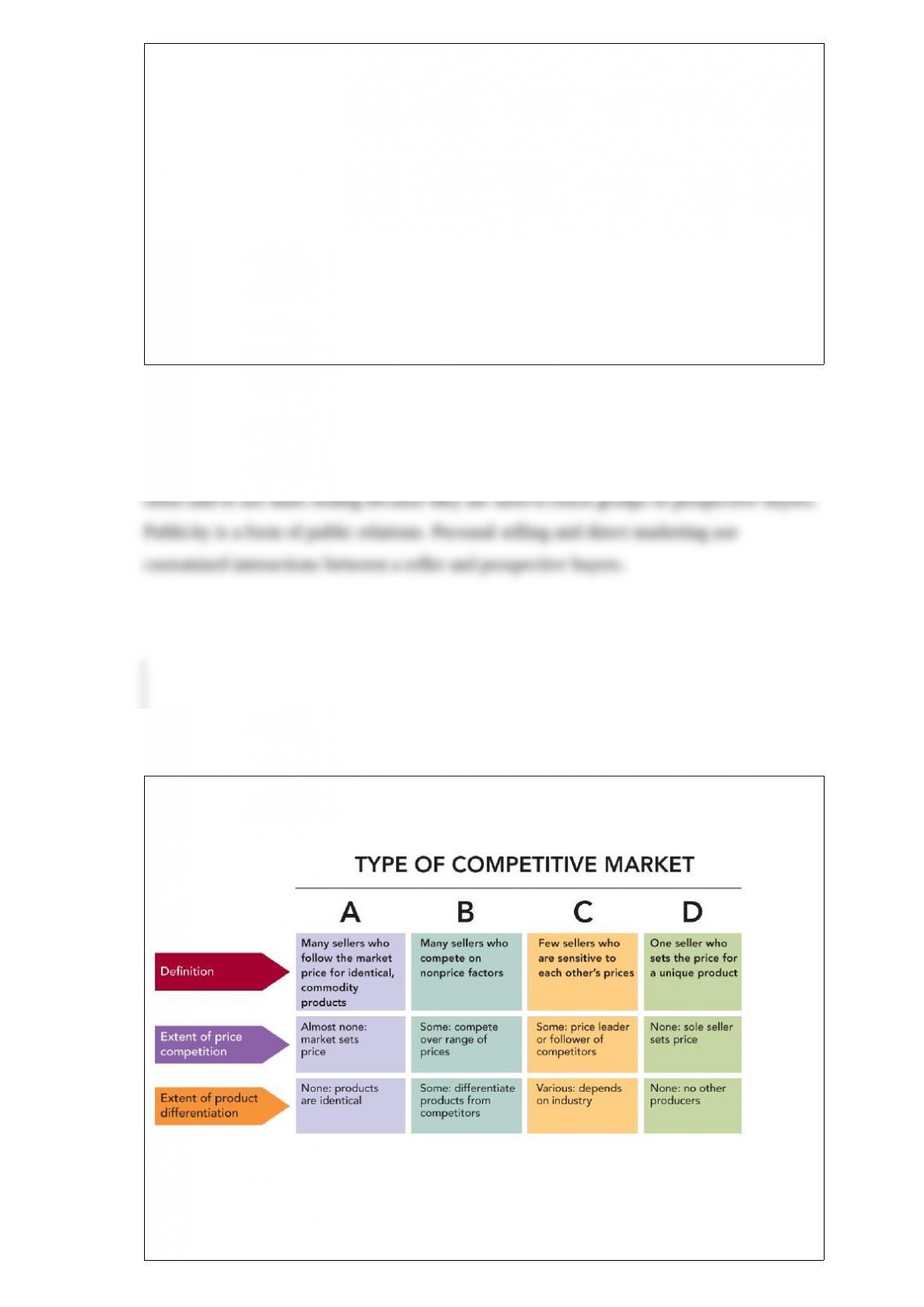
Figure 1.
In Figure 1. above, column “B” represents which type of competitive market?
a. pure monopoly

b. oligopoly
c. monopolistic competition
d. pure competition
e. monopolistic oligopoly
Answer:
In the late 1950s and 1960s, television westerns were extremely popular. The shows
were adventure shows with settings and costumes that were very unlike what really
existed. There was Gunsmoke, Bonanza, Wagon Train, The Big Valley etc. When ratings
declined as viewers gradually stopped watching this TV genre, production companies
found the networks no longer wanted to buy and televise such shows. The production
companies used a __________ strategy and stopped production on all television
westerns when the networks stopped showing them.
a. diversification
b. aggregation
c. segmentation
d. deletion
e. harvesting
Answer:

Which stage of the product life cycle is usually a period of phase-out for the product,
when little money is spent in the promotional mix?
a. introduction
b. growth
c. maturity
d. decline
e. termination
Answer: