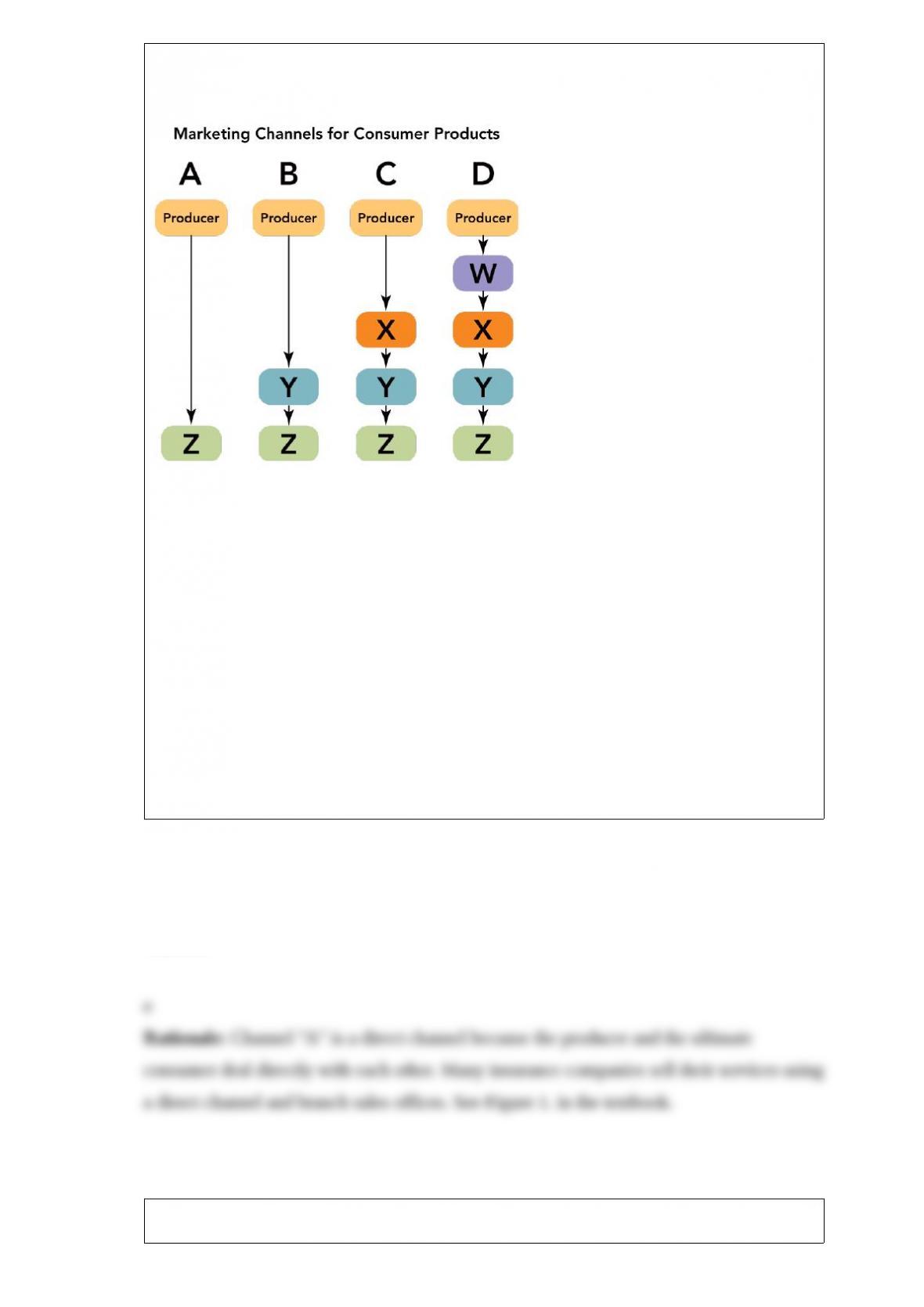
Figure 1.
Figure 1. above depicts four common marketing channels for consumer products and
services that differ by the kind and number of intermediaries. Channel “A” would be an
appropriate marketing channel for which of the following?
a. automobiles
b. jewelry
c. construction machinery
d. candy
e. insurance products
Answer:
Generally, as the proportion of middle-income households in a country increases, the
nation’s purchasing power __________.
a. levels off
b. decreases
c. increases
d. becomes less of an economic priority
e. becomes progressively unstable
Answer:
Which of the following statements regarding when and where online consumers shop
and buy is most accurate?
a. Twenty percent of online sales occur Monday through Friday.
b. The busiest shopping day is Wednesday.
c. Favorite websites for workday shopping and buying include those featuring health
and beauty items, and apparel and accessories.
d. Some 20 percent of consumers say they visit websites from work.
e. Most people buy online when they are depressed.
Answer:
A manufacturer’s branding strategy in which a distinct brand name is given to each of
its products is referred to as __________.
a. multiproduct branding
b. generic branding
c. product differentiation branding
d. mixed branding
e. multibranding
Answer:
Which of the following new products is the best example of the lowest level of risk
from the company’s point of view?
a. adding Chocolate Cheerios in addition to traditional Cheerios
b. moving from land-line telephones to cell phones
c. marketing the first Apple computer
d. changing the formula from Coca-Cola to new Coke and then back to Coca Cola
Classic
e. offering online marketing classes
Answer:
Advertising, sales promotion, and public relations are often said to use _________
because they are used with groups of prospective buyers.
a. cooperative selling
b. mass selling
c. customized selling
d. collection selling
e. bulk selling
Answer:
Self-regulatory efforts to respond to online consumers’ concerns about privacy and
security include
a. eliminating the use of cookies on marketing websites.
b. prohibiting the collection of online consumers’ personal and financial information.
c. awarding the TRUSTe trademark to companies that comply with privacy standards.
d. lobbying against the adoption of federal Internet privacy laws.
e. relying on the U.S. government to protect online consumer privacy.
Answer:
The element of the marketing mix that describes a means of getting the product to the
consumer is known as
a. a product.
b. the price.
c. promotion.
d. the place or distribution.
e. transportation.
Answer:
Google purchased _________, an advertising exchange where websites put space up for
auction and ad agencies bid to place ads for their clients.
a. YouTube
b. ClickBot
c. eBay
d. DoubleHit
e. DoubleClick
Answer:
Cookies refer to
a. computer files that a marketer can download onto the computer of an online shopper
who visits the marketer’s website.
b. embedded programs that flash split-second subliminal messages at regular intervals.
c. benign threads that direct a customer to alternate websites that might be of interest to
them.
d. embedded programs that follow a user’s path from one site to another in order to
determine where else a customer shops.
e. spyware used to retrieve personal information from a person’s computer.
Answer:
Attributes such as imagination and problem-solving ability, strong work ethic, honesty,
intimate product knowledge, effective communication and listening skills, and
attentiveness reflected in responsiveness to buyer needs and customer loyalty and
follow-up are found in a __________.
a. job analysis
b. job description
c. statement of credentials
d. statement of qualifications
e. statement of experience
Answer:
The purpose of the introduction of 3M Post-it Flag Highlighters was to
a. stay ahead of trends and focus its marketing program on only one segment.
b. stay ahead of trends and focus its marketing program on two mutually inclusive
segments.
c. increase production economies of scale by reducing manufacturing and marketing
costs for Post-it Flags and Post-it Notes.
d. preempt a competitive move by Sanford’s Sharpie to introduce a similar product.
e. help college students with their studying.
Answer:
Almost all countries have some division of social class. The determining factor for the
assignment to one of these classes may differ from country to country. For example, in
the United States, the primary determining factor is occupation; in India, it is birthright;
in China, it is geographical region and education; and in Singapore, it is income. These
differences are best explained in terms of a country’s
a. cultural mores.
b. beliefs.
c. customs.
d. religion.
e. values.
Answer:
A __________ is the simplest sales organizational structure, in which the United States,
or indeed the globe, is first divided into regions and then each region is divided into
districts or territories.
a. product organization
b. customer sales organization
c. geographic sales organization
d. demographic sales organization
e. NAICS sales organization
Answer:
A break-even chart refers to a graphic presentation
a. that shows the maximum number of units that will be sold at a certain price.
b. of a break-even analysis that shows when total revenue and total cost intersect to
identify profit or loss for a given quantity sold.
c. that relates variable costs in terms of product or service substitutes in order to
determine which items or services would least affect total revenues.
d. that relates profits and revenues versus total costs in order to determine the time
frame in which a company could achieve profitability.
e. in the form of a scatter graph used to identify specific activities or items that are
creating the greatest return on investment.
Answer:
Lava.com is an Internet company that helps other organizations implement marketing
strategies that they hope will let them dominate their industry. Lava’s advertising, states,
“We ignore the rules, and we let no obstacle stand in your company’s wayno matter how
bold or impossible your idea may seem.” The company is composed of eighteen bright
young Internet experts. They work in one large room, which also contains dartboards, a
pool table, and a meditation center. If you were to walk into the office, it would be next
to impossible to tell the company owners from its lowest ranking employee. This best
describes the Internet company’s
a. modus operandi.
b. mission or vision.
c. socialization process.
d. business definition.
e. corporate culture.
Answer:
Market penetration refers to the marketing strategy of

a. selling current products to new markets.
b. selling new products to new markets.
c. selling new products to current markets.
d. selling the same brands in both current and new markets.
e. increasing sales of current products in current markets.
Answer:
A global marketing strategy refers to
a. the strategy of transnational firms not to employ adaptive marketing techniques when
there are cultural differences, but to redefine their target markets instead.
b. the strategy of transnational firms not to employ adaptive marketing techniques when
there are cultural differences, but to redirect their marketing resources towards customer
education.
c. the strategy of transnational firms that employ the practice of standardizing
marketing activities when there are cultural similarities and adapting them when
cultures differ.
d. the strategy of seeking out already established firms in other nations and selling them
the rights to manufacture and distribute the firm’s products through host nation’s
established infrastructure.
e. the strategy currently used by most U.S. domestic firms that when entering a new
international market, these firms offer only those products that require the least amount
of product adaptation or consumer education.
Answer:
Amazon.com is an Internet retailer located in the U.S. About 45 percent of its sales are
to customers who live outside the United States. This shows how electronic commerce
contributes to customer value through the creation of __________.
a. service utility
b. place utility
c. possession utility
d. form utility
e. time and possession utility
Answer:
Marketers can use one of two strategies: the first strategy uses Groupon and Living
Social Deals, and the second strategy uses ads in newspapers, magazines, and on TV.
The difference between these two types of marketing strategies is that the first one
targets consumers who are __________ and the second one targets consumers who are
__________.
a. “passive receivers”; “active receivers”
b. an older demographic; a younger demographic
c. wealthy; disadvantaged
d. “active receivers”; “passive receivers”
e. disadvantaged; wealthy
Answer:
A retailer-sponsored cooperative refers to
a. small, independent retailers forming an organization that operates a wholesale facility
cooperatively.
b. a vertical marketing system that involves a contractual relationship between a
wholesaler and small independent retailers to standardize and coordinate buying
practices, merchandising programs, and inventory management.
c. an agreement among small, privately owned manufacturers to pool their resources by
sharing installations, heavy equipment, and warehousing that they would be unable to
afford on their own.
d. an agreement among retailers to pool their resources by purchasing services such as
signage, snow removal, and trash removal that affects the physical space (mall, strip
mall, main street, etc.) they all share.
e. small, independent retailers that pool their resources to purchase cooperative
advertising.
Answer:
To develop a successful marketing plan for a soft drink soda, the process of
__________ would most likely be used to group consumers on the basis of whether
they wanted sugar-free and caffeine-free soda, caffeine-free sugared soda, or regular
soda with sugar and caffeine.
a. market aggregation
b. product segmentation
c. customer grouping
d. mass marketing
e. market segmentation
Answer:
Which of the following is the best marketing strategy for promoting Betty Crocker
products using social media?
a. create “Betty Cooks,” a blog featuring recipes for trendy dishes using Betty Crocker
products.
b. monitor e-mail for customer complaints and respond promptly with a 50% discount
coupon
c. hold a cooking contest to generate new recipes using Betty Crocker products
d. produce commercials incorporating images of Betty Crocker cooking with Julia
Child
e. produce a movie featuring a female or male cooking her/his way through all the
recipes in the latest edition of the Betty Crocker cookbook
Answer:
Average revenue is
a. the typical or average sales generated for all items within an industry.
b. the average amount of revenue necessary for a business to remain profitable.
c. total revenue divided by the quantity sold.
d. the difference between the highest and lowest price charged for a given item within a
specific firm.
e. the difference between the highest and lowest price charged for a given item within a
specific industry.
Answer:

U. S. Army Ad
The U.S. Army ad shown above is an example of a(n) __________ advertisement.
a. reminder institutional
b. competitive institutional
c. pioneering institutional
d. advocacy
e. subliminal institutional
Answer:
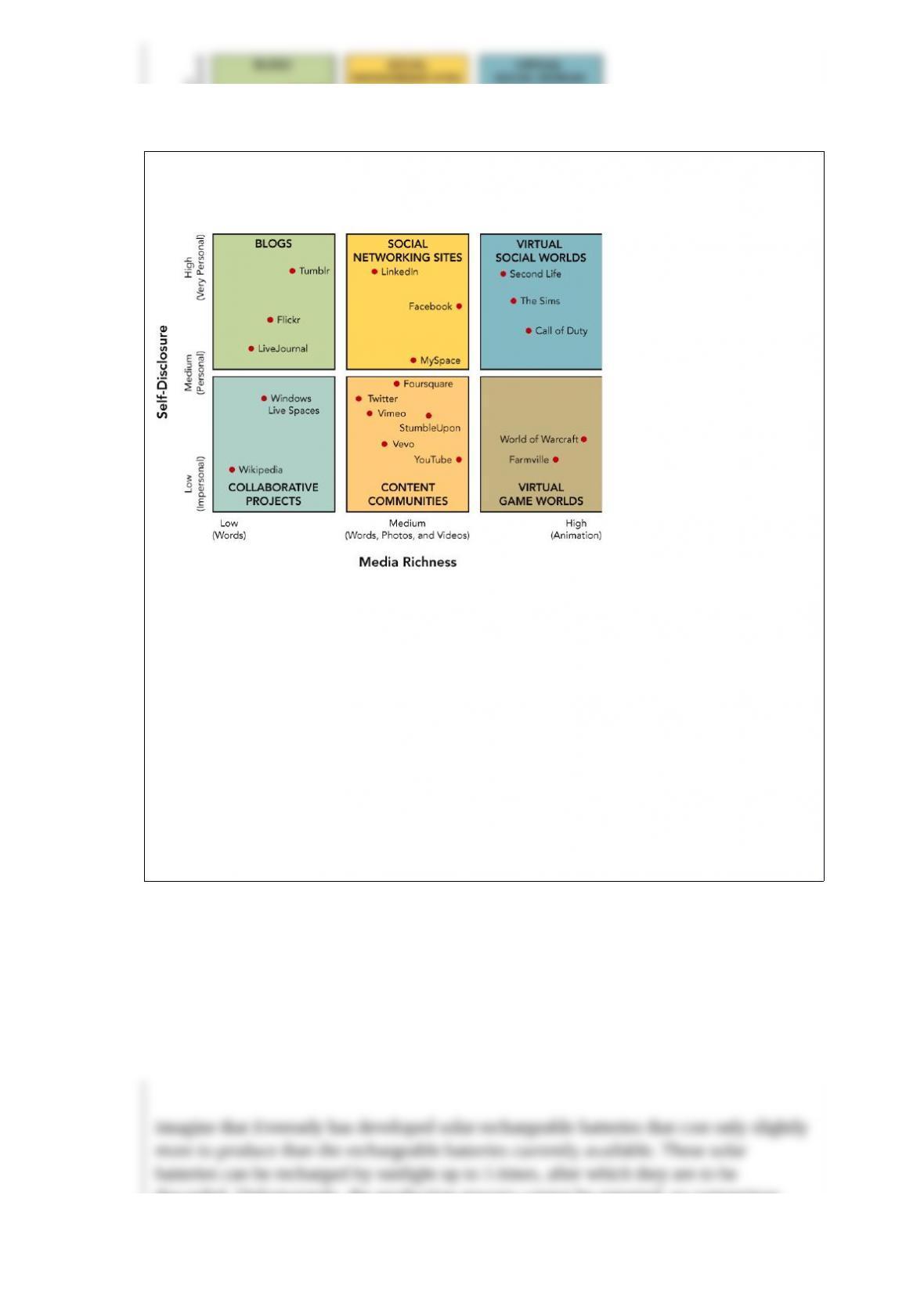
Figure 1.
Based on the social media identified in Figure 1. above, Foursquare is seen as
a. low in self-disclosure and low in media richness.
b. low in self-disclosure and medium in media richness.
c. high in self-disclosure and high in media richness.
d. medium in self-disclosure and medium in media richness.
e. low in self-disclosure and high in media richness.
Answer:
Imagine that Eveready has developed solar rechargeable batteries that cost only slightly
more to produce than the rechargeable batteries currently available. These solar
batteries can be recharged by sunlight up to 5 times, after which they are to be
discarded. Unfortunately, the production process cannot be patented, so competitors
could enter the market within a year. Which of the following is the best description of
the product life cycle of this product?
a. rapid growth followed by rapid decline
b. long, level beginning, and rapid ascent
c. moderately slow introduction, followed by modest growth, gradually leveling off
d. high introductory sales, with rapid decline
e. high initial sales followed by slow decline
Answer:
A product item refers to
a. the variations within a product class.
b. the entire product category or industry.
c. a group of SKUs that are closely related.
d. a specific product that has a unique brand, size, or price.
e. the services offered by an organization.

Answer:
Marketers use three approaches to try to change consumer attitudes toward products
and brands: (1) changing beliefs about the extent to which a brand has certain attributes;
(2) changing the perceived importance of attributes; and (3) __________.
a. reinforcing the consumers’ sense of self confidence in making wise purchase
decisions
b. adding new attributes to the product
c. refocusing a consumer’s attention from one attribute to another
d. actively educating consumers about the product’s competitive advantages
e. denigrating the attributes of competitors’ products
Answer:
A collection of databases that store, organize, and manage data sources is called a
_________.
a. data vault
b. data warehouse
c. data depot
d. data storehouse
e. data stockroom
Answer:
Economists have identified four types of competitive markets: pure monopoly, pure
competition, oligopoly, and __________.
a. capitalism
b. socialism
c. monopolistic competition
d. consumer-dominated
e. government-dominated
Answer:

When Rose went shopping for a new purse, she thought she had found a real valuea
Gucci purse for about 50% of what she was planning to pay. When she looked more
closely, she noticed that the purse was identical to a Gucci but was not manufactured by
Gucci. This was most likely an example of __________.
a. product counterfeiting
b. brand licensing
c. co-branding
d. brand imitation
e. re-manufacturing
Answer:
In the VALS framework, consumers who are looking for products and services that
demonstrate success to their peers or to a peer group they aspire to are called a(n)
a. ideals-motivated group.
b. rewards-and-success-motivated group.
c. self-expression-motivated group.
d. achievement-motivated group.
e. high-and-low-resource group.
Answer:
A market-product grid relates the market segments to the products offered or potential
marketing actions. With respect to pillows, what would be the most effective way to
segment the pillow market? One should segment this market by
a. the age of the sleeper: less than 18 years of age, 18 to 44 years of age, or 45 years and
older.
b. the sleeper’s annual income: less than $25,000, $25,000 to $49,999, or $50,000 and
over.
c. the sleeper’s gender: male or female.
d. whether the sleeper has sleeping problems: yes or no.
e. how the sleeper sleeps: side, back,or stomach.
Answer:
What is meant by the term economic infrastructure and how can this affect a firm’s
plans to enter a global market?
Answer:
What is the difference between noncumulative and cumulative quantity discounts?
Answer:
What is the difference between a patent and a copyright?
Answer:
MasterCard International links usage of its card with fund raising for institutions that
combat cancer, heart disease, child abuse, and muscular dystrophy. MasterCard gives a
modest percentage of charges from its credit card charges to the institutions. What is
this called and how does it affect cardholders’ behavior?
Answer:
What are the characteristics of the organizational buying process?
Answer:
With respect to consumer product and service marketing channels, what are the key
differences between a direct and an indirect channel?
Answer:
What is the retailing mix?
Answer:
In the process of setting price, a marketer must first identify pricing objectives and
constraints. Next, in Step 2, three specific estimates are necessary. What are they?
Answer:
Discuss licensing. Define it, give the advantages and disadvantages, and explain what
contract manufacturing, contract assembly, and franchising are.
Answer:
Briefly describe the three levels of service offered by retail outlets.
Answer:
What are the six broad objectives that an organization may pursue that tie in directly to
its pricing policies?
Answer:
Briefly define what is meant by a product. Explain the characteristics that would define
a good and a service. Give an example of each.
Answer:
As the brand manager, how would you use social media to drive traffic to the Bitter
Girls website?In your answer, include your rationale for using each type of social
media.
Answer:
What is a product placement? Provide an example of a reverse product placement.
Answer:
Marketing managers often use break-even analysis to analyze the relationship between
total revenue and total cost to determine profitability at various levels of output. What is
the break-even formula? Use the formula to calculate how many DVD players a dealer
must sell if her fixed costs are $100,000, unit variable costs are $150, and the selling
price is $200.
Answer:
Explain what a Gantt chart is and how it is used.
Answer:
Compare and contrast routine problem solving, limited problem solving, and extended
problem solving. Give an example of when each might be used.
Answer:
Price elasticity of demand measures how sensitive consumer demand and the firm’s
revenues are to changes in the product’s price. Explain the difference between a product
with elastic demand and a product with inelastic demand.
Answer:
There are three actions a marketing manager must take in the final step of the five-step
marketing research approach. What are they?
Answer: