Which of the following statements about Hispanic buying patterns is most accurate?
A. Hispanics are often brand loyal and willing to pay a premium price for premium
quality.
B. Hispanic buying preferences are strongly influenced by contemporary fads and
fashions.
C. Hispanics are dubious about using advertising as an information source.
D. Convenience is an essential product attribute for Hispanic homemakers with respect
to food preparation or consumption.
E. Uniquely Hispanic buying patterns have virtually disappeared over the past ten years
due to increased assimilation.
Answer:
About 60 percent of U.S. companies now include __________ as a behavioral measure
of salesperson performance.
A. the ability to read body language
B. customer satisfaction
C. suggestive selling skills
D. emotional intelligence
E. cold canvassing skills
Answer:
A picture or verbal description of a product or service a firm might offer for sale is
referred to as a(n)
A. constraint.
B. exemplar.
C. new-product concept.
D. test offering.
E. protocol.
Answer:
YouTube would be an excellent social network to advertise all of the following products
EXCEPT:
A. power tools.
B. financial services.
C. cars.
D. men’s cologne.
E. blenders.
Answer:
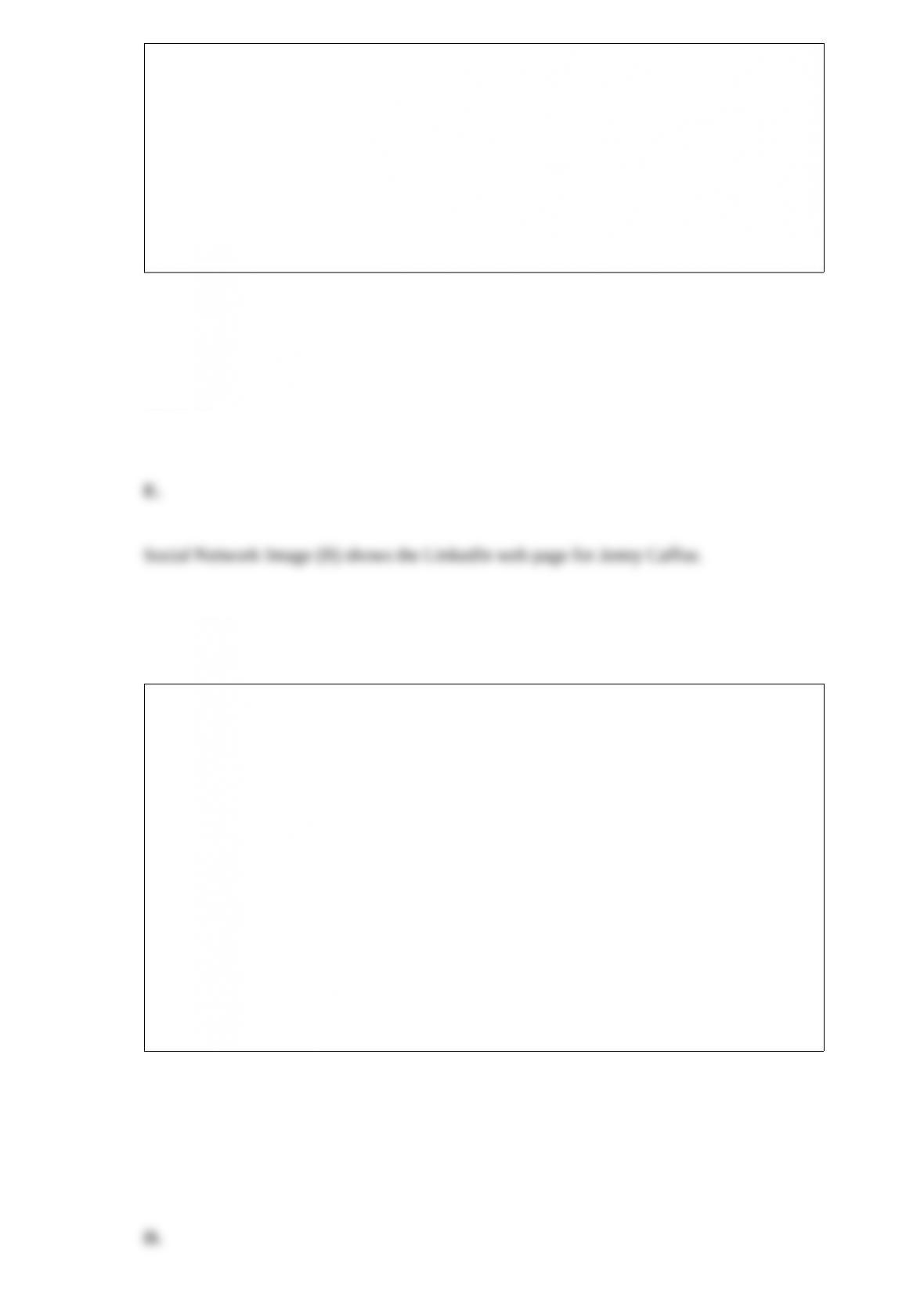
Social Network Image (B)
Social Network Image (B) above shows the __________ web page for college student
and StuffDot intern Jenny Caffoe, which allows her to search for other internships or
permanent work after graduation.
A. YouTube
B. Pinterest
C. Twitter
D. Facebook
E. LinkedIn
Answer:
Marketers pay slotting fees to grocers in payment for space – or slots – on their retail
shelves. Such slotting fees significantly increase the cost of which stage of the
new-product process?
A. business analysis
B. market testing
C. screening and evaluation
D. commercialization
E. idea generation
Answer:
In 1970, the typical U.S. household earned about $8,700. In 2012, the typical U.S.
household earned about $51,017. If adjusted for inflation, the gross income of the
typical U.S. household in 2011 relative to 1970 has __________.
A. increased dramatically
B. increased somewhat
C. remained relatively stable
D. decreased somewhat
E. decreased dramatically
Answer:
Customer relationship management refers to
A. the view that organizations should satisfy the needs of consumers in a way that
provides for society’s well being.

B. the process of identifying prospective buyers, understanding them intimately, and
developing favorable long-term perceptions of the organization and its offerings so
buyers will choose them in the marketplace.
C. the idea that an organization should (1) strive to satisfy the needs of consumers (2)
while also trying to achieve the organization’s goals.
D. the links an organization has to its individual customers, employees, suppliers, and
other partners for their mutual long-term benefit.
E. the cluster of benefits that an organization promises customers to satisfy their needs.
Answer:
Which of the following statements about strategy is most accurate?
A. An organization can be all things to all people because it has access to all the
resources it needs to discover and satisfy the needs and wants of its target markets.
B. The marketing department helps to both set an organization’s direction and move it
there.
C. The American Marketing Association (AMA) recently has established the definition
of strategy.
D. Strategy is an organization’s short-term course of action designed to deliver a
specific customer experience while achieving its internal standards.
E. Only start-up organizations must develop strategies to help them raise capital as well
as focus and direct their efforts to accomplish their goals.
Answer:

Beliefs refer to
A. a person’s consistent behaviors or responses to recurring situations.
B. a learned predisposition to respond to an object or class of objects in a consistently
favorable or unfavorable way.
C. the process by which an individual selects, organizes, and interprets information to
create a meaningful picture of the world.
D. a consumer’s subjective perception of how a product or brand performs on different
attributes.
E. the moral and ethical precepts that guide a person’s behavior.
Answer:
Some __________ of online consumers say they visit websites from their place of
work, which partially accounts for the sales level during the workweek.
A. 30%
B. 40%
C. 50%
D. 60%
E. 70%
Answer:
While watching TV one evening, your stomach growls. You see an ad for Subway. You
walk to the Subway shop and buy a sandwich, which tastes great. In terms of behavioral
learning, seeing a TV ad for Subway is a __________.
A. drive
B. reinforcement
C. cue
D. response
E. prompt
Answer:
The Japanese manufacture tractors for rice paddies. They are smaller than most U.S.
tractors and perfect for a weekend farmer who wants to tend to a small garden. The
tractors are not sold in the United States through any authorized channels, yet they are
available in the U.S. at prices below the manufacturer’s suggested retail price. These
Japanese tractors are being sold
A. through the gray market.
B. under the table.
C. over the counter.
D. with bypassed global channels.
E. by breaking the distribution monopoly.
Answer:
The fourth and last step in the sequential process of building brand equity is to
__________.
A. develop positive brand awareness
B. establish a brand’s meaning in the minds of consumers
C. elicit the proper consumer responses to a brands identity and meaning
D. create an intense, active, and loyal consumer-brand connection
E. reward loyal customer behavior
Answer:
Those in favor of protectionism argue that it
A. helps reduce tariffs and quotas.
B. encourages the development of domestic industries.
C. encourages economic reliance on foreign countries.
D. creates opportunities for the outsourcing of domestic jobs.
E. creates a more favorable environment for a global economy.
Answer:
You are selling a new line of T-shirts on the boardwalk. The selling price will be $25
per shirt. The labor cost is $5 per shirt. The administrative costs of operating the
company are estimated to be $60,000 annually and the sales and marketing expenses
are $20,000 a year. Additionally, the cost of materials will be $10 per shirt. What is the
break-even quantity?
A. 2,000 shirts
B. 3,200 shirts
C. 5,334 shirts
D. 8,000 shirts
E. 16,000 shirts
Answer:
A marketing channel relies on __________ to make products available to consumers
and industrial users.
A. logistics
B. strategic distribution
C. strategic marketing planning
D. supply chains
E. value chain optimization
Answer:
In terms of scheduling advertising, purchase frequency refers to
A. the number of times a buyer tries a product before becoming a brand loyal customer
of the firm’s product.
B. the number of times a buyer purchases a product during its life cycle.
C. how often a consumer will try competitive brands before becoming a brand loyal
customer of the firm’s product.
D. how frequently a product is purchased over a particular time period.
E. the idea that the more frequently the product is purchased, the less advertising
repetition is required.
Answer:
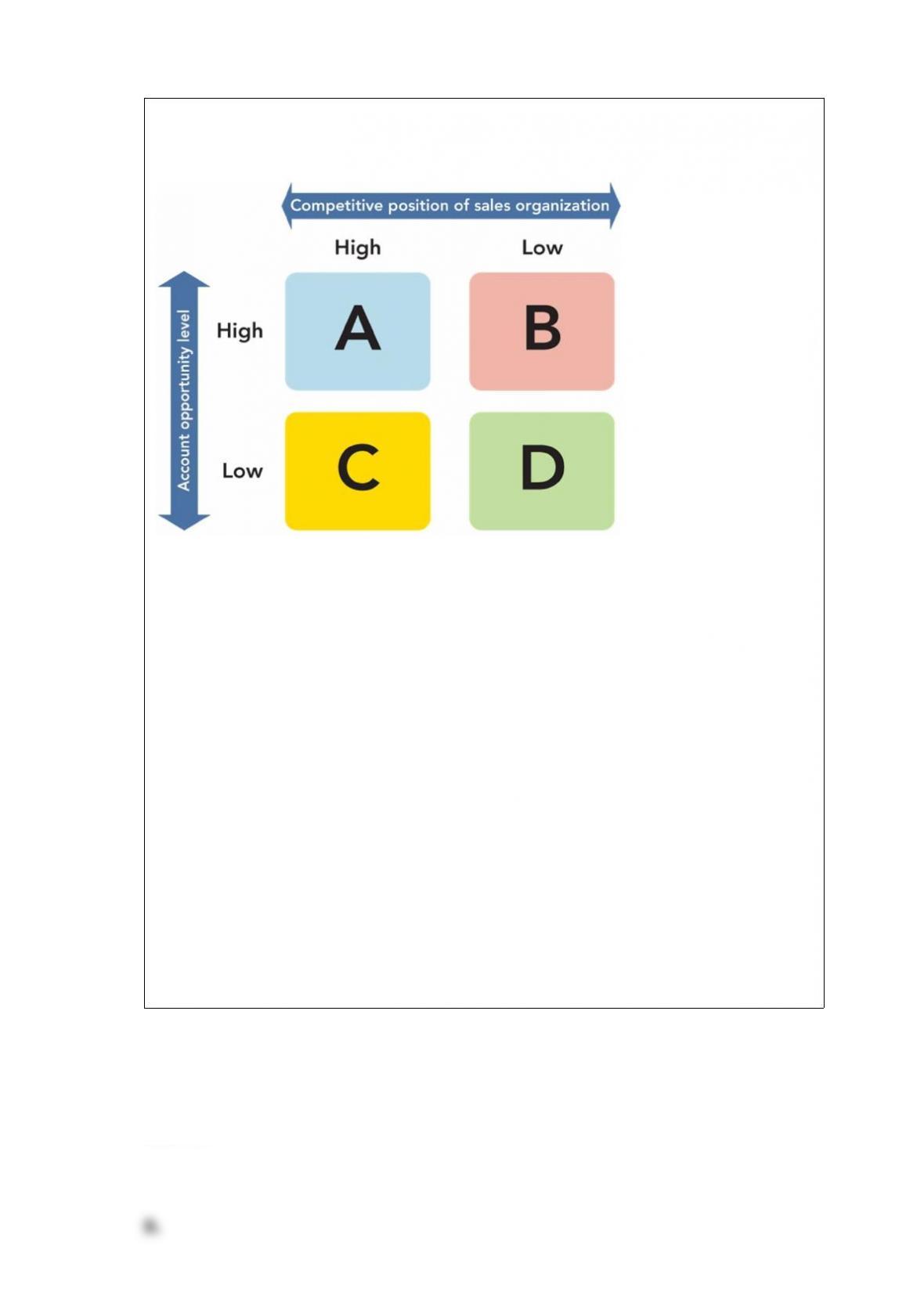
Figure 17-4
Consider Figure 17-4 above, which is an account management policy grid that groups
customers according to the level of opportunity and the firm’s competitive sales
position. D represents which account management policy?
A. accounts that should emphasize a heavy sales organization position or shift resources
to other accounts if a stronger sales organization position is impossible
B. accounts that the firm should consider replacing personal calls with telephone sales
or direct mail to service accounts
C. accounts offer little opportunity and the sales organization position is weak
D. accounts that should receive a high level of sales calls and service to retain and
possibly build accounts
E. accounts that should receive moderate level of sales and service to maintain current
position of sales organization
Answer:
SBUs with a low share of slow-growth markets that may generate enough cash to
sustain themselves but do not hold the promise of ever becoming real winners for the
organization are referred to as __________.
A. dogs
B. cash cows
C. stars
D. question marks
E. hedgehogs
Answer:
A salesclerk at L.L. Bean uses a __________ when he asks a customer if she also needs
a pair of hiking socks with the purchase of her mountain boots.
A. stimulus-response presentation
B. transactional sales presentation
C. need-satisfaction selling
D. consultative selling
E. formula-selling
Answer:
Any container in which a product is offered for sale and on which information is
communicated is referred to as __________.
A. a point of purchase display
B. merchandising
C. packaging
D. a label
E. a product bundle
Answer:
SHAPE magazine is targeted at young women seeking healthier lifestyles. At a price of
$3.00 per copy, 1.25 million copies are sold. If the price per issue is increased to $3.25,
only 1 million copies would be sold. Fixed costs are $1 million and unit variable costs
are $0.50 per magazine. From the information provided here, what is SHAPE
magazine’s total revenue obtained at the lower $3.00 price?
A. $3,750,000
B. $3,250,000
C. $3,000,000
D. $2,125,000
E. $1,750,000
Answer:
Business researchers emphasize that firms must actively involve customers and
suppliers in the new-product development process. This means that the focus should be
on what the new product will __________ rather than simply what they want.
A. look like
B. cost them
C. do for them
D. feel like
E. consist of in terms of new features
Answer:
A channel that includes intermediaries that are between the producer and consumers
and perform numerous channel functions is referred to as a(n)
A. indirect channel.
B. direct channel.
C. multilevel channel.
D. full-service channel.
E. limited-service channel
Answer:

An Internet-enabled digital environment characterized by face-to-screen exchange
relationships and electronic images and offerings is referred to as a(n) __________.
A. extranet
B. intranet
C. marketplace
D. marketspace
E. web portal
Answer:
Stakeholder responsibility refers to
A. the view that an organization has an obligation to those who can affect the
achievement of its objectives.
B. the obligation of a firm to price its products or services at a level whereby the
consumer is treated fairly and the firm is still able to make a profit.
C. the duty of a firm to maximize profits for its owners or stockholders.
D. the concept that no expansion or additional research and development will occur
until a company is making a profit.
E. the idea that organizations are part of a larger society and are accountable to that
society for their actions.
Answer:
Factors influencing personal moral philosophy and ethical behavior include societal
culture and norms, business culture and industry practices, and __________.
A. religious beliefs and practices
B. corporate culture and expectations
C. national and regional legislation
D. universal core values
E. the universal concept of good vs. evil
Answer:
Grouping potential buyers into meaningful segments involves meeting some specific
criteria that answer the following question:
A. “Is this product useful on a global scale?”
B. “Is it possible to reposition this product?”
C. “Is there too much competition for this product?”
D. “Is the market loyal to the product?”
E. “Would segmentation be worth doing and is it possible?”
Answer:
What market entry option allows a company to make the least number of changes in
terms of its product, its organization, and even its corporate goals?
A. exporting
B. licensing
C. joint venture
D. direct investment
E. franchising
Answer:
Many airlines now have terminals that allow you to check yourself in for your flight
electronically upon your arrival at the airport. This is an example of what level of
service?
A. limited-service
B. non-service
C. reduced-service
D. restricted-service
E. self-service
Answer:
All of the following are true about marketing EXCEPT:
A. Marketing is a broader activity than advertising.
B. Marketing stresses the importance of delivering genuine benefits in the offerings of
goods, services, and ideas sold to customers.
C. Marketing persuades people to buy the “wrong” things.
D. When an organization engages in marketing, all stakeholders should benefit.
E. Marketing is a broader activity than personal selling.
Answer:
Which of the following characterizes organizational buyer-seller relationships?
A. Purchases are often made after lengthy or complex negotiations.
B. Purchases are usually of small dollar values.
C. Short-term contracts are often prevalent.
D. Reciprocal arrangements are illegal.
E. Delivery schedules are less important than production capacity.
Answer:
Companies like Hewlett-Packard and Frito-Lay routinely monitor blogs to gain insight
into
A. popular trends among members of the over-65 market.
B. technological advancements that can be used to promote their brands.
C. new slang terms to create more effective advertisement copy.
D. recruiting prospective employees.
E. customer complaints and suggestions.
Answer:
Walmart asked that Procter & Gamble (P&G) electronically link to its computerized
cash register scanning system, allowing for direct electronic ordering and replenishing
for all of its stores. This way, Walmart can tell P&G what merchandise it needs, along
with how much, when, and to which store to deliver on a daily basis. Walmart is
engaged in __________.
A. ISO 9000 certification
B. ISO 14000 certification
C. a supply partnership
D. sustainable development
E. cause marketing
Answer: