
The added value a brand name gives to a product beyond the functional benefits
provided is referred to as __________.
a. brand cach
b. brand net worth
c. brand equity
d. brand benefit
e. brand enhancement
Answer:
The marketing concept refers to
a. the activity for creating, communicating, delivering, and exchanging offerings that
benefit its customers, the organization, its stakeholders, and society at large.
b. the belief that an organization should focus its efforts on (1) continuously collecting
information about customers’ needs, (2) sharing this information across departments,
and (3) using it to create customer value.
c. the view that organizations should satisfy the needs of consumers in a way that
provides for society’s well-being.
d. the process of identifying prospective buyers, understanding them intimately, and
developing favorable long-term perceptions of the organization and its offerings so that
buyers will choose them in the marketplace.
e. the idea that an organization should (1) strive to satisfy the needs of consumers (2)
while also trying to achieve the organization’s goals.
Answer:
Business portfolio analysis refers to
a. a tool that helps a firm search for growth opportunities from among current and new
markets as well as current and new products.
b. a technique that managers use to subjectively evaluate performance measures and
growth targets to analyze their firm’s strategic business units (SBUs) as though they
were a single expense.
c. a technique that managers use to quantify performance measures and growth targets
to analyze their firm’s strategic business units (SBUs) as though they were a collection
of separate investments.
d. an analysis that uses percentage points of market share as the common basis of
comparison to allocate marketing resources effectively for different product lines within
the same firm.
e. a tool that seeks opportunities by finding the optimum balance between marketing
efficiencies versus R&D”manufacturing efficiencies.
Answer:
In terms of brand loyalty, consumers are aware of a brand but will readily accept
substitutes for which type of product?
a. convenience products
b. specialty products
c. unsought products
d. shopping products
e. supplies
Answer:
Which of the following statements should the salesperson use to postpone a prospect’s
objection?
a. “I think I might be able to explain that better to you after showing you this diagram.”
b. “Yes, you”re right, it is lighter but that is done intentionally to make your work
easier.”
c. “That’s true. It does have a shorter shelf life, but that really hasn”t been a problem. It
is so popular it never stays on the shelf that long anyway.”
d. “Where did you hear that? Your source must have erroneous information.”
e. “As I was saying, .”
Answer:
Economists have identified four types of competitive markets: pure monopoly,
monopolistic competition, pure competition, and __________.
a. capitalism
b. socialism
c. consumer-dominated
d. oligopoly
e. government-dominated
Answer:
Convenience products refer to
a. items that consumers will make special efforts to seek out and buy.
b. items for which consumers compare several alternatives on criteria such as price,
quality, or style.
c. products consumers purchase frequently, conveniently, and with a minimum of
shopping effort.
d. ancillary products used to make other products work more efficiently.
e. low-cost items for which there are numerous substitutes and generic equivalents.
Answer:
The ________ presentation is a selling format that emphasizes probing and listening by
the salesperson to identify the needs and interests of prospective buyers.
a. formula selling
b. stimulus-response
c. marketing concept
d. relationship selling
e. need-satisfaction
Answer:
It had been the Campbell Soup Co.’s practice to insert clear glass marbles into the
bottom of soup containers used in print advertisements to bring the soup ingredients
(e.g., noodles or chicken) to the surface, thus misrepresenting the amount of solid
ingredients in the soup. This was an example of
a. corrective advertising.
b. bait-and-switch advertising.
c. deceptive advertising.
d. cease-and-insist advertising.
e. self-regulation.
Answer:
The Dell EC 280 is a small desktop computer that uses less electrical power and is
targeted at the less affluent, but very large Chinese market that has never owned a
personal computer. The PC was introduced at a price of $340 for a basic configuration.
Dell most likely used which pricing strategy in this example?
a. penetration pricing
b. cost-plus pricing
c. target ROI pricing
d. below-market pricing
e. skimming pricing
Answer:
Smucker’s is always near the top of the Fortune list of the 100 Best Companies to Work
For. Its straightforward culture is based on four key elements in its code of conduct: (1)
“Listen with your full attention”; (2) “Look for the good in others”; (3) __________;
and (4) “Say thank you for a job well done.”
a. “Be kind to all”
b. “Take your time”
c. “Learn to relax”
d. “Have a sense of humor”
e. “Remember, everyone makes mistakes”
Answer:
An order getter refers to __________.
a. a salesperson who specializes in identifying, analyzing, and solving customer
problems, but who does not actually sell products and services
b. a salesperson who processes routine orders or reorders for products that are presold
by the outbound telemarketers
c. a salesperson who sells in a conventional sense and identifies prospective customers,
provides customers with information, persuades customers to buy, closes sales, and
follows up on customers’ use of a product or service
d. a person on the selling team who is responsible for obtaining qualified leads
e. a member of the sales support team who does not directly solicit orders but rather
concentrates on performing promotional activities and introducing new products
Answer:
Companies can employ four general branding strategies, which include: (1)
multiproduct branding; (2) __________; (3) private branding; and (4) mixed branding.
a. multibranding
b. retailer branding
c. intermediary branding
d. brand licensing
e. co-branding
Answer:
A __________ is common in the employment services and tax services industries where
franchisors license individuals or firms to dispense a service under a trade name and
specific guidelines.
a. service-sponsored franchise system
b. service-sponsored retail franchise system
c. manufacturer-sponsored wholesale franchise system
d. manufacturer-sponsored retail franchise system
e. administered vertical marketing system
Answer:
After conducting a value analysis, a company is hopefully able to
a. identify product defects.
b. reduce purchasing costs.
c. increase product value.
d. evaluate the merits of one product in relation to that of its competitor(s).
e. determine a fair but profitable price for purchased products.
Answer:
Which of the following trends identified in an environmental scan is a technological
trend?
a. New smartphone apps, such as mobile location promotion, quick response (QR)
codes, and mobile payments will become increasingly more available.
b. Customer-generated content is growing as a competitive advantage.
c. The slow recovery of the current recession is leading to sustained higher levels of
unemployment.
d. Online privacy protection advocacy and regulation will continue to grow.
e. Social networks are becoming the dominant form of communication for consumers.
Answer:
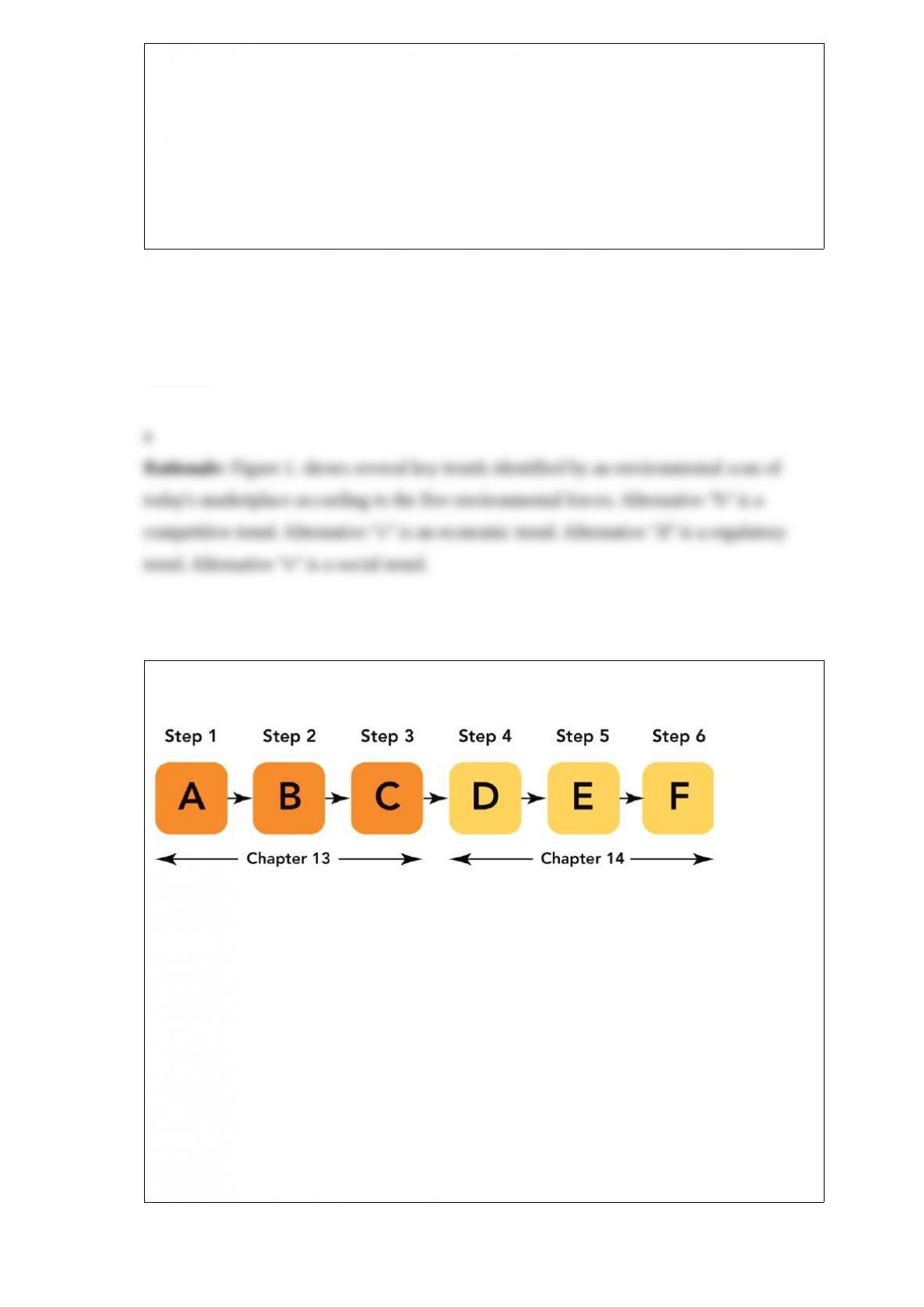
Figure 1.
Figure 1. above represents the six steps in the price-setting process. Which letter
represents the step where a firm would make geographical adjustments?
a. “D”
b. “B”
c. “E”
d. “F”
e. “C”
Answer:
QVC is a television home shopping network. It generates sales of more than $7 billion
from its 60 million customers by
a. restricting purchases only through its Mall of America studio.
b. broadcasting live twelve hours a day 365 days a year.
c. offering more than 1,150 products each week.
d. offering overstocked items from retailers at a fraction of the original cost.
e. running live podcasts and live streaming over the Internet
Answer:
Which problem solving variation would normally be used to purchase items such as
cereal or laundry detergent?
a. limited problem solving
b. extended problem solving
c. routine problem solving
d. situational problem solving
e. integrated problem solving
Answer:
The five roles of individual family members in the purchase decision process are
a. membership group, aspiration group, opinion leader, decision maker, and user.
b. sustainer, experiential, belonger, emulator, and achiever.
c. opinion leader, influencer, decision maker, purchaser, and user.
d. information gatherer, influencer, decision maker, purchaser, and user.
e. need driven, inner directed, outer directed, opinion leader, and decision maker.
Answer:
The successive price cutting by competitors to increase or maintain their unit sales or
market share is referred to as
a. everyday low pricing.
b. a price war.
c. fair trade pricing.
d. a market war.
e. a price reduction.
Answer:
Starbucks is using its purchasing power to continue its quest to reduce its energy usage
by a quarter by the end of 2012. Recently, the company announced plans to replace all
of the traditional incandescent and halogen bulbs in its stores worldwide with more
efficient light emitting diode (LED) bulbsa move the company claims will enable it to
cut energy consumption in its stores by up to 7%. Starbucks would be considered a
leader in
a. ISO 9000 certification.
b. sustainable procurement.
c. cause marketing.
d. ecological procurement.
e. sustainable development.
Answer:
Some retailers now allow consumers to respond to their text messages announcing a
sale for a specified time period. Consumers must then visit the site to purchase the sale
items. Which of the following retailing websites offer these limited time “flash sales?”
a. TextBuyIt
b. Best Buy
c. PeaPod
d. eBay
e. Gilt
Answer:

An approach whereby an organization allocates its marketing mix resources to reach its
target markets is referred to as (the)
a. tactical marketing process.
b. situational analysis.
c. diversification analysis.
d. synergy analysis.
e. strategic marketing process.
Answer:
Consumers spend little time and effort evaluating alternatives in the purchase of table
salt and milk. The consumer purchase decision process for such staples involves
__________, which is virtually a habit and typifies low-involvement decision-making.
a. limited problem solving
b. extended problem solving
c. situational problem solving
d. rational problem solving
e. routine problem solving
Answer:
The first stage in the organizational buying decision process is
a. information search.
b. antecedent states.
c. alternative evaluation.
d. purchase decision.
e. problem recognition.
Answer:
As a salesperson asks questions about a prospect’s transportation system, the prospect
says, “What I really want is reliable transportation at the lowest price I can get.” The
salesperson stops asking questions and pulls out a comparative price list that shows her
company’s transportation is the lowest priced and most reliable on the market. The
salesperson has engaged in __________ selling.
a. adaptive
b. suggestive
c. formula
d. consultative
e. relationship
Answer:
Primary data refer to
a. facts and figures that are newly collected for a project at hand.
b. facts and figures that have already been recorded prior to the project at hand.
c. facts and figures obtained by watching people mechanically rather than in person.
d. facts and figures obtained by either by asking people questions through the use of
information technology.
e. conclusions developed from information obtained from a representative sample of a
population..
Answer:
If Wendy’s customers are buying an eating experience, which of the following
rationales would make the most sense if you were to group the products Wendy’s sells?
a. grouping by product type such as types of drinks
b. grouping by price
c. grouping by meal occasion
d. grouping by usage rate
e. grouping by individual item (hamburgers, fries, etc.)
Answer:
You decide to buy a new car. You talk to friends about it, research mechanical
specifications in Consumer Reports, test drive different makes and models, and
compare prices at several dealerships. Into which classification of consumer products
would your new car purchase fall?
a. shopping product
b. specialty product
c. unsought product
d. discretionary product
e. convenience product
Answer:

Much of Google’s success is based on the ten guidelines of its corporate philosophy.
Guideline 9 states, “You can be serious without __________.”
a. having an attitude
b. a PhD
c. an MBA
d. a suit
e. losing your sense of humor
Answer: