
The description of how new retail outlets enter the market is referred to as the
__________.
a. retail life cycle
b. product life cycle
c. wheel of retailing
d. retail life matrix
e. retail continuum
Answer:
Marketers produce a customer experience through seven website design elements: (1)
context; (2) content; (3) community; (4) __________; (5) communication; (6)
connection; and (7) commerce.
a. customization
b. control
c. consistency
d. collaboration
e. creativity
Answer:
Which type of sales personnel concentrates on performing promotional activities but
generally does not solicit actual sales orders?
a. missionary salespeople
b. sales engineers
c. outside order getters
d. inside order getters
e. outbound telemarketers
Answer:
Microfinance refers to
a. the practice of offering small, collateral-free loans to individuals who otherwise
would not have access to the capital necessary to begin small businesses or other
income-generating activities in exchange for a percentage of future profits rather than
repaying of loans.
b. the practice of offering small, collateral-free loans to individuals who otherwise
would not have access to the capital necessary to begin small businesses or other
income-generating activities.
c. the lending of money contingent upon a daily accounting of all expenditures made
and all income generated.
d. the day-to-day expenses such as coffee for the office, flowers for anniversaries, etc.
that are considered too small or too insignificant to be itemized and instead are listed as
discretionary funds.
e. the expenditures within an individual household assigned to each individual family
member whether they personally generate income or not.
Answer:
According to a recent environmental scan, the United States has spent over $1 trillion
on the war on terrorism since 2001. This expenditure is an example of a(n) __________
force.
a. social
b. economic
c. technological
d. competitive
e. regulatory
Answer:
A department store recently replaced its fabric-covered chairs with oversized leather
couches. This was most likely done to

a. reduce the need to constantly reupholster.
b. create a more natural environment.
c. create a more masculine ambiance for male shoppers.
d. make mothers shopping with small children less nervous.
e. encourage customers to linger longer.
Answer:
An organization with a market orientation
a. focuses its efforts on: (1) continuously collecting information about the environment;
(2) keeping abreast of the actions of its competitors; and (3) using this information to
create customer value.
b. identifies prospective buyers, understands them intimately, and develops favorable
long-term perceptions of the organization and its offerings so that they will choose it in
the marketplace.
c. strives to satisfy the needs of consumers while also trying to achieve its goals.
d. satisfies the needs of consumers in a way that provides for society’s well-being.
e. focuses its efforts on: (1) continuously collecting information about customers’ needs;
(2) sharing this information across departments; and (3) using it to create customer
value.
Answer:
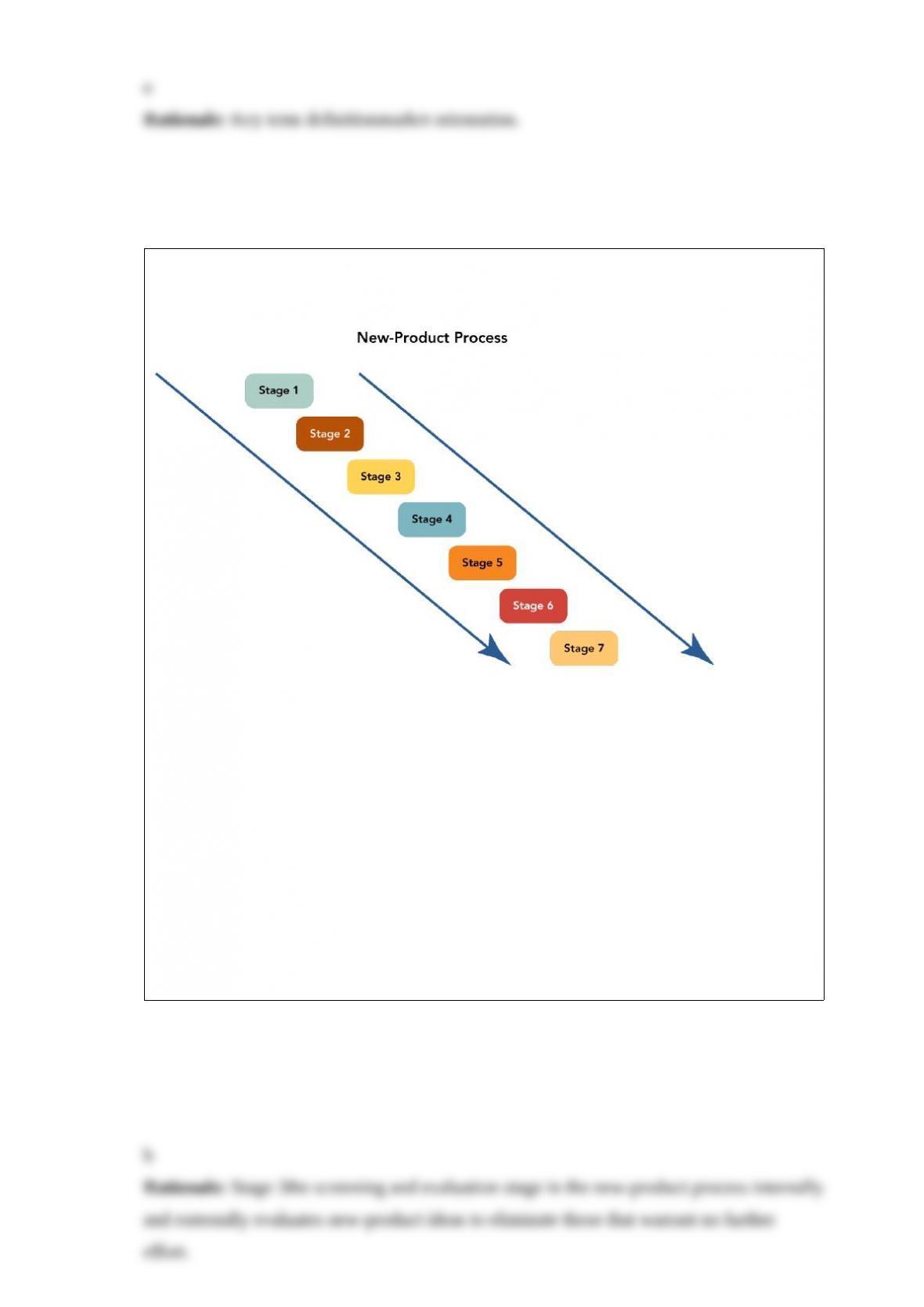
Figure 1.
Figure 1. above represents the seven stages of the new-product development process.
Stage 3 is the __________ stage.
a. idea generation
b. screening and evaluation
c. screening and analysis
d. new-product strategy development
e. product assessment
Answer:
What federal law protects the trademarks of a firm?
a. Sherman Act
b. Landham Act
c. ISO 9000
d. Clayton Act
e. Robinson-Patman Act
Answer:
There are five key dimensions of service quality:
a. reliability, responsiveness, competence, courtesy, and empathy.
b. knowledge, responsiveness, respect, diligence, and honesty.
c. honesty, respect, empathy, reliability, and diligence.
d. reliability, competence, alacrity, fairness, and product knowledge.
e. reliability, tangibility, responsiveness, assurance, and empathy.
Answer:
As organizations have changed their orientation, society’s expectations of marketers
have also changed. Today, the emphasis of marketing practice has shifted from the
interests of __________ to the interests of consumers.
a. society at large
b. government
c. suppliers
d. resellers
e. producers
Answer:
SmartGrid infrastructure, online energy management, and consumer-generated energy
(home wind turbines) best describe examples of today’s (and tomorrow’s) __________
force identified through an environmental scan.
a. sociocultural
b. competitive
c. legal/regulatory
d. technological
e. economic
Answer:
Manufacturers use seasonal discounts to
a. get rid of dated merchandise.
b. prevent retailers from purchasing competitors’ products.
c. prolong the peak seasonal selling season.
d. establish an immediate feeling of goodwill between the buyer and seller that
hopefully will continue when prices return to normal.
e. entice dealers to purchase seasonal merchandise earlier in the selling season.
Answer:
One of the reasons for the continued success of Zappos.com is
a. chat assistance.
b. blog assistance.
c. tweet assistance.
d. choice assistance.
e. bot assistance.
Answer:
The stage of the new-product process that internally and externally evaluates
new-product ideas to eliminate those that warrant no further effort is referred to as
__________.
a. development
b. stage-gate
c. idea generation
d. business analysis
e. screening and evaluation

Answer:
The Brazilian government wants to build a global positioning satellite (GPS) system.
The satellite manufacturer will receive a mutually agreed upon profit over and above all
costs associated with the project. The pricing approach the satellite manufacturer uses is
called
a. standard markup pricing.
b. experience curve pricing.
c. cost-plus percentage-of-cost pricing.
d. cost-plus fixed-fee pricing.
e. bundle pricing.
Answer:
Key problems that emerge in a firm’s strategic marketing process include: (1) bad news
is filtered out as information goes up the line to give top management a very rosy
picture; (2) plans are based on very poor assumptions about environmental forces; (3)
__________; (4) too much time and effort may be spent on data collection and writing
plans that are too complex to implement; and (5) line operating managers often feel no
sense of ownership in implementing the plans.
a. there is poor communication between the firm and its stakeholders

b. there is a lack of leadership
c. although management says they are behind the plans, they do not allocate resources
to the degree necessary for success
d. planners and their plans may have lost sight of their customers’ needs
e. plans can be thwarted by disgruntled employees, other departments, or competitors
Answer:
Excuses for not making a purchase commitment or decision are referred to as
__________.
a. rationalizations
b. equivocations
c. refusals
d. objections
e. qualifications
Answer:

On the Coca-Cola-hosted MyCoke.com, people congregate online and exchange views
on topics of common interest. This website is an example of __________.
a. spam
b. a shopping bot
c. a web community
d. a blog
e. a web caf
Answer:
Motivation refers to
a. the energizing force that stimulates the behavior of a seller to complete an exchange.
b. the energizing force that stimulates behavior to satisfy a consumer need.
c. a person’s consistent behaviors or responses to recurring situations.
d. the way people see themselves and the way they believe others see them.
e. a learned predisposition to respond to an object or class of objects in a consistently
favorable or unfavorable way.

Answer:
Albert Searchware is a type of search engine used at company websites to handle
customer questions. The firm is trying to determine what promotional strategy should
be employed with its flagship product. It has determined that search engine software is
in the growth stage of its product life cycle. Which of the following options should it
employ?
a. Devote 40 percent of the promotional budget to sales promotions that supply the
public with demonstration CDs to prove the merits of Albert Searchware.
b. Spend 30 percent of the budget in the effort to generate publicity for Albert
Searchware.
c. Use the majority of its promotional budget on advertising that focuses on brand
differences.
d. Use a balanced budget and spend equally for each of the four promotional choices in
an attempt to even out sales growth.
e. Encourage its tech support staff to emphasize the superiority of Albert Searchware
and its after-sale support.
Answer:
The combination of one or more communication tools used to: (1) inform prospective
buyers about the benefits of the product, (2) persuade them to try it, and (3) remind

them later about the benefits they enjoyed by using the product is referred to as the
__________.
a. promotion channel
b. channel of communication
c. marketing matrix
d. promotional mix
e. media mix
Answer:
Which of the following statements about unitary demand is most accurate?
a. Products for which there are a lot of substitutes traditionally have unitary demand.
b. Products such as life-saving drugs tend to have unitary demand.
c. Products with unitary demand will have price elasticity equal to 1.
d. Products with unitary demand have a price elasticity that is greater than one.
e. High-end consumer products like jets, yachts, and summer homes usually have
unitary demand.
Answer:

In 2002, Geek Squad was purchased by leading consumer electronics retailer
__________.
a. Fry’s Electronics.
b. Best Buy.
c. Circuit City.
d. Micro Center.
e. Ultimate Electronics.
Answer:
The promotional mix includes advertising, personal selling, __________, public
relations, and direct marketing.
a. publicity
b. infomercials
c. merchandising
d. word-of-mouth
e. sales promotion
Answer:
To reward wholesalers and retailers for marketing functions they will perform in the
future, a manufacturer often gives __________ discounts.
a. seasonal
b. cash
c. trade
d. quantity
e. cumulative
Answer:

Which of the following are examples of elements of Step 3 in the price-setting process?
a. profit, market share, and survival
b. estimation of demand, sales revenue, and price elasticity
c. cost estimation, marginal analysis, and break-even analysis
d. demand for the product class and brand, newness of the product, and competition
e. market segmentation, targeting, and positioning
Answer:
A statistical area that has at least one urban cluster of at least 10,000 but less than
50,000 people and adjacent territory that has a high degree of social and economic
integration is referred to as a
a. micropolitan statistical area.
b. metropolitan statistical area.
c. consolidated metropolitan statistical area.
d. megapolitan statistical area.
e. metropolitan division.
Answer:
How did Greenpeace use social media to leverage “crowd power” to get Nestl to
capitulate to its demands?
a. Greenpeace hacked into Nestl’s website.
b. Greenpeace posted a provocative video on YouTube, then later on Vimeo.
c. Greenpeace swarmed Nestl’s Facebook Page with comments.
d. Greenpeace protested Nestl’s policies on a television talk show.
e. Greenpeace got experts to testify against Nestl’s environmentally unsound actions.
Answer:
After defining the problem, the next step in the five-step marketing research approach is
to
a. develop the research plan.
b. evaluate the results.
c. examine the alternatives.
d. enumerate the uncertainties.
e. experiment.
Answer:

Companies that successfully employ permission marketing adhere to three rules: (1)
__________; (2) customers are given the option of opting out, or changing the kind,
amount, or timing of information set to them; and (3) their customers are assured that
their name or buyer profile data will not be sold or shared with others.
a. opt-in customers will be guaranteed the lowest possible price for an item
b. customers will receive information on-line before that information is available to
customers at retail outlets
c. opt-in customers receive only information that is relevant or meaningful to them
d. customers will receive a full 100 percent satisfaction guarantee of product quality
and performance for any product purchased online
e. customers will be guaranteed up to $1 million dollars in identity theft protection for
any product purchased online
Answer:
The dimension of service quality called __________ is the ability to perform the

promised service dependably and accurately.
a. reliability
b. assurance
c. accuracy
d. responsiveness
e. empathy
Answer:
A retailer bought a collectible Precious Moments figurine for $26. She sets the initial
selling price at $60. The final selling price was $52. What was the original markup?
a. $8
b. $16
c. $26
d. $34
e. $86
Answer:
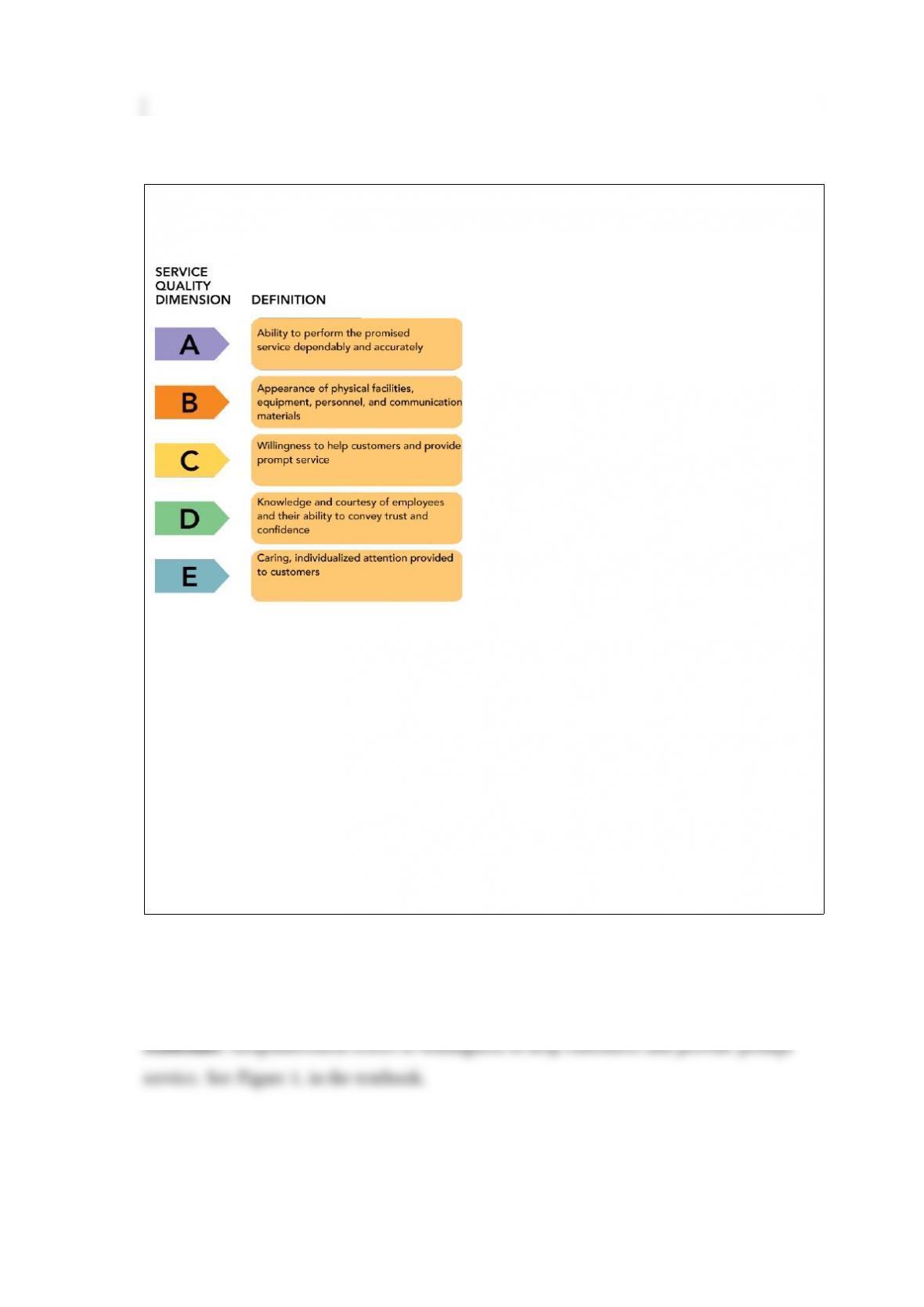
Figure 1.
According to Figure 1. above, “C” represents which dimension of service quality?
a. reliability
b. empathy
c. tangibility (tangibles)
d. assurance
e. responsiveness
Answer: