As a general rule, __________ seems to work best when the consumer target market for
the product is alike across countries and cultures -that is, consumers share the same
desires, needs, and use for the product.
A. product adaptation
B. product extension
C. product integration
D. product invention
E. product customization
Answer:
Australia-based Renewable Energy Ltd. sells a $10 million device that converts manure
into energy. One of these devices is capable of generating energy equal to $2 million of
natural gas per year. The company believes its target market consists of businesses
similar to its first customer, a fertilizer manufacturer that was located in a rural area. If
the firm expands to the United States, it most likely will use which of the following
strategies to segment its market?
A. behavioral and geographic
B. number of employees and behavioral
C. purchase location and purchase type
D. NAICS code and geographic
E. behavioral and NAICS code
Answer:
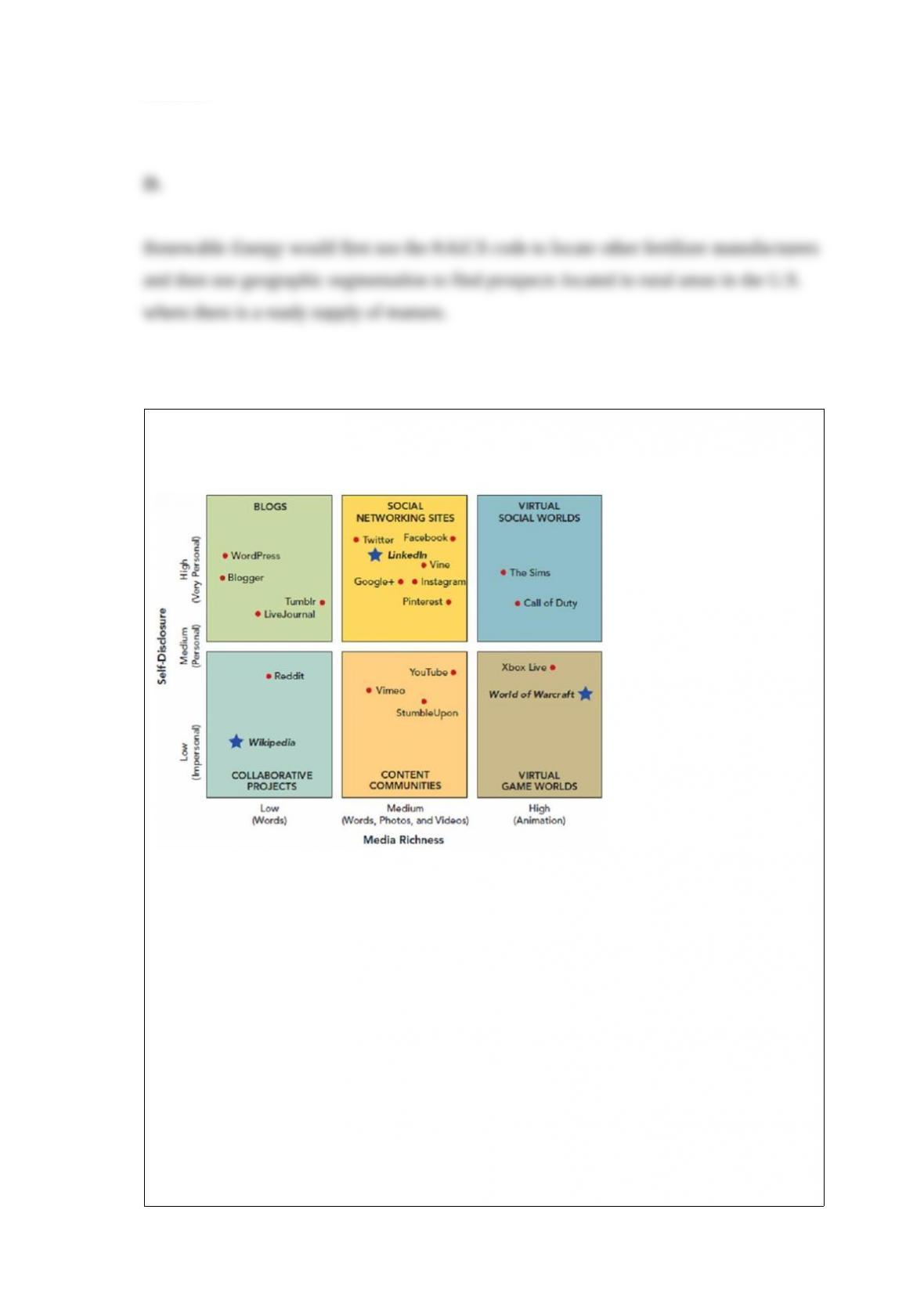
Figure 16-1
As the content of a blog or messages posted on social media sites move from
impersonal to highly personal, the level of self-disclosure __________.
A. decreases
B. is not affected
C. undermines the credibility of the site
D. increases
E. increases the credibility of the site
Answer:
Dependability is the consistency of replenishment. This is important to all firms in a
supply chain and to consumers. It can be broken into three elements: safe delivery,
complete delivery, and __________.
A. honest and accurate pricing
B. quality products
C. consistent lead time
D. a well-informed delivery staff
E. product warranties
Answer:
There are four commonly used forms of institutional advertising: advocacy, pioneering,
competitive, and __________.
A. sustainable
B. philanthropic
C. reminder
D. persuasive
E. informational
Answer:
The planning gap refers to
A. the difference between projected total costs and realized total revenues.
B. the difference between projected total costs and net profits.
C. the difference between marginal revenue and marginal cost.
D. the percentage point difference between a firm and its next largest competitor in
terms of market share.
E. the difference between the projection of the path to reach a new goal and the
projection of the path of the results of a plan already in place.
Answer:

The Consumer Bill of Rights refers to a law that
A. codified the ethics of exchange between manufacturers, distributors, and suppliers,
including the right to be paid.
B. codified the ethics of exchange between manufacturers, distributors, and suppliers,
including the rights to safe working conditions, fair pay, and collaborative decision
making.
C. codified the ethics of exchange between buyers and sellers, including the rights to
safety, to be informed, to choose, and to be heard.
D. guaranteed consumers the right to be compensated through replacement, repair, or
reimbursement for products that fail to perform as promised by the manufacturer.
E. guaranteed consumers the rights that are enumerated in the First Amendment to the
U.S. Constitution.
Answer:
Which of the following is an inherent weakness of direct marketing?
A. high absolute costs
B. declining customer response rates
C. messages may differ between salespeople
D. difficult to get media cooperation
E. easily duplicated and can easily lead to promotion wars
Answer:
A consumer’s purchases are often influenced by the views, opinions, or behavior of
others. Two important aspects of personal influence to marketing are
A. lifestyle and motivation.
B. personality and lifestyle.
C. opinion leadership and word-of-mouth activity.
D. word-of-mouth activity and psychographics.
E. psychographics and demographics.
Answer:
Searching out, using, and training reputable medical device distributors across Asia to
call on cardiologists and medical clinics is an example of Medtronic’s
A. market segmentation and targeting strategy.
B. price strategy.
C. place strategy.
D. promotion strategy.
E. product/service strategy.
Answer:
Market modification refers to a marketing strategy that __________.
A. alters a product’s characteristic, such as its quality, performance, or appearance, to
increase its value to customers and to increase sales
B. manages a product’s life cycle to find new customers, increase a product’s use among

existing customers, or create new use situations
C. tries to find new customers and convince users who abandoned the product to
purchase again
D. drops the lowest producing market segment and replaces it with an entirely new one
E. combines the two lowest producing market segments to achieve marketing
economies of scale
Answer:
Loehmann’s is an upscale, off-price specialty retailer that sells name-brand designer
fashions. A few salespeople are around to help in select places, but customers are
basically on their own to find what they need and bring it to checkout. Loehmann’s
provides its consumers with
A. full-service.
B. limited service.
C. self-service.
D. restricted service.
E. functional service.
Answer:
Level of service is used to classify retailers. Three levels of service are: __________-,
limited-, and full-service retailers.
A. self
B. non
C. minimal
D. fair
E. upon request
Answer:
The purpose of __________ is to give the author of a literary, dramatic, musical, or
artistic work the exclusive right to print, perform, or otherwise copy that work.
A. copyright law
B. patent law
C. trademark law
D. commercial law
E. antitrust law
Answer:
__________-enabled smartphones gave mobile consumers access to online ads, local
restaurant promotions, and time-sensitive discounts at retailers.
A. GPS
B. APP
C. CMO
D. WEB 2.0
E. Google+
Answer:
The country expected to have the largest population in 2050 is __________.
A. the United States
B. India
C. China
D. Russia
E. Brazil
Answer:
In a buying center, __________ have formal authority and responsibility to select the
supplier and negotiate the terms of a contract.
A. buyers
B. gatekeepers
C. adopters
D. influencers
E. users
Answer:
Epicurious is a website where recipes are posted by the site owner and individual cooks.
Using a four-fork rating system, users rate and comment on these recipes for ease or
difficulty in preparation, the taste of the finished dish, and whether or not they would
use the recipe again. What type of social media website most likely is Epicurious?
A. Web 2.0
B. a Facebook Page
C. a wiki
D. a blog
E. a Twitter Page
Answer:
In the VALS framework, consumers motivated by ideals are guided by knowledge and
principle. One segment of the two Ideals-motivated groups, known as __________,
have fewer resources and are conservative, conventional people with concrete beliefs
based on traditional, established codes such as family, religion, community, and the
nation.
A. Experiencers
B. Believers
C. Makers
D. Achievers
E. Thinkers
Answer:
The overlay of sound, video, and graphics with the real-world environment creates what
type of reality for wearers of these new Google Glass digital eyeglasses?
A. virtual
B. cognitive
C. augmented
D. apparent
E. ultimate
Answer:
Which of the following statements regarding direct selling is most accurate?
A. Unlike other forms of nonstore retailing, direct selling takes place in the business
market.
B. Direct selling is found exclusively in the United States.
C. Direct selling succeeds by providing customers with convenience and personalized
service.
D. Direct sales have been declining rapidly in the United States since the 1980s.
E. By definition, direct selling can only take place in a home.
Answer:
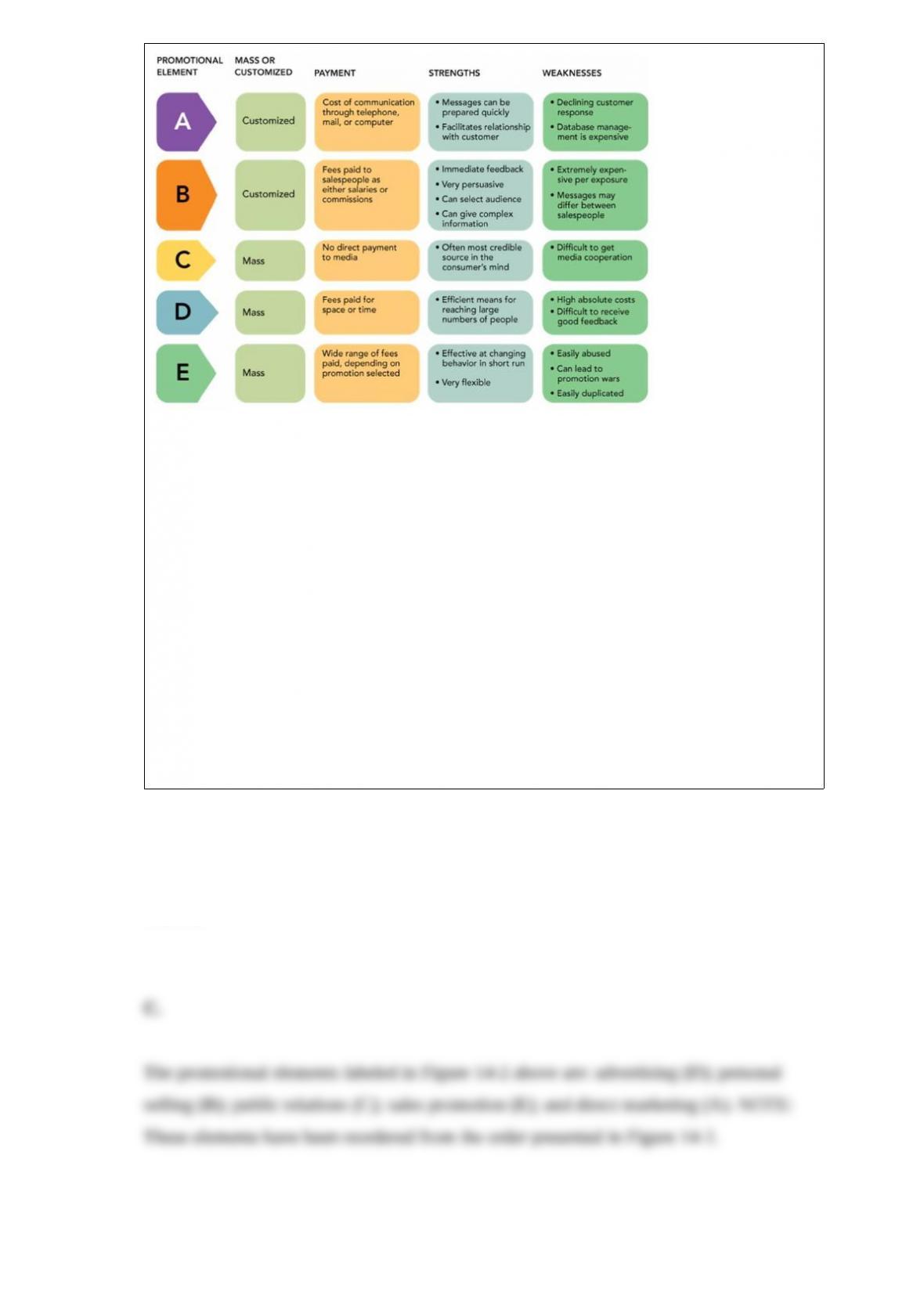
Figure 14-2
To communicate with consumers, a company can use one or more of five promotion
alternatives. In Figure 14-2 above, the promotional element labeled C represents
__________.
A. advertising
B. personal selling
C. public relations
D. sales promotion
E. direct marketing
Answer:
In a direct channel, all channel functions are performed by __________.
A. retailers
B. wholesalers
C. producers
D. brokers and agents
E. middlemen
Answer:
At the weekly meeting for Choice Hotels, the marketing manager said, “We need an
inexpensive creative way to increase awareness of our hotels among people who travel
by automobile. To do that, I want to find some new media that the other hotel chains are
not using.” The purchase of this new media for the hotel chains’ advertising would be an
example of a
A. new buy.
B. straight rebuy.
C. converted rebuy.
D. modified rebuy.
E. initial buy.
Answer:
Kendall was excited to begin her new job after she graduated from college. Which of
the following purchases would most likely have the greatest perceived risk for her the
day before she begins the job?
A. a subscription to The Wall Street Journal
B. an outfit for her first day
C. a new coffee maker
D. flowers to decorate her new apartment
E. running shoes
Answer:
Three important aspects of product life cycles are their length, the shape of their sales
curves, and the rate at which __________.
A. consumers recognize differences among products
B. consumers adopt products
C. consumers abandon products
D. competitors create competitive offerings
E. environmental forces affect products
Answer:
A firm becomes a channel captain because it is the channel member with the ability to
influence the behavior of other members. Influence can take four forms, one of which is
A. stakeholder position.
B. familial ties to other channel members.
C. longevity in the industry.
D. identification with a particular channel member.
E. geographic proximity to the manufacturing plant.
Answer:
According to the price equation, a product’s or service’s final price equals its list price
minus incentives and allowances plus
A. profits.
B. commissions.
C. trade-ins.
D. extra fees.
E. taxes.
Answer:
Within the buying center, influencers are people who
A. have the formal authority and responsibility to select the supplier and negotiate the
terms of the contract.
B. control the flow of information in the buying center.
C. affect the buying decision usually by helping define the specifications for what is
bought.
D. have the formal or informal power to select or approve the supplier that receives the
contract.
E. actually use and evaluate the product or service.
Answer:
Market segmentation stresses __________ and relating them to specific marketing
actions.
A. aligning tasks to match competitor tactics
B. grouping people according to similar needs
C. dividing people within a market randomly into equally sized groups
D. dividing people into the smallest groups possible
E. identifying potential new buyers who are not yet familiar with a new product
Answer:
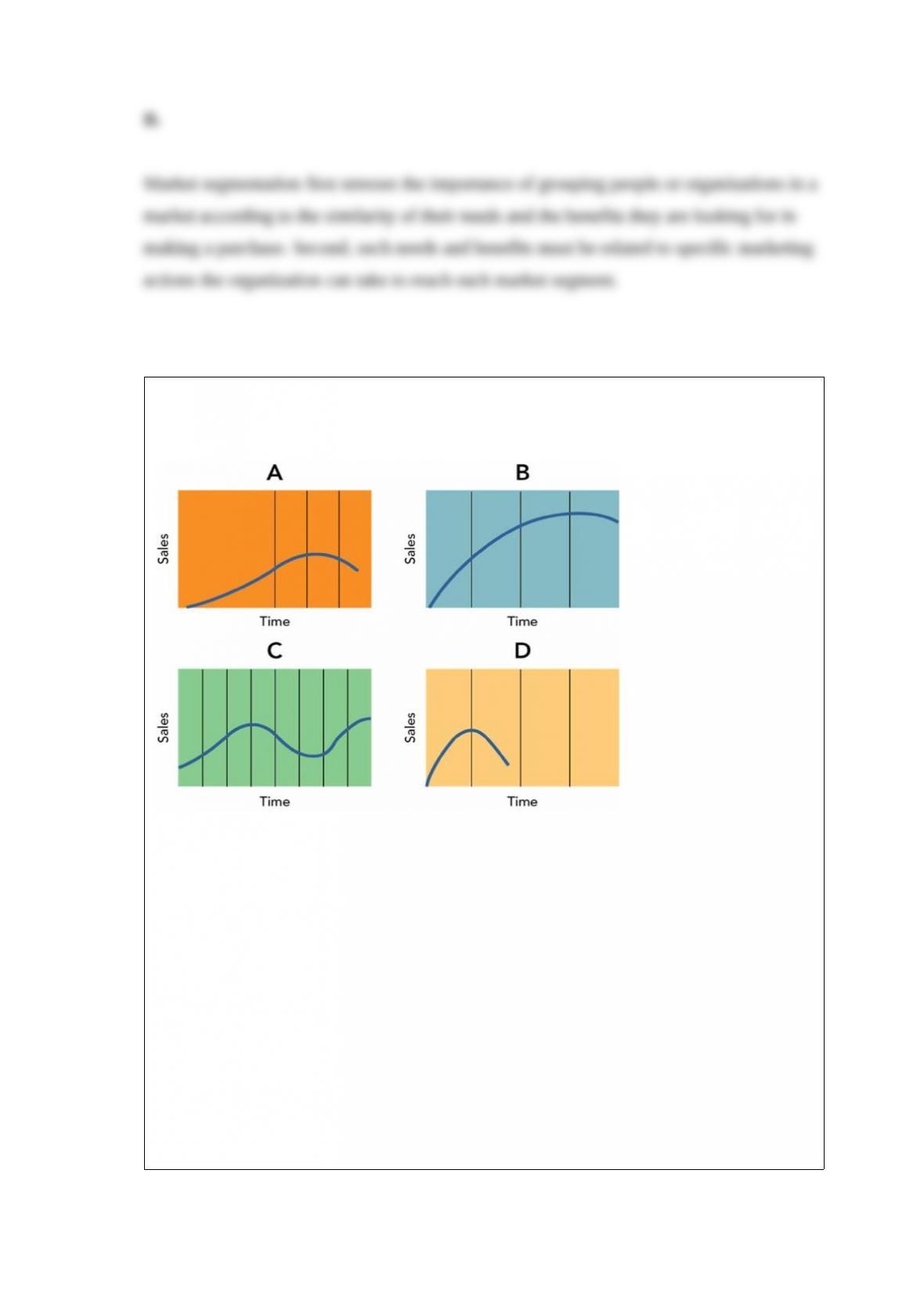
Figure 10-3
The product life cycle shown in Box A in Figure 10-3 above is an example of a
__________ product.
A. low-learning
B. fashion
C. fad
D. high-learning
E. generalized
Answer:
Which of the following types of firms comprises an industrial market?
A. retailing
B. construction
C. wholesaling
D. state governments
E. federal regulatory agencies
Answer:
Combinations of the marketing mix that reflect the unique attitudes, ancestry,
communication preferences, and lifestyles of different races are referred to as
__________ marketing programs.
A. panethnic
B. generational
C. cross-cultural
D. multicultural
E. regional
Answer: