Chapter 9
Criminal Law and Cyber Crime
N.B.: TYPE indicates that a question is new, modified, or unchanged, as follows.
N A question new to this edition of the Test Bank.
+ A question modified from the previous edition of the Test Bank.
= A question included in the previous edition of the Test Bank.
TRUE/FALSE QUESTIONS
A1. A misdemeanor is a crime punishable only by a fine.
A2. Thinking about killing someone constitutes the crime of attempted murder.
A3. A wrongful mental state is typically required for criminal liability.
A4. Picking pockets is not robbery.
A5. A person who commits larceny can be sued under tort law.
A6. It may be a crime to take another’s property, but it is not a crime to receive stolen
goods.
A7. Changing a trademark is forgery.
A8. A person’s intent to return embezzled property is a defense to the crime of
embezzlement.
A9. A kickback for a special favor or service is not considered a bribe.
A10. A defendant may be relieved of liability by showing that a criminal act was necessary
to prevent an even greater harm.
A11. Ordinarily, “ignorance of the law is an excuse,” or a valid defense to criminal liability.
A12. A suspect cannot be tried twice in the same court for the same crime.
A13. The purpose of the exclusionary rule is to encourage criminals to provide exclusive
evidence of their crimes.
A14. Any crime that requires knowledge of computer technology for its investigation is a
computer crime.
A15. Most cyber crimes are “new” crimes.
A16. It is not identity theft to use a fabricated identity to access financial resources online.
A17. Dishing is phishing that involves voice communication.
A18. A stolen credit card is more likely to hurt a consumer than a merchant.
A19. A hacker is someone who uses one computer to break into another.
A20. A cyberterrorist might target a government agency, but not a business.
MULTIPLE CHOICE QUESTIONS
A1. Gail is a “payday” lender charged with filing false claims in bankruptcy proceedings
against her debtors. The standard of proof to find a defendant who has been charged
with a crime guilty is
a. a preponderance of the evidence.
b. beyond all doubt.
c. beyond a reasonable doubt.
d. clear and convincing evidence.
A2. Domino causes a disturbance at El Nino Cafe. He is arrested and charged with
disorderly conduct, a misdemeanor. A misdemeanor is a crime punishable by
a. a fine only.
b. imprisonment up to one year.
c. imprisonment up to six months.
d. imprisonment up to ten days.
A3. Plato works for Quirky Squirters, Inc. During work hours, Plato “steals” his employer’s
computer time to start up his own business, Rowdy Drenchers. This is
a. burglary.
b. robbery.
c. larceny.
d. no crime.
A4. Rock pushes Sylvia to the ground, grabbing her purse as she falls. The use of force or
fear is required for this act to constitute
a. burglary.
b. forgery.
c. larceny.
d. robbery.
A5. Ivan signs Jeb’s name, without his authorization, to the back of a check. This is
a. no crime.
b. forgery.
c. larceny.
d. robbery.
A6. Sven receives an MP3 player stolen from Tomas. To be criminally liable, Sven must
know
a. the player is stolen.
b. Tomas is the true owner.
c. how to operate an MP3 player.
d. what an MP3 player is.
A7. Riley, a Sterling Bank employee, deposits into his account checks that are given to him
by bank customers to deposit into their accounts. This is
a. burglary.
b. embezzlement.
c. larceny.
d. money laundering.
A8. Mona offers Ned, a building inspector, money to overlook the violations in her new
warehouse. Ned accepts the money and overlooks the violations. Mona is charged
with the crime of bribery. The crime occurred when
a. Mona decided to offer the bribe.
b. Mona offered the bribe.
c. Ned accepted the bribe.
d. Ned overlooked the violations.
A9. Cameron manages an illegal gambling operation in his BBQ Bar & Grill. Cameron
reports the profits of the gambling operation as income from BBQ’s legitimate
activities on its tax returns. This is
a. embezzlement.
b. larceny.
c. money laundering.
d. no crime.
A10. Davis points a gun at Eton, threatening to shoot him if he does not steal from his
employer, Freddy’s Convenience Store, and give the stolen funds to Davis. Charged
with theft, Eton can successfully claim, as a defense
a. nothing.
b. duress.
c. entrapment.
d. self-defense.
A11. Vance points a gun at Workman, threatening to shoot him. Workman hits Vance,
causing his death. Charged with homicide, Workman can successfully claim as a
defense
a. nothing.
b. duress.
c. entrapment.
d. self-defense.
A12. Ollie, an employee of Payroll Management Corporation, is arrested at work. A grand
jury issues a formal charge against Ollie for larceny. This charge is
a. an arraignment.
b. an indictment.
c. an information.
d. an inquisition.
A13. Jean sends e-mail to Irwin promising a percentage of the amount in an African bank
account for assistance in transferring the funds to a U.S. bank account. Irwin forwards
his account number, but the funds are never sent. Instead, Jean quickly withdraws the
funds in Irwin’s account. This is
a. online greed but not fraud.
b. an online “fool-me–once, shame on you” occurrence but not fraud.
c. online gambling but not fraud.
d. online fraud.
A14. Harvey puts up a guitar for bids on eWay, a Web auction site. Faith makes the highest
bid and sends the payment, which Harvey receives, but he does not send the guitar to
her. This is online
a. auction fraud.
b. puffery.
c. retail fraud.
d. frustration but not fraud.
A15. Posing as Platinum Bank, Oswald e-mails Nadia, asking her to update her personal
banking information through a link in the e-mail. She clicks on the link and types in the
data, which Oswald promptly sells to Moe. This is
a. no crime.
b. employment fraud.
c. phishing.
d. vishing.
Fact Pattern 9–1 (Questions A16–A17 apply)
Minka uses her computer to secretly install software on hundreds of personal computers
without their owners’ knowledge.
A16. Refer to Fact Pattern 9–1. Minka’s secretly installed software allows her to forward
transmissions from her unauthorized network to even more systems. This network is
a. a hacker.
b. a bot.
c. a botnet.
d. a worm.
A17. Refer to Fact Pattern 9-1. Minka’s software is harmful to the computers on which she
installed it. This program is
a. malware.
b. badware.
c. harmware.
d. infectware.
A18. Posing as a representative of Global Games Company, Ferris e-mails Evan, a job
seeker, asking him to forward personal banking information so that if he is hired,
payroll checks can be deposited directly into his account. Evan supplies the data,
which Ferris promptly sells to Dixie. This is
a. no crime.
b. employment fraud.
c. phishing.
d. vishing.
A19. Via the Internet, Rocky sabotages the computer system of Quik Chik’n Company, a
food manufacturer, with the purpose of altering the levels of ingredients of the
company’s products so that consumers of the food become ill. Rocky is
a. a cyberterrorist.
b. a botnet.
c. a virus.
d. a worm.
A20. Rashad accesses Quant Company’s computer system without authority to obtain
protected financial data. Under federal law, this is
a. a felony if it is committed for a commercial purpose.
b. a felony if Quant brings a civil suit against Rashad.
c. not a crime.
d. a crime, but not a felony.
ESSAY QUESTIONS
A1. Sophie is the president of Tasty Foods Corporation, a wholesale grocery company. An
inspection by Uri, a government agent, uncovers unsanitary conditions caused by Vic,
a Tasty Foods employee, in the company’s warehouse. Will, a Tasty Foods vice
president, assures Uri that the situation will be corrected, but a later inspection
reveals no such corrections. Sophie knows nothing about any of this. Can Tasty Foods
be convicted of a crime in these circumstances? Can Sophie be held personally liable?
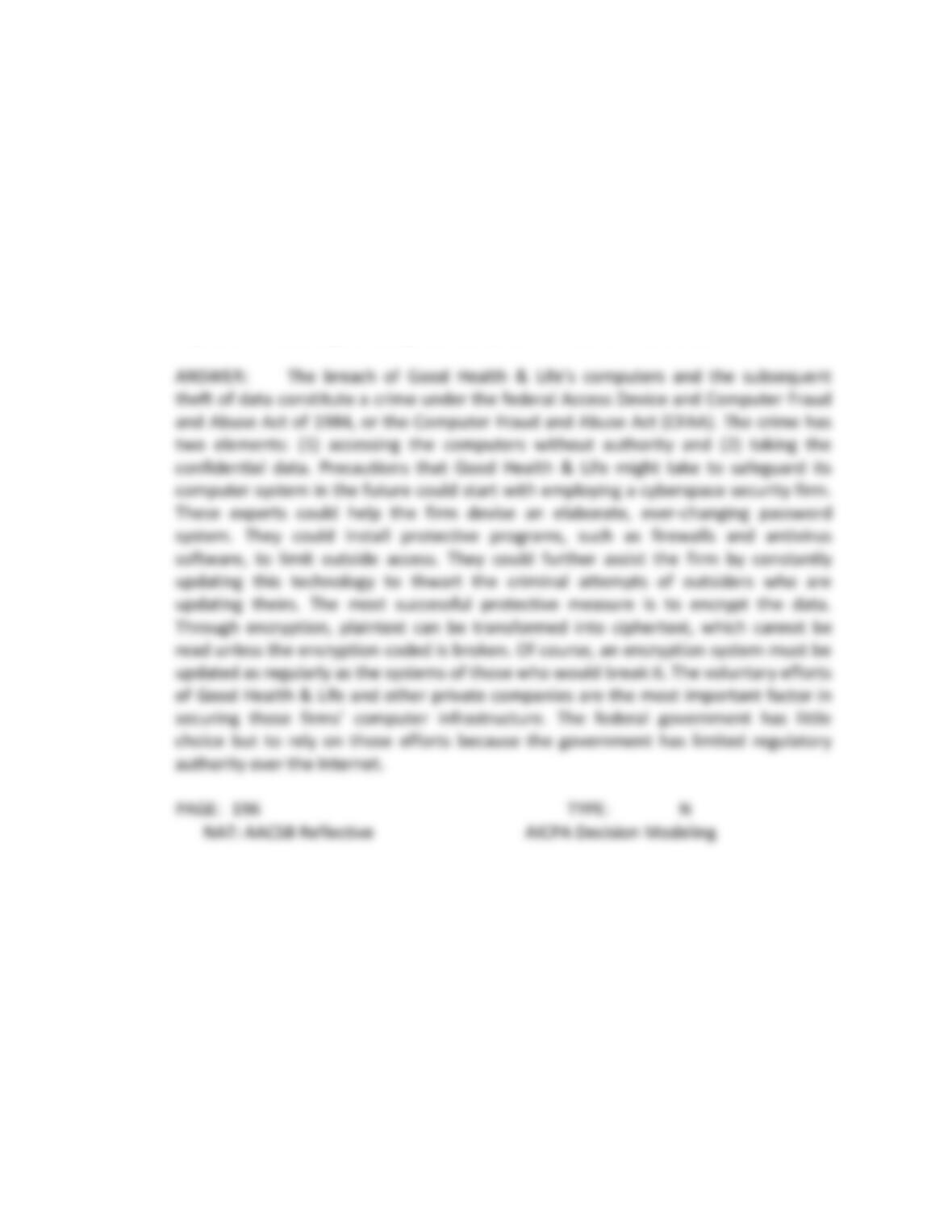
A2. Good Health & Life Insurance Corporation suffers a security breach in its computer
network. Before the company discovers the breach, the perpetrator obtains corporate
financial records and other confidential data, including marketing plans. Is this a
crime? If so, what are its elements? What steps might Good Health & Life take to
ensure that going forward only authorized users access the data on its computers?
Whose efforts—those of the federal government or Good Health & Life—are most
important in securing the company’s computer infrastructure and why?