
Chapter 8: Relative, Asset-Oriented, and Real Option
Valuation Basics
Answers to End of Chapter Discussion Questions
8.1 Does the application of the comparable companies’ valuation method require the addition of an acquisition premium? Why? /
Why not?
8.2 Which is generally considered more accurate: the comparable companies’ or recent comparable transactions method? Explain
your answer.
8.3 What are the key assumptions implicit in the comparable companies’ valuation method? The recent transactions method? Be
specific.
8.4 Explain the primary differences between the income (discounted cash flow), relative (market-based), and asset-oriented valuation
methods?
8.5 Under what circumstances might it be more appropriate to use relative valuation methods rather than the DCF approach? Be
specific.

2
8.6 PEG ratios allow for the adjustment of relative valuation methods for the expected growth of the firm. How might this be
helpful in selecting potential acquisition targets? Be specific?
8.7 How is the liquidation value of the firm calculated? Why is the assumption of orderly liquidation important?
8.8 What are real options and how are they applied in valuing acquisitions?
8.9 Give examples of pre– and post-closing real options.
8.10 Conventional DCF analysis does not incorporate the effects of real options into the valuation of an asset. How might an analyst
incorporate the potential impact of real options into conventional DCF valuation methods?
Answers to End of Chapter Practice Problems
8.11 BigCo’s Chief Financial Officer is trying to determine a fair value for PrivCo, a non-publicly traded firm that BigCo’s is
considering acquiring. Several of PrivCo’s competitors, Ion International, and Zenon are publicly traded. Ion and Zenon have
price-to–earnings ratios of 20 and 15, respectively. Moreover, Ion and Zenon’s shares are trading at a multiple of earnings
before interest, taxes, depreciation, and amortization (EBITDA) of 10 and 8, respectively. BigCo estimates that next year
PrivCo will achieve net income and EBITDA of $4 million and $8 million, respectively. To gain a controlling interest in the
firm, BigCo expects to have to pay at least a 30% premium to the firm’s market value. What should BigCo expect to pay for

PrivCo?
a. Based on price–to-earnings ratios?
b. Based on EBITDA?
8.12 LAFCO Industries believes that its two primary product lines, automotive and commercial aircraft valves, are rapidly becoming
obsolete. Its free cash flow is rapidly diminishing as it loses market share to new firms entering its industry. LAFCO has $200
million in debt outstanding. Senior management expects the automotive and commercial aircraft valve product lines to
generate $25 million and $15 million, respectively, in earnings before interest, taxes, depreciation, and amortization next year.
Senior management also believes that they will not be able to upgrade these product lines due to declining cash flow and
excessive current leverage. A competitor to its automotive valve business last year sold for 10 times EBITDA. Moreover, a
company that is similar to its commercial aircraft valve product line sold last month for 12 times EBITDA. Estimate LAFCO’s
breakup value before taxes.
8.13 Siebel Incorporated, a non-publicly traded company, has 2009 after-tax earnings of $20 million, which are expected to grow at 5
percent annually into the foreseeable future. The firm is debt-free, capital spending equals the firm’s rate of depreciation; and the
annual change in working capital is expected to be minimal. The firm‘s beta is estimated to be 2.0, the 10-year Treasury bond is 5
percent, and the historical risk premium of stocks over the risk-free rate is 5.5 percent. Publicly-traded Rand Technology, a direct
competitor of Siebel’s, was sold recently at a purchase price of 11 times its 2009 after–tax earnings, which included a 20 percent
premium over its current market price. Aware of the premium paid for the purchase of Rand, Siebel’s equity owners would like
to determine what it might be worth if they were to attempt to sell the firm in the near future. They chose to value the firm using
the discounted cash flow and comparable recent transactions methods. They believe that either method provides an equally valid.
Estimate of the firm’s value.
a What is the value of Siebel using the DCF method?
b What is the value using the comparable recent transactions method?
c What would be the value of the firm if we combine the results of both methods?

8.14 Titanic Corporation has reached agreement with its creditors to liquidate voluntarily its assets and to use the proceeds to pay off
as much of its liabilities as possible. The firm anticipates that it will be able to sell off its assets in an orderly fashion, realizing
as much as 70% of the book value of its receivables, 40% of its inventory, and 25% of its net fixed assets (excluding land).
However, the firm believes that the land on which it is located can be sold for 120% of book value. The firm has legal and
professional expenses associated with the liquidation process of $2,900,000. The firm has only common stock outstanding.
Estimate the amount of cash that would remain for the firm’s common shareholders once all assets have been liquidated.
Balance Sheet Item
Book Value of Assets
Liquidation Value
Cash
$10
Accounts Receivable
$20
Inventory
$15
Net Fixed Assets
Excluding Land
$8
Land
$6
Total Assets
$59
Total Liabilities
$35
Shareholders Equity
$24
Balance Sheet Item
Book Value of Assets
Liquidation Value
Cash
$10
$10
Accounts Receivable
$20
$14
Inventory
$15
$6
Net Fixed Assets,
Excluding Land
$8
$2.0
Land
$6
$7.2
Total Assets
$59
$39.2
Total Liabilities
$35
$35
Shareholders Equity
$24
$4.2
Liquidation Related
$.9
$2.9
Cash Available for
Common Shareholders
$1.3
8.15 Best’s Foods is seeking to acquire the Heinz Baking Company, whose shareholders equity and goodwill are $41 million and $7
million, respectively. A comparable bakery was recently acquired for $400 million, 30 percent more than its tangible book value
(TBV). What was the tangible book value of the recently acquired bakery? How much should Best’s Foods expect to have to
pay for the Heinz Baking Company? Show your work.
8.16 Delhi Automotive Inc. is the leading supplier of specialty fasteners for passenger cars in the U.S. market, with an estimated 25
percent share of this $5 billion market. Delhi’s rapid growth in recent years has been fueled by high levels of reinvestment in the
firm. While this has resulted in the firm having “state of the art” plants, it has also resulted in the firm showing limited
profitability and positive cash flow. Delhi is privately owned and has announced that it is going to undertake an initial public
offering in the near future. Investors know that economies of scale are important in this high fixed cost industry and understand
that market share is an important determinant of future profitability. Thornton Auto Inc., a publicly traded firm and the leader in
this market, has an estimated market share of 38 percent and an $800 million market value. How should investors value the
Delhi IPO? Show your work.

8.17 Photon Inc. is considering acquiring one of its competitors. Photon’s management wants to buy a firm it believes is most
undervalued. The firm’s three major competitors, AJAX, BABO, and COMET, have current market values of $375 million, $310
million, and $265 million, respectively. AJAX’s FCFE is expected to grow at 10 percent annually, while BABO’s and COMET’s
FCFE are projected to grow by 12 and 14 percent per year, respectively. AJAX, BABO, and COMET’s current year FCFE are
$24, $22, and $17 million, respectively. The industry average price–to-FCFE ratio and growth rate are 10 and 8%, respectively.
Estimate the market value of each of the three potential acquisition targets based on the information provided? Which firm is the
most undervalued? Which firm is most overvalued?
8.18 Acquirer Incorporated’s management believes that the most reliable way to value a potential target firm is by averaging multiple
valuation methods, since all methods have their shortcomings. Consequently, Acquirer’s Chief Financial Officer estimates that
the value of Target Inc. could range, before an acquisition premium is added, from a high of $650 million using discounted cash
flow analysis to a low of $500 million using the comparable companies’ relative valuation method. A valuation based on a recent
comparable transaction is $672 million. The CFO anticipates that Target Inc.’s management and shareholders would be willing
to sell for a 20 percent acquisition premium, based on the premium paid for the recent comparable transaction. The CEO asks the
CFO to provide a single estimate of the value of Target Inc. based on the three estimates. In calculating a weighted average of
the three estimates, she gives a value of .5 to the recent transactions method, 3 to the DCF estimate, and .2 to the comparable
companies’ estimate. What it weighted average estimate she gives to the CEO? Show your work.
336.0
234.0
120.0
1.00
690.0
8.19 An investor group has the opportunity to purchase a firm whose primary asset is ownership of the exclusive rights to develop a
parcel of undeveloped land sometime during the next 5 years. Without considering the value of the option to develop the
property, the investor group believes the net present value of the firm is $(10) million. However, to convert the property to
commercial use (i.e., exercise the option), the investors will have to invest $60 million immediately in infrastructure
improvements. The primary uncertainty associated with the property is how rapidly the surrounding area will grow. Based on
their experience with similar properties, the investors estimated that the variance of the projected cash flows is 5% of the NPV,
which is $55 million, of developing the property. Assume the risk-free rate of return is 4 percent. What is the value of the call
option the investor group would obtain by buying the firm? Is it sufficient to justify the acquisition of the firm?

6
8.20 Acquirer Company’s management believes that there is a 60 percent chance that Target Company’s free cash flow to the firm
will grow at 20 percent per year during the next five years from this year’s level of $5 million. Sustainable growth beyond the
fifth year is estimated at 4 percent per year. However, they also believe that there is a 40 percent chance that cash flow will grow
at half that annual rate during the next five years and then at a 4 percent rate thereafter. The discount rate is estimated to be 15
percent during the high growth period and 12 percent during the sustainable growth period for each scenario. What is the
expected value of Target Company?
Solutions to End of Chapter Case Study Questions
Did British American Tobacco Overpay for Reynolds American?
Discussion Questions
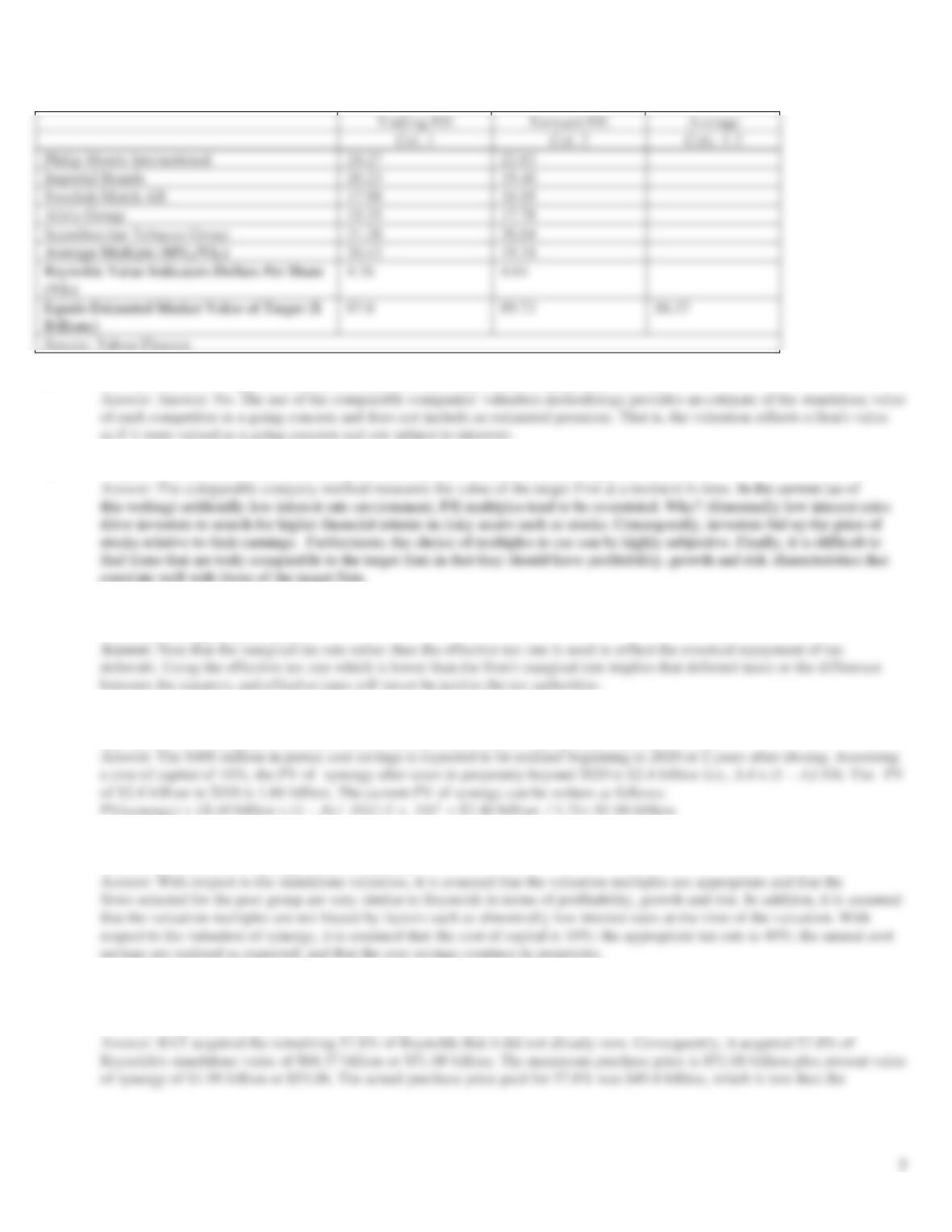
1. Based on the information provided in Table 8.5, what do you believe is a reasonable standalone value for Reynolds? (Hint: Use
the comparable company valuation method to derive a single point estimate of standalone value.) Show your work.
2. Does your answer to question (1) include a purchase price premium? Explain your answer.
3. What are the key limitations of the comparable companies’ valuation methodology? Be specific.
4. In estimating the value of anticipated cost savings, should an analyst use Reynolds marginal tax rate of 40% or its effective tax
rate of 22%? Explain your answer.
5. What is the 2018 after-tax present value of the $400 million pre-tax annual cost savings expected to start in 2019? Assume the
appropriate cost of capital is 10% and that the savings will continue in perpetuity. Show your work.
6. What are the key valuation assumptions underlying the valuation of Reynolds? Include both the valuation of Reynolds as a
standalone business and synergy value. Be specific.
7. What is the maximum amount BAT could have paid for Reynolds and still earned its cost of capital? Recall that BAT acquired
the remaining 57.8% of Reynolds that it did not already own. Did BAT overpay for Reynolds based on the information given in
the case? Explain your answer. (Hint: Use your answers to questions (1) and (5))

8
Examination Questions and Answers
True and False Questions: Answer true or false to the following questions:
1. The comparable companies’ valuation method uses the discounted value of a firm’s free cash flow. True or False
2. The comparable recent transactions method is usually considered less reliable than the comparable companies’ valuation method.
True or False
3. If the market leader in an industry has a $300 million market value and a 30% market share, the market is valuing each
percentage point of market share at $10 million. If a target company in the same industry has a 20% market share, the market
value of the target company is $200 million. True or False
4. Liquidation value is the projected sale value of a firm’s assets. True or False
5. If the tangible book value of a firm significantly exceeds its market value for an extended period of time, it can become an
attractive takeover target. True or False
6. Valuations of target firms based on the comparable companies and recent transactions methods must be adjusted to reflect
control premiums. True or False
7. The replacement cost approach to valuation of a target firm ignores value created by operating the assets in combination as a
going concern. True or False
8. Tangible book value is the value of shareholders’ equity less net fixed assets. True or False
9. Break-up value assumes that individual businesses can be sold quickly without any material loss of value. True or False
10. Liquidation value provides an estimate of the minimum value of the target firm. True or False
11. The capitalization rate is equivalent to the discount rate when the firm’s revenues are not expected to grow. True or False
12. Book values are maligned as measures of value, because they represent historical rather than current market values. True or
False
13. The principal limitation to the comparable companies’ valuation approach is the difficulty in finding companies that are truly
comparable to the target firm. True or False
14. Price-to-earnings ratios of comparable companies provide an excellent means of valuing the target firm at any point in the
business cycle. True or False

15. Market-based valuation measures are meaningful only for firms with a stable earnings, cash flow, or sales history. True or False
16. Asset oriented approaches to valuation involve the use of tangible book value, liquidation value, discounted cash flows, and
break-up values. True or False
17. The weighted average valuation approach involves the use of a number of different valuation methods, weighted by the relative
importance the appraiser attributes to each method. True or False
18. Relative valuation methods are often described as market-based, as they reflect the amounts investors are willing to pay for each
dollar of earnings, cash flow, sales, or book value at a moment in time. True or False
19. If the P/E ratio for the comparable firm is equal to 10 and the after-tax earnings of the target firm are $2 million, the market value
of the target firm would be $5 million. True or False
20. The use of market-based valuation methods usually reflect actual demand and supply considerations at a moment in time. True
or False
21. The comparable companies’ method is widely used in so–called “fairness opinion” letters. True or False
22. The comparable companies’ transactions valuation method is generally considered the most accurate of all the valuation
methods. True or False
23. The value of the comparable companies’ method may vary widely depending upon when it is calculated in the business cycle.
True or False
24. Like the recent transactions method, comparable company valuation estimates do not require the addition of a purchase price
premium. True or False
25. Market-based valuation methods are less prone to manipulation than discounted cash flow methods because they require a more
detailed statement of assumptions. True or False
26. The analyst should be careful not to mechanically add an acquisition premium to the target firm’s estimated value based on the
comparable companies’ method if there is evidence that the market values of these “comparable firms” already reflect the effects
of acquisition activity elsewhere in the industry. True or False
27. Studies show that rival firms’ share prices will rise in response to the announced acquisition of a competitor, regardless of
whether the proposed acquisition is ultimately successful or unsuccessful. True or False
28. The comparable companies’ method and recent transactions methods of valuation are conceptually similar. True or False

29. Disadvantages of the comparable industry method of valuation include the presumption that industry multiples are actually
comparable and that analysts’ earnings projections are unbiased. True or False
30. Analysts have increasingly used the relationship between enterprise value to earnings before interest and taxes, depreciation, and
amortization to value firms. True or False
31. The enterprise value to EBITDA multiple relates the total book value of the firm from the perspective of the liability side of the
balance sheet (i.e., long-term debt plus preferred and common equity), excluding cash, to EBITDA. True or False
32. In constructing the enterprise value, the market value of the firm’s common equity value is added to the market value of the
firm’s long–term debt and the market value of preferred stock. True or False
33. The enterprise value to EBITDA method is useful because more firms are likely to have negative earnings than negative
EBITDA. True or False
34. The enterprise to EBITDA method of valuation can be compared more readily among firms exhibiting different levels of
leverage than for other measures of earnings, since the numerator represents the total value of the firm and the denominator
measures earnings before interest. True or False
35. A higher P/E ratio for a firm may be justified if its earnings are expected to grow significantly faster than firm’s future earnings.
True or False
36. The so-called PEG ratio is calculated by dividing the firm’s price–to-earning ratio by the expected growth rate in the firm’s share
price. True or False
37. Conceptually, firms with P/E ratios less than their projected growth rates may be considered undervalued; while those with P/E
ratios greater than their projected growth rates may be viewed as overvalued. True or False
38. It is critical for the analyst to remember that high growth rates by themselves are likely to increase multiples such as a firm’s
price to earnings ratio even without any improvement in financial returns. True or False
39. Investors may be willing to pay considerably more for a stock whose PEG ratio is greater than one if they believe the increase in
earnings will result in future financial returns that significantly exceed the firm’s cost of equity. True or False
40. Empirical evidence suggests that forecasts of earnings and other value indicators are better predictors of firm value than value
indicators based on historical data. True or False
41. The PEG ratio can be helpful in evaluating the potential market values of a number of different firms in the same industry in
selecting which may be the most attractive acquisition target. True or False
42. In the absence of earnings, other factors that drive the creation of value for a firm may be used for valuation purposes. True or
False

11
43. Macro value drivers are those factors which directly influence specific activities within the firm. True or False
44. The number of billing errors as a percent of total invoices is a specific example of a macro value driver. True or False
45. Micro value drivers are those factors affecting specific functions within the firm. True or False
46. The major advantage of the value driver approach to valuation is the implied assumption that a single value driver or factor is
representative of the total value of the business. True or False
47. Tangible book value is widely used for valuing financial services companies, where tangible book value is primarily cash or
liquid assets. True or False
48. Liquidation or breakup value is the projected price of the firm’s assets sold separately in liquidating or breaking up the firm.
True or False
49. When estimating liquidation value, analysts often make a simplifying assumption that the assets can be sold in an orderly
fashion, which is defined as a reasonable amount of time to solicit bids from qualified buyers. True or False
50. In determining the liquidation value of inventories, it is not necessary to look at their composition. True or False
51. The replacement cost approach to valuation estimates what it would cost to replace the target firm’s assets at current market
prices using professional appraisers less the present value of the firm’s liabilities. True or False
52. Valuing the assets separately in terms of what it would cost to replace them may seriously overstate the firm’s true going concern
value. True or False
53. An option is the exclusive right, but not the obligation, to buy, sell, or use property for a specific period of time in exchange for a
predetermined amount of money. True or False
54. Real options include the right to buy land, commercial property, and equipment. Such assets can be valued as call options if its
current value exceeds the difference between the asset’s current value and some predetermined level. True or False
55. Real options, also called strategic management options, refer to management’s ability to adopt and later revise corporate
investment decisions. True or False
56. Since real options provide flexibility that can greatly change the value of a project, it should be considered in capital budgeting
methodology. True or False
57. Investment decisions, including M&As, often contain certain “embedded options” such as the ability to accelerate growth by
adding to the initial investment (i.e., expand), to delay the timing of the initial investment (i.e., delay), or to walk away from the
project (i.e., abandon). True or False

58. The NPV of an acquisition of a manufacturer operating at full capacity may have a lower value than if the NPV is adjusted for a
decision made at a later date to expand capacity. If the additional capacity is fully utilized, the resulting higher level of future
cash flows may increase the acquisition’s NPV. In this instance, the value of the real option to expand is the difference between
the NPV with and without expansion. True or False
59. All investment decisions include clearly identifiable and measurable real options whose estimated value should be included in
the valuation of the opportunity. True or False
60. An option to abandon an investment (i.e., divest or liquidate) will often increase the NPV because of its effect on reducing risk.
By exiting the business, the acquirer may be able to recover a portion of its original investment and truncate projected negative
cash flows associated with the acquisition. True or False
1. Which one of the following factors is not considered calculating a firm’s PEG ratio?
a. Projected growth rate of the value indicator (e.g., earnings)
b. Ratio of market price to value indicator (e.g., P/E)
c. Share exchange ratio
d. Historical growth rate of the value indicator
e. None of the above
2. In determining the purchase price for an acquisition target, which one of the following valuation methods does not require the
addition of a purchase price premium?
a. Discounted cash flow method
b. Comparable companies’ method
c. Comparable industries’ method
d. Recent transactions’ method
e. A & B only
3. Limitations in applying the comparable companies’ method of valuation include which of the following?
a. Finding truly comparable companies is difficult
b. The use of market-based methods can result in significant under– or overvaluation during periods of declining or rising
stock markets
c. Market-based methods can be manipulated easily, because the methods do not require a clear statement of assumptions
with respect to risk, growth, or the timing or magnitude of future earnings and cash flows.
d. A, B, & C
e. A & B only
4. Which of the following represent options available to managers in making investment decisions?
a. Delay initial investment
b. Accelerate cumulative investment
c. Abandon the investment at a later date
d. A & B only
e. A, B, & C

13
5. Which one of the following is not a commonly used method of valuing target firms?
a. Discounted cash flow
b. Comparable companies method
c. Recent transactions method
d. Asset oriented method
e. Share exchange ratio method
6. Which of the following is not true about real options?
a. All investment decisions contain identifiable and measurable real options.
b. Under certain circumstances, management may be able to delay their initial investment in a project or M&A.
c. Real options may be valued as the expected value of various alternative cash flow projections.
d. Real options can be valued using the Black-Sholes method.
e. None of the above
7. Which of the following represent limitations of real options?
a. Key assumptions often are very difficult to quantify, especially volatility
b. Project delays may incur significant opportunity costs
c. Options often are not independent; therefore, selecting one option may foreclose other options
d. Often requires complex modeling
e. All of the above
8. Which of the following statements about the comparable companies’ valuation method is not true?
a. Requires the use of firms that are “substantially” similar to the target firm
b. Uses market based rather than cash flow based valuations
c. Often used as the basis of investment banker fairness opinions
d. Generally provides the most accurate valuation method
e. Provides an estimate of the target firm at a moment in time.
9. The tangible book value or equity per share method is applicable primarily to the following industries:
a. Steel and financial services
b. Distribution and financial services
c. Electric and natural gas utilities
d. Coal and copper mining
e. Space and defense
10. Which of the following is not true about the liquidation/break-up valuation methods?
a. Highly diversified companies are often valued in terms of the sum of the standalone values of their operating units
b. The calculation of such values is heavily dependent on the skill of appraisers who are intimately familiar with the
operations to be liquidated.
c. Assets can sometimes be liquidated in an orderly fashion.
d. Legal, appraisal, and consulting fees may comprise a substantial share of the total proceeds of the sale of the assets
e. The liquidation value of most of the firm’s assets is about the same.
11. Intangible assets often constitute a substantial source of value to the acquiring firm. Which of the following are not generally
considered intangible assets?

14
12. Which of the following represent advantages of the comparable companies’ valuation method?
a. Uses the most accurate market-based valuation at a point in time
b. Valuations need to be adjusted to reflect control premiums
c. Adjusts for risk of future cash flows
d. Adjusts for the timing of future cash flows
e. A & B only
13. Which of the following is not generally considered a valuation method?
a. Discounted cash flow method
b. Comparable companies’ method
c. Share exchange ratio method
d. Liquidation value method
e. Comparable transaction’s method
14. All of the following are true for market based valuation methods except for which of the following?
a. Assumes that markets are efficient such that current values reflect all the information currently known about the
business
b. Current values represent what a willing buyer and seller are willing to pay for a business in the absence of full
information
c. Market based methods are always superior to discounted cash flow techniques
d. Include comparable company and recent transactions methods
e. Include the tangible book value approach
15. Which of the following are examples of intangible assets that may have value to the acquiring company?
a. Patents
b. Trade names
c. Customer lists and relationships
d. Covenants not to compete
e. All of the above
Case Study Short-Essay Examination Questions
MANAGING COKE’S NATURAL DRINK BUSINESS PORTFOLIO
______________________________________________________________
KEY POINTS
• DCF and relative valuation methods suggest implicitly that once an investment decision has been made there is little opportunity
for management to change the outcome.

15
• In practice, management often has considerable flexibility to accelerate, delay, or abandon the original investment as new
information is obtained.
• Recognizing the need for flexibility in decision making, partial takeovers often include a mechanism (so-called “real options”)
for expanding or exiting an investment.
_____________________________________________________________________________
Faced with a maturing soda market, Coca-Cola (Coke) has sought to broaden its brand offering portfolio. To this end, the firm has taken
ownership stakes varying in amount in a variety of companies whose brands offer greater growth potential than its core product line. The
firm’s strategy is to find promising new brands and then test the firm’s potential by making a minority ownership investment. Coke has
previously invested in Monster Beverage Corp, the energy drink company, and Keurig Green Mountain Inc. which sells single serving
coffee pods. Coke already owns Odwalla, Honest Tea, and Zico Coconut Water.
In an investment consistent with this strategy, Coke announced on August 19, 2015 that it had invested $90 million for a 30%
ownership position in Suja Life LLC (Suja) along with Goldman Sach’s (Goldman) merchant banking subsidiary which had invested $60
million for a slightly smaller stake in Suja. The combined $150 million investment gives the two investors slightly less than 50%
ownership of Suja’s outstanding equity. The deal also gives Coke an option to require the remainder of the company at a predetermined
price within three years. As part of the deal, Coke will expand Suja’s distribution and provide funds to build a new factory. The deal will
help boost the number of locations that sell Suja by 50% by late 2016. Coke also will use its procurement network to buy raw materials at
a lower cost.
Health drink brand, Suja, whose juices include combinations such as strawberry and flax seed, has posted rapid revenue growth since
its startup in early 2012, with its sales doubling each year since then to more than $43 million in 2014. New juice brands are benefitting
from consumers turning away from sugary brands of soda. For Suja, the deal has been highly controversial as many of its customers are
concerned that Coke will cause the firm to stray from what makes it unique and socially responsible. Suja avoids using genetically
modified organisms, or GMOs, and donates a portion of its sales to environmental causes. Some customers stopped purchasing the
product in protest.
The risk to Coke and Goldman Sachs is clear: Does Suja’s meteoric revenue growth rate have staying power? Currently, Suja’s
products are a niche market and as many such products could be destined to fade as fickle consumers lose interest. Moreover, the
association with Coke could cause the current unrest among Suja customers to grow. These factors could substantially reduce Suja’s
value. Given these uncertainties what future options do Coke and Goldman have?
Real options differ from strategic options in that they are available to management after an investment is made. In practice, Coke’s
management could accelerate investment in Suja if revenue and profit growth rates justify it by exercising its option to buy the 50% of the
shares it and Goldman do not currently own. Goldman could participate by providing a portion of the additional funds needed to buy out
the remaining Suja shareholders. If the firm’s growth slows appreciably, the option could be allowed to expire. Finally, Coke and
Goldman could abandon their investment by spinning-off or divesting their minority positions. While expensive potentially, the latter
option allows the investors to limit future losses.
INVESTORS QUESTION ABBOTT LABS’ VALUATION
OF ST. JUDE’S MEDICAL
Case Study Objectives: To Illustrate
• The application of relative valuation methods,
• The limitations of such methods,
• How to approximate the value of synergy, and
• The role key assumptions play in establishing the credibility of any valuation.
Abbott Lab‘s market value plunged more than $5 billion or six percent in a single day following the announcement of the firm’s
acquisition of St. Jude Medical (St. Jude) on April 26, 2016, as investors expressed their disapproval. Their concern was that Abbot was
overpaying and would be unable to earn financial returns demanded by investors. The $25 billion deal included a $6.5 billion premium,
37% above St. Jude’s closing price on April 25, 2016. St. Jude’s shares soared by more than 27% boosting the firm’s market capitalization
to $24.1 billion from its level of $17.59 billion the prior day.

In announcing the transaction, Abbott said the primary motive for the takeover was to expand its heart device business. Abbott, the
industry leader in manufacturing coronary stents and heart valves, wanted to combine with St. Jude, a maker of pacemakers and other
devices for failing hearts. The aging population makes the “failing heart” market likely to show considerable growth in the coming years.
Medical equipment makers are under pressure to offer a wider portfolio of products to their hospital customers, which have been
through a wave of mergers that have increased their power to negotiate pricing. With combined revenue of $8.7 billion, Abbott said its
deal would help it compete more effectively against larger rivals Medtronic Plc, Boston Scientific Corp, and Edward Life Sciences. The
combination of Abbott and St. Jude creates a medical device manufacturer with leading positions in high growth cardiovascular markets,
including atrial fibrillation, structural heart and heart failure, as well as a leading position in the high growth neuromodulation market.
The new firm also will have the largest pipeline (products in development) to deliver a steady stream of new medical devices to these high
growth markets.
The definitive agreement reached by Abbott and St. Jude called for St. Jude shareholders to receive $46.75 in cash and .8708 shares of
Abbott common stock. This represented a total consideration of $85 per share. Abbott expects the deal would be accretive to earnings per
share and that the combined firm will earn double-digit financial returns within 5 years. Management expects annual pre-tax cost savings
of $500 million to begin within five years following closing. For the firm to earn the returns promised by management, it must be able to
realize expected annual pretax cost savings beginning in 2020. Failure to realize these expected savings in a timely manner can impact
significantly synergy value. Also, it is unclear if the full cost of realizing these synergies has been deducted from the projected savings.
One way of determining if Abbott is overpaying is to estimate St. Jude’s standalone value plus the present value of anticipated synergy.
This estimate represents the upper limit (maximum) for the amount Abbott should pay for St. Jude and still be able to earn its cost of
capital. Any payment in excess of the maximum purchase price means that Abbott is destroying shareholder value by in effect
transferring more value than would be created to the target firm shareholders.
Table 8.5 provides data enabling an analyst to value St. Jude on a standalone basis using the comparable company method. Note that
the table contains valuation multiples for St. Jude’s three primary competitors as well as earnings, revenue, book value and enterprise
value per share for St. Jude. The choice of valuation multiples is subjective in that it is unclear which best mirror the standalone value of
St. Jude’s. Abnormally low interest rates at the time of the merger announcement could have resulted in artificially high valuation
multiples. Also, the competitors selected are larger and more diversified than St. Jude’s and their growth rates and profitability tend to be
greater while the riskiness of their cash flows tends to be less.
Table 8.5 St. Jude Medical Valuation Data
Forward P/Ea
Price /
Revenueb
Price/Bookc
Enterprise
Value to
EBITDA
Enterprise
Value to
Revenue
Col. 1
Col. 2
Col. 3
Col. 4
Col. 5
Primary Competitors
Medtronic (Ratio)
16.14
4.17
2.32
15.19
4.69
Boston Scientific
(Ratio)
18.04
4.10
4.82
18.41
4.70
Edward Life Sciences
(Ratio)
29.28
4.87
9.13
26.77
4.99
St. Jude Medical
(Dollars Per Share)
Earnings Per
Share
$1.06
Annual
Revenue /
Share
$5.54
Book Value /
Share
$4.04
Enterprise
Value /
Share
$1.12
Annual
Revenue /
Share
$5.54
a S&P Capital IQ report Consensus Estimate (4/26/16)
b Trailing 52 week average from S&P Capital IQ for period ending March 31, 2016.
c Most recent quarter (April 2, 2016)
Discussion Questions and Answers:
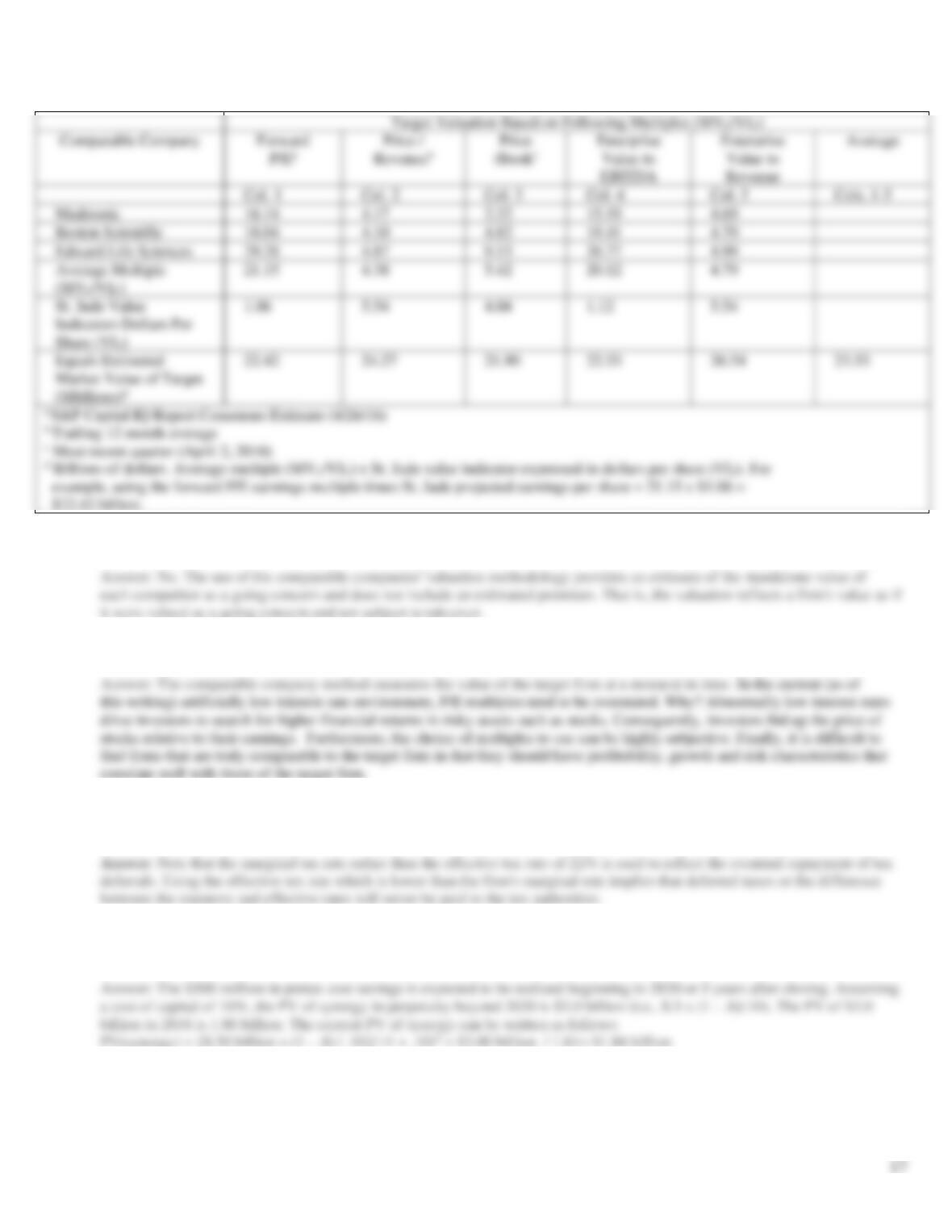
1. Based on the information provided in Table 8.5, what do you believe is a reasonable standalone value for St. Jude Medical?
(Hint: Use the comparable company valuation method to derive a single point estimate of standalone value.)
2. Does your answer to question (1) include a purchase price premium? Explain your answer.
3. What are the key limitations of the comparable companies’ valuation methodology? Be specific.
4. In estimating the value of anticipated cost savings, should the analyst use St. Jude’s marginal tax rate of 40% or its effective tax
rate of 22%? Explain your answer.
5. What is the present value of the $500 million pre-tax annual cost savings expected to start in 2020? Assume the appropriate cost
of capital is 10% and that the savings will continue in perpetuity. Show your work.
6. What are the key valuation assumptions underlying this valuation of St. Jude Medical? Be specific.