
Name:
Class:
Date:
Ch 08 International Law
1. Multinational enterprises are companies doing business in several countries simultaneously.
a.
True
b.
False
True
2. The United States is the world’s largest exporter of agricultural products.
a.
True
b.
False
True
3. Tariffs are generally higher in developing countries than in developed countries.
a.
True
b.
False
True
4. Generally, consumers are not adversely affected by tariffs since tariffs affect wholesale prices, not retail prices.
a.
True
b.
False
False
5. Ad valorem duty is based on the fair market value of the imported good as of the date it reaches the United States, not
the price actually paid for the good when sold for export to the United States.
a.
True
b.
False
False
6. Although the United States government officially signed the GATT treaty, the United States Congress has refused to
ratify the agreement.
a.
True
b.
False
False
7. The European Union is one of the world’s most powerful regional associations with 42 member nations as of 2011.
a.
True
b.
False
False
8. A contract involving the sale of goods from a Texas seller to a French wholesaler must always use the United Nations
Convention on Contracts for the International Sale of Goods (CISG).
a.
True
b.
False
False
9. If the United States sets a limit on the number of cars that can be imported, this action is a form of tariff.
a.
True

Name:
Class:
Date:
Ch 08 International Law
b.
False
False
10. It is not a violation of United States law for a domestic company to pay money to a foreign governmental official in
order to obtain a contract with the foreign government if this type of “commission” is commonly paid in that foreign
country.
a.
True
b.
False
False
11. The Presidents of Oxtron, Inc., a U.S. company, and Dunka, Inc. a German company, met in Munich, Germany.
Oxtron and Dunka are direct competitors in over-the-counter medicines. The presidents agree to fix prices on their major
products. This agreement may violate U.S. antitrust law even though the agreement was made in Germany.
a.
True
b.
False
True
12. Trein, Inc., a U.S. company entered into an exclusive distributorship agreement with Posty, Inc., a Zambian company.
This means that Trein will only use Posty to distribute products in Zambia.
a.
True
b.
False
True
13. Under European Union law, any agreement, contract, or discussion that distorts competition within European Union
countries is illegal.
a.
True
b.
False
True
14. International comity holds that the courts of one nation lack the jurisdiction to hear suits against foreign governments.
a.
True
b.
False
False
15. The two principal actions prohibited by the Foreign Corrupt Practices Act include making bribes and making grease
payments.
a.
True
b.
False
False
16. For manufactured goods, the United States and European Union impose an average tariff of ________ percent, and
major trading partners around the world impose tariffs of ________ percent for identical items.
a.
10; 5
b.
less than 4; 10 to 30
c.
25; 39 to 70
d.
10 to 30; less than 4

Name:
Class:
Date:
Ch 08 International Law
b
17. Axle Corporation imports goods into the United States. Who is required to pay the duty on the imported goods?
a.
The importer, Axle Corporation.
b.
The World Trade Organization.
c.
Each party pays one-half the duty.
d.
The exporter of the goods.
18. The United States and Argentina have signed the Convention on Contracts for the International Sale of Goods (CISG).
Oxtron, Inc., a U.S. company, and Leer, an Argentinean company, have entered into a contract under which Oxtron is to
ship medical devices to Leer. The contract does not include a choice of law provision. The contract will be governed by:
a.
the CISG.
b.
the UCC.
c.
the domestic contract law of Argentina.
d.
the domestic contract law of the United States.
19. The United States and Singapore have signed the Convention on Contracts for the International Sale of Goods (CISG).
Notren, Inc., a U.S. company, and SWT, a Singapore company, have entered into a contract under which SWT is to ship
party supplies to Notren. One of the terms of the contract states, “The validity and performance of this contract will be
governed by the Uniform Commercial Code (UCC) of the state of New York, not the Convention of the International Sale
of Goods (CISG).” The contract will be governed by the:
a.
CISG.
b.
Uniform Commercial Code of New York.
c.
common law.
d.
World Trade Law.
20. Oxtron, Inc., a U.S. company, and Leer, an Argentinean company, orally agreed to a contract under which Oxtron is to
ship medical devices to Leer. The contract is governed by the CISG. Which statement is correct?
a.
The contract is not enforceable because it is oral.
b.
Whether the contract is enforceable without a written agreement depends on the value of the medical devices.
c.
Whether the contract is enforceable without a written agreement depends on whether the medical devices are a
necessity.
d.
The contract is enforceable without a written agreement.
d
21. In Marubeni America Corp. v. United States, the federal appellate court ruled that the Nissan Pathfinder was, for tariff
classification purposes a motor vehicle for the transport of passengers. The classification of goods is significant because:
a.
the tariffs will vary depending on the classification.
b.
the fair value will vary depending on the classification.
c.
the subsidy will vary depending on the classification.
d.
the dumping duty will vary depending on the classification.

Name:
Class:
Date:
Ch 08 International Law
Cengage Learning Testing, Powered by Cognero
Page 4
22. If a foreign company “dumps” goods on the United States market:
a.
the goods will be considered illegal goods and not be allowed to be sold in the United States.
b.
the United States will issue trade sanctions against the country that allowed the dumping.
c.
a “dumping duty” will be imposed on the dumped goods if the Commerce Department determines the goods
are being sold at less than fair value and that this harms an American industry.
d.
All the above are correct.
23. Notren, Inc., a U.S. company, and SWT, a Singapore company, entered into a contract under which SWT is to ship
party supplies to Notren. One of the terms of the contract states, “Any disputes that arise under this contract will be
resolved in the courts of Singapore.” This contract term is a:
a.
letter of credit.
b.
choice of language clause.
c.
choice of forum clause.
d.
draft clause.
24. What is a major argument against the GATT Treaty?
a.
The United States will have to compete against countries with unlimited pools of exploited labor.
b.
The United States will lose millions of jobs involving low-end employment and these types of workers are
least capable of finding other employment.
c.
Both a and b above are major arguments against GATT.
d.
Neither a nor b above is a major argument against GATT.
25. The European Union has adopted a currency known as the:
a.
Yuri.
b.
Common Union.
c.
Yen.
d.
Euro.
d
26. Zebra Toy Company, located in Chicago, sells $500,000 worth of toys to a London, England, a wholesaler. This
contract could be governed by:
a.
Illinois’s Uniform Commercial Code.
b.
English law.
c.
the CISG.
d.
All the above are correct.
d
27. With respect to United States patents and copyrights, GATT:
a.
expressly excludes controversies involving patent and copyright violations.
b.
will allow the United States to assess tariffs against a country that refuses to honor U.S. copyrights or patents.
c.
imposes sanctions against any country refusing to honor another signatory country’s patents or copyrights.
Name:
Class:
Date:
d.
requires retribution to be paid to the United States by any country ignoring U.S. patents or copyrights.
b
28. The primary goal of the North American Free Trade Agreement (NAFTA) is to:
a.
allow Canada, the United States, and Mexico to compete as a common economic entity against other countries
in the world.
b.
allow for the free and unrestricted movement of people from one country to another to improve the labor
market of all three counties.
c.
eliminate almost all trade barriers between the three nations.
d.
All the above are correct.
29. What is a major difference between a United States lawsuit versus a French lawsuit?
a.
In a French civil lawsuit, there is usually no right to a jury trial.
b.
The French legal system does not engage in extensive discovery procedures commonly used in the United
States.
c.
In a French lawsuit, the rules of evidence are more flexible.
d.
All of the above are correct.
d
30. Hardhat Machine Company sold goods to Irish Eyes Company of Northern Ireland. Big Bank issued a letter of credit
on behalf of Irish Eyes and the letter was given to Hardhat. The “account party” is:
a.
Irish Eyes.
b.
Hardhat Machine Company.
c.
Big Bank.
d.
None of the above.
31. Hardhat Machine Company sold goods to Irish Eyes Company of Northern Ireland. Big Bank issued a letter of credit
on behalf of Irish Eyes and the letter was given to Hardhat. The documents required by the letter of credit are presented to
the bank for payment while the goods are still in transit. Is Hardhat entitled to be paid?
a.
No, payment is not due until the goods are delivered.
b.
No, payment is not due until 30 days after delivery.
c.
No, payment is not due until the buyer has had a reasonable time to inspect the goods.
d.
Yes, the letter of credit is a promise by the bank to pay when certain documents are presented.
d
32. When considering both imports and exports, the country trading the most goods with the United States is:
a.
Canada.
b.
China.
c.
Japan.
d.
Mexico.

Name:
Class:
Date:
Ch 08 International Law
33. Zebra Toy Company invests a large sum of money in retail stores located in a foreign country. Zebra intends to bring
its foreign earnings back home to the United States. This practice is known as:
a.
repatriation of profits.
b.
inflow profit streaming.
c.
expropriation.
d.
comity.
34. The Australian government has opened a for-profit tourist information center in New York City. If a dispute arises
over the lease of the storefront, may the landlord sue the Australian government in the United States courts?
a.
Yes, because the Australian government was engaged in a commercial activity.
b.
No, because of the Foreign Sovereign Immunities Act which forbids U.S. courts from hearing any cases
involving foreign governments.
c.
It depends. The Australian government can only be sued if it signed a written waiver giving up its immunity.
d.
It depends. The Australian government can only be sued if it is a signatory on the CISG.
35. MagNet, a small United States computer company, started doing business in a foreign country. The foreign country
later decided to take over all computer industry, including MagNet’s operation. The foreign country paid MagNet
adequate compensation in United States dollars. The foreign country’s action is called:
a.
comity.
b.
repatriation.
c.
expropriation.
d.
inflow profit streaming.
36. Kjell is the vice president of international sales for Oxtren, Inc, a U.S. company. To secure a multimillion dollar
contract for his company, Kjell paid a Mongolian governmental officer $10,000. Kjell:
a.
has violated the Foreign Corrupt Practices Act.
b.
has not violated the Foreign Corrupt Practice Act because the payment was a grease payment.
c.
has not violated the Foreign Corrupt Practices Act because the government official was from Mongolia, not
the United States.
d.
has not done anything illegal because Congress has not ratified the Convention of Combatting Bribery of
Foreign Public Officials in International Transactions.
37. The Marcel Company is opening an office in Mexico. The cost to obtain electrical service is $500, but the clerk
suggests that service could be started faster if an additional $50 is paid, which the clerk will keep. If the Marcel official
pays the additional $50:
a.
he will have violated the Foreign Corrupt Practices Act.
b.
he will not have violated the Foreign Corrupt Practices Act because this would be considered a “grease” or
facilitating payment, which is legal.
c.
he will be guilty of violating the Foreign Corrupt Practices Act only if the payment was illegal under the
written law of Mexico.
d.
he will be guilty of violating both the Foreign Corrupt Practices Act and the Convention of Combatting
Bribery of Foreign Public Officials in International Business Transactions.
Name:
Class:
Date:
Ch 08 International Law
b
38. Archer Co. has decided it wants to expand into international business, but it is concerned about expropriation of its
property or losses caused by political unrest. Archer is considering purchasing insurance through the Overseas Private
Investment Corporation (OPIC). OPIC:
a.
provides insurance, but the cost is relatively high.
b.
provides insurance, but the list of countries in which it is willing to provide such protection is fairly short.
c.
has had remarkable success at no cost to the U.S. government.
d.
insures against expropriation, but not against losses stemming from political violence.
39. The United States has agreed to which of the following?
a.
GATT.
b.
NAFTA.
c.
CISG.
d.
All of the above.
d
40. The purpose of the Export Administrative Act of 1985 is:
a.
to set national quotas on exported goods.
b.
to limit the export of certain items which may pose a security risk.
c.
to document all new exports to facilitate tracking.
d.
All of the above.
b
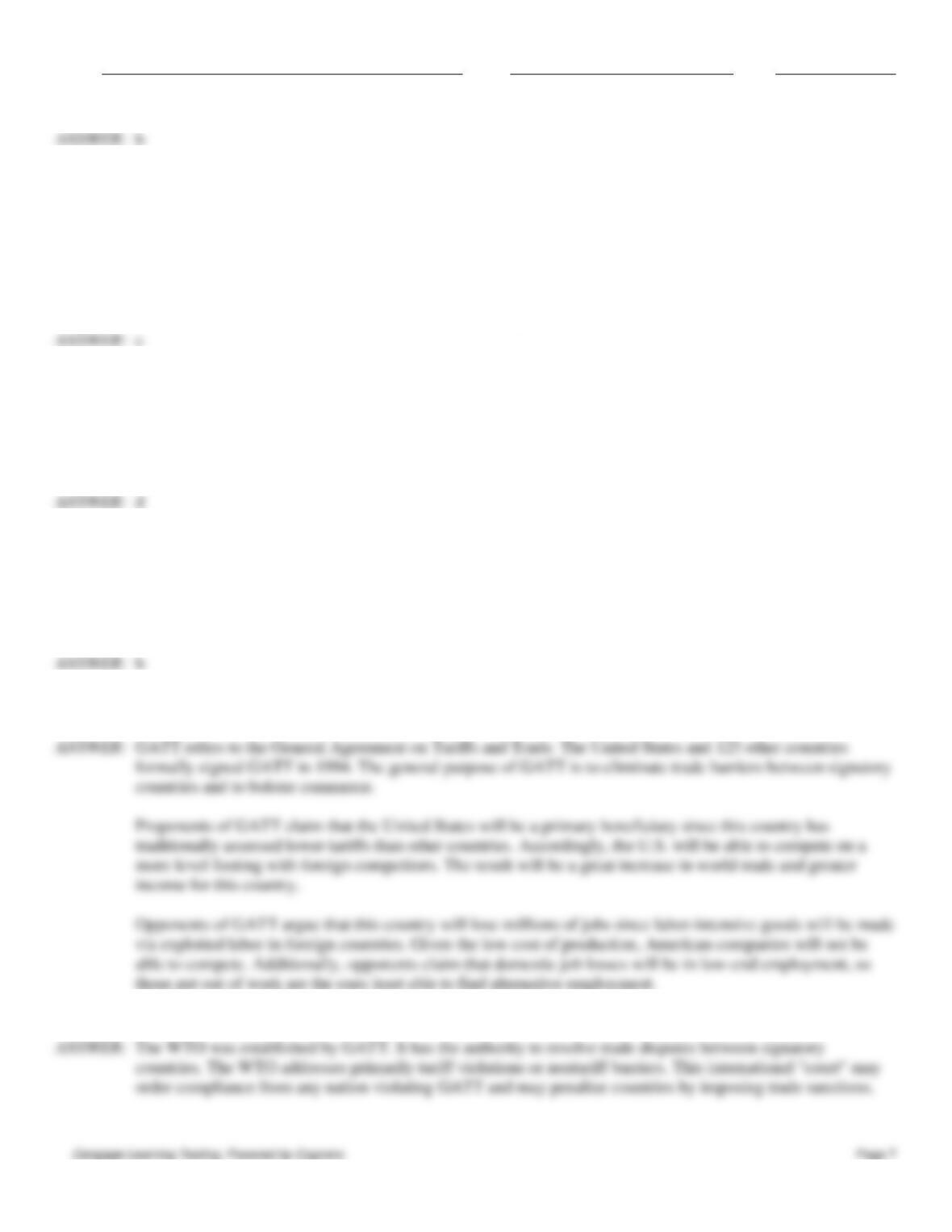
41. Explain what the General Agreement on Tariffs and Trade (GATT) is and give pro and con arguments concerning this
agreement.
those put out of work are the ones least able to find alternative employment.
42. Explain the origin and purpose of the World Trade Organization.
order compliance from any nation violating GATT and may penalize countries by imposing trade sanctions.
Name:
Class:
Date:
Ch 08 International Law
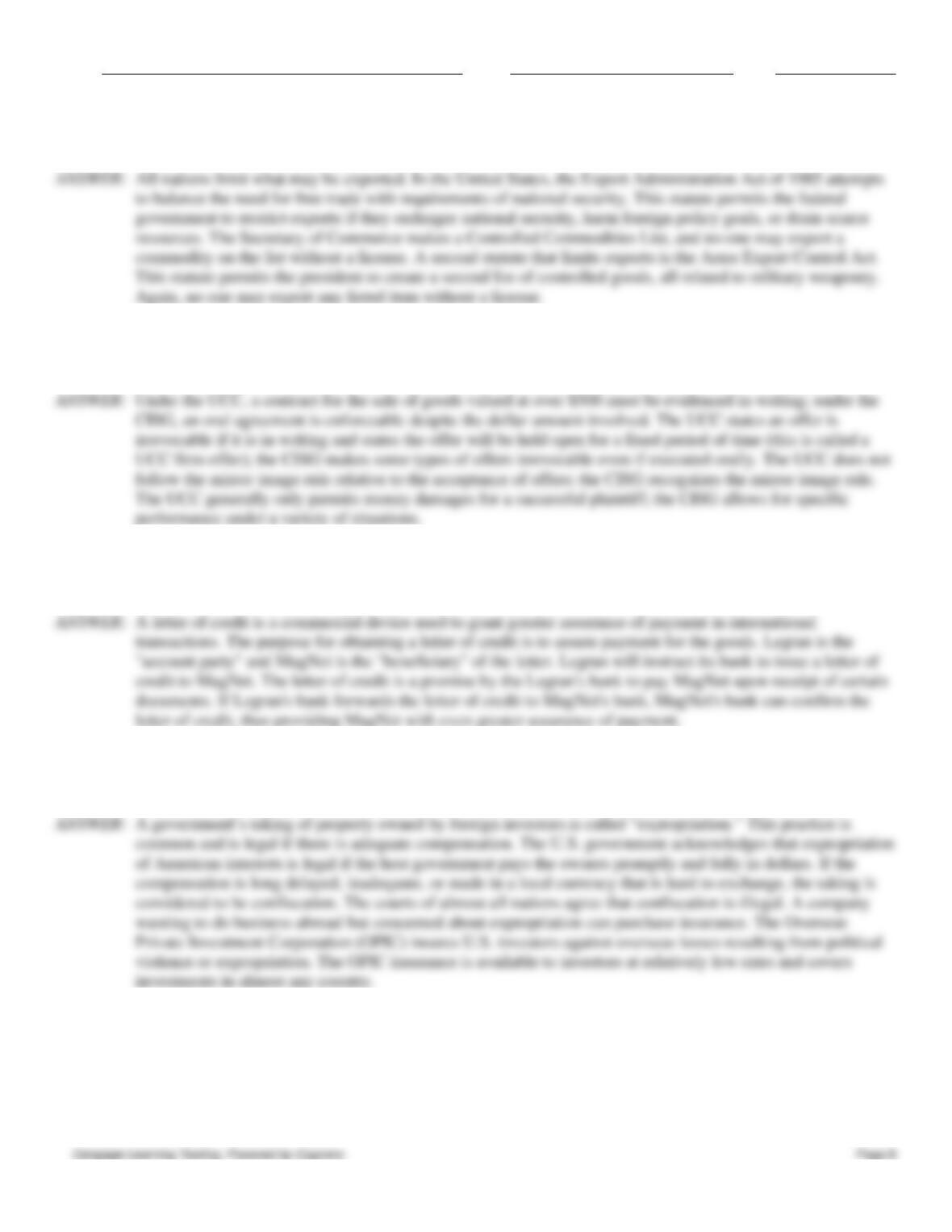
43. Yount, Inc. is interested in expanding its business to include exporting its products to several other countries. Discuss
two federal statutes that should be considered before making the decision to export.
44. MagNet is a U.S. company based in Utah. It is negotiating to sell $4 million worth of computer goods to a French
company, L’la. L’la is insisting that the contract be governed by the CISG. What are some of the primary differences
between the UCC and the CISG?
45. MagNet is a U.S. company based in Utah. It is negotiating to sell $4 million worth of computer goods to a French
company, Legran. MagNet’s attorney suggests that payment be by a letter of credit. What is a letter of credit and why does
MagNet’s attorney recommend payment by letter of credit?
46. Identify the term for and discuss the legality of a government’s taking of property owned by foreign investors. Discuss
what action a company might take if it wants to do business abroad but is concerned about losing its property to a foreign
government.