627
Chapter 51
Insurance
N.B.: TYPE indicates that a question is new, modified, or unchanged, as follows.
N A question new to this edition of the Test Bank.
+ A question modified from the previous edition of the Test Bank.
= A question included in the previous edition of the Test Bank.
TRUE/FALSE QUESTIONS
A1. The consideration paid to an insurer to obtain an insurance policy is the premium.
A2. Insurance companies are prohibited from practicing risk management.
A3. A party who would sustain a financial loss from the destruction of property has an
insurable interest in it.
A4. A sibling may have an insurable interest in his or her sibling’s life.
628 TEST BANK A—UNIT TEN: PROPERTY AND ITS PROTECTION
A5. The existence of an insurable interest is a primary concern when determining liability under
an insurance policy.
A6. An insurance application is part of the insurance contract.
A7. A loss sustained between the time of application and the delivery of an insurance
policy may not be covered
A8. Liability insurance protects against liability imposed on the insured as a result of
injuries to the person or property of another.
A9. A coinsurance clause provides that two or more people will receive payment on a
claim under the same insurance policy.
A10. State law may mandate that an incontestability clause be included in an insurance policy.
A11. Under an antilapse clause, an insurance policy will lapse only if no premium is paid
on the date due.
CHAPTER 51: INSURANCE 629
A12. Cash surrender value is the amount an insured must pay to cancel a policy.
A13. An insured who has policies with several companies covering the same insurable
interest has multiple insurance coverage.
A14. The insured can cancel a policy at any time.
A15. Because insurance law follows contract law, bad faith tort actions against insurers are
not allowed.
A16. An insured’s lack of an insurable interest is an absolute defense against payment.
A17. Term insurance provides life insurance with an accumulated cash surrender value
that can be used as collateral for a loan.
A18. A fire insurance policy covers losses to the insured as a result of fire and lightning, but
not damage from smoke and water.
630 TEST BANK A—UNIT TEN: PROPERTY AND ITS PROTECTION
A19. Automobile liability insurance covers liability for bodily injury and property damage.
A20. A business may procure coverage for product liability under a comprehensive general
liability policy.
MULTIPLE CHOICE QUESTIONS
A1. Bret obtains a fire insurance policy on his rental house with Continental Insurance
Company. Like all insurance, this policy is an arrangement for
a. avoiding the assumption of responsibility.
b. predicting a potential loss based on unknown factors.
c. shifting the imposition of liability.
d. transferring and allocating risk.
A2. International Foods Corporation insures its real and personal property, as well as the
lives of its key employees, to protect its financial interest should some event
undermine its security. This is
a. risk management.
b. risk pooling.
c. risky.
d. risqué.
CHAPTER 51: INSURANCE 631
A3. Dhani is the beneficiary of a life insurance policy on Elmo’s life obtained from Famous
Insurance Company. The insurer of this policy is
a. Dhani.
b. Elmo.
c. Famous.
d. the agent or broker through whom the policy was obtained.
A4. Grover is an executive accountant with the firm of Hall & Associates, which obtains
insurance from Interstate Insurance, Inc, on Grover’s life. Grover dies. The proceeds of
the policy belong to
a. Grover’s heirs.
b. Hall & Associates.
c. Interstate Insurance.
d. the state.
A5. EZ Rentals Company wants to insure the equipment that it rents to the public. To
obtain insurance, EZ must have an insurable interest in the equipment
a. at any time.
b. at the time a loss occurs.
c. at the time a policy is obtained.
d. continuously from the time a policy is obtained to the time a loss occurs.
632 TEST BANK A—UNIT TEN: PROPERTY AND ITS PROTECTION
A6. Chocolate Gourmet Company obtains an insurance policy to protect against losses
incurred by the firm as a result of being held liable for personal injuries or property
damage sustained by others. This is
a. casualty insurance.
b. fire insurance.
c. life insurance.
d. title insurance.
A7. Shingle & Tile Roofing Contractor, LLC, obtains an insurance policy against liability for
injuries or losses sustained by employees during the course of their employment. The
policy covers claims not covered by workers’ compensation insurance. This is
a. casualty insurance.
b. fidelity or guaranty insurance.
c. key-person life insurance.
d. employer’s liability insurance.
A8. Bob applies to City Insurance Company for homeowners’ insurance. City issues a pol–
icy, but later discovers that Bob’s application includes several misstatements. Most
likely, these misstatements can
a. affect the coverage under the policy but cannot void the policy.
b. bind Bob but cannot affect the coverage.
c. not bind Bob or affect the policy.
d. void the policy.
CHAPTER 51: INSURANCE 633
A9. Grace applies for a homeowners’ insurance policy on her house with Heroic Insurance
Company through Ian, a broker. In this transaction, Ian is
a. an agent for both parties.
b. Grace’s agent, and not Heroic’s agent.
c. Heroic’s agent, and not Grace’s agent.
d. not an agent.
A10. Investors Commercial Property Corporation obtains an insurance policy that protects
against any losses incurred as a result of existing claims against or liens on certain
property at the time of its purchase. This is
a. casualty insurance.
b. fire insurance.
c. life insurance.
d. title insurance.
A11. Ginny obtains a health insurance policy for her family from Hope Insurance Company.
The policy includes an incontestability clause. Under such a clause, after a policy has
been in force for two or three years
a. Ginny cannot contest Hope’s insurable interest.
b. Ginny cannot contest Hope’s refusal to pay a claim under the policy.
c. Hope cannot contest Ginny’s eligibility for continued coverage.
d. Hope cannot contest Ginny’s statements in the application.
634 TEST BANK A—UNIT TEN: PROPERTY AND ITS PROTECTION
A12. Rolling Transport & Storage Corporation wants to insure its warehouse to obtain the
maximum possible recovery for the lowest possible premium. To obtain the maximum
recovery under a coinsurance clause, the percentage of the value of the property
that should be insured is
a. 80 percent.
b. 90 percent.
c. 100 percent.
d. 120 percent.
A13. Boyce obtains from Capital Insurance Company a policy that provides that if the
parties cannot agree on the amount of a loss covered by the policy, an estimate of the
value by an impartial third party can be demanded. This is
a. an antilapse clause.
b. an arbitration clause.
c. an appraisal clause.
d. an incontestability clause.
A14. General Allied Company obtains insurance policies with Hy-Rate Insurance, Inc., and
Ideal InsurCo against the risk of loss of General’s office building in a fire. Each policy
includes a multiple insurance clause. A fire partially destroys the building. General
can collect from Hy-Rate
a. all of the loss.
b. half of the loss.
c. its proportionate share of the loss to the total amount of insurance.
d. none of the loss.
CHAPTER 51: INSURANCE 635
A15. Dag obtains from Expedient Insurance Company a policy that provides Dag has thirty
days after a premium’s due date to pay it before the policy will be canceled. This is
a. an antilapse clause.
b. an arbitration clause.
c. an appraisal clause.
d. an incontestability clause.
A16. Myles obtains a business liability insurance policy from Nova Insurance Company for
Myles’s Hydraulics & Transmission Repair shop. Nova can cancel the policy
a. if Myles increases the risk assumed by the Nova.
b. if Myles files a claim under the policy.
c. if Myles appears as a witness in a case brought against Nova.
d. under no circumstances.
A17. Brassy obtains an insurance policy for her electric guitar collection from Crest
Insurance Company. Brassy can cancel the policy
a. at any time.
b. only at the end of a period for which a premium has been paid.
c. only if Brassy no longer has an insurable interest in the collection.
d. only on advance written notice.
636 TEST BANK A—UNIT TEN: PROPERTY AND ITS PROTECTION
A18. Edy obtains a homeowners’ insurance policy with First Source Insurance Company.
First Source can cancel the policy
a. if Edy appears as a witness in a case against First Source.
b. if Edy fails to pay the premiums.
c. if Edy makes changes that add to the home’s value.
d. under no circumstances.
A19. Speedy Shipping Corporation applies to TransInsurance Company for a fire insurance
policy on Speedy’s warehouse. On the application, Speedy misrepresents the age of
the property to obtain a lower premium. When a fire soon destroys the warehouse,
TransInsurance can
a. deny payment, because a fire destroyed Speedy’s warehouse.
b. deny payment, because of Speedy’s fraud in the application.
c. not deny payment, because a fire destroyed Speedy’s warehouse.
d. not deny payment, because the application is not part of the policy.
A20. Lila obtains a life insurance policy with no cash surrender value and names her son
Maurice as the beneficiary. This is
a. casualty insurance.
b. decreasing-term life insurance.
c. health insurance.
d. term life insurance.
ESSAY QUESTIONS
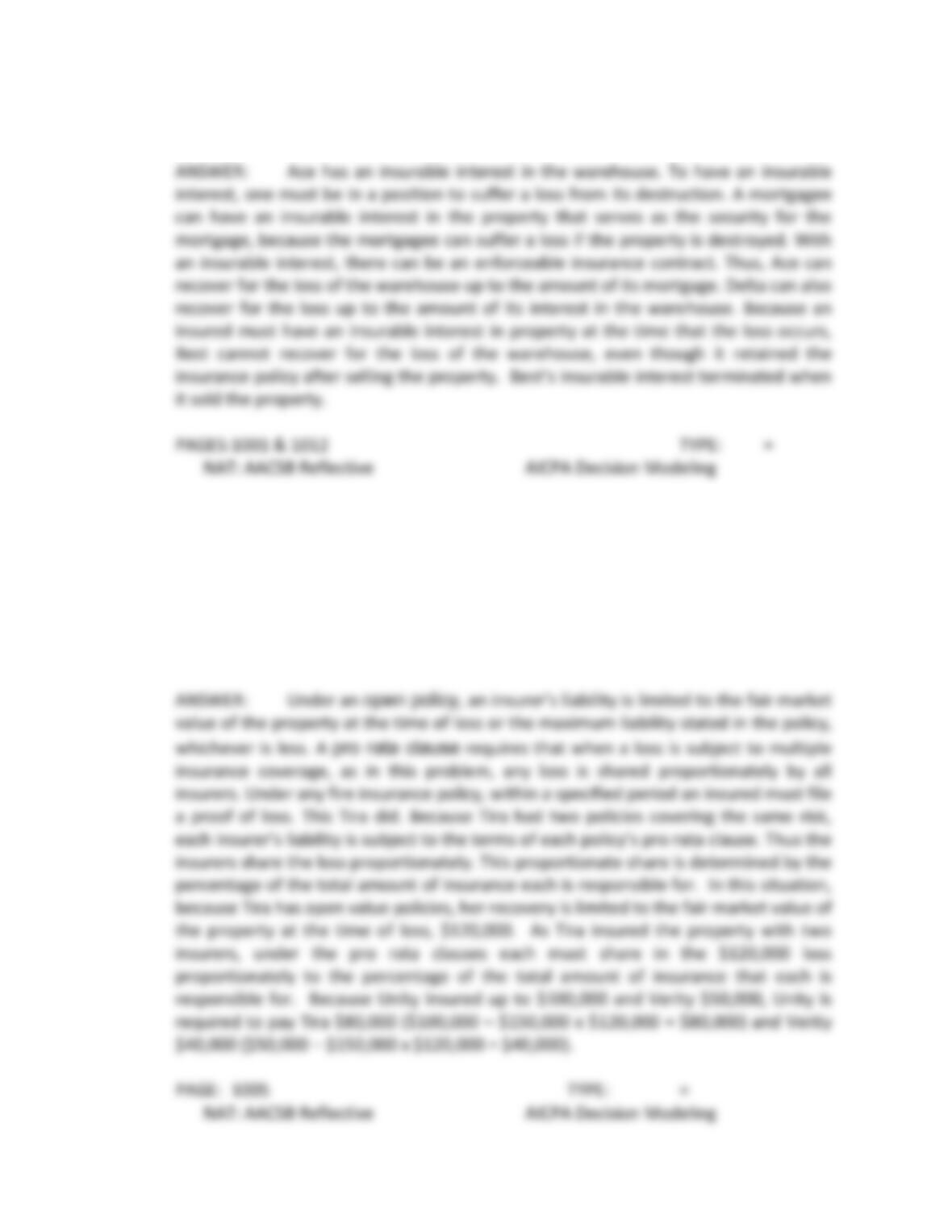
A1. Ace Investments, Inc., is the mortgagee for a warehouse owned by Best Storage, Inc.
Ace obtains an insurance policy from Complete Insurance Corporation (CIC) to cover
the warehouse. Best also obtains a policy from CIC to cover the warehouse. Later,
Best sells the warehouse to Delta Company but keeps the policy. Delta also obtains a
policy from CIC to cover the warehouse. Ace agrees to act as Delta’s mortgagee. A fire
totally destroys the warehouse. Who can recover for the loss?
CHAPTER 51: INSURANCE 637
A2. Tira obtains two fire insurance policies on her house. Each is an open policy with a pro
rata clause. Tira’s policy with Unity Insurance Company is for a maximum amount of
$100,000. Her policy with Verity Insurance Company is for a maximum amount of
$50,000. Each policy includes a pro rata clause. Due to defective electrical wiring,
Tira’s house catches fire and burns completely. The value the house at the time of the
loss is $120,000. Tira files a proof of loss with each insurer. What is an open policy?
What is a pro rata clause? What is the liability of Unity and Verity for this event?