Chapter 47
Antitrust Law
N.B.: TYPE indicates that a question is new, modified, or unchanged, as follows.
N A question new to this edition of the Test Bank.
+ A question modified from the previous edition of the Test Bank.
= A question included in the previous edition of the Test Bank.
TRUE/FALSE QUESTIONS
A1. The basic purpose of antitrust law is to restrict competition.
A2. Unilateral conduct can not result in a violation of antitrust law.
A3. Under the rule of reason, a court will consider the effect or the potential effect of a
business agreement on competition.
A4. Any agreement among competitors to fix prices constitutes a per se violation of
antitrust law.
576 TEST BANK A—UNIT NINE: GOVERNMENT REGULATION
A5. Most group boycotts are legal.
A6. Joint ventures undertaken by competitors are not subject to antitrust laws.
A7. A horizontal restraint of trade results from an agreement between firms at different
levels in the manufacturing and distribution process.
A8. Territorial and customer restrictions are currently considered per se violations of
antitrust law.
A9. Resale price maintenance agreements are subject to analysis under the rule of reason.
A10. A firm may be a monopolist even though it is not the sole seller in a market.
A11. For products that are sold nationwide, there are no geographic boundaries for the
market.
CHAPTER 47: ANTITRUST LAW 577
A12. Any action challenged as an attempt to monopolize must have been specifically
intended to exclude competitors and garner monopoly power.
A13. Monopsony power is market power on the buy side of a market.
A14. Price discrimination occurs when a seller charges the same price to competing
buyers for identical goods or services.
A15. A contract under which a seller forbids a buyer to purchase products from the seller’s
competitors is a tying arrangement.
A16. When a small number of companies share a large part of a market, the market is
concentrated.
A17. Mergers between firms that compete in the same market are vertical mergers.
A18. Only the U.S. Department of Justice can prosecute violations of all of the antitrust
laws.
578 TEST BANK A—UNIT NINE: GOVERNMENT REGULATION
A19. In a situation involving a price-fixing agreement, normally each competitor is liable for
the total amount of any damages.
A20. Any conspiracy—even if it occurs outside the United States—that has a substantial
effect on U.S. commerce is within the reach of the U.S. antitrust laws.
MULTIPLE CHOICE QUESTIONS
A1. North Mining Company and South Excavation Company agree to abide by the
decisions of East Coast Financial Corporation as to their respective levels of
production, markets, and prices, effectively reducing competition and increasing
profits. This is most likely
a. a common, legal, time-honored type of business arrangement.
b. an illegal restraint on trade.
c. an innovative, legally efficient approach to doing business.
d. an outdated, but legal business trust.
A2. Helio Company can process hydrogen into an inexpensive fuel for internal combustion
engines. As an innovator in its market, Helio currently has the power to affect the
price of its product. This is
a. market power.
b. predatory pricing.
c. price discrimination.
d. price-fixing.
CHAPTER 47: ANTITRUST LAW 579
A3. Health Resources Corporation makes and sells Intake, the most prescribed name-
brand cholesterol-lowering medication. Jenerica Company has the potential to make a
generic version of the same drug. Health Resources pays Jenerica not to sell its
product. This is
a. a customer restriction.
b. a joint venture.
c. an exclusive-dealing contract.
d. a price-fixing agreement.
A4. Delta Services, Inc., is the major wholesale distributor of software in the state of
Florida. Its closest competitor is Efficient Systems Company, another Florida firm. The
two firms agree that Delta will operate in south Florida and Efficient will operate in
north Florida. This is
a. a group boycott.
b. a market division.
c. a price-fixing agreement.
d. a tying arrangement.
A5. Engine Components, Inc., a manufacturer of vehicle parts, refuses to sell to Fix-It, Inc.,
a national vehicle service firm. Engine Components convinces Greasy Motor Parts
Company, a competitor, to do the same. This is
a. a group boycott.
b. an exclusive-dealing contract.
c. a price-fixing agreement.
d. a tying arrangement.
580 TEST BANK A—UNIT NINE: GOVERNMENT REGULATION
A6. Lightning Cycles, Inc., makes Lightning-brand motorcycles and accessories, which are
distributed to authorized dealers, including Macho Motors, Inc. Macho operates
dealerships in several locations. Lightning imposes territorial restrictions on Macho to
insulate other dealers from direct competition. This is
a. a situation that neither restrains trade or harms competition.
b. a legal restraint of trade.
c. a per se violation of antitrust law.
d. subject to analysis under the rule of reason.
A7. USA Cellphone Corporation requires all distributors of its products to sell the products
at specified minimum prices. This resale price maintenance agreement is
a. a per se violation of antitrust law.
b. a legal restraint of trade.
c. subject to evaluation under the rule of reason.
d. not subject to antitrust law.
A8. Imperio Caffeine Corporation makes and sells coffee under a variety of brand names.
Imperio wants to merge with Java Company, its main competitor. In weighing a
challenge to the deal, a court looks at the relevant product market. This most likely
includes coffee and
a. no other products.
b. products that are not identical but are related, such as spin-offs.
c. products that are reasonably interchangeable.
d. products with identical attributes only.
CHAPTER 47: ANTITRUST LAW 581
A9. International Products, Inc. (ICI), has exclusive control over the market for its product.
ICI’s market power is most likely
a. a situation that neither restrains trade or harms competition.
b. a legal restraint of trade.
c. a per se violation of antitrust law.
d. subject to further evaluation.
A10. To acquire monopoly power in its market, Pure Plastics, Inc., sets its prices
substantially below the normal costs of production. Under antitrust law, this is
a. a per se violation.
b. a violation if its competitors make similar deals.
c. a violation if it thereby acquires monopoly power.
d. not a violation.
A11. Rally Speedboat Corporation refuses to sell its products to Super Weekends, Inc., a
recreational water products dealership. This is
a. a group boycott.
b. a horizontal market division.
c. attempted monopolization.
d. a unilateral refusal to deal.
582 TEST BANK A—UNIT NINE: GOVERNMENT REGULATION
A12. A suit is filed against Urbana Corporation, alleging that the firm committed the
offense of monopolization. To determine whether Urbana has monopoly power
requires looking at
a. the company’s size alone.
b. business ethics and corporate gamesmanship.
c. production methods and marketing techniques.
d. the relevant geographic market and the relevant product market.
A13. Seaside Cannery, Inc., is one of many producers of canned seafood. Seaside refuses to
sell its products to Port Harbor Restaurant Corporation. Under antitrust law, this
refusal is most likely
a. a per se violation.
b. a violation if its competitors make similar deals.
c. a violation if it thereby acquires monopoly power.
d. not a violation.
A14. An antitrust action is brought against Tri-State Transport Company, alleging the
offense of attempted monopolization. To be guilty of this offense, Tri-State’s attempt
must have
a. a dangerous probability of success.
b. a deadly guaranty of success.
c. a distant possibility of success.
d. a distinct improbability of success.
CHAPTER 47: ANTITRUST LAW 583
A15. To prevent its competitors from obtaining sufficient supplies to make their products,
Molded Plastics, Inc., uses its market power to increase the prices of those supplies.
This is
a. a refusal to deal.
b. business judgment.
c. predatory bidding.
d. predatory pricing.
A16. By contract, Quality Metals Corporation forbids Resource Refining, Inc., a wholesale
buyer of Quality’s products, from purchasing the products of Quality’s competitors.
This exclusive-dealing contract is allowed
a. under any circumstances.
b. unless its effect is to cause a competitor a loss of any business.
c. unless its effect is to substantially lessen competition.
d. unless there is no effect on a competitor.
A17. To drive its competitors out of a certain geographic segment of its market, Fryin’
Potatoes, Inc., sets the prices of its products below cost for the buyers in that area.
This is
a. a refusal to deal.
b. business judgment.
c. predatory bidding.
d. price discrimination.
584 TEST BANK A—UNIT NINE: GOVERNMENT REGULATION
A18. Integrated Software, Inc., conditions the sale of one of its products on Inventory
Office System’s agreeing to buy another of Integrated’s products. This deal is
a. legal, depending on its purpose and the effect on competition.
b. legal, depending on production and transportation costs.
c. legal under any circumstances.
d. not legal under any circumstances.
A19. Midwest Agri-Products Corporation offers to sell its sugar substitute to Nice Candies,
Inc., only if Nice Candies agrees to buy all the corn it needs from Midwest Agri–
Products, even though there are other corn sellers from whom Nice Candies could
buy. This is
a. an exclusive-dealing contract.
b. a tying arrangement.
c. price discrimination.
d. price fixing.
A20. Mango Corporation believes that Melon Corporation engages in anticompetitive
behavior in an attempt to drive Mango, its chief competitor, out of the market.
Antitrust laws can be enforced against Melon by
a. only a disinterested third party.
b. Congress.
c. Mango.
d. none of the choices.
ESSAY QUESTIONS
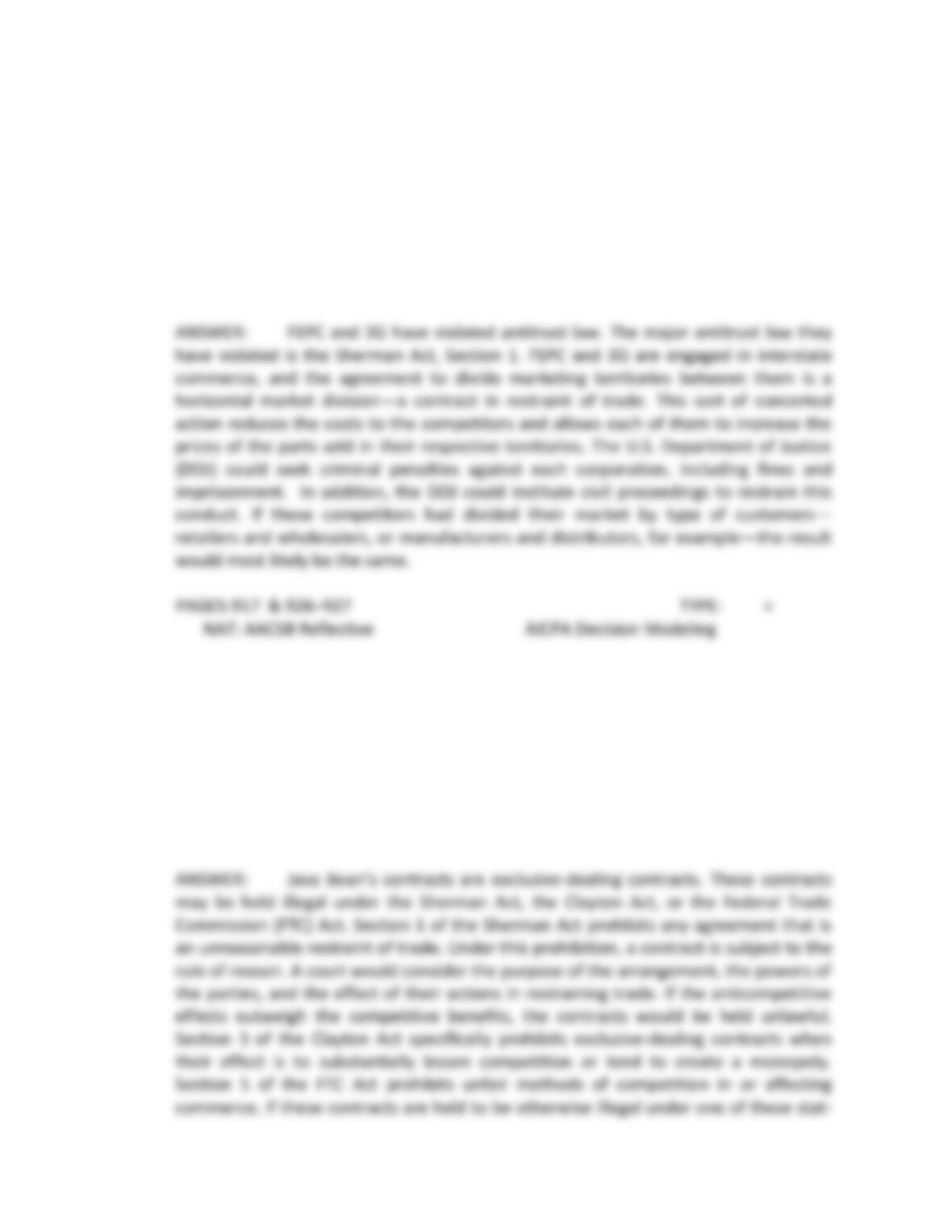
A1. Finely Engineered Parts Corporation (FEPC) and Great Gears & Gauges, Inc. (3G), are
competitors selling certain machine parts that are otherwise generally unattainable in
CHAPTER 47: ANTITRUST LAW 585
their geographic market. This market includes the states of California, Oregon,
Washington, and Idaho. FEPC and 3G agree that FEPC will no longer sell in California
and that 3G will no longer sell in Oregon, Washington, and Idaho. Have FEPC and 3G
violated any antitrust law? If so, which one? Explain. If they had divided their market
by type of customer rather than geographic are, would the result be the same? Why
or why not?
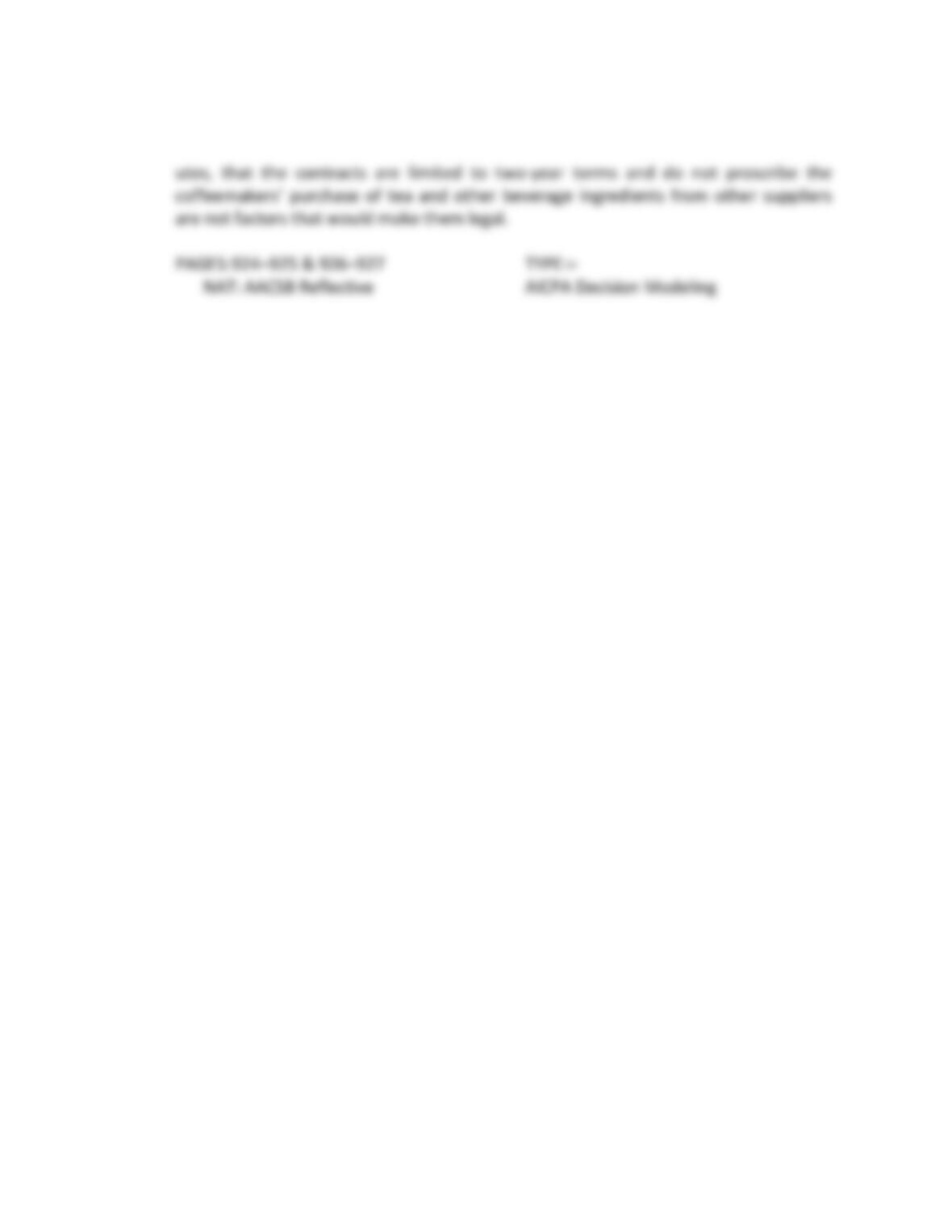
A2. Java Bean Company imports coffee beans and sells them under two-year contracts to
Mellow Roast, Inc., and other coffeemakers. The contracts require that during the
two–year term a coffeemaker not buy beans from Java Bean’s competitors. The
contracts do not limit the coffeemakers’ purchase of tea or other beverage
ingredients from other suppliers, however. In the second year of the contract, Mellow
Roast protests that this arrangement violates antitrust law. Is Mellow Roast correct? If
not, why not? If so, under which antitrust statute, or statutes, could these contracts
be held illegal?
586 TEST BANK A—UNIT NINE: GOVERNMENT REGULATION