
Chapter 42
Securities Law and
Corporate Governance
N.B.: TYPE indicates that a question is new, modified, or unchanged, as follows.
N A question new to this edition of the Test Bank.
+ A question modified from the previous edition of the Test Bank.
= A question included in the previous edition of the Test Bank.
TRUE/FALSE QUESTIONS
B1. The Securities and Exchange Commission creates regulations governing the purchase
and sale of securities.
B2. The Securities and Exchange Commission can seek sanctions against those who violate
foreign securities laws.
B3. A prospectus is a contract in which a person (1) invests (2) in a common enterprise (3)
reasonably expecting profits.
B4. Once the registration statement has been filed, there is no waiting period—the issuer
can offer and sell the securities without restrictions.
B5. Noninvestment companies are firms that are not engaged primarily in the business of
investing or trading in securities.
B6. Securities offerings in unlimited amounts can be exempt from the registration
requirements in certain circumstances.
B7. Most securities can not be resold without registration.
B8. Selling securities under an exemption for which the securities do not qualify results in
liability.
B9. Securities must be registered under the Securities Act of 1933 for the Securities
Exchange Act of 1934 to apply.
B10. To be considered material, a fact must be significant enough that it would likely affect
an investor’s decision to buy or sell a company’s securities.
B11. Liability under Section 10(b) of the Securities Exchange Act of 1934 has been extended
to include certain “outsiders.”
B12. It is always wrong to disclose material, nonpublic information about a company to a
person who would not otherwise be privy to it.
B13. For civil sanctions to be imposed under Section 10(b) of the Securities Exchange Act of
1934 and SEC Rule 10b-5, scienter must not exist.
B14. Violations of Section 16(b) of the Securities Exchange Act of 1934 include the sale by
insiders of stock acquired less than six months before the time of sale.
B15. For a defendant to be convicted in a criminal prosecution under the securities laws, a
jury is allowed to speculate that the defendant may have acted wrongfully.
B16. Private parties can sue violators of Section 10(b) of the Securities Exchange Act of
1934 and SEC Rule 10b-5.
B17. Typically, state laws have disclosure requirements and antifraud provisions patterned
after Section 10(b) of the Securities Exchange Act of 1934 and SEC Rule 10b-5.
B18. Corporate accountability can be increased by imposing strict disclosure requirements
for securities transactions.
B19. Under the Sarbanes-Oxley Act of 2002, chief financial officers must certify the
accuracy of information in corporate financial statements.
B20. The Securities and Exchange Commission rarely issues interpretive releases to explain
how securities laws apply in the online environment.
MULTIPLE CHOICE QUESTIONS
B1. Readmore Bookstore Corporation files a registration statement and delivers a
prospectus to the appropriate parties. These items are intended to enable the
evaluation of certain financial risks by
a. market professionals to explain to all investors.
b. government regulators to disclose to the general public.
c. sophisticated investors only.
d. unsophisticated investors.
NAT: AACSB Reflective AICPA Legal
B2. Bild-It-Rite Corporation is a public company that is poised to issue securities that do
not qualify for an exemption from registration. This means that Bild-It–Rite must
a. file a registration statement with the SEC.
b. issue the securities through an online registration site.
c. refrain from issuing the securities to unregistered investors.
d. register the securities with a national stock exchange.

B3. Squeaky Clean Corporation wants to make an offering of securities to the public. This
offering is not exempt from registration under the Securities Act of 1933. Before
Squeaky sells its securities, it must provide investors with
a. a forward-looking financial forecast.
b. an investment contract.
c. a prospectus.
d. samples of is products.
B4. Begin Anew Enterprise, Inc., completes its registration process and issues a free-writing
prospectus. This tells prospective investors
a. about investing freely.
b. how to write their own prospectus.
c. that they can “freely write their own ticket” to buy Begin’s securities.
d. that they may obtain the prospectus at the SEC’s Web site.
B5. Mountain View Corporation is a noninvestment company that wants to issue stock of
$3 million in a twelve-month period. Mountain View, with less than $20 million in
annual sales, qualifies as a small business issuer. Before Mountain View sells the
stock, it must provide investors with
a. an offering circular.
b. a notice of the issue.
c. a red herring prospectus.
d. a tombstone ad.
B6. Flite Airline Corporation is poised to issue securities in a transaction that, under the
Securities Act of 1933, is “exempt.” This enables Flite to
a. avoid the costs and complications of registration.
b. buy and sell the securities without liability for “recaptures.”
c. make forward-looking financial forecasts without liability.
d. withhold inside information from accredited investors.
B7. As part of a stock offering for Equine Corporation, Flem, Equine’s accountant,
intentionally misrepresents material facts in the prospectus. Gigi buys the stock
unaware of the misrepresentation and suffers a loss. Flem may be subject to
a. a fine and damages only.
b. a fine and imprisonment only.
c. a fine, imprisonment, and damages.
d. damages only.
B8. GR8 Stuf Company files a registration statement with the SEC before making an
offering to the general public. The registration contains false, immaterial statements
of which the investors are unaware. GR8 Stuf is charged with violating the Securities
Act of 1933. GR8 Stuf’s best defense is
a. the investors were not aware of the misrepresentations.
b. the issuer reasonably believed the misstatements were true.
c. the offering was made available to the general public.
d. the untrue statements were not material.
B9. Hometown Shops Retail Company has assets of less than $10 million and fewer than
five hundred shareholders. Interstate Outlets, Inc., has assets of more than $10 mil–
lion and more than five hundred shareholders. The Securities Exchange Act of 1934
applies to
a. Hometown Shops and Interstate Outlets.
b. Hometown Shops only.
c. Interstate Outlets only.
d. neither Hometown Shops nor Interstate Outlets.
B10. Nouveau Riche Corporation, and its officers, directors, and shareholders, buy and sell
securities. SEC Rule 10b-5 applies to
a. only the purchase or sale of a security by a financial corporation.
b. only the purchase or sale of a security involving an officer or director.
c. only the purchase or sale of a security involving a shareholder.
d. the purchase or sale of any security.
B11. To raise capital to form Plasticity Corporation with Quinn, Rona sells bonds and stock
in other companies, and plans to register an initial public offering under the Securities
Act of 1933. SEC Rule l0b-5 covers
a. most forms of securities.
b. only bonds.
c. only securities registered under the Securities Act of 1933.
d. only stock.
Fact Pattern 42-1B (Questions B12–B13 apply)
Sid, a director of Tech Software Company, learns that a Tech engineer has developed “Ur
Call,” a new, exciting video game. Sid buys Tech stock and tells his friend Velma, who also
buys Tech stock. When the new game is released three weeks later, Sid and Velma sell their
stock for a big profit.
B12. Refer to Fact Pattern 42-1B. Under SEC Rule l0b-5, Sid would not be liable if he had
waited to buy Tech stock until
a. after Sid told Velma of the new game.
b. after Velma bought Tech stock.
c. after the public release of the game.
d. just before the game was released.
B13. Refer to Fact Pattern 42-1B. Regarding Sid’s profits on the purchase and sale of Tech
stock, under Section 16(b) of the Securities Exchange Act of 1934 Tech may recapture
a. all of Sid’s profits.
b. half of Sid’s profits.
c. 10 percent of Sid’s profits.
d. none of Sid’s profits.
B14. Dave, an accountant, does not work for Emergent Company, but wrongfully obtains
inside information concerning Emergent. Based on the information, Dave buys and
sells Emergent stock for personal gain. The Securities and Exchange Commission
prosecutes Dave, arguing that he is liable because he stole information rightfully
belonging to another. This argument is
a. the blue-sky theory.
b. the misappropriation theory.
c. the red-herring theory.
d. the tipper/tippee theory.
B15. Excel Aviation Corporation is required to register its securities under Section 12 of the
Securities Exchange Act of 1934. Section 14(a) of the act regulates
a. the declaration of dividends by Excel’s board of directors.
b. the later re-registration of Excel’s securities.
c. the short-swing activities of Excel’s insiders.
d. the solicitation of proxies from Excel’s shareholders.
B16. Ernie contracts to buy securities from Freda. Later, believing that Freda committed
fraud in the deal, Ernie files a suit against her. If Freda is found liable, Ernie may
obtain
a. an apology only.
b. damages to the extent of Freda’s illegal profits only.
c. damages to the extent of Freda’s illegal profits or rescission of Ernie’s contract
to buy securities from Freda.
d. rescission of Ernie’s contract to buy securities from Freda only.
B17. Corner Café Company offers its stock for sale only in a single state. The law in Corner’s
state is like the law in most states. Corner’s offer is subject to state securities statutes
that include
a. antifraud and disclosure provisions.
b. antifraud provisions only.
c. disclosure provisions only.
d. neither antifraud nor disclosure provisions.
B18. Maple Products Corporation is a public company, which New Hampshire regulates and
in which Orin invests. The Sarbanes-Oxley Act of 2002 introduced direct federal
corporate governance requirements to
a. public companies.
b. private investors.
c. state regulators.
d. none of these choices.
B19. Heavy Hauling, Inc., is a public company whose shares are traded in the public
securities markets. Under the Sarbanes-Oxley Act of 2002, to ensure that Heavy
Hauling’s financial results are accurate and timely, the firm’s senior officers must set
up and maintain
a. internal “disclosure controls and procedures.”
b. external “release and reveal timetables.”
c. personal “peruse and review liability policies.”
d. public “information and discussion forums.”
B20. Lara is the chief executive officer of Micro, Inc., which is required to file certain
financial reports with the Securities and Exchange Commission (SEC). Under the
Sarbanes-Oxley Act of 2002, Lara must
a. certify that the reports are complete and accurate.
b. designate a corporate official to assume liability for inaccuracies.
c. do nothing.
d. read the reports and be prepared to answer questions about them.
ESSAY QUESTIONS
B1. Drew is an officer of Energy Fuel, Inc. Drew knows that an Energy engineer recently
developed a new, inexpensive method for converting hydrogen into fuel. Drew takes
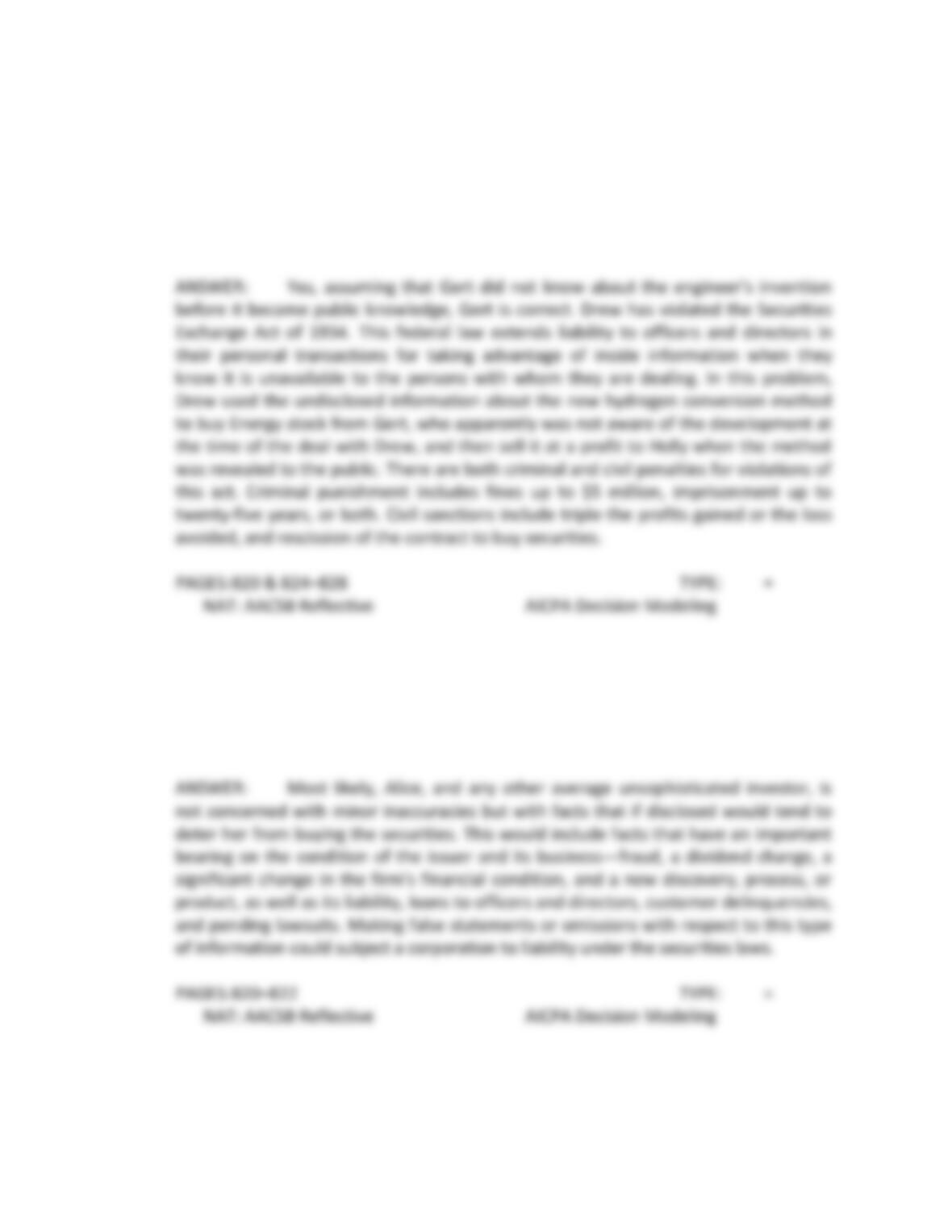
advantage of this information to buy Energy stock from Gert and, after the discovery
is announced, to sell the stock to Holly at a profit. Gert claims that this is a violation of
federal law. Is Gert correct? If so, what federal law has Drew violated, and what are its
possible penalties?
B2. When Looking Glass Corporation wishes to issue certain securities, it must provide
sufficient information for Alice, and other unsophisticated investors, to evaluate the
financial risk involved. Specifically, the law imposes liability for making a false
statement or omission that is “material.” What sort of information would Alice
consider material?