
Chapter 31
Sole Proprietorships
and Private Franchises
N.B.: TYPE indicates that a question is new, modified, or unchanged, as follows.
N A question new to this edition of the Test Bank.
+ A question modified from the previous edition of the Test Bank.
= A question included in the previous edition of the Test Bank.
TRUE/FALSE QUESTIONS
1. In choosing a form of business organization for a new enterprise, important
factors include the ease of creation.
2. In choosing a form of business organization for a new enterprise, important
factors include the liability of the owner.
3. The simplest form of business is a sole proprietorship.
4. A sole proprietor may own and manage any type of business.
5. In a sole proprietorship, the proprietor shares the burden of any losses or
liabilities incurred by the business enterprise with the government.
6. In a sole proprietorship, the owner receives 90 percent of the profits and the
government receives 10 percent.
7. A sole proprietor must create a separate business organization to create a sole
proprietorship.
8. A sole proprietor has unlimited liability for all obligations that arise in doing
business.
9. In raising capital, a sole proprietor is limited to his or her personal funds—a
loan is not possible.
10. A sole proprietorship lacks continuity on the death of the proprietor.
11. A franchisor is the purchaser of a franchise.
12. A franchisee can operate as an independent businessperson but still obtain the
advantages of a national organization.
13. A franchise exists when the owner of a copyright licenses its use to another
party to sell goods or services.
14. A franchise exists when the owner of a trademark licenses its use to another
party to sell goods or services.
15. Laws governing franchising are designed in part to prevent franchisors from
terminating franchises without good cause.
16. A franchise is a contractual arrangement.
17. In a manufacturing arrangement, a franchisor transmits to a franchisee the
ingredients to make a particular product.
18. The laws governing franchising are primarily designed to protect franchisors
from dishonest franchisees.
19. Some states require franchisors to provide presale disclosures to prospective
franchisees.
4 UNIT FIVE: BUSINESS ORGANIZATIONS
20. Some states require that a franchisor submit advertising aimed at prospective
franchisees to the state for approval.
21. If a party to a franchise contract fails to perform, he or she may be subject to a
suit for breach of contract.
22. A franchisee normally does not pay a fee for a franchise license until after the
first year of using it.
23. A franchisee may be required to pay for certain of the franchisor’s
administrative expenses.
24. A franchisee normally pays an initial lump sum for a franchise license.
25. Normally, a franchisee determines the territory that it will serve.
26. A franchise agreement may specify that the premises for the business must be
leased.
27. The validity of a provision permitting the franchisor to establish and enforce
certain quality standards is questionable.
28. A franchisor can set the retail prices for the goods that a franchisee sells.
29. A franchisor can require a franchisee to purchase certain supplies from the
franchisor at an established price.
30. The duration of a franchise is a matter to be determined between the parties.
31. Most franchise agreements provide that notice of termination of a franchise is
not necessary.
32. Much franchise litigation involves claims of wrongful termination.
33. The termination provision of a franchise contract is usually more favorable to
the franchisor.
34. A franchisor’s decision to terminate a franchise may be made in the normal
course of business operations.
35. In determining whether a franchisor acted in good faith in terminating a
franchise relationship, a court would balance the rights of both parties.
MULTIPLE CHOICE QUESTIONS
1. Cal sells “DownSize,” a weight-reduction program, from a Web site, in
competition with Eat-Less Inc.’s product “Fit ‘n Trim.” Eat-Less files a suit
against Cal, alleging in part that he is a sole proprietor, but his enterprise
should be deemed a different form of business. Cal’s enterprise should most
likely be considered
a. a corporation because DownSize is sold online.
b. a franchisee because DownSize is sold in competition to Fit ‘n Trim.
c. a sole proprietorship because Cal is a sole proprietor.
d. no form of business entity because Cal has no formal organization.
2. Julia owns and operates Collectable Dolls without creating a separate business
organization. She receives all the profits from the doll sales. Collectable Dolls is
most likely a
a. a corporation.
b. a limited liability company.
c. a partnership.
d. a sole proprietorship.
3. Leigh wants to go into the business of construction contracting. Among the
reasons that would probably convince Leigh to set up his business as a sole
proprietorship would be
a. its greater organizational flexibility.
b. its limited liability.
c. its perpetual existence.
d. the ease of transferring the business to other family members.
CHAPTER 31: SOLE PROPRIETORSHIPS AND PRIVATE FRANCHISES 7
4. Kelly, the owner of Llama Farms, a sole proprietorship, wants to obtain
additional business capital but to maintain control. This can best be
accomplished by
a. borrowing funds.
b. bringing in partners.
c. issuing stock.
d. selling the business.
5. Phillipa is the sole proprietor of Fun Floral Arrangements. As a sole proprietor,
on Fun Floral Arrangements’ profits, Phillipa
a. does not pay income taxes.
b. pays only personal income taxes.
c. is taxed twice.
d. pays both personal and sole proprietor income taxes.
6. Robert owns Textbooks Plus, a sole proprietorship that sells textbooks. When
Robert dies, Textbooks Plus will
a. be automatically dissolved.
b. pass directly to his oldest child.
c. pass directly to the state.
d. be evenly divided among all Robert’s heirs.
7. Jody owns KuppaJava Kiosks, a sole proprietorship. Jody’s liability is
a. limited by state statute and varies from state to state.
b. limited to the extent of capital expenditures.
c. limited to the extent of his or her original investment.
d. unlimited.
8. Worldwide Realtors, Inc., sells a franchise to XL Sales Company. XL is
a. a franchisee.
b. a franchisor.
c. an agent.
d. a principal.
9. Mello Coffee Shops, Inc., sells a franchise to Noah’s Arch, a café. Mello is
CHAPTER 31: SOLE PROPRIETORSHIPS AND PRIVATE FRANCHISES 9
a. a franchisee.
b. a franchisor.
c. an agent.
d. a principal.
10. Events Promotion Corporation licenses trademarks to Fandom Souvenirs, Inc.,
to use in selling caps, sweatshirts, and similar goods. This is
a. a franchise.
b. an entrepreneur.
c. a principal-agent relationship.
d. a sole proprietorship.
11. Instead of setting up a business to market her own products, Krissy considers
entering into a distributorship franchise with Little Breweries Corporation. This
involves the transfer of
a. a license.
b. a trade name.
c. the formula to make a certain product.
d. the ownership of the business.
12. CheezBurger Heaven, Inc., conducts a chain-style franchise. This involves the
transfer to Clive, one of its franchisees, of
a. a license.
b. a trade name.
c. the formula to make a product.
d. the ownership of the business.
13. Leo buys an exclusive territory in which he is authorized to set up a plant to
make Midwest Dairy, Inc., products. After receiving the formula, Leo begins
making Nice-brand ice cream and other Midwest products. This is
a. a chain-style franchise.
b. a distributorship franchise.
c. a manufacturing franchise.
d. no franchise.
14. Paradise Footwear buys a franchise from Reliant Athletic Shoes Inc. This
relationship, like all other franchise relationships, is governed by
a. contract law.
b. no law.
c. the Franchise Disclosure Document, or FDD.
d. the rules of the National Collegiate Athletic Association.
15. Pepsi-Cola Bottling Company is
a. a chain-style franchise.
b. a distributorship franchise.
c. a manufacturing franchise.
d. not a franchise.
16. Frooty Drinks, Inc., and Great Gulp Bottling Company have a processing-plant
franchise arrangement. This involves the transfer of
a. a license.
b. a trade name.
c. the formula to make a certain product.
d. the ownership of the business.
17. Otis is interested in buying a franchise from Plentiful Inc. This transaction, like
other franchise deals, is regulated to protect
a. certain types of anticompetitive agreements.
b. franchisors from dishonest prospective franchisees.
c. prospective franchisees from dishonest franchisors.
d. the government’s power to restrict freedom of contract.
12 UNIT FIVE: BUSINESS ORGANIZATIONS
Fact Pattern 31-1 (Questions 18–19 apply)
Jumbo Juice Inc. offers entrepreneurs the opportunity to operate a franchise under the
Jumbo Juice trade name as a member of a select group of dealers that engage in
retail juice sales.
18. Refer to Fact Pattern 31-1. To potential investors, Jumbo Juice must provide
a. actual earnings figures.
b. hypothetical earnings figures.
c. projected earnings figures.
d. none of the choices.
19. Refer to Fact Pattern 31-1. Jumbo Juice makes earnings claims to potential
investors. For those claims, the franchisor must have
a. a hypothetical basis.
b. a reasonable basis.
c. an actual basis.
d. no basis.
20. In-Home Maid Service Company uses a Web site to provide downloadable
information to prospective franchises. This online information is the equivalent
of an offer that must comply with
a. the Automobile Dealers’ Franchise Act of 1965.
b. no law.
c. the Federal Trade Commission’s Franchise Rule.
d. the state Franchise Disclosure Document, or FDD.
21. Pilar is interested in buying a franchise from Quixotic Travel & Tours
Corporation. Quixotic must disclose material facts that Pilar needs to make an
informed decision concerning this purchase, according to
a. no law.
b. the Petroleum Marketing Practices Act of 1979.
CHAPTER 31: SOLE PROPRIETORSHIPS AND PRIVATE FRANCHISES 13
c. the Federal Trade Commission’s Franchise Rule.
d. the Uniform Commercial Code.
22. Cluckee Chick’n Corporation provides its prospective franchisees with
projected earnings figures based on actual data. Cluckee Chick’n must also
disclose
a. the number and percentage of franchisees that achieved the figures.
b. hypothetical examples of potential earnings.
c. an answer to the entrepreneur’s question, “How much will I make?”
d. none of the choices.
23. Gage buys from Fishing Guide Corporation the exclusive right to sell Fishing
Guide rods and reels in a certain area. Their franchise agreement requires
Gage to pay certain administrative expenses. Their agreement may also
require Gage to pay a percentage of the franchisor’s
a. advertising costs.
b. personal expenses.
c. retirement income.
d. none of the choices.
24. Flip Gymnastics & Karate, Inc., grants a franchise to Gibby to operate a Flip
gym. Flip may require Gibby to pay the franchisor a percentage of his
a. annual sales or volume of business.
b. weekly payroll expense.
c. monthly overhead savings.
d. none of the choices.
25. Pronto Tacos LLC grants a franchise to Omar to open and operate a Pronto
Tacos restaurant. Pronto will likely charge Omar
a. an initial fee or lump sum price for the franchise license.
b. a percentage of Omar’s weekly payroll expense.
c. an amount of Omar’s monthly overhead savings, if any.
d. none of the choices.
26. Echo enters into an agreement with Deep Pan Pies, Inc., to operate a franchise
in Centre City. Later, Deep grants franchises to others within the city. Echo files
a suit to close them. If the court rules in Echo’s favor it will most likely be on the
ground that
a. Deep violated the antitrust laws.
b. Deep violated the implied covenant of good faith and fair dealing.
c. Echo paid a franchise fee.
d. Echo was the first Deep franchisee in Centre City.
27. Fern contracts to buy a franchise from Gooseberry Grocers, Inc. The contract
is silent on the issue of territorial rights. Gooseberry allows a competing
franchise to be established near Fern’s store, which suffers a significant loss in
profits. This is most likely a violation of
a. no law.
b. the ban on certain types of anticompetitive agreements.
c. the Federal Trade Commission’s Franchise Rule.
d. the implied covenant of good faith and fair dealing.
28. Sweet Styles, Inc., a franchisor of clothing stores, wishes to standardize the
pricing practices of its franchisees that have engaged in price-cutting to
increase their respective shares of the market. The most prudent action might
be for Sweet to
a. mandate the prices at which its franchisees sell their products.
b. suggest the prices at which its franchisees sell their products.
c. require its franchisees to buy inventory exclusively from Sweet.
d. threaten its franchisees with a material breach of contract.
29. Rita buys a Super Grill franchise. Super Grill requires that its franchisees buy
its products for every phase of their operations. Because Rita wishes to buy
less expensive products, she challenges the requirement. Her best argument is
probably that the requirement violates
a. the commerce clause.
b. the Equal Protection Clause.
c. the federal antitrust laws.
d. the First Amendment.
30. Pricey Auto Corporation gives notice to Quint that Pricey is terminating their
franchise arrangement. Winding up the business requires
a. a new franchise agreement.
b. nothing more than closing immediately.
16 UNIT FIVE: BUSINESS ORGANIZATIONS
c. Quint’s death, disability, or insolvency.
d. the return of Pricey’s property.
31. A franchise agreement between Simple Software Company and Total Game,
Inc., is silent on a time for termination of the franchise. Simple may
a. never terminate.
b. terminate at any time.
c. terminate on reasonable notice.
d. terminate on three days notice.
32. Star Resorts Corporation wants to terminate its franchise arrangement with
Tony. Their contract does not provide for notice of termination or set a time for
winding up the business. This means that to wind up, Tony
a. has a reasonable time, with notice.
b. has whatever time A determines, with or without notice.
c. is entitled to notice, but nothing more.
d. must close immediately.
33. Bret buys a franchise from Comida Mexicano Ltd. If their agreement is like
most franchise agreements, it will specify that Comida can terminate the
franchise
a. at will.
b. for any reason.
c. for cause only.
d. for no reason.
34. Bob operated a pet grooming shop under a franchise agreement with Clean
Pets Corp (CPC). The agreement allowed CPC to terminate the franchise if
Bob was fined for cruelty to animals. After an investigation initiated by a
customer complaint, Bob was fined for cruelty. CPC terminated the franchise.
Bob filed a suit against CPC for wrongful termination. The court will most likely
rule in favor of
a. Bob, because CPC had no good cause to terminate the franchise.
b. Bob, because the fine for cruelty was based on a customer complaint.
c. CPC, because a franchisor can terminate a franchise at any time.
d. CPC, because the franchise was terminated for good cause.
35. Jack buys a Kitchens, Inc., franchise, which the franchisor later terminates. In
determining whether the termination was proper, a court will generally
a. balance the rights of both parties.
b. emphasize the right of Kitchens, Inc., to its business operation.
c. focus on the right of Jack to be dealt with fairly.
d. underscore the interest of consumers in affordability.
18 UNIT FIVE: BUSINESS ORGANIZATIONS
ESSAY QUESTIONS
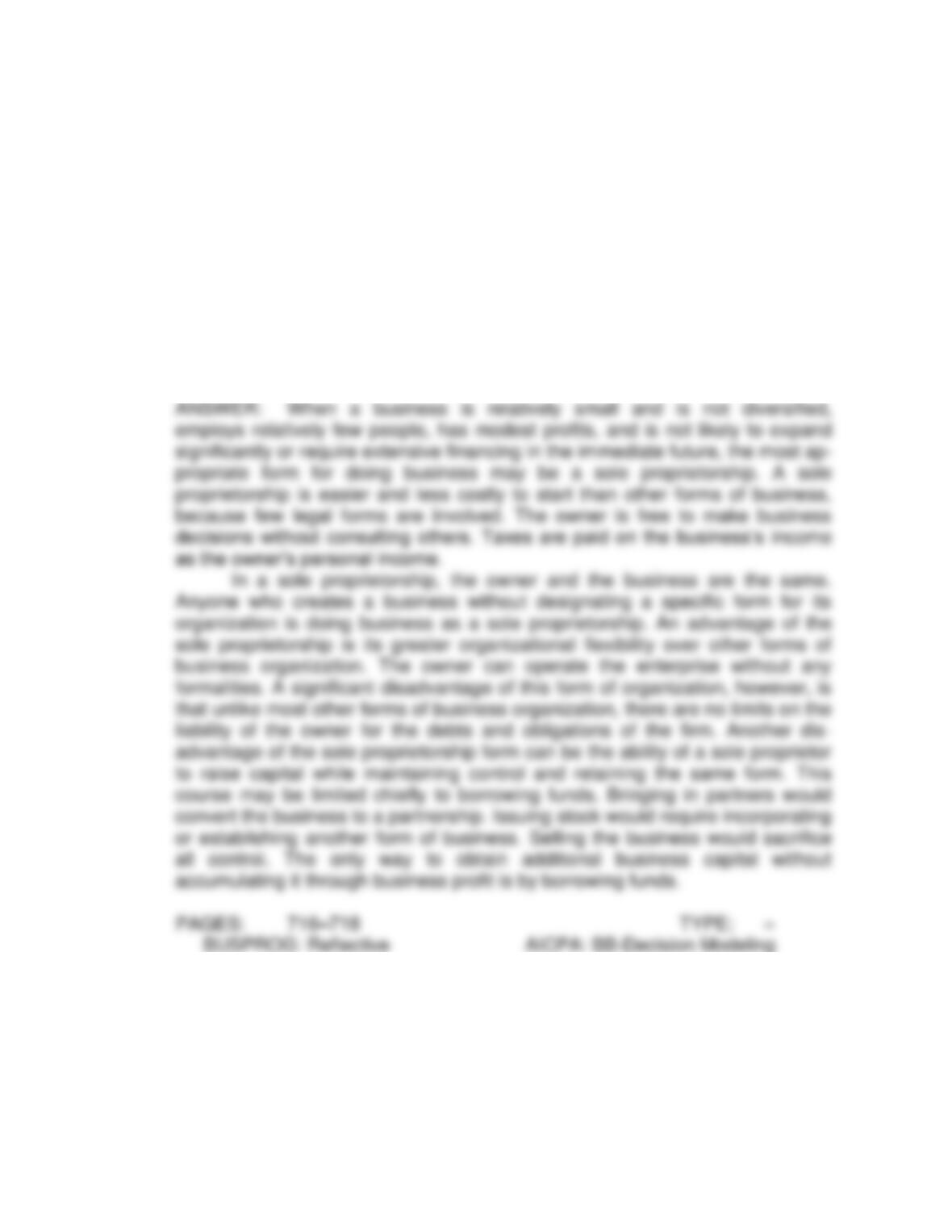
1. Owen plans to open Owen’s Pets Store, a pet sales and pet supplies outlet,
and to hire Quimby and Ruth. Owen will invest only his own money. He does
not expect to make any profit for at least two years and to make almost no
profit for the first three years, but he hopes to expand eventually. Which form of
business organization would be most appropriate? What are the chief
characteristics, advantages, and disadvantages of this form of business
organization? If Owen wants to obtain additional capital to expand the
business, but does not want to lose control of the firm, what is his best option?
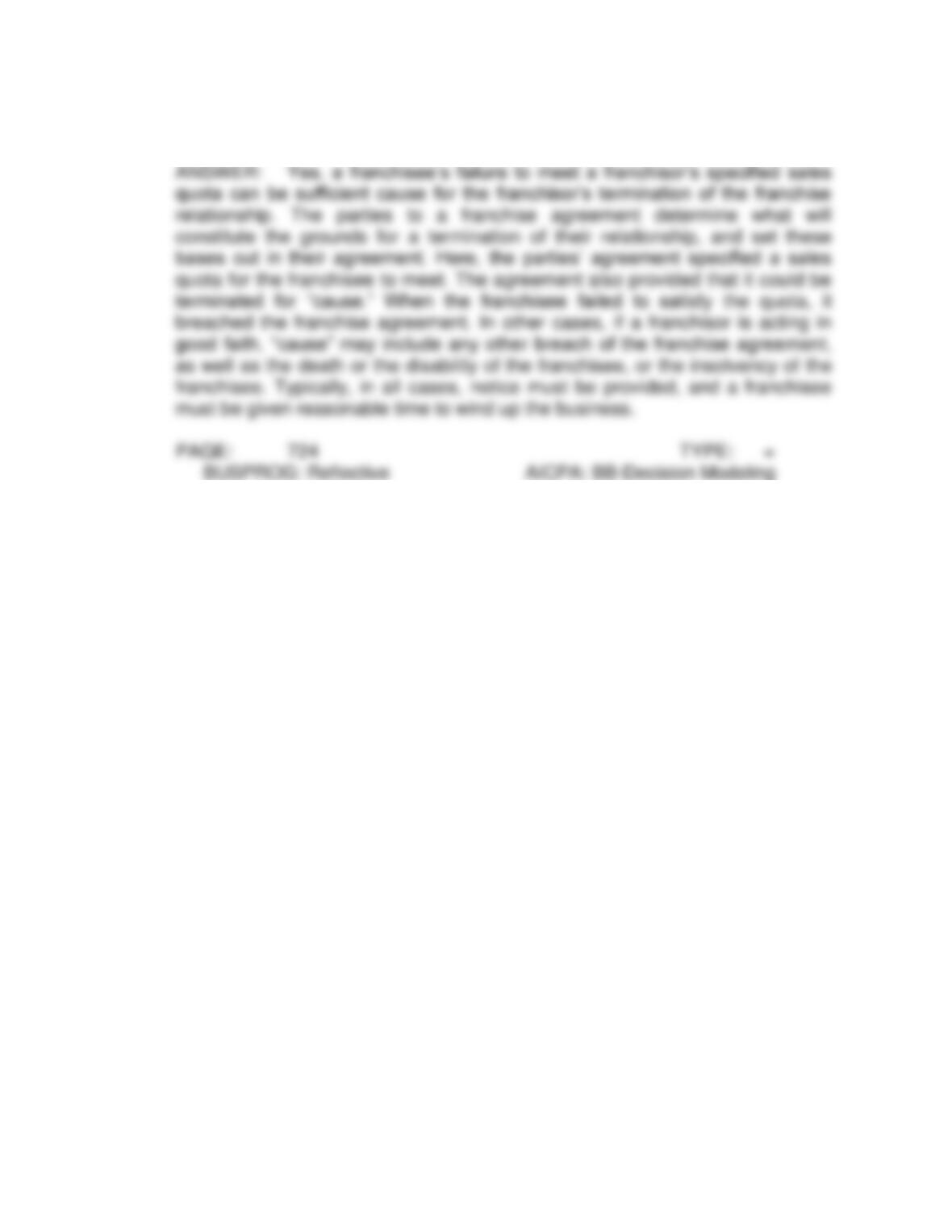
2. Doc’s Sports Club enters into a franchise agreement with Elite Fitness Centers
that provides for termination at any time for “cause.” Doc’s fails to meet Elite’s
“Friends and Family” membership sales quota. Is this “cause” for termination?
Explain.
CHAPTER 31: SOLE PROPRIETORSHIPS AND PRIVATE FRANCHISES 19