23
Chapter 3
Court Procedures
N.B.: TYPE indicates that a question is new, modified, or unchanged, as follows.
N A question new to this edition of the Test Bank.
+ A question modified from the previous edition of the Test Bank.
= A question included in the previous edition of the Test Bank.
TRUE/FALSE QUESTIONS
A1. There is one set of procedural rules for federal courts and various sets for state courts.
A2. A default judgment is entered against a party who fails to respond to the allegations in
a complaint.
A3. Service of process is the process of obtaining information from an opposing party
before trial.
A4. An answer can admit to the allegations made in a complaint.
24 TEST BANK A—UNIT ONE: THE LEGAL ENVIRONMENT OF BUSINESS
A5. At every stage of a trial, either party can file a motion to dismiss the case.
A6. A summary judgment is granted only if there is no genuine question of law.
A7. A motion for summary judgment may be made before, during, or after a trial.
A8. Only a defendant may file a motion for summary judgment.
A9. If a discovery request involves confidential business information, the scope of the
request can be limited.
A10. Voir dire is a process for presenting evidence in a case.
A11. Hearsay evidence is a statement made by someone who was not under oath at the
time.
A12. A trial commences with the plaintiff’s attorney’s direct examination of the first
witness.
CHAPTER 3: COURT PROCEDURES 25
A13. After a defendant finishes introducing his or her evidence, the plaintiff can present a
rebuttal.
A14. A motion for a directed verdict is also known as a motion for judgment as a matter of
law.
A15. A motion for a new trial will be granted only if the trial judge feels that it is
appropriate to grant a judgment for the other side.
A16. Either party can appeal a judge’s ruling on any pretrial motion.
A17. In most appealed cases, a trial court’s decision is affirmed.
A18. An appellate court can reverse the decision of a trial court that erred.
A19. A case is remanded when it is sent back for further proceedings to the court that
originally heard the case.
A20. Every judgment is enforceable.
26 TEST BANK A—UNIT ONE: THE LEGAL ENVIRONMENT OF BUSINESS
MULTIPLE CHOICE QUESTIONS
A1. Glen retains Holly, an attorney, on a contingent-fee basis to seek $100,000 in damages
in a personal-injury suit against Interstate Shipping Corporation. Glen wins. He must
pay
a. court fees and other expenses, but not Holly’s fee.
b. Holly’s fee, court fees, and other expenses.
c. Holly’s fee only.
d. neither Holly’s fee nor court fees and other expenses.
A2. Ridgeline Trucking wants to initiate a suit against Valley Farms by filing a complaint.
The complaint should include
a. an explanation to refute any defense the defendant might assert.
b. a motion for summary judgment.
c. a motion to dismiss.
d. a statement alleging the facts establishing Ridgeline’s basis for relief.
Fact Pattern 3–A1 (Questions A3–A4 apply)
Mac and Nan engage in a business transaction from which a dispute arises. Mac initiates a
lawsuit against Nan by filing a complaint.
A3. Refer to Fact Pattern 3-A1. The sheriff serves Nan with a summons. If Nan chooses to
ignore it
a. Mac must file an amended complaint.
b. Mac will have a judgment entered in his favor.
c. Nan must be served with a second summons.
d. Nan will have a judgment entered in her favor.
CHAPTER 3: COURT PROCEDURES 27
A4. Refer to Fact Pattern 3-A1. If Nan responds to Mac’s complaint by filing a
counterclaim, then
a. Mac will also have to file a response.
b. Mac will have a judgment entered in his favor.
c. Nan will also have to file an amended answer.
d. Nan will have a judgment entered in her favor.
A5. All-USA Imports, Inc., disputes the use of “all–usa.com” as a domain name by All-USA
Overseas Exports, Ltd., and files a suit to resolve the dispute. Service of process must
be by
a. e-mail.
b. personal delivery.
c. regular mail.
d. whatever means is reasonably calculated to do the job.
A6. Indelible Fabrics, Inc. (IFI), makes “Jean’s Denim,” a famous brand of clothing. Without
IFI’s consent, Kopy Company (KC) begins to use “jeansdenim” as part of a domain
name. IFI files a suit against KC and engages in service of process. Service of process
must provide
a. equality and fairness in adjudication.
b. notice and an opportunity to respond.
c. space to fill in important information and time in which to do it.
d. privacy between the litigants and publicity in the judgment.

28 TEST BANK A—UNIT ONE: THE LEGAL ENVIRONMENT OF BUSINESS
A7. Loren files a suit against Mabel, alleging a failure to pay for the harvest of Mabel’s
orchards. Mabel denies Loren’s charge and claims that Loren breached their contract
to harvest a certain number of acres and owes Mabel money for the breach. Mabel’s
claim is
a. a contrary charge.
b. a counterclaim.
c. a counterpoint.
d. a cross complaint.
A8. Opal files a complaint in a suit against Phil, and he files an answer. The case may now
be
a. dismissed only after a trial begins.
b. dismissed or settled at this point.
c. resolved only after a trial ends.
d. settled only during a trial.
A9. Quin files a suit against Regal Products, Inc. Regal responds that even if Quin’s
statement of the facts is true, according to the law Regal is not liable. This is
a. a counterclaim.
b. a motion for judgment on the pleadings.
c. a motion for summary judgment.
d. a motion to dismiss.

CHAPTER 3: COURT PROCEDURES 29
A10. Cody files a suit against Delta Corporation. Delta responds that it appears from the
pleadings the parties do not dispute the facts and the only question is how the law
applies to those facts. Delta supports this response with witnesses’ sworn statements.
This is
a. a counterclaim.
b. a motion for judgment on the pleadings.
c. a motion for summary judgment.
d. a motion to dismiss.
A11. In Restful Motel’s suit against Sleepy Hotels, Inc., Restful serves a written request for
Sleepy to admit the truth of matters relating to the trial. Sleepy’s admission in
response is the equivalent of
a. an admission in court.
b. a statement to the media.
c. information to which Sleepy has a right of privacy.
d. irrelevant evidence.
A12. Excel Products Company files a suit against Flying Distribution, Inc., over a contract.
Before the trial, Excel can obtain from Flying
a. all documents in Flying’s possession relating to the contract.
b. any documents in Flying’s possession.
c. no documents in Flying’s possession.
d. only those documents that Flying agrees to release.

30 TEST BANK A—UNIT ONE: THE LEGAL ENVIRONMENT OF BUSINESS
A13. During a trial in Gene’s suit against Homer over the use of Gene’s lakeside cabin,
Gene’s attorney asks questions of the plaintiff’s witness Illya. This is
a. a cross-examination.
b. a deposition.
c. a direct examination.
d. an interrogatory.
Fact Pattern 3–A2 (Questions A14–A16 apply)
Fine Dining Corporation files a suit against Eat-at–Joe’s, Inc.
A14. Refer to Fact Pattern 3-A2. During the trial, Fine Dining’s attorney questions the
plaintiff’s witness Floyd. Floyd, who is not an expert in the matter about which he is
being asked, can
a. testify about any of the facts in the case.
b. testify about only what he personally observed.
c. offer his opinion about any of the evidence.
d. offer his conclusion with regard to the case.
A15. Refer to Fact Pattern 3-A2. The attorney for Eat-at–Joe’s also questions Floyd. This is
a. a cross-examination.
b. a direct examination.
c. an interrogatory.
d. a request for admissions.
CHAPTER 3: COURT PROCEDURES 31
A16. In Rendezvous Cafe’s suit against Sanitary Waste Services, Inc., the court issues a
judgment in Rendezvous’s favor. The judgment can be appealed to an appropriate
court of appeals by
a. neither party.
b. Rendezvous only.
c. Rendezvous or Sanitary.
d. Sanitary only.
Fact Pattern 3–A3 (Questions A17–A20 apply)
Liz files a suit against Moe in a state court. The case proceeds to trial, after which the court
renders a verdict.
A17. Refer to Fact Pattern 3–A3. If Moe decides to appeal to a state appellate court, Moe’s
attorney must file, with the clerk of the trial court within a prescribed period of time
a. a formal refusal to abide by the verdict.
b. a notice of appeal.
c. a transcript of the trial and copies of the exhibits.
d. the judgment order from which the appeal is taken.
A18. Refer to Fact Pattern 3-A3. If either party appeals, the clerk of the trial court will send
to the clerk of the appellate court within a prescribed period of time
a. a brief including the arguments of both parties.
b. a copy of the record on appeal.
c. an explanation for the verdict.
d. a statement of the grounds for reversal.
32 TEST BANK A—UNIT ONE: THE LEGAL ENVIRONMENT OF BUSINESS
A19. Refer to Fact Pattern 3-A3. If Liz decides to appeal to a state appellate court, Liz’s
attorney must file, with the clerk of the appellate court within a prescribed period of
time
a. a demand to be heard.
b. a motion for a judgment n.o.v.
c. a notice of appeal.
d. a request for affirmance, remand, or reversal.
A20. Refer to Fact Pattern 3-A3. If Moe appeals to, and files a brief with, a state appellate
court, Liz’s attorney may file within a prescribed period of time
a. an advisory interrogatory.
b. an answering brief.
c. a request for a deposition.
d. a responding motion for judgment on the brief.
ESSAY QUESTIONS
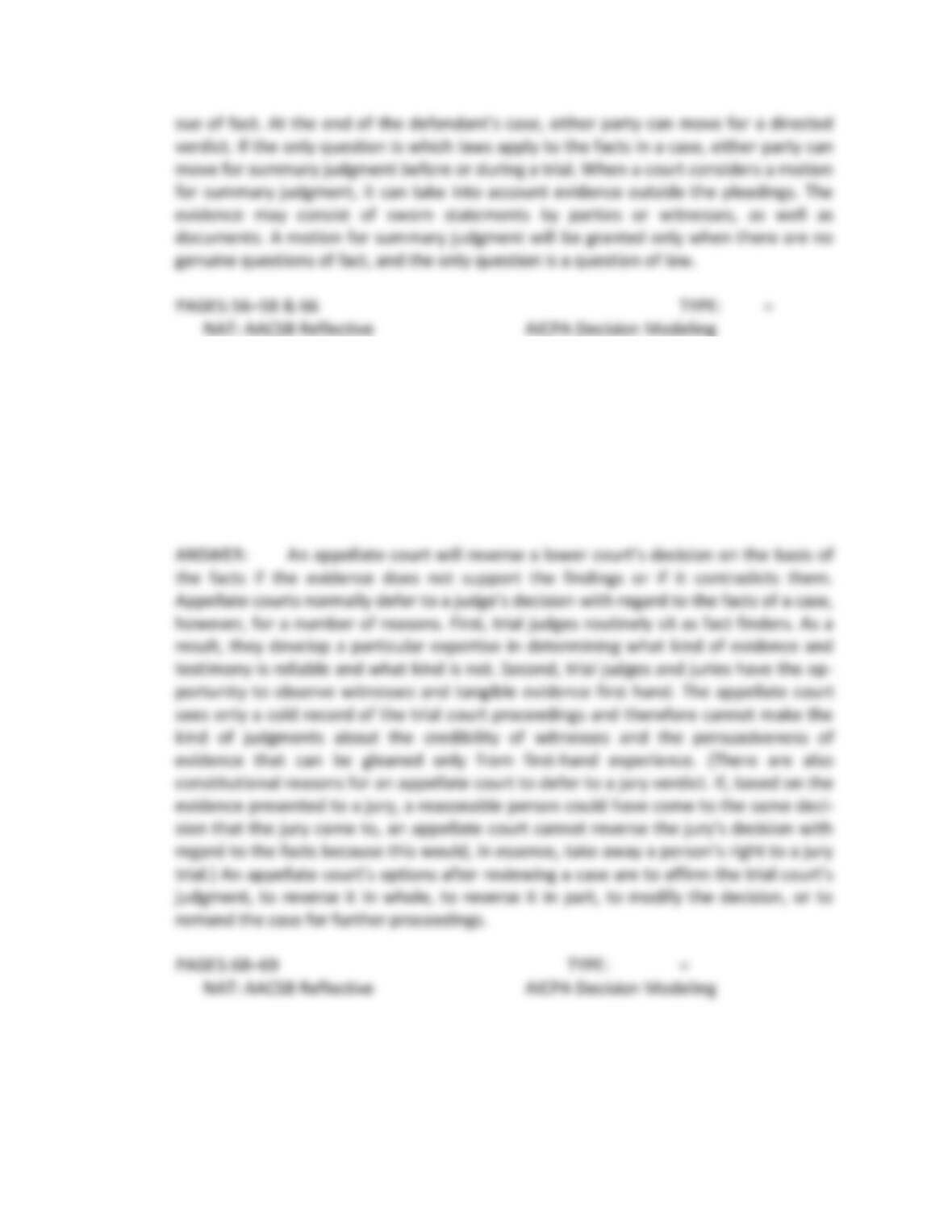
A1. Delta Stores, Inc., files a suit in a state court against Eagle Computer Corporation,
alleging that Eagle breached a contract to sell 500 notebook computers to Delta.
During the course of the suit, Delta files a motion for judgment on the pleadings, Eagle
files a motion for a directed verdict, and both parties file motions for summary
judgment. When and for what purpose are each of these motions made?
CHAPTER 3: COURT PROCEDURES 33
A2. National Trucking Corporation files a suit in a state court against Odell’s Service
Company (OSC), and wins. OSC appeals the court’s decision, asserting that the
evidence presented at trial to support National’s claim was so scanty that no
reasonable jury could have found for the plaintiff. Therefore, argues OSC, the
appellate court should reverse the trial court’s decision. Is the appellate court likely to
reverse the trial court’s findings with respect to the facts? If not, why not? What are
an appellate court’s options after reviewing a case?