
CHAPTER THREE
True-False
Any element of falsity renders the statement false.
1. Most state court systems have only trial courts. Appeals from state courts go directly to the federal
appellate courts.
2. Discovery includes the use of a group of formal methods to learn facts about a dispute before trial.
3. Disputes between parties transacting business over the Internet are subject to special tests regarding
the existence of jurisdiction.
4. Exclusive jurisdiction occurs when only one court system has the power to hear a case.
5. A civil jury is instructed, among other things, to decide the facts in a dispute.
6. Diversity of citizenship jurisdiction applies only if one of the parties is a citizen of another country
and does not apply if the parties are from different states.
7. A bankruptcy matter can be heard in either a federal or state court.
8. A jury trial is usually available in cases involving equity claims.
9. The burden of proof in a civil case rests on the defendant/respondent.

2 Chapter Three
10. In a criminal case, discovery for the prosecution is limited because of the defendant’s privilege
against self-incrimination.
11. In a civil suit, the plaintiff is not allowed to waive his or her right to a jury trial.
12. Most civil cases are conducted in courts which are open to public observation.
13. One example of a long-arm statute is diversity jurisdiction.
14. Appellate courts decide questions of law, and do not ordinarily decide questions of fact.
15. A deposition is a type of pretrial discovery device available only to the defendant in a civil case.
16. The questioning of prospective jurors to determine their impartiality is called interrogation.
17. The mere presence on the World Wide Web establishes the minimum contacts necessary to subject
a corporation to personal jurisdiction on a worldwide basis.
18. In small-claims court, legal documents are minimized and the rules of evidence relaxed.
19. In a civil case, the plaintiff has the burden of proving the case beyond a reasonable doubt.
20. In a criminal case, the burden of proof is on the government and it must prove the case beyond a
reasonable doubt

Test Bank 3
21. If a defendant in a civil case ignores a complaint, the plaintiff may be entitled to a default judgment.
22. The U.S. Constitution requires that juries in serious criminal cases in state courts be composed of
12 persons.
23. If a defendant in a civil case ignores a complaint, the plaintiff can then file a cross-complaint.
24. Each state has its own court system.
25. A complaint is a responsive pleading.
26. In personam jurisdiction means jurisdiction over the person.
27. Government agencies may not use civil courts to sue a private citizen.
28. A suit demanding money damages is a matter of equity.
29. An appellate court conducts the initial proceedings in a legal dispute.
30. Concurrent jurisdiction occurs when both a federal court and a state court have the power to hear a
case.
31. One example of a long-arm statute providing a basis for jurisdiction would be a claim involving an
automobile accident purportedly caused by North Dakota driver whose was careless and injured
another while driving in New York.

4 Chapter Three
32. The burden of proof in criminal civil case rests on the Prosecution and the preponderance of the
evidence.
33. In small-claims court, attorneys cannot represent other litigants but they can represent themselves
or corporations if they are the sole shareholder.
34. A trial de novo is an appeal for the highest court in the state.
35. An answer is a responsive pleading.
36. The local place, within the geographical boundaries of a larger jurisdiction, is where a case is
generally most appropriately tried.
37. The post trial collection process from a judgment debtor is called default judgment.
38. Trials in ancient Greece were conducted before a jury of 5 elected jurors.
39. Judges in courts of equity can apply equitable maxims—which are propositions or statements that
provide a guide to a judge’s exercise of his or her discretion.
Fill-ins
Complete each sentence or statement.
1. Almost all legal disputes are resolved in a(n) __________________ court.

Test Bank 5
2. The entire judicial process that is designed to resolve (i.e. decide or settle) legal controversies is
called __________________.
3. The party appealing a case to a higher court is called __________________ and the other party is
called __________________.
4. “The power to speak the law” is a phrase used to describe the term __________________.
5. A(n) __________________ is a document served on a defendant in a civil case, together with a(n)
__________________. It tells the defendant to respond or risk losing the lawsuit without further
notification.
6. A(n) __________________ is the expressed opinion of the jury.
7. Proper __________________ reflects a policy of geographic closeness prescribing that a court
trying a suit should be close to where the incident or facts of the suit occurred, or, in the alternative,
where the defendant resides.
8. A Washington resident seeks jurisdiction over a Montana resident who was involved in an
automobile accident while driving in Washington. The Washington resident may seek appropriate
jurisdiction in the Washington court over a Montana resident through use of a(n)
__________________.
9. If both a federal court and a state court have the power to hear a case, they are said to have
__________________ jurisdiction. When cases can be tried only in federal courts or only in state
courts, __________________ jurisdiction exists.
10. A(n) __________________ briefly states the facts that a plaintiff believes justify his or her claim,
the basis for jurisdiction of the court, and the request for damages or other relief.

6 Chapter Three
11. __________________ jurisdiction may exist when a plaintiff is a citizen of one state and the
defendant is a citizen of another state, or when one party is a foreign country or a citizen of a
foreign country and the other is a citizen of the United States.
12. Personal service of a summons on the defendant who is within the boundaries of the state where the
court sits is the most common way to obtain __________________ jurisdiction.
13. A(n) __________________ requires that particular legal actions be commenced within stated
periods of time.
14. If a defendant does nothing following receipt of the summons and complaint, undoubtedly the
plaintiff will obtain a(n) __________________ from the court.
15. __________________ is the questioning of prospective jurors to expose bias as a possible basis for
disqualification from selection for service.
16. In English medieval history, certain types of cases were decided by chancellors rather than in the
king’s court. These were called matters in __________________.
17. The burden of proof in a civil case is __________________ and it is generally imposed on the
plaintiff who seeks __________________ or other relief.
18. __________________ and __________________ are the most common types of discovery
procedures.
19. Fill-in paragraph. (Primarily Chapter 3, but some Chapter 1 questions.)
Marya Calus, a California citizen, was walking next to a busy street in Sacramento, California. A
large crate flew off a passing truck and hit her, resulting in numerous injuries. She suffered a great
deal of pain plus numerous medical expenses, and she could not work for six months. She wished to
sue Barney Stare, who was driving the truck, for $85,000 in damages. Barney lived in Georgia,
although he was making a delivery in the truck in California. Marya decided to bring her suit in a
California State court.
Test Bank 7
Based on the preceding paragraph, fill in the blanks below. (Use the appropriate letter only once.)
The case is a _____ case. A trial court has _____ jurisdiction over this case. Marya can sue in
Sacramento County, because Marya can use a(n) _____ statute to get _____ jurisdiction and
because Barney was driving in California when the accident occurred. Sacramento County rather
than San Francisco County is the correct _____, because the accident occurred in Sacramento
County. Marya could have chosen to sue in a federal court based on _____ , because the federal
court has _____ jurisdiction in this case.
Choices:
a. federal cause g. civil m. precedent
b. diversity of citizenship h. venue n. equity
c. long arm i. concurrent o. criminal
d. procedural j. voir dire p. res ipsa loquitur
e. subject matter k. in rem q. presumption
f. public l. res judicata r. in personam
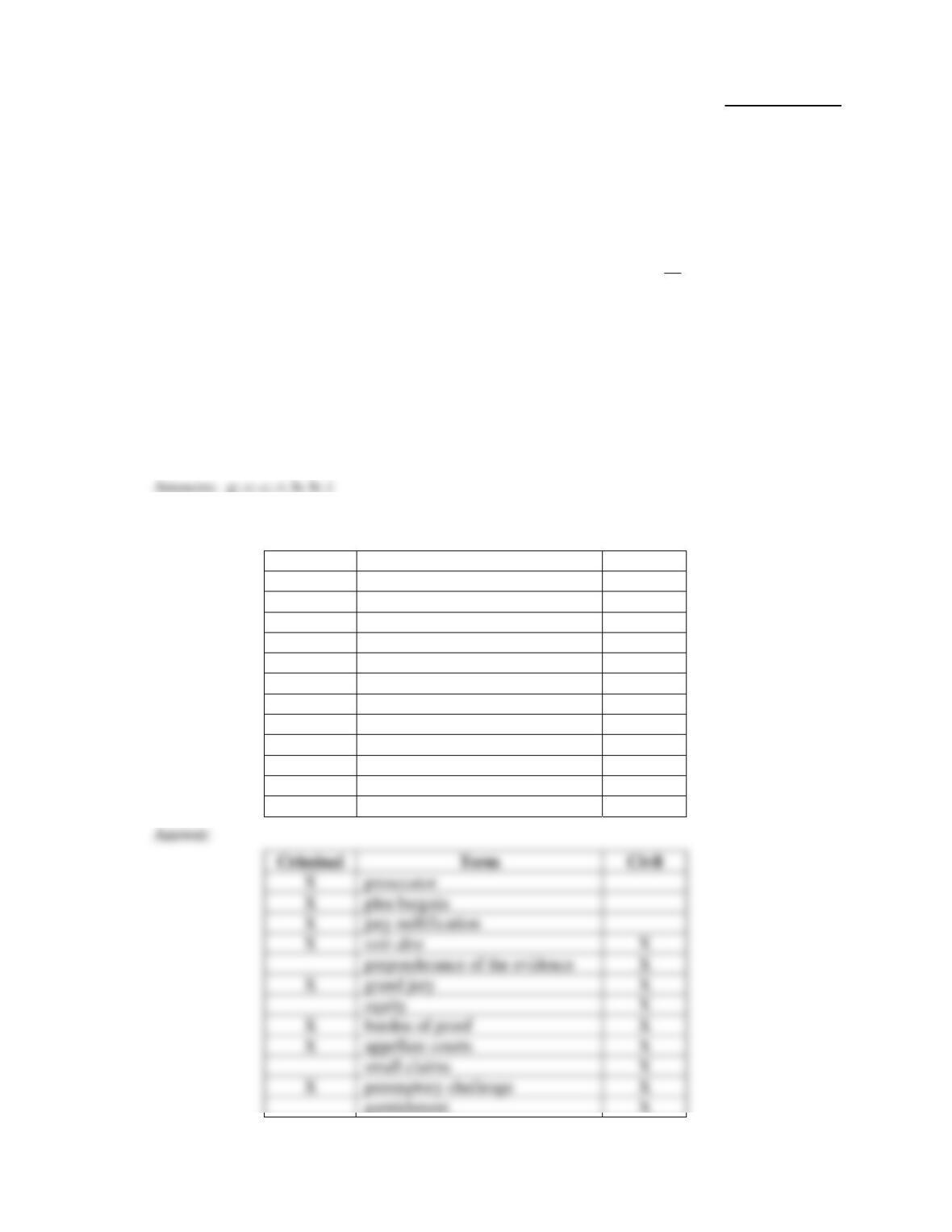
20. Consider the following list of terms. Check if they apply to criminal law or civil law or both.
Criminal Term Civil
prosecutor
plea bargain
jury nullification
voir dire
preponderance of the evidence
grand jury
equity
burden of proof
appellate courts
small claims
peremptory challenge
garnishment

8 Chapter Three
Multiple Choice
Select the one best answer.
1. Sharon sues Brian to retrieve money she claims she is owed. To successfully pursue a legal action
she would need
a. in rem jurisdiction over Brian.
b. in personam jurisdiction over Brian.
c. precedent jurisdiction over Brian.
d. concurrent jurisdiction over Brian.
2. The inherent ability of a jury in a criminal case to decide a case contrary to the law is called
a. jury voir dire.
b. jury discovery.
c. jury nullification.
d. the Farmoné rule.
3. In a civil trial, the burden of proof is usually
a. higher than in a criminal trial because of relaxed evidence rules.
b. less than in a criminal trial unless in federal court.
c. unimportant compared to the need for privacy.
d. a preponderance of the evidence.
4. In the Trustees of Columbia University v. Jacobsen, Jacobsen
a. lost by default.
b. had a summary judgment granted against him.
c. appealed the case based on jury misconduct.
d. won the case.
5. Which of the following is characteristic of a civil trial?
a. The process is begun by filing a complaint.
b. The burden of proof required is beyond a reasonable doubt and moral certainty.
c. In order to win, a plaintiff must obtain a unanimous jury verdict.
d. The moving party is a district attorney.

Test Bank 9
6. Fred Arden is tried in a criminal court and found innocent of the charge of theft. Shawn Finister,
the victim of the alleged crime, sues Fred in civil court to recover damages for civil conversion. The
tort claim involves the same act for which Fred was found innocent in the criminal court. Which of
the statements below is false?
a. Although such suits may be brought, plaintiffs seldom do so because criminal defendants are
often judgment proof.
b. The civil court filing must be dismissed because of the constitutional right against double
jeopardy.
c. Fred could also be sued if he had been found guilty.
d. The suit may be brought and recovery is possible in part because the burden of proof is less
demanding in a civil trial.
7. Walter sues Jaime because Jaime failed to show up at the soccer game. In response to Walter’s
complaint Jaime files a demurrer. This pleading means that Jaime
a. attended the soccer game.
b. does not understand what Walter is suing for and is seeking clarification from the court.
c. is saying that Walter selected the wrong court and Jaime is seeking to change venue.
d. claims that even if the facts are all true, Walter has no legal injury that the law will compensate.
8. A discovery tool that is useful to probe the merits of the opponent’s case consisting of written
questions is called a:
a. interrogatory.
b. demurrer
c. summons.
d. deposition
9. Carla filed a lawsuit against her neighbor Brenda for damages related to a breach of contract. The
trial began but ended when Carla made a motion for a summary judgment and the judge granted it.
Brenda appealed and the Supreme Court of Tennessee has remanded the case back to the trial court.
At this point in the proceedings we know that
a. Carla has won because her success at the trial court.
b. Brenda has won because of the remand.
c. Neither party won the case because a remand is a dismissal to criminal court.
d. We do not know who wins at this point because the case has been returned to the trail court for
further action.

10 Chapter Three
10. Which of the following is an equitable remedy available in a civil proceeding?
a. money damages
b. a fine
c. a jail or prison sentence
d. an injunction
11. Acting in pro se is
a. refusing to pay an attorney the agreed-upon proper fee.
b. representing one’s self in a court proceeding.
c. a Latin phrase meaning “fiduciary responsibility.”
d. presenting a case without using persons as witnesses.
12. Which of the following is not a civil case in equity?
a. an action for dissolution of a marriage
b. an action requesting the court to require compliance with the terms of a contract
c. an action to recover money for breach of an apartment lease contract
d. an action to bar a person from continuing to wrongfully hunt on your private property
13. The questioning of potential jurors before selection to a particular jury is called
a. certiorari.
b. a deposition.
c. interrogatories.
d. voir dire.
14. Which of the following is characteristic of the civil trial process as opposed to the criminal trial
process?
a. The burden of proof required is preponderance of the evidence.
b. The district attorney can make an accusation.
c. The burden of proof required is beyond a reasonable doubt.
d. A unanimous verdict is always required.
15. A defendant who is currently unable to pay her or his debts is often referred to as
a. judgment proof.
b. res ipsa loquitur.
c. cross-complainant.
d. incapacitated.

Test Bank 11
16. Which of the following is a typical expense of civil litigation?
a. discovery costs
b. expert witness fees
c. court costs
d. all of the above
17. A judge in a civil case could overturn a verdict of a jury in response to a motion
a. to dismiss.
b. for stare decisis.
c. for judgment on the pleadings.
d. for a judgment notwithstanding the verdict.
18. Which of the following is not a response by a defendant to a plaintiff’s initial pleading?
a. complaint
b. answer
c. demurrer
d. motion to dismiss
19. One of the major attractions of the typical small-claims court is that
a. cases claiming up to $50,000 in damages can be brought in the court.
b. business firms cannot sue in small-claims court.
c. the proceedings are more informal, and hence more understandable, than typical court
proceedings.
d. equitable maxims determine the outcome of the trial.
20. A court order directing a sheriff to confiscate a judgment debtor’s property and to apply the
property or the proceeds of a sale of the property to pay the debt is called a
a. civil complaint.
b. writ of execution.
c. writ of attachment.
d. summons.

12 Chapter Three
21. Alice is a possible juror in a trial of Carla for the crime of robbery. Alice is questioned as to her
knowledge of the defendant and about her general notions of the guilt or innocence of persons
accused of crimes. Which of the following motions by Carla’s attorney is the best example of one
that is both legally correct and tactically appropriate?
a. After Alice states she believes that police never make mistakes, Carla’s attorney makes a
peremptory challenge to excuse Alice from the jury.
b. After Alice states she believes that police never make mistakes, Carla’s attorney makes a
challenge for cause to excuse Alice from the jury.
c. After Alice states she is very excited to be selected to serve on a jury, Carla’s attorney makes a
challenge for cause to excuse Alice from the jury.
d. After Alice states she believes a person is innocent until proven guilty, Carla’s attorney makes a
peremptory challenge to excuse Alice from the jury.
22. A person in the business of formally delivering legal documents to litigants is known as
a. a court reporter.
b. a marshal.
c. a process server.
d. an attaché.
23. In a criminal case discovery is more limited than in a civil case because of the
a. privilege against discovery.
b. attorney-client privilege.
c. privilege against self-incrimination.
d. greater difficulty in determining facts in criminal cases.
24. Before a court can exercise valid authority over a civil case brought before it
a. the defendant must expressly consent to be sued.
b. the court must have jurisdiction.
c. there must be discovery.
d. there must be a pretrial hearing.
25. Members of the federal judiciary are
a. elected to office for life by the state senates.
b. chosen by the respective state legislator for life.
c. required to retire at age 70.
d. appointed by the president and confirmed by the U.S. Senate for a life term or until retirement.

Test Bank 13
26. Carlos carelessly ran a red light, and struck Cantwell, a pedestrian, all in full view of several
bystanders. When Cantwell sued Carlos for damages, all the witnesses testified that Carlos did
indeed run the light. Nevertheless, the jury found Carlos had met his duty of care and therefore was
not liable for the injuries. The judge, however, responding to a motion from Cantwell’s attorney,
found Carlos negligent and liable on the basis of the overwhelming evidence presented at trial.
Which of the following statements best describes the judge’s action?
a. This is illegal, as it would be double jeopardy.
b. This was improper, because the judge cannot overrule a jury.
c. This is proper and is called voir dire.
d. The judge has the power to grant the motion and it is called a judgment n.o.v.
27. If both state and federal courts have the authority to hear and decide a case, the matter is said to be
one of
a. exclusive jurisdiction.
b. long-arm jurisdiction.
c. in personam jurisdiction.
d. concurrent jurisdiction.
28. Solomon filed a complaint that stated: “I went over to my neighbor Dominquez’s house and he
refused to let me borrow his hedge trimmer. A possible buyer of my house came over that evening
and, when she saw my untrimmed hedges, lost interest in the house. I demand $2,000 from
Dominquez, because he would not let me use his hedge trimmer and because of his refusal I did not
sell my house.” Dominquez’s attorney should
a. try and settle the case for something less than $2,000.
b. file a motion to dismiss (demurrer).
c. file an answer to Solomon’s complaint.
d. file a cross-complaint for $2,500 in damages.
29. Martha signed a contract to buy an engineering business from Alice. Alice claims Martha had failed
to make several payments on the contract. What “burden of proof” must Alice meet in a lawsuit
regarding the agreement?
a. a preponderance of the evidence
b. beyond a reasonable doubt
c. beyond any doubt
d. clear and convincing proof

14 Chapter Three
30. The court system consists essentially of trial courts and appellate courts. Identify the most accurate
statement.
a. An appellate court is expected to review errors of factual analysis made by lower trial court
juries.
b. An appellate court decision only has value as precedent if the highest court makes the decision
in the judicial system.
c. The trial court judge presides over the trial and determines issues of law, and a jury makes
findings of fact.
d. A panel of three federal trial court judges hears any dispute where a money damage claim is
made in excess of $50,000. Called small claim diversity suits, the judges are authorized to
decide issues of fact and law sans (without) jury.
31. When only a federal court (not a state court) has the power to hear a case it has
a. concurrent jurisdiction.
b. concentrated jurisdiction.
c. in personam jurisdiction.
d. exclusive jurisdiction.
32. Which of the following are common attributes of a small-claims court?
a. place to appeal judgment from general trial courts
b. simplified filing procedures and hearing rules
c. right of both parties to appeal any judgment
d. place to resolve divorce matters.
33. Carlton Dean is late for his class at Grinnell College in Grinnell, Iowa and carelessly runs a stop
sign. As luck would have it, Elliot Klein is driving through the intersection. Elliot is a visitor in
Grinnell from Arizona. Although Elliott is not injured, his Mercedes suffers badly, with $7,000
total damages, and he is forced to rent a car for a week while it is repaired. Additional expenses for
car repair bring his total damages to $7,600.
a. Elliott can sue Carlton in an Iowa court, because the accident occurred in Iowa.
b. Elliot can sue Carlton in a federal court, because of diversity of citizenship.
c. Elliot can sue Carlton in an Arizona court.
d. all of the above
34. Which of the following is not a distinct purpose of a trial court?
a. to determine the facts of a dispute
b. to review the judgment of other courts to correct errors of law
c. to determine what rules of law should be applied to a set of facts
d. to apply appropriate rules of law to proven facts

Test Bank 15
35. Carla Breakneck has sued Herman Foosball. He is accused of failing to pay a debt he claims he
does not owe. Herman is very concerned about the trial processes and his privacy.
a. Herman need not be concerned, as civil trials are closed to the press and the public.
b. Herman should have only a slight concern for although the public can attend the trial the press
cannot report trial court proceedings.
c. If Herman asks for a judge trial, the public will not have access to the proceedings.
d. Herman should hope the trial is not interesting, as both civil and criminal trail courts are open
to the press and the public.
36. Greg Buntz is late for his class at Sac Town College in Natomas, California and carelessly runs a
stop sign. As luck would have it, Sanjay Varshney is driving through the intersection. Sanjay is a
visitor in Natomas from Nevada. Although Sanjay injures are minor, his Porsche suffers badly, with
$70,000 total damages, and he is forced to rent a car for a week while it is repaired. Additional
expenses for car repair and medical bills bring his total damages to $79,000.
a. Sanjay can sue Greg in an California court, because the accident occurred in California.
b. Sanjay can sue Greg in a federal court, because of diversity of citizenship.
c. Both of the above.
d. None of the above
37. Which of the following is contained in a complaint?
a. A statement of the remedy the plaintiff is seeking.
b. A list of the possible defenses that can be conveniently raised by the defendant.
c. A certification by the county magistrate that the case has merit.
d. A listing of the case or statutory authority upon the case is based.
38. Jong is seeking a de novo review. What is he asking for?
a. A completely new hearing on the matter.
b. A review by the entire appellate division
c. An appeal to the U.S. Supreme Court
d. A different judge to decide the case.
Short Answer Essays
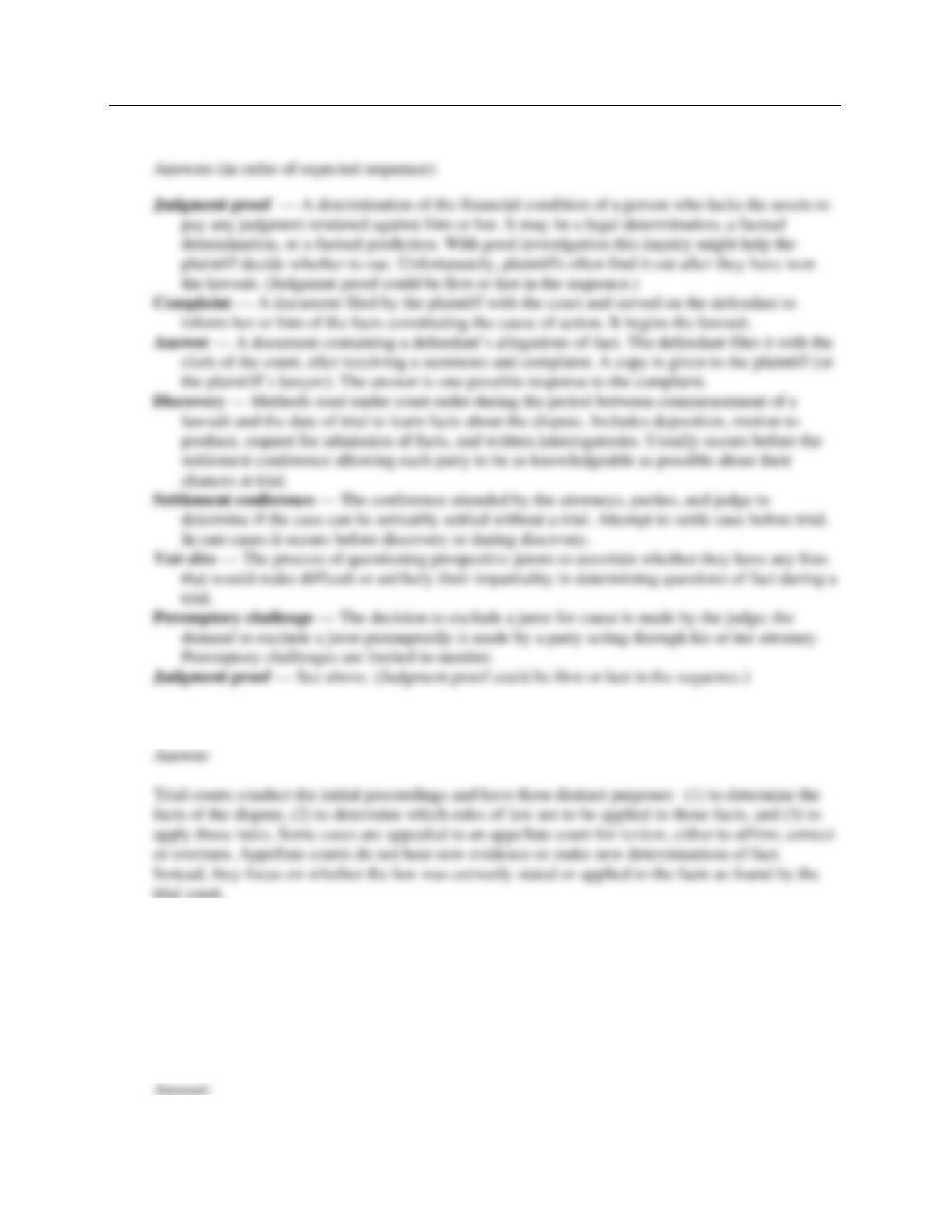
1. Discuss the meaning of each of these terms, and arrange them in their expected sequence in a civil
trial.
a. discovery
b. answer
c. complaint
d. judgment proof
e. settlement conference
f. voir dire
g. peremptory challenge
16 Chapter Three
2. Describe the differences between trial and appellate courts.
3. You have been served with a complaint in which H. Jane Yamada contends that you injured her
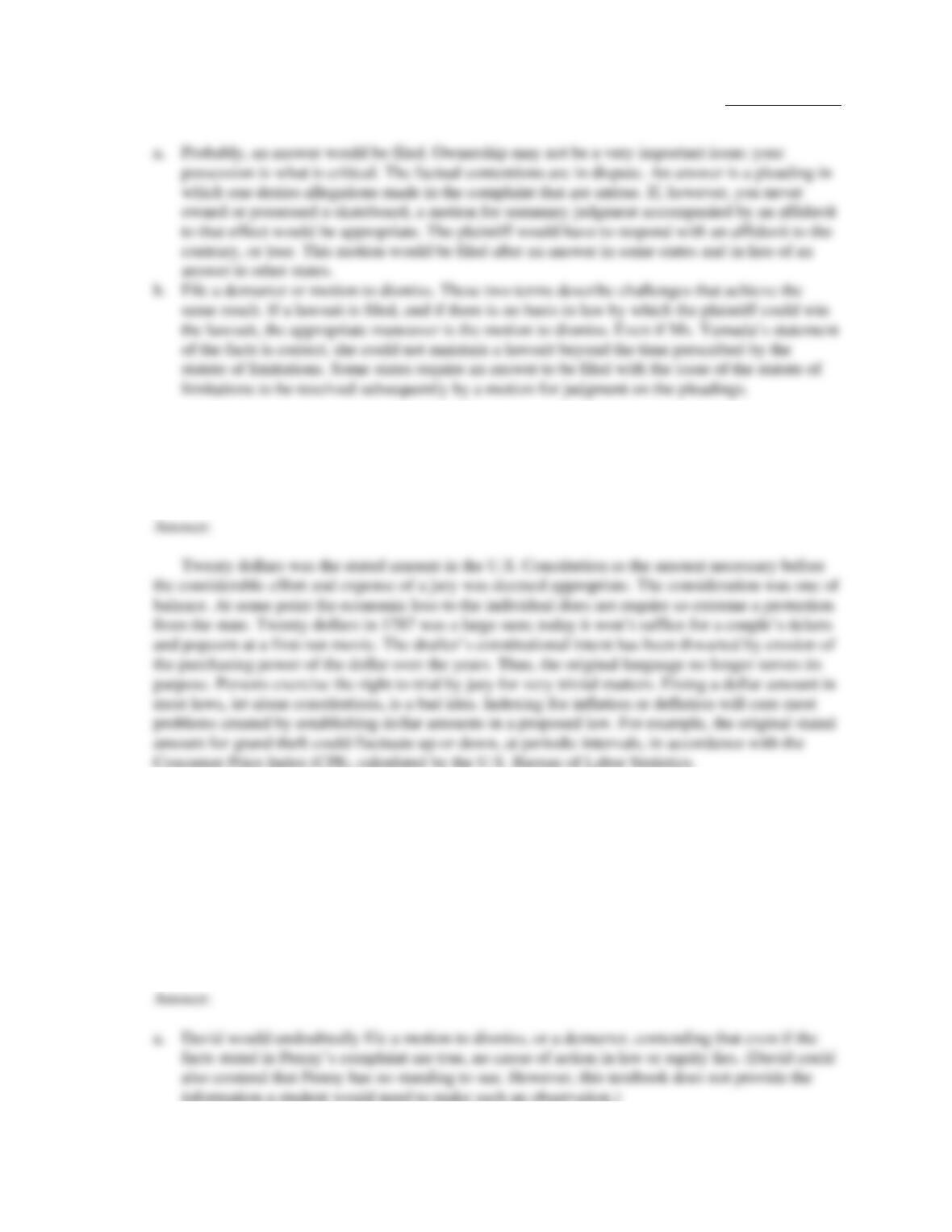
person when you carelessly left your skateboard on the university library steps, causing her to slip
and fall. What would be your procedural response in each of the following situations? Explain each
answer.
a. You have never owned a skateboard.
b. The time period provided for a person to bring suit for injuries of this type expired three months
before the complaint was filed.
Test Bank 17
4. The U.S. Constitution provides that any party to a civil lawsuit has a right to a trial by jury in all
cases at law “where the value in controversy shall exceed $20.” What was the reason for providing
a minimum dollar limitation? Is the purpose still served? Discuss the implications of providing
rights tied to dollar amounts specified in a constitution.
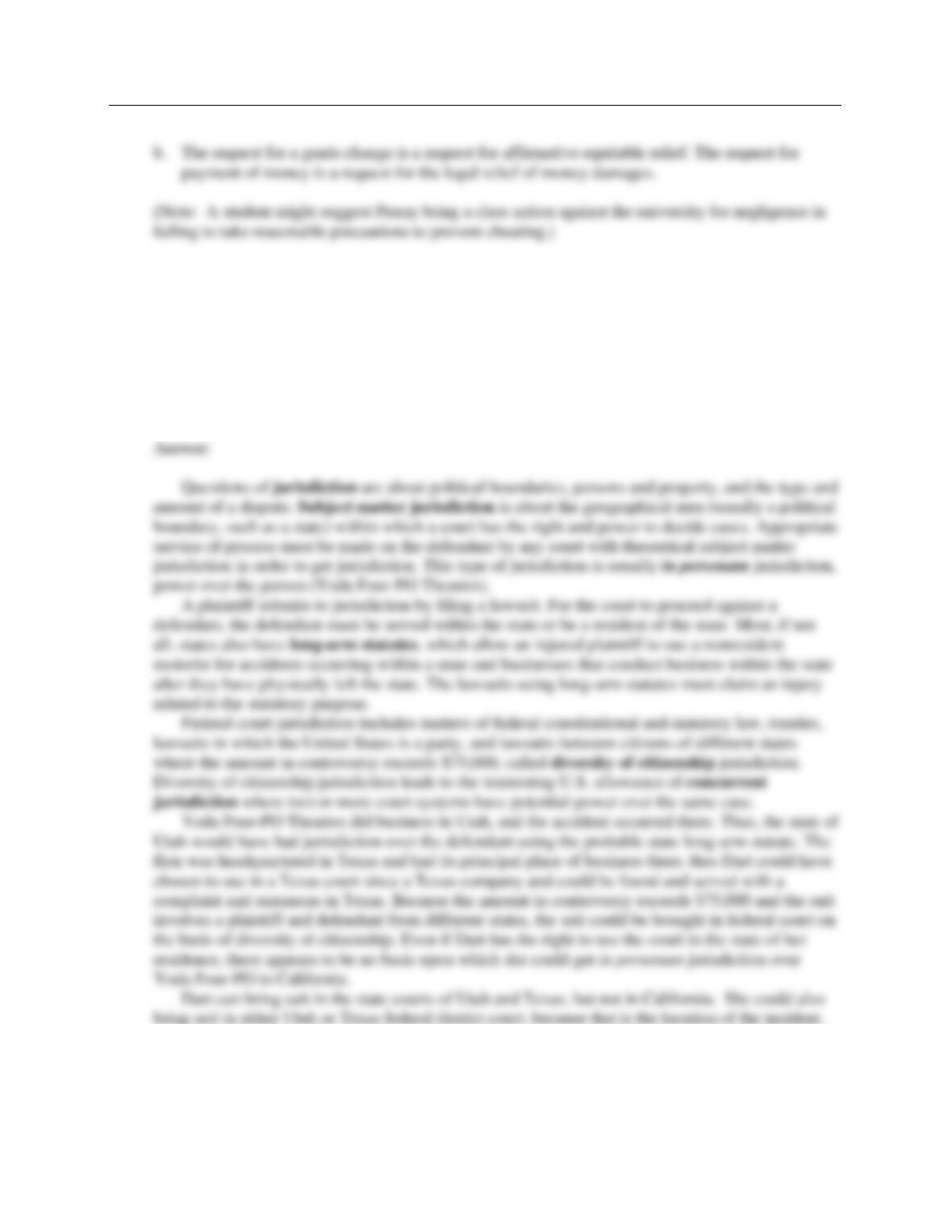
5. Penny serves David with a copy of a summons and complaint. The complaint alleges that David
cheated on an examination and received an “A” in the course. Penny was in the same class and was
borderline between an “A” and a “B.” Because of the instructor’s grading curve, David’s grade
pushed Penny’s down and she received a “B.” This lowered her grade point average and reduced
her job prospects. Penny asks the court to reduce David’s grade to an “F” and change her grade to
an “A.” In the alternative, she asks that David pay her a sum representing her reduced earning
capacity for the remainder of her life. Discuss:
a. What pleadings might David file, and why?
b. What types of relief is Penny seeking? Explain?
18 Chapter Three
6. Jana Dart, a citizen of California, was attending the premier showing of the movie “Titanic” at the
Yoda Four-PO Theatres in Salt Lake City, Utah. She bought a cola and popcorn, and the popcorn
contained some small pieces of broken glass. Engrossed in the movie, she ate enough glass to cause
severe and numerous internal injuries. She suffered a great deal of pain and anguish, plus numerous
medical expenses, and she could not work for four months. She wishes to sue Yoda Four-PO
Theatres for $200,000 in damages. The firm’s headquarters are in Texas, although the company
does business in Utah and Maine. In which court or courts can Dart bring her suit—in a Utah State
court, a Texas State court, a California State court, or a federal court?
Test Bank 19
7. What is the distinction between jurisdiction over the person and jurisdiction over the subject matter?
8. Discovery procedures are often used in civil actions. Identify and explain the purpose of discovery
and explain one type of procedure and what can be accomplished by using it.