1
Chapter 25
Bankruptcy
N.B.: TYPE indicates that a question is new, modified, or unchanged, as follows.
N A question new to this edition of the Test Bank.
+ A question modified from the previous edition of the Test Bank,
= A question included in the previous edition of the Test Bank.
TRUE/FALSE QUESTIONS
1. The right to petition for bankruptcy relief under federal law may be a necessary
evil in our capitalistic society.
2. One goal of bankruptcy law is to protect a debtor.
3. Bankruptcy law is state law.
4. Bankruptcy proceedings are held in federal courts.
5. Rulings from bankruptcy courts are final—they cannot be appealed.
2 UNIT THREE: COMMERCIAL TRANSACTIONS
6. The clerk of a bankruptcy court must provide consumer-debtors with
information on the types of services available from credit counseling agencies.
7. A husband and wife may file a joint petition for bankruptcy.
8. Any “person”—defined as including corporations—may be a debtor in a
liquidation proceeding.
9. Before filing for bankruptcy, a consumer-debtor must receive credit counseling.
10. Concealing assets from a bankruptcy court is a crime.
11. If a debtor’s income is below the median income, there is no presumption of
bankruptcy abuse.
12. The means test forces more people to file for Chapter 7 bankruptcy rather than
gave their debts discharged under Chapter 13.
13. An order for relief in a bankruptcy proceeding amounts to a discharge of the
debts of the party petitioning for bankruptcy protection.
CHAPTER 25: BANKRUPTCY 3
14. The filing of a petition for bankruptcy will automatically stay most legal actions
against the debtor.
15. An involuntary bankruptcy occurs when a debtor’s creditors are forced to
accept a discharge of the debtor’s debts.
16. A bankruptcy estate consists of all the debtor’s interests in property currently
held, wherever located.
17. Child-support debts will be suspended by a voluntary bankruptcy filing.
18. A trustee has the power to avoid a sale of the debtor’s property.
19. The basic duty of a trustee is to collect the debtor’s available estate and reduce
it to cash for distribution.
20. In most states, state law determines the amount of a debtor’s property that is
exempt from distribution on bankruptcy.
21. A trustee must call a meeting of the creditors listed in the schedules filed by the
debtor.
22. In order of priority, the claims of all unsecured creditors in a class must be
satisfied before any remaining amounts can be distributed to the next class.
23. Some student loans are dischargeable in a Chapter 7 bankruptcy.
24. A discharge will be denied to a debtor who received a discharge within eight
years of filing the current petition.
25. Once a discharge is granted, it may not be revoked, even if, for example, a
debtor concealed property to defraud a creditor.
26. Certain debtors may not qualify to have all debts discharged in bankruptcy.
27. A bankruptcy court may deny a discharge based on a debtor’s conduct.
28. The same principles that govern the filing of a liquidation petition apply to
reorganization proceedings.
29. On the entry of an order for relief in a Chapter 11 case, the creditors generally
take over the operation of the debtor’s business.
30. A Chapter 11 reorganization plan must provide for payment of tax claims over a
five-year period.
31. For individual debtors, the plan in a reorganization case must be completed
before discharge will be granted.
32. Certain liquidation cases may be converted to Chapter 13 with the consent of
the debtor.
33. The procedure for filing a family-farmer bankruptcy plan is similar to the proce–
dure for filing a repayment plan.
34. In a repayment plan case, the plan must provide for payment of all obligations
in full, not for a lesser amount.
35. A student loan is discharged under Chapter 13 unless the creditor can show
“undue hardship.”
6 UNIT THREE: COMMERCIAL TRANSACTIONS
MULTIPLE CHOICE QUESTIONS
1. Bess wishes to appeal a decision from a federal bankruptcy court. Bess must
appeal to
a. a county court.
b. a federal district court.
c. the U.S. Supreme Court.
d. a state court.
2. Deborah files a petition in bankruptcy. One of the goals of bankruptcy law with
respect to a debtor who has “gotten in over his head” is to
a. encourage the continued use of credit to borrow funds.
b. ensure that co-debtors will continue to guarantee loans.
c. provide s debtor by giving him or her a fresh start without creditors’
claims.
d. shield assets from creditors.
3. A petition for a discharge in bankruptcy in a liquidation proceeding may be filed
by
a. Eminent Employees Credit Union, a corporation.
b. Federal Savings & Loan Association, a corporation.
c. Guaranty Insurance Company, a corporation.
d. Hazel, an independent accountant.
4. Norma Jean files for Chapter 7 bankruptcy. She turns her assets over to Addie,
who sells the assets and then distributes the proceeds to Norma Jean’s
creditors. Addie is a
a. creditor.
b. federal judge.
c. bankruptcy trustee.
d. debtor.
5. Wilson wants to file an ordinary, or straight, bankruptcy. Wilson should file
using
a. Chapter 7.
b. Chapter 11.
c. Chapter 13.
d. his state’s bankruptcy code.
6. Roland files for Chapter 7 bankruptcy. After all his assets have been sold and
the proceeds distributed among his creditors, Roland’s remaining debts
a. are discharged.
b. paid by the court.
c. must be paid by Roland.
d. are put on hold until Roland has sufficient means to pay them.
7. Joe files a voluntary petition for Chapter 7 bankruptcy. His petition does not
need to include
a. a list of Joe’s secured creditors.
b. a list of Joe’s unsecured creditors.
c. a list of the occupations of all Joe’s creditors.
d. the addresses of all Joe’s creditors.
8. Sheri files a petition for bankruptcy. She must include with the petition
a. a plan to turn over her future income to a trustee.
b. a certificate proving credit-counseling from an approved agency.
c. a provision of adequate means to make periodic cash payments to creditors.
d a statement of preference for one creditor over another.
9. Charlton files a petition in bankruptcy in a liquidation proceeding. If the court
administers the means test and concludes that Charlton is abusing the bankruptcy
process by filing for a liquidation, most likely
a. Charlton will be forced to file for relief through an individual repayment
plan.
b. the court will discharge Charlton’s debts.
c. the court will distribute Charlton’s property to Charlton’s creditors.
d. the court will issue an automatic stay against any actions by Charlton’s
creditors.
10. Bobby has fifteen creditors. To force Bobby into bankruptcy proceedings, at
least three creditors must join the petition and their unsecured claims must add
up to at least
a. $500.
b. $10,250.
c. $14,425.
d. $50,000.
11. Donna goes through an involuntary bankruptcy proceeding. An involuntary
bankruptcy occurs when
a. a debtor files forms designated for the purpose in a bankruptcy court.
b. a debtor is unable to pay his or her debts as they come due.
c. a debtor’s creditors force the debtor into bankruptcy proceedings.
d. a debtor’s debts exceed the fair market value of his or her assets.
12. Jayme’s voluntary petition for bankruptcy is found to be proper. The order for
relief is effective as soon as
a. Jayme files the petition.
b. Jayme posts a bond to cover the costs of the proceedings.
c. Jayme’s creditors agree to the terms.
d. the trustee collects and distributes the property of Jayme’s estate.
13. Patsy files a petition in bankruptcy. At the moment of filing
a. an automatic stay goes into effect.
b. Patsy’s debts are discharged.
c. Patsy’s petition is dismissed.
d. Patsy’s property is distributed to her creditors.
14. Gerald files a bankruptcy petition. The resulting automatic stay will apply to
Gerald’s
a. alimony debts.
b. child-support debts.
c. spousal maintenance debts.
d. car payment debts.
15. Thirty-one days before filing a petition in bankruptcy, Dee transfers property
and makes payments that favor one creditor over another. These are
CHAPTER 25: BANKRUPTCY 11
a. affirmation agreements.
b. preferences.
c. secured interests.
d. unsecured debts.
16. Norma files a petition in bankruptcy. She turns her assets over to O’Brien, who
sells them and then distributes the proceeds to Norma’s creditors. O’Brien is a
a. preferred creditor.
b. bankruptcy court judge.
c. bankruptcy trustee.
d. debtor.
17. Thirty-one days before filing a petition in bankruptcy, Gavin transfers property
and makes payments that favor one creditor over another. These are
a. affirmation agreements.
b. preferences.
c. secured interests.
d. unsecured debts.
12 UNIT THREE: COMMERCIAL TRANSACTIONS
Fact Pattern 25-1 (Questions 18–19 apply)
Damian owns a pick-up truck and a motorcycle. He sells the motorcycle to Eden for
$10,000. Eden pays for the cycle with a check, knowing that she had insufficient funds
in her account to cover the amount. A week later, Damian files a petition in bankruptcy
for relief through a liquidation.
18. Refer to Fact Pattern 25-1. Regarding the sale of the cycle, the bankruptcy
trustee can
a. cancel it as a fraudulent transfer.
b. cancel it as a voidable preference.
c. not cancel it or sue to recover the price because it occurred before
Damian filed his petition in bankruptcy.
d. not cancel it, but can sue Eden to recover the price.
19. Refer to Fact Pattern 25-1. Regarding the pick-up truck, Damian
a. can exempt an interest in it up to $3,675 from the bankruptcy.
b. must include it as part of the estate because Damian sold the cycle.
c. must include it as part of the estate because Eden’s check did not cover
the cost of the cycle.
d. must include it as part of the estate unless the trustee recovers the price
from Eden.
20. Umiko files a petition for bankruptcy. Her creditors must file with the court their
proof of claims against her assets within
a. fifteen days of the order for relief.
b. thirty days of the filing of the petition.
c. sixty days of the automatic stay.
d. ninety days of the creditors’ meeting.
21. Lionel files a voluntary petition for bankruptcy under Chapter 7. The court will
likely deny a discharge of Lionel’s debts if he
CHAPTER 25: BANKRUPTCY 13
a. conceals records of his financial condition with the intent to defraud a
creditor.
b. does not have sufficient assets to pay all his secured creditors.
c. filed for bankruptcy twelve years ago.
d. has a criminal record.
22. Sheryl files a petition in bankruptcy. Sheryl’s non-dischargeable debts include
a. domestic-support obligations.
b. student loans if payment would impose undue hardship.
c. unpaid loans to finance home repairs.
d. unsecured credit-card debt.
23. Wild River Tours Corporation wants to formulate a plan under which it pays a
portion of its debts and is discharged of the remainder while continuing in
business. To accomplish this goal, Wild River should file a petition in
bankruptcy for relief through
a. a liquidation.
b. a reorganization.
c. a repayment plan.
d. a family-farmer bankruptcy plan.
24. Paxton agrees to pay QuikChek Lenders a debt that is otherwise dischargeable in
bankruptcy. This is
a. a reaffirmation.
b. a rescission.
c. a reorganization.
d. a revocation.
25. A petition for a discharge in bankruptcy under Chapter 11 may be filed by
a. Reliable Insurance Company.
b. Pacific Mountain Railroad.
c. Solid State Bank.
d. Valley Credit Union.
26. Shale Oil, Inc., files a petition in bankruptcy for relief through a reorganization
and assumes the role of a debtor in possession. In this role, Shale Oil is similar
to
a. a creditor at a creditors’ meeting.
b. an individual debtor who is denied a discharge under the means test.
c. a secured creditor in possession of collateral.
d. a trustee in a liquidation.
27. Checkerboard Pizza, Inc. (CPI), files for bankruptcy under Chapter 11. CPI’s
Chapter 11 plan must contain
a. a plan to turn over its future income to the trustee.
b. a certificate proving attendance at a credit-counseling briefing.
c. a provision of adequate means for the plan’s execution.
d a statement of preference for one creditor over another.
28. To adjust debt and institute a repayment plan, Delton, a family fisherman in the
Gulf of Mexico, may file a petition in bankruptcy for relief under the Bankruptcy
Code’s Chapter
a. 1.
b. 3.
c. 5.
d. 12.
29. Ed is a debtor. Financial Loans, Inc., and the government are Ed’s creditors.
For these parties, a bankruptcy proceeding under Chapter 13 could be initiated
by the filing of a petition by
a. Ed alone or by his creditors jointly.
b. Ed only.
c. Financial Loans only.
d. the government only.
30. Anthony believes that he needs to obtain a Chapter 13 discharge in bank-
ruptcy. A Chapter 13 case can be initiated by a filing of a voluntary petition by
a. a creditor only.
b. a corporation only.
c. a debtor only.
d. a trustee only.
31. A petition for a discharge in bankruptcy under Chapter 13 may be filed by
a. Gracie, the sole proprietor of Home Net Services.
b. Internet Portals & Pages, a partnership.
c. World Web Services, Inc., a corporation.
d. Internet Portals & Pages or World Web Services, Inc..
32. To adjust debt and institute a repayment plan, Bianca—who is not a corpo-
ration, a partnership, or a family farmer or fisherman—may file a petition in
bankruptcy for relief through
a. a liquidation.
b. a reorganization.
c. a repayment plan.
d. a family-farmer bankruptcy plan.
33. Zeke files a petition for bankruptcy under Chapter 13. Zeke’s Chapter 13 plan
must provide for
a. the turnover of his future income to the trustee.
b. his attendance at a credit-counseling briefing.
c. adequate means for the petition’s execution.
d a preference for one creditor over another.
34. Dorothy files a petition for bankruptcy under Chapter 13. If she is granted a
discharge, debts that will most likely be discharged include
a. claims not provided for by the plan.
b. payments on retirement accounts.
c. claims for domestic support obligations.
d. credit-card debt incurred more than one year before filing.
35. Philo files a petition in bankruptcy for relief through an individual’s repayment
plan. He is granted a discharge. Debts that will not be discharged include
claims for
a. all debts provided for by the plan.
b. money owed for services rendered.
c. claims not provided for by the plan.
d. credit-card debt.
ESSAY QUESTIONS
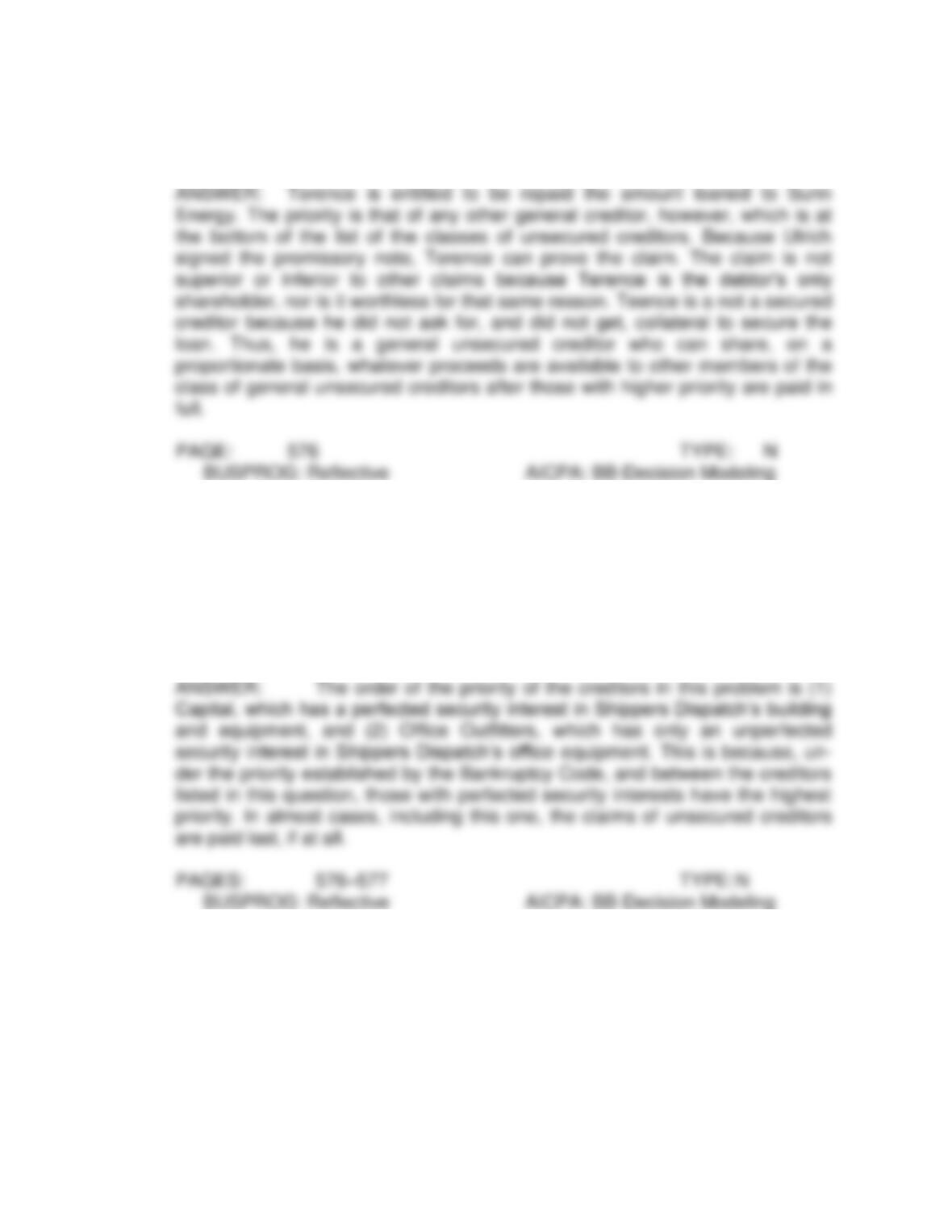
1. Sunn Energy, Inc., needs funds to meet its payroll, to make other current
operating expenses, and to pay its creditors. Terence, Sunn’s only shareholder,
loans the company $100,000 and accepts a promissory note signed on behalf
of Sunn by Ulrich, the firm’s accountant. Sunn’s financial problems continue,
however, and the firm’s creditors file an involuntary petition to force it into
bankruptcy. Is Terence entitled to repayment of the loan to Sunn? If so, what is
the priority of the claim?
18 UNIT THREE: COMMERCIAL TRANSACTIONS
2. Shippers Dispatch Corporation orders office equipment from Office Outfitters,
Inc., which has an unperfected security interest in the equipment until it is paid
for. Meanwhile, Shippers Dispatch takes out a loan from Capital Credit, Inc.,
subject to a security interest in Shippers Dispatch’s building and equipment,
which Capital perfects. Shippers Dispatch files a bankruptcy petition under
Chapter 7. If the petition is granted, in what order will Shippers Dispatch’s
creditors be paid?