54) Explain the types of activities that are considered to be horizontal restraints of trade.
55) Discuss arguments for the application of rule-of-reason standard and the per se standard to
vertical territorial restraints.
56) Which of the following terms refers to a price differential that is below the average variable
cost for the seller, considered predatory, and therefore illegal, under the Clayton Act?
A) variable pricing
B) price discrimination
C) tying arrangement
D) interlocking directorate
57) Which of the following is true of Section 2(a) of the Clayton Act?
A) Sales can exist without enforceable contracts.
B) Services and intangibles are considered to be commodities.
C) Commodities must be of similar grade and quality.
D) Two sales by a single seller to two purchasers should take place in intrastate commerce.
58) Price differences in milk cartons that are slightly different in size falls under Section
________ of the Clayton Act.
A) 2(f)
B) 2(d)
C) 2(b)
D) 2(a)
59) Section ________ of the Clayton Act prohibits fictitious brokerage payments.
A) 2(a)
B) 2(d)
C) 2(c)
D) 2(f)
60) ________ injury occurs when a seller cuts prices in one geographic area in order to drive out
a local competitor.
A) Secondary-line
B) Primary-line
C) Collateral-line
D) Tertiary-line
61) ________ occurs when a discriminatory price is passed along from a secondary-line buyer to
a retailer.
A) Predatory pricing
B) Primary-line injury
C) Variable pricing
D) Tertiary-line injury
62) Which of the following forms of price discrimination occurs at the buyer level?
A) Secondary-line injury
B) Primary-line injury
C) Collateral-line injury
D) Tertiary-line injury
63) Which of the following terms refers to one company’s acquisition of another company’s
assets or stock in such a way that the second company is absorbed by the first?
A) diversification
B) penetration
C) merger
D) collusion
64) General Automotive, a car manufacturer, purchased Bluestone Motors, its competitor, and
thus eliminated the competition at its level in the industry. This is an example of ________.
A) a vertical merger
B) a horizontal merger
C) market diversification
D) market penetration
65) Steinem’s, a women’s clothing line, decides to acquire a company that owns several retail
outlets that sell its clothing. This is an example of a ________ merger.
A) backward horizontal
B) forward horizontal
C) backward vertical
D) forward vertical
66) ________ mergers involve the acquisition by one firm of another that produces products or
services that are not directly related to those of the acquiring firm.
A) Conglomerate
B) Forward vertical
C) Backward vertical
D) Horizontal
67) Which of the following is true of the enforcement of the Clayton Act of 1914?
A) When the Clayton Act was enacted, it provided criminal punishment for violators.
B) The Clayton Act does not allow individuals to obtain injunctions.
C) The Justice Department, the Federal Trade Commission, and private individuals and
corporations can all enforce Section 7 of the Clayton Act.
D) If a business is found guilty of violating the Sherman Act, this finding cannot be used as
evidence of a violation when a party sues for damages under the Clayton Act.
68) Courts have generally relied on Section ________ of the ________ Act in cases concerning
tying arrangements and exclusive-dealing contracts.
A) 3; Clayton
B) 3; Sherman
C) 1; Clayton
D) 1; Sherman
69) The purpose of Section ________ of the ________ Act is to prohibit anticompetitive mergers
and acquisitions that tend to lessen competition at their incipiency.
A) 3; Clayton
B) 7; Clayton
C) 1; Sherman
D) 3 Sherman
70) Mergers may take place for all but which of the following reasons?
A) the philosophy that “bigness” is not “bad”
B) a desire to increase competition in the relevant market
C) tax credits for research and development
D) economies of scale
71) Which of the following acts amended Section 7 of the Clayton Act and introduced a
premerger notification requirement into the area of mergers?
A) the Sarbanes-Oxley Act of 2002
B) the Securities Exchange Act of 1934
C) the Federal Trade Commission Act of 1914
D) the Hart-Scott-Rodino Act of 1976
72) Section ________ of the Clayton Act prohibits an individual from becoming a director in
two or more corporations if any of them has capital, surplus, and individual profits aggregating
more than $21,327,000 or competitive sales of $2,132,000 when engaged in interstate commerce.
A) 2
B) 8
C) 3
D) 7
73) The “sales” element that must be proved by a plaintiff in any action brought under Section
2(a) of the Clayton Act must be three or more actual sales.
74) Secondary-line injury occurs when competitors of one of the buyers are injured because the
seller sold to that one buyer at a lower price than it sold to the others.
75) If two sales by a single seller to two purchasers take place in intrastate commerce, the
Clayton Act does not apply.
76) All tying arrangements and exclusive-dealing contracts are per se illegal.
77) Merger guidelines constitute law and, therefore, serve as more than just an advisory function.
78) Summarize the provisions of the Clayton Act as amended by the Robinson-Patman Act.
79) State the reasons for the increase in mergers and the criteria for determining the legality of
mergers.
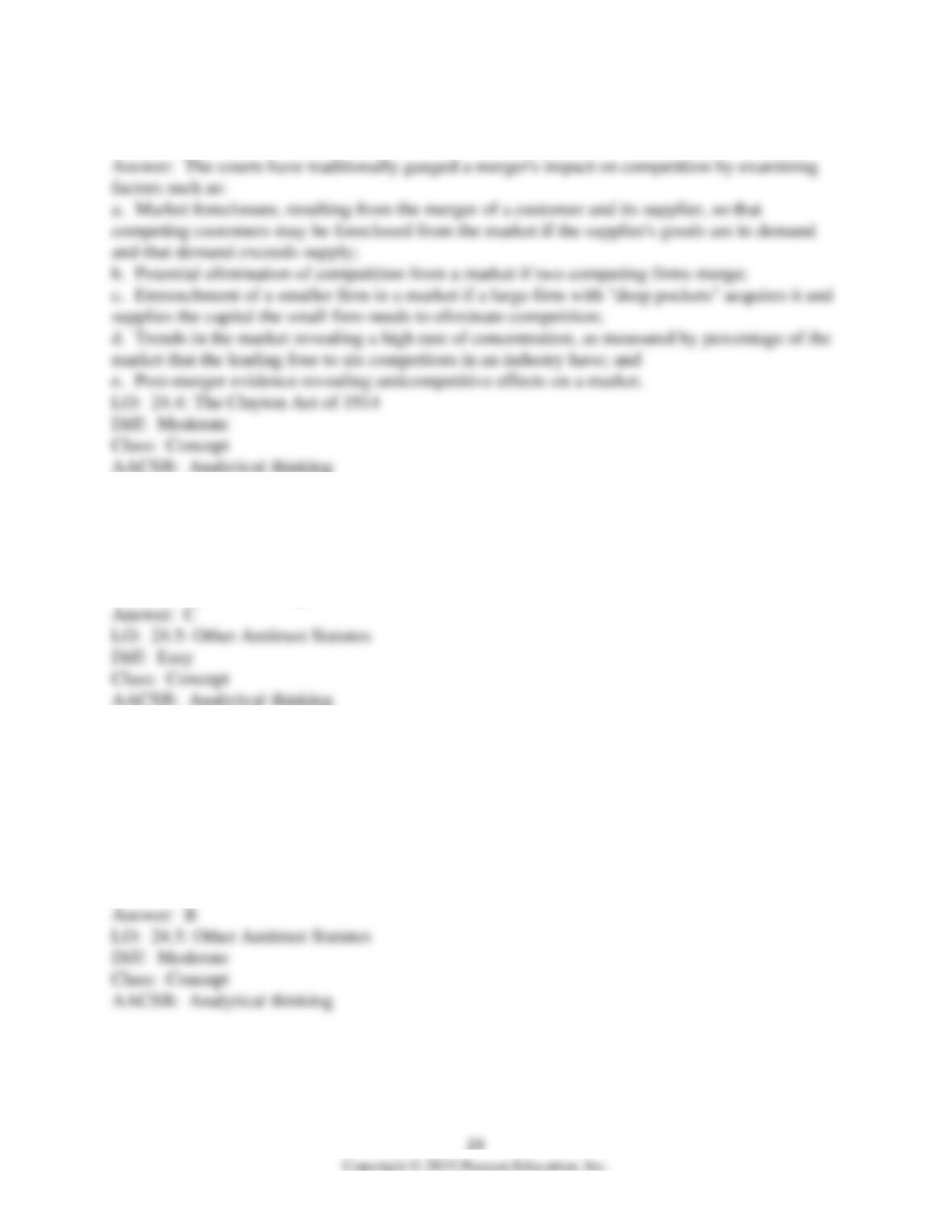
80) List the factors courts have traditionally examined in order to gauge a merger’s impact on
competition.
81) Which of the following acts prohibits “unfair methods of competition”?
A) the Clayton Act of 1914
B) the Hart-Scott-Rodino Act of 1976
C) the Federal Trade Commission Act of 1914
D) the Securities Exchange Act of 1934
82) The Federal Trade Commission Act of 1914 is important because ________.
A) its narrow language focuses on monopolistic practices
B) its broad language brings antitrust enforcement actions against business conduct prohibited by
the Sherman and Clayton Acts
C) it amends the Clayton Act to permit horizontal mergers in cases involving market-division
activity
D) it amends the Sherman Act to permit monopolistic behaviors that would otherwise be
considered unfair
83) If not challenged by the U.S. attorney general within ________ days, a bank merger is still
subject to liability under Section 2 of the Sherman Act if it is shown to have resulted in a
monopoly.
A) 15
B) 30
C) 60
D) 90
84) The outburst of reform that produced the Clayton Act also produced the Federal Trade
Commission Act (FTCA), which prohibits “unfair methods of competition.”
85) The language of the FTCA allows the Consumer Financial Protection Bureau (CFPB) to
bring antitrust enforcement actions against business conduct prohibited by the Sherman and
Clayton Acts.
86) Business conduct that may not quite reach the level of prohibition under either the Sherman
or the Clayton Act may be actionable under the “unfair” competition language of the FTCA.
87) The Bank Merger Act of 1966 requires that all bank mergers be approved in advance by the
banking agency having jurisdiction—that is, the Federal Reserve Board, the Federal Deposit
Insurance Corporation (FDIC), or the Comptroller of the Currency.
88) The Bank Merger Act has become more significant in light of a 1985 executive order by
former U.S. president Ronald Reagan approving regional banking and acquisitions by banks
across state lines, when state legislatures have given prior approval.
89) Describe the Bank Merger Act.
90) The general principle guiding the courts in application of the Sherman Act and other U.S.
antitrust laws has been that if the United States or foreign private companies enter into an
agreement forbidden by Section 1 and that agreement affects the foreign commerce of the United
States, then the ________ jurisdiction.
A) U.S. courts have
B) United Nations has
C) League of Nations has
D) World Court has
91) The U.S. Department of Justice’s guidelines on its foreign antitrust enforcement policy
announced a jurisdictional standard that requires business practices to have a “________ and
________ effect on the foreign commerce of the United States.”
A) fundamental; quantifiable
B) fundamental; foreseeable
C) substantial; foreseeable
D) substantial; quantifiable
92) Which of the following is a correct statement regarding the global dimensions of U.S.
antitrust laws?
A) The U.S. Department of Justice has stated that U.S. antitrust law will be applied to all
business practices, even if they have no “direct or intended effect” on the foreign commerce of
the United States.
B) Most commentators agree that even trivial restraints on the foreign commerce of the United
States are likely to be prosecuted.
C) U.S. appellate courts have held that U.S. courts have jurisdiction over business conduct by a
foreign corporation that is based on a decision by the corporation’s government to replace a
competitive economic model with a state-regulated model.
D) The courts of the United States evaluate the lawfulness of acts of foreign sovereigns
performed within their own territories.
93) The courts of the United States do not evaluate the lawfulness of acts of foreign sovereigns
performed within their own territories, even if the foreign commerce of the United States is
affected by those acts, because the ________ doctrine forbids them to do so.
A) commercial impracticability
B) substantial performance
C) act-of-state
D) impossibility of performance
94) Under the act-of-state doctrine, when illegal conduct is that of a ________, the courts are not
permitted to examine and decide the merits of the claim alleged.
A) foreign individual
B) foreign government
C) domestic individual
D) domestic corporation
95) Which of the following is true of the act-of-state doctrine?
A) State-regulated models discourage price-fixing and collaboration among competitors.
B) When the illegal conduct is that of a foreign government, the courts are permitted to examine
and decide the merits of any claim alleged.
C) It forbids courts of the United States from evaluating the lawfulness of acts of foreign
sovereigns performed within their own territories.
D) It forbids the merger of foreign companies that have significant sales in the United States.
96) When the International Association of Machinists brought a suit claiming that an agreement
by member states of the Organization of Petroleum Exporting Countries (OPEC) to increase the
price of crude oil through taxes and price-setting was in violation of Sections 1 and 2 of the
________ Act, the federal district court dismissed the case for lack of jurisdiction based on the
________ doctrine.
A) Sherman; act-of-state
B) Sherman; commercial impracticability
C) Clayton; substantial performance
D) Clayton; frustration of purpose
97) Which of the following is a correct statement regarding the enforcement of U.S. antitrust
laws?
A) A court decision condemning certain business practices prohibited by U.S. antitrust laws will
always give the plaintiff equitable relief.
B) Very few foreign corporations have assets such as bank accounts in the United States.
C) Section 6 of the Sherman Act provides for forfeiture of property to enforce an antitrust
decree.
D) All treaties between the United States and a foreign country provide for the implementation
of judicial decrees of U.S. courts in the foreign country’s courts.
98) The Antitrust Enforcement Assistance Act of 1994 gave the U.S. Department of Justice
authority to negotiate “mutual assistance” agreements with foreign antitrust enforcers.
99) State-regulated economic models discourage price-fixing and collaboration among
competitors, especially when a government actually prohibits competition between firms.
100) Describe the Antitrust Enforcement Assistance Act of 1994.