Chapter 22
Checks and Banking in
the Digital Age
N.B.: TYPE indicates that a question is new, modified, or unchanged, as follows.
N A question new to this edition of the Test Bank.
+ A question modified from the previous edition of the Test Bank,
= A question included in the previous edition of the Test Bank.
TRUE/FALSE QUESTIONS
1. The Uniform Commercial Code governs checks.
2. A check is not a substitute for cash.
3. A check is a special type of draft.
4. A certified check is a check that has been signed by a notary public.
5. When a customer deposits cash into a checking account, he or she becomes a
debtor for the amount deposited.
6. The rights and duties of a bank and its customer are contractual.
7. If a customer does not have sufficient funds to pay a check available in his or
her checking account and the bank dishonors the check, the bank is liable to
the customer.
8. A customer who writes a bad check may be subject to criminal prosecution.
9. Commercial banking practices consider a check that has been outstanding for
three months to be a stale check.
10. A bank has no right to charge a customer’s account for the amount of a stale
check.
11. A bank is not obligated to pay an uncertified check presented less than six
months from its date.
CHAPTER 22: CHECKS AND BANKING IN THE DIGITAL AGE 3
12. An oral stop payment order is valid for fourteen days.
13. A written stop payment order is valid for only thirty days.
14. A customer has a right to stop payment on a check that has been certified or
accepted by a bank.
15. A bank may contractually shift to the customer the risk of forged checks
16. A bank may not pay any checks on a customer’s account after the date of the
customer’s death.
17. The incompetence of a customer revokes a bank’s authority to pay an item.
18. A bank is not responsible for determining whether a signature on a customer’s
check is genuine.
19. A forged signature is effective as the signature of a drawer to the extent that is
resembles the drawer’s actual signature.
20. A bank that pays a customer’s check with a forged drawer’s signature can
generally pass the loss onto the customer.
21. A bank cannot recover from a party who cashes a check bearing a forged
drawer’s signature once the bank has accepted and paid the item.
22. A customer must examine a bank statement and report any discovered forged
signature to recover from the bank for the forgery.
23. A forged indorsement does not transfer title.
24. The first bank to receive a check for payment is the depositary bank.
25. Under the Check Clearing in the 21st Century Act, a bank has to credit a
customer’s account as soon as the bank receives the funds.
CHAPTER 22: CHECKS AND BANKING IN THE DIGITAL AGE 5
26. Each bank in a collection chain must pass a check on before noon of the day of
its receipt.
27. The Federal Reserve System acts as a clearinghouse where banks exchange
checks.
29. A substitute check is a paper reproduction of the front and back of an original
check.
30. Banks can replace original with substitute checks.
31. A point-of-sale system is a type of electronic fund transfer system.
32. If a customer’s debit card is lost or stolen, the customer will not be liable for any
unauthorized use of the card.
33. A customer has sixty days from the date of receipt of a statement of an
electronic transfer to notify the financial institution of any errors.
34. Gaining unauthorized access to an electronic fund transfer system is a felony.
35. Stored-value cards are a form of digital cash.
MULTIPLE CHOICE QUESTIONS
1. Ian buys a cell phone in Jiffy Mart, using the means that accounts for more
retail payments than any other. This means of payment is
a. a commercial check.
b. a debit card.
c. a personal check.
d. a cash.
2. Kris presents an instrument that states “pay to the order of Kris” to Metro Bank
for payment. This is a special type of draft drawn on a bank, ordering the bank
to pay a fixed amount of money on demand. This is
a. a commercial wire transfer.
b. a check.
c. a debit card transaction receipt.
d. a cash transaction
3. Scott presents an instrument that states “pay to the order of Scott” to Town
Bank for payment. This instrument is the most common type of negotiable
instrument, which is
a. a commercial wire transfer.
b. a check.
c. a note.
d. a substitute check.
4. Rikki signs a check “pay to the order of Scholar University” drawn on Rikki’s
account in Town Bank to pay her tuition. Rikki is
a. the certifier.
b. the drawee.
c. the drawer.
d. the payee.
5. Albert buys a surround sound system from his neighbor George at George’s
garage sale. Albert writes George a check for $250 for the sound system.
George is
a. the certifier.
b. the drawee.
c. the drawer.
d. the payee.
6. Martha has a checking account with Homeplace Bank. Martha signs a check
“payable to Phillipa” drawn on Martha’s account. Homeplace Bank is
a. the payer.
b. the drawee.
c. the drawer.
d. the payee.
7. Brendan signs a check “pay to the order of City College Bookstore” drawn on
his account in Delta Bank to pay for his current semester’s textbooks. The
bookstore deposits the check in its account in Eagle Bank. Like most checks,
this check is
a. a one-party instrument.
b. a nonnegotiable instrument.
c. a special type of draft.
d. not a substitute for cash.
8. Elmo pays First National Bank $1,000 plus a service fee to draw a check on
itself made payable to Go Delivery Service. This is
a. a cashier’s check.
b. an overdraft.
c. a stale check.
d. a stop-payment order.
9. Ellen pays State Bank $500 plus a service fee to draw a check on itself payable
to Paul’s Plumbing. Which of the following parties is responsible for paying the
check?
a. Only Ellen
b. Both Ellen and State Bank
c. Only State Bank
d. None of the parties
10. Julia opens a checking account with Washington Bank and deposits funds into
the account. Julia and Washington Bank
a. do not have a contractual relationship.
b. have a creditor-debtor relationship in which Julia is the creditor and
Washington Bank is the debtor.
c. have a creditor-debtor relationship in which Washington Bank is the
creditor and Julia bank is the debtor.
d. do not have a creditor-debtor relationship.
11. Little Local Bank wrongfully fails to honor a check signed by its customer
Andrea. Little Local Bank is
a. not liable to Andrea for damages resulting from its refusal to pay.
b. only liable to Andrea for damages resulting from its refusal to pay if
Andrea takes action against the bank within one business day of the
failure to honor the check.
c. only liable to Andrea for one half of the damages resulting from its
refusal to pay.
d. liable to Andrea for damages resulting from its refusal to pay.
12. Jen signs a check “pay to the order of Key” drawn on Jen’s account in Little
Bank to buy Key’s car. If there are insufficient funds in Jen’s account to cover
the amount of the check, but the bank pays it, this creates
a. a cashier’s check.
b. an overdraft.
c. a stale check.
d. a stop-payment order.
13. Luc writes a check for $1,000 drawn on Ridgetop Bank and presents it to
Bianca. Bianca presents the check for payment to Ridgetop Bank, which dis–
honors it for insufficient funds. The party most likely liable to Bianca is
a. Luc in a civil suit.
b. Luc in a criminal prosecution.
c. Ridgetop Bank in an administrative proceeding.
d. neither Luc nor Ridgetop Bank.
14. Daria writes a check for $100 drawn on Village Bank and presents it to Fast
Cash, Inc., for payment. If the check is not backed by sufficient funds, Daria
may be prosecuted for
a. forgery.
CHAPTER 22: CHECKS AND BANKING IN THE DIGITAL AGE 11
b. fraud.
c. negligence.
d. nothing.
15. Shakira issues a check drawn on Thrifty Bank to Ranch & Farm Supply to pay
for a rototiller. Later, Shakira discovers a defect in the device and orders Thrifty
to stop payment on the check. Shakira does not renew the order, and the bank
clears the check eight months later. The bank
a. must recredit Shakira’s account.
b. must obtain funds from Ranch & Farm to cover the check.
c. must substitute acceptable goods.
d. need not recredit Shakira’s account.
16. Elton presents an uncertified check for payment more than six months after its
date. The check was drawn by Dakota on her account in First Community
Bank. The usual banking practice in such a case is to
a. cash the check.
b. consult the customer.
c. refuse to cash the check.
d. ask the payee what he or she would prefer.
17. Jacob writes Phillip an uncertified check for $500 on January 1. Seven months
later, Phillip presents the check at the bank. The bank pays the check in good
faith without consulting Jacob. The bank
a. does not have the right to charge Jacob’s account for $500.
b. only has the right to charge Jacob’s account for $250.
c. has the right to charge Jacob’s account for $500.
d. can be held liable for breach of contract.
18. Dhani signs a check “pay to the order of Etan” drawn on Dhani’s account in
First State Bank and dates the check “May 1.” Etan presents the check to the
bank for payment on December 15. This is
a. a cashier’s check.
b. an overdraft.
c. a certified check.
d. a stale check.
Fact Pattern 22-1 (Questions 19 and 20 apply)
Echo takes her car to Fix-It, Inc., which repairs the car and bills Echo for $500. Echo
writes out a check drawn on Capital Bank, but later, believing that Fix-It did not repair
the car properly, issues a stop-payment order.
19. Refer to Fact Pattern 22-1. Capital Bank pays the check. Capital
a. can sue Echo for a wrongful stop-payment order.
b. can sue Fix-It for breach of contract.
c. can sue no one because it paid a check that was not properly payable.
d. is liable for Echo’s loss due to the wrongful payment.
20. Refer to Fact Pattern 22-1. Capital Bank
a. is liable to Fix-It for the amount of the check.
b. must stop payment if Capital has a reasonable time to act.
c. need not stop payment unless Echo had a valid reason to act.
d. need not follow Echo’s order unless the check was certified.
21. Jon writes a check to LocoMotion, Inc., as payment for a golf cart but soon
discovers the cart is broken. He goes to Fairway Bank, the drawee, and orally
authorizes Lolly, a bank officer, to stop payment on the check. This order is
valid for
a. fourteen days.
b. fourteen months.
c. fourteen attempts to cash it.
d. fourteen subsequent “on–us” items.
22. Mary writes a check drawn on County Bank for $400 “payable to Bill” on May 1.
Mary dies on May 3. Bill presents the check to County Bank on May 5. County
Bank
a. may not pay the check.
b. may pay the check.
c. must consult with Mary’s heirs before paying the check.
d. must read Mary’s will before paying the check.
23. Trudy forges Uma’s signature on a check “payable to the order of Trudy” drawn
on Uma’s account in Verity Bank. Most likely, if the bank pays the check
a. the Federal Reserve will reimburse all parties for their costs.
b. the loss will be apportioned among all of Verity’s customers.
c. Uma will be liable for the amount.
d. Verity will have to recredit Uma’s account.
24. Brandy forges Caleb’s signature on a check “payable to the order of Brandy”
drawn on Caleb’s account in Downtown Bank. Caleb’s forged signature is
a. effective if an innocent third party accepts the check.
b. effective to the degree that it matches Caleb’s genuine signature.
c. effective to the extent that Downtown Bank debits Caleb’s account.
d. not effective.
25. Simon signs a check “pay to the order of Tilly” drawn on Simon’s account in
United Bank. Vela forges Tilly’s indorsement, First Federal Bank cashes the
check, and Vela disappears. United pays First Federal and debits Simon’s
account. Most likely, the ultimate loss will fall on
a. Simon.
b. Trudy.
c. United Bank.
d. First Federal Bank.
26. Valley Bank retains the cancelled checks of its customers. Valley must be able
to provide customers with legible copies of checks paid for
a. one year.
b. five years.
c. seven years.
d. nine years.
27. Dru signs a check “pay to the order of Eppie” drawn on Dru’s account in
Bayside Bank. Greta forges Eppie’s indorsement. Bayside pays the check.
Most likely
a. Dru will be liable for the amount.
b. Eppie will have to pay Dru for the amount.
c. Bayside will have to recredit Dru’s account.
d. the Federal Reserve will reimburse all parties for their costs.
28. Horace can write checks on his account at InterCity Bank. Jemma steals the
checks, forges Horace’s signature, and cashes the checks at InterCity. The
bank is excused from any liability if, after receipt of the first forged check,
Horace fails to report the forgeries within
a. fourteen days.
b. one year.
c. six days.
d. six months.
29. Clyde issues a check payable to Discount Mart. Elle, Discount’s cashier, forges
the store’s indorsement and deposits the check in her bank account. Clyde’s
bank, Main Street Bank, pays the check. Clyde can recover from
a. Elle, but not Main Street Bank.
b. Main Street Bank, which cannot recover from Elle.
c. Main Street Bank, which can recover from Elle.
d. no one.
30. Roald writes a check for $700 to Savannah. Savannah indorses the check in
blank and transfers it to Twitchell, who alters the check to read $7,000 and
presents it to Union Bank, the drawee, for payment. The bank cashes it. Roald
discovers the alteration and files a suit against the bank. Roald can recover
a. $7,000.
b. $6,300.
c. $700.
d. 0.
Fact Pattern 22-2 (Questions 31–32 apply)
Tom draws a check, on his account in State Bank in New York, payable to Digital
Media, Inc., in San Francisco. Digital deposits the check in its account at First
National Bank.
31. Refer to Fact Pattern 22–2. Digital’s bank is
a. the cashing bank.
b. the depositary bank.
c. the intermediary bank.
d. the payor bank.
32. Refer to Fact Pattern 22–2. Tom’s bank is
a. the cashing bank.
b. the depositary bank.
c. the intermediary bank.
d. the payor bank.
33. On Monday, Michelle deposits in her account at Fiscal Bank a local check for
$500. After 5:00 P.M. on Friday, from these funds, Michelle can withdraw no
more than
a. $100.
b. $400.
c. $500.
d. $600.
34. Finance Bank receives a check drawn on the account of Get-Rich Industries,
Inc., one of the bank’s customers, at 3 P.M. Friday. Hildy, the presenter of the
check, is not one of the bank’s customers. The bank uses deferred posting with
a 2 P.M. cutoff hour. If it decides to dishonor the check, it must do so by
midnight
a. Saturday.
b. Sunday.
c. Monday.
d. Tuesday.
35. Jackie inserts a debit card issued by her bank into a machine and keys in her
personal identification number. She is then able to withdraw $500 in cash.
Jackie is using
a. an automated teller machine.
b. a point-of-sale system.
c. a direct deposit system.
d. an Internet payment system.
ESSAY QUESTIONS
1. Joy steals a check from Kyle, forges his signature, and transfers the check to
Loco Loans, Inc., for value. Unaware that the signature is not Kyle’s, Loco
Loans presents the check to Metro Bank, the drawee, which cashes the check.
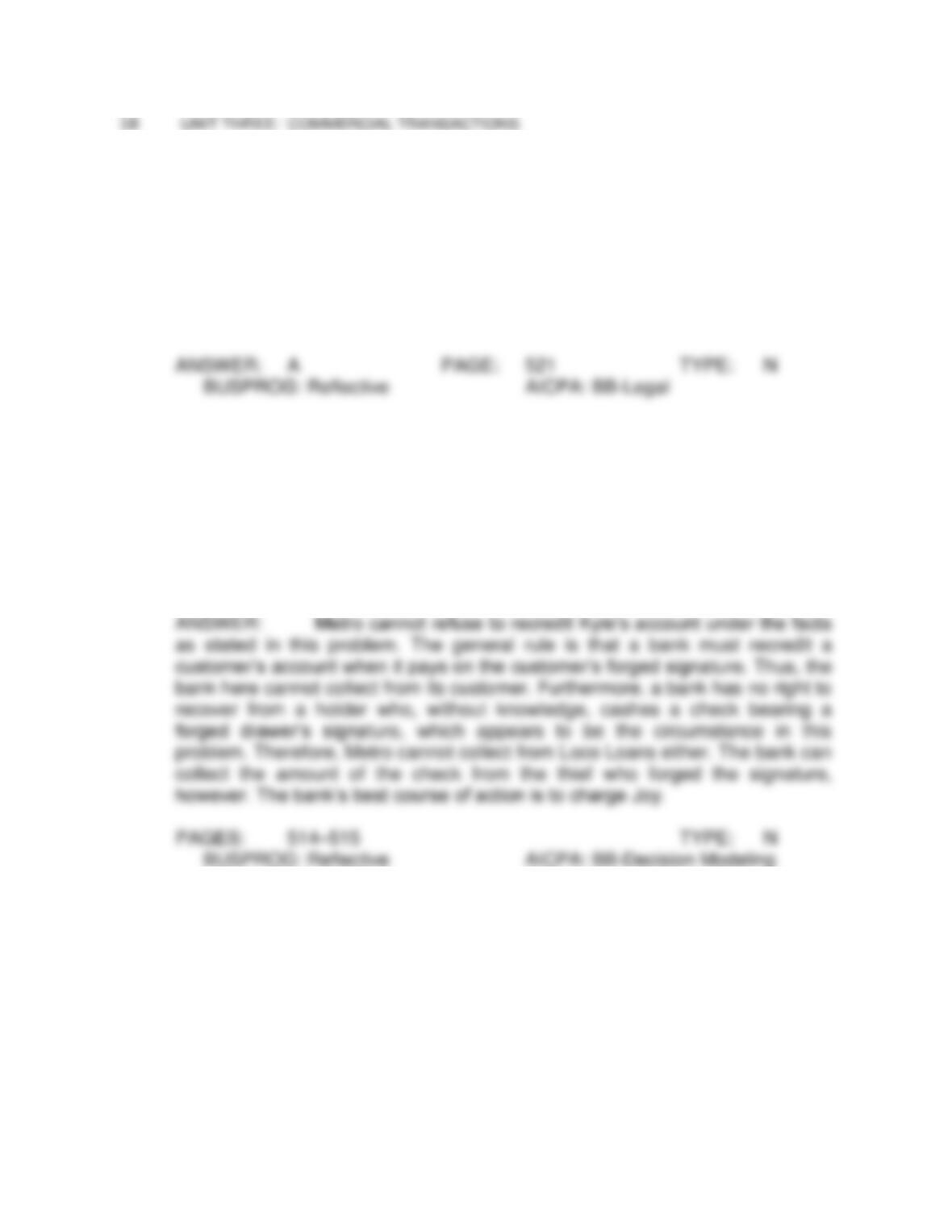
Kyle discovers the forgery and insists that Metro recredit his account. Can
Metro refuse? If not, from whom can the bank recover?
2. Hoppy steals two checks from Eagle Retail Stores, Inc.—a blank check and a
check payable to the order of General Supplies Company (GSC), drawn on
Eagle’s account with First National Bank. Hoppy forges Eagle’s signature on
the blank check and makes it payable to himself. Hoppy forges GSC’s
indorsement on the back of the check payable to GSC, and adds “Pay to the
order of Hoppy.” At Friendly Credit, Inc., Hoppy indorses the back of both
checks with his own name and gives them to Friendly for cash. Friendly does
not know about the theft or the forged signatures and presents the checks to
First National, which pays them. Eagle, which was not negligent, discovers the
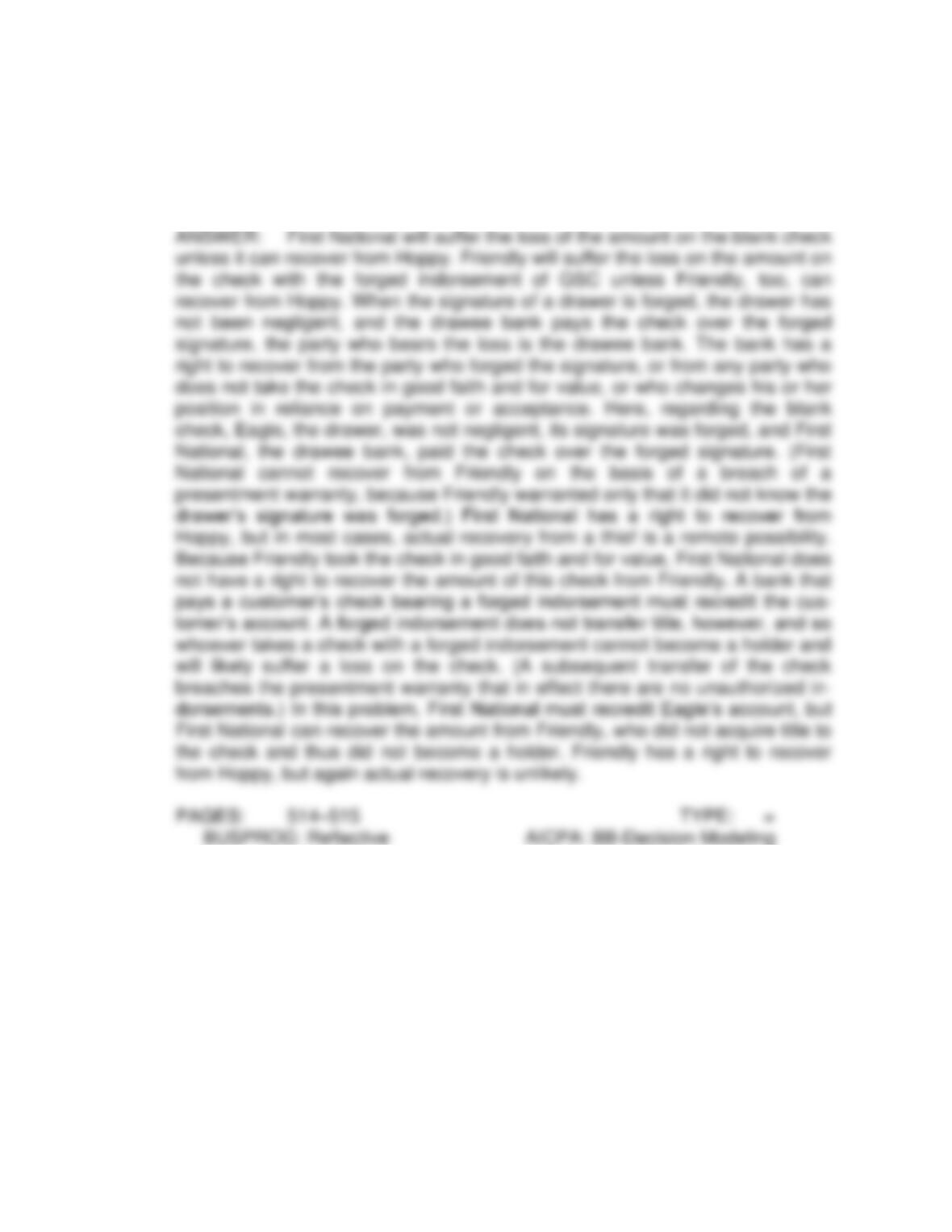
CHAPTER 22: CHECKS AND BANKING IN THE DIGITAL AGE 19
forgeries and asks First National to recredit its account. Who suffers the loss on
each check?