261
Chapter 22
Warranties and Product
Liability
N.B.: TYPE indicates that a question is new, modified, or unchanged, as follows.
N A question new to this edition of the Test Bank.
+ A question modified from the previous edition of the Test Bank.
= A question included in the previous edition of the Test Bank.
TRUE/FALSE QUESTIONS
A1. In most sales, sellers warrant that they have good and valid title to the goods sold.
A2. A warranty is an assurance by the buyer to the seller that he or she will pay valid con–
sideration for a product.
A3. Promises of fact made during the bargaining process are not express warranties.
A4. Express warranties can be found in a seller’s brochure
262 TEST BANK A—UNIT 4: DOMESTIC & INT’L SALES & LEASE CONTRACTS
A5. To be merchantable, goods must be at least average, fair, or medium-grade quality.
A6. Every sale or lease by a merchant who deals in goods of the kind sold or leased
automatically gives rise to an implied warranty of merchantability.
A7. Goods that are merchantable are fit for any purpose.
A8. Every seller is required to provide a written warranty for consumer goods sold.
A9. Implied warranties can arise as a result of a course of dealing.
A10. Generally, the implied warranties of merchantability and fitness for a particular
purpose cannot be disclaimed.
A11. A product liability action based on negligence requires the injured plaintiff and the
negligent defendant-manufacturer to be in privity of contract.
CHAPTER 22: WARRANTIES AND PRODUCT LIABILITY 263
A12. A product liability action may be based on warranty theories.
A13. The majority of states limit the application of strict product liability theory to
situations involving personal injuries.
A14. A public policy underlying the imposition of strict product liability is that consumers
should be protected against unsafe products.
A15. Sellers or lessors are liable only for products that are reasonably dangerous.
A16. An action in strict product liability requires that the product not be in a defective
condition when the defendant sells it.
A17. An action in strict product liability requires that the defendant fail to exercise
reasonable care.
A18. The types of product defects that have traditionally been recognized in product
liability law include inadequate warnings.
264 TEST BANK A—UNIT 4: DOMESTIC & INT’L SALES & LEASE CONTRACTS
A19. Courts in many jurisdictions will consider the negligent actions of both the plaintiff
and the defendant when apportioning liability in a product liability action.
A20. A statute of limitation may restrict the time within which an action in product liability
may be brought.
MULTIPLE CHOICE QUESTIONS
A1. City Cab Company and Dave’s Autos enter into a contract for a sale of motor vehicles.
City assures Dave’s that it has valid title to the vehicles. Under the UCC, warranties of
title arise
a. automatically in most sales contracts.
b. only if the buyer asks for such a warranty.
c. only if the seller expresses such a warranty.
d. only in conjunction with lease contracts, not sales contracts.
A2. Concrete Products, Inc., assures Deepwater Construction Company (DCC) that
Concrete’s cement will not crack within a certain range of pressure. DCC uses the
product. When cracks develop within the stated range, DCC files a suit against
Concrete. The court is most likely to rule in favor of
a. Concrete, because its statement was an expression of opinion.
b. Concrete, because DCC chose Concrete’s product voluntarily.
c. DCC, because Concrete’s statement was an express warranty.
d. DCC, because Concrete’s statement constituted puffery.
A3. Sari buys a new sport utility vehicle (SUV) from ‘Tastic Cars & Trucks, Inc. The most
important factor in determining whether an express warranty is created is whether
CHAPTER 22: WARRANTIES AND PRODUCT LIABILITY 265
a. Sari expresses to ‘Tastic what she wants warranted.
b. Sari’s desire for the SUV becomes part of her motivation to deal.
c. ‘Tastic expresses to Sari what it expects of its customers.
d. ‘Tastic’s promise becomes part of the basis of the bargain.
A4. Rent-all Trucks & Trailers, Inc. (RT&T), and United Delivery Service enter into a
contract for a lease of trucks. RT&T is a merchant who deals in goods of the kind
leased. Under the UCC, an implied warranty of merchantability arises
a. automatically in lease contracts.
b. only if the lessee asks for it.
c. only if the lessor does not expressly disclaim it.
d. only in conjunction with sales contracts, not lease contracts.
A5. Dependable Appliances, Inc., and Elain enter into a contract for a sale of kitchen
appliances. Dependable, a merchant who deals in goods of the kind sold, notes that its
goods come with an implied warranty of merchantability. Under the UCC, this means
that the goods are reasonably
a. fit for the buyer’s particular purpose.
b. fit for the ordinary purpose for which such goods are used.
c. suitable for resale at an acceptable price.
d. the best quality that money can buy.
266 TEST BANK A—UNIT 4: DOMESTIC & INT’L SALES & LEASE CONTRACTS
A6. Olga, a salesperson for Pre-owned Cars & Trucks, Inc., tells Quincy, “This is the best
car I’ve ever seen.” This statement is
a. an express warranty.
b. an implied warranty.
c. a warranty of title.
d. puffery.
A7. Neil goes to Oil Shop to change the oil in his car. Pat, the service technician, learns
that Neil plans to take a trip and advises the use of a certain type of oil. The oil breaks
down during the trip, damaging the car. Neil may recover from Oil Shop for breach of
a. an express warranty.
b. an implied warranty of fitness for a particular purpose.
c. an implied warranty of merchantability.
d. a warranty of title.
A8. Woodgrain Products Company and Sylvia enter into a contract for a sale of lumber.
Woodgrain knows the purpose for which Sylvia will use the goods. Under the UCC, an
implied warranty of fitness of a particular purpose arises
a. if the buyer is relying on the seller to select suitable goods.
b. if the buyer asks for it.
c. if the seller is a merchant who deals in goods of the kind sold.
d. in conjunction with lease contracts, not sales contracts.
CHAPTER 22: WARRANTIES AND PRODUCT LIABILITY 267
A9. Mountain Bikes, Inc. (MBI), and Nero enter into a contract for a sale of a mountain
bike. MBI, a merchant who deals in goods of the kind sold, makes implied and express
warranties in connection with the sale. The Magnuson-Moss Warranty Act was
designed to prevent deception in warranties by
a. displacing the UCC as the primary source of warranty rules.
b. making warranties easier to understand.
c. prohibiting disclaimers of warranties.
d. requiring sellers to give written warranties for consumer goods.
A10. Longlast Tools, Inc., sells power tools, power tool parts, and related supplies under
“full” warranties. Under the Magnuson-Moss Warranty Act, this means that Longlast
must provide
a. free repair or replacement of any defective part.
b. a toll-free number for a Longlast-approved service company.
c. a complete catalog of products and parts available for sale.
d. repair or replacement of any defective part at a reduced charge.
A11. Imported Carpets Store and Jill enter into a contract for a sale of an Oriental rug.
Imported Carpets, a merchant who deals in goods of the kind sold, generally describes
the goods, details technical specifications, and shows a sample. Under the UCC, if
these are inconsistent
a. the general description displaces the sample.
b. the general description displaces the technical specifications.
c. the sample takes precedence over the general description.
d. the sample takes precedence over the technical specifications.
268 TEST BANK A—UNIT 4: DOMESTIC & INT’L SALES & LEASE CONTRACTS
A12. GR8 Skates Company makes and sells a pair of skates to Homer. GR8 fails to exercise
“due care” to make the skates safe, and Homer is injured as a result. GR8 is most likely
liable for
a. assumption of risk.
b. knowledgeable use.
c. negligence.
d. foreseeable misuse.
A13. Farm Equip, Inc., makes farming machinery. Gail discovers that her Farm Equip tractor
is defective and sues the maker for product liability based on negligence. To win, Gail
must show that
a. Farm Equip sold the tractor to Gail.
b. Gail knew and appreciated the risk caused by the defect.
c. Gail suffered an injury caused by the defect.
d. the “defect” was a commonly known danger.
A14. Green Glass Corporation makes glass bottles for food and beverage makers to package
their products for wholesale distribution and retail sale. Liability may be imposed on
Green Glass based on
a. the “reasonableness” of the manufacturer’s quality control efforts.
b. the type of the manufacturer’s insurance coverage.
c. a manufacturing defect.
d. the opinion and testimony of non-experts.
CHAPTER 22: WARRANTIES AND PRODUCT LIABILITY 269
A15. Welding Systems, Inc. (WSI), makes welding torches, masks, and related products. A
WSI product may be unreasonably dangerous due to
a. a defect in its design.
b. the expectations of its seller.
c. the intentions of its distributor.
d. the method of accounting of its maker.
A16. Safe-T-Made Company makes electrical cords and other connectors for electronic
devices. Rowena files a product liability suit against Safe-Rite, alleging a warning
defect. Under the Restatement (Third) of Torts: Products Liability, in deciding whether
to hold Safe-T-Made liable, the court may consider
a. the expectations of the seller.
b. the identities of the company’s owner.
c. the intentions of the manufacturer.
d. the characteristics of expected users.
A17. Pharma Company, Quitox Corporation, and Renal, Inc., are drug makers. Med Sales
Company and National OTC, Inc., are drug distributors. In a suit against all of these
parties in which market-share liability is imposed, most likely to be liable are
a. neither the distributors nor the makers.
b. the distributors and the makers.
c. the distributors only.
d. the makers only.
270 TEST BANK A—UNIT 4: DOMESTIC & INT’L SALES & LEASE CONTRACTS
A18. Fun Toyz Corporation makes skateboards, which it sells to consumers, including
Gitana. Gitana is injured due to a defect in the board that causes an accident in which
Haley, a bystander, is also injured. In a product liability suit based on strict product
liability, Fun Toyz may be liable to
a. Gitana and Haley.
b. Gitana only.
c. Haley only.
d. no one.
A19. Grady, an obese individual, files a suit against Fry Fast Food Corporation (FFFC),
alleging that FFFC’s food is unhealthy because, as Grady knows, it contains high levels
of cholesterol and saturated fat. Grady is most likely to
a. lose, because Grady assumed the risk when he bought FFFC’s food.
b. lose, because Grady knows of the food’s unhealthiness.
c. win, because FFFC’s food poses an unhealthy risk to Grady.
d. win, because Grady knows of the food’s unhealthiness.
A20. Air Navigation, Inc., makes aviation guidance systems. Ollie is injured in a crash caused
by a defective Air Navigation product. A statute restricts the time within which Ollie
may file a product liability suit against Air Navigation regardless of when he was
injured. This is a statute of
a. limitations.
b. preemption.
c. repose.
d. suspension.
ESSAY QUESTIONS
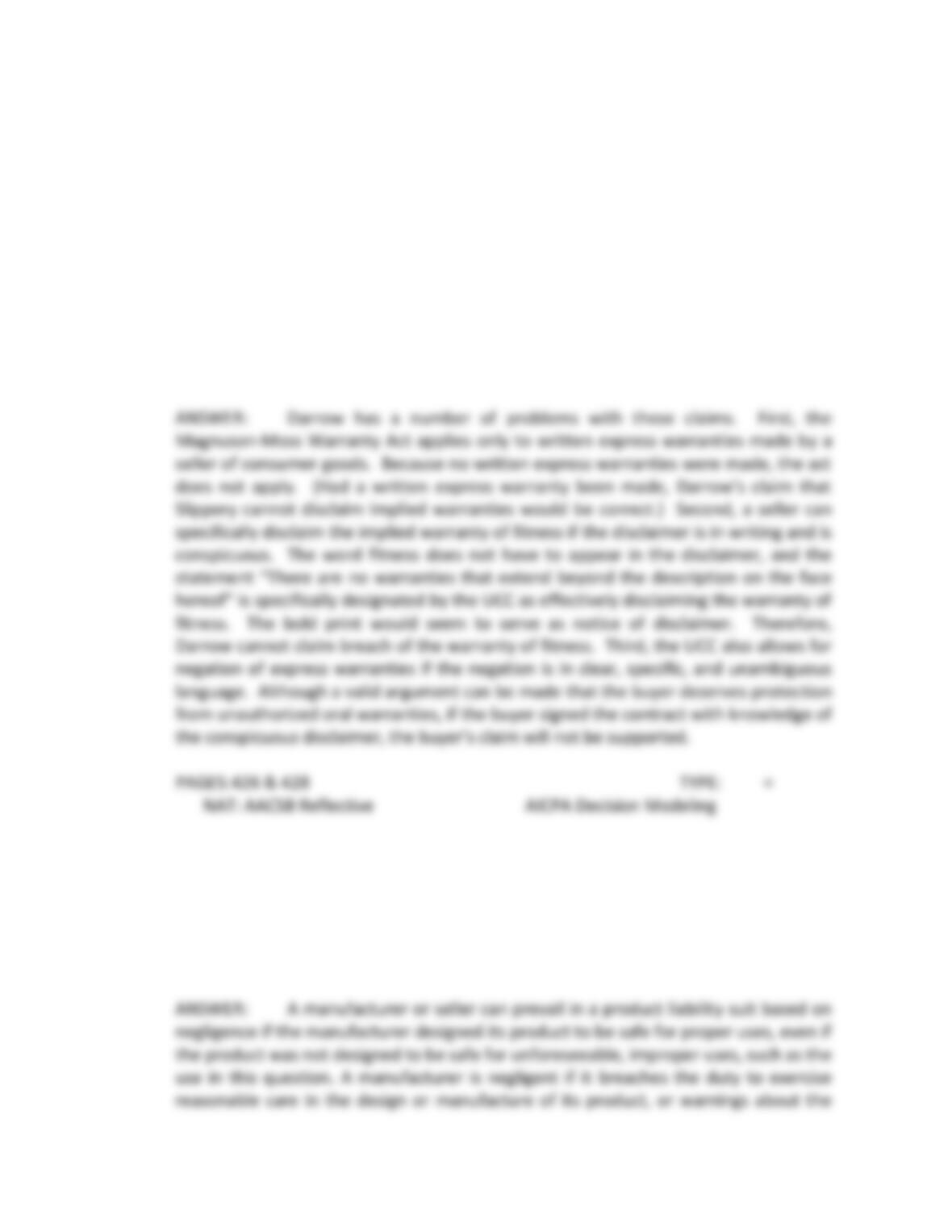
A1. Darrow purchases a new car from Slippery Motors. The retail installment contract
states immediately above the buyer’s signature in large, bold type: “There are no
warranties that extend beyond the description on the face hereof” and “There are no
express warranties that accompany this sale unless expressly written in this contract.”
CHAPTER 22: WARRANTIES AND PRODUCT LIABILITY 271
Before purchasing the car, Darrow specifically informed Slippery’s salesperson that he
wanted a car that could be driven in a dusty area without needing mechanical repairs.
Slippery’s salesperson said to Darrow, “Nothing will go wrong with this car, but if it
does, return it to us, and we will repair it without cost to you.” Neither this statement
nor any similar statement appears in the retail sales contract. Darrow drives the car
into a dust storm. The air filter gets plugged up, and the car engine overheats, causing
motor damage. Slippery Motors refuses to repair the engine under any warranty.
Darrow claims that Slippery is liable for breach of the implied warranty of fitness for a
particular purpose, that the Magnuson-Moss Warranty Act prohibits disclaiming this
implied warranty, and that the salesperson’s express warranty has also been
breached. What are the problems with Darrow’s claims?
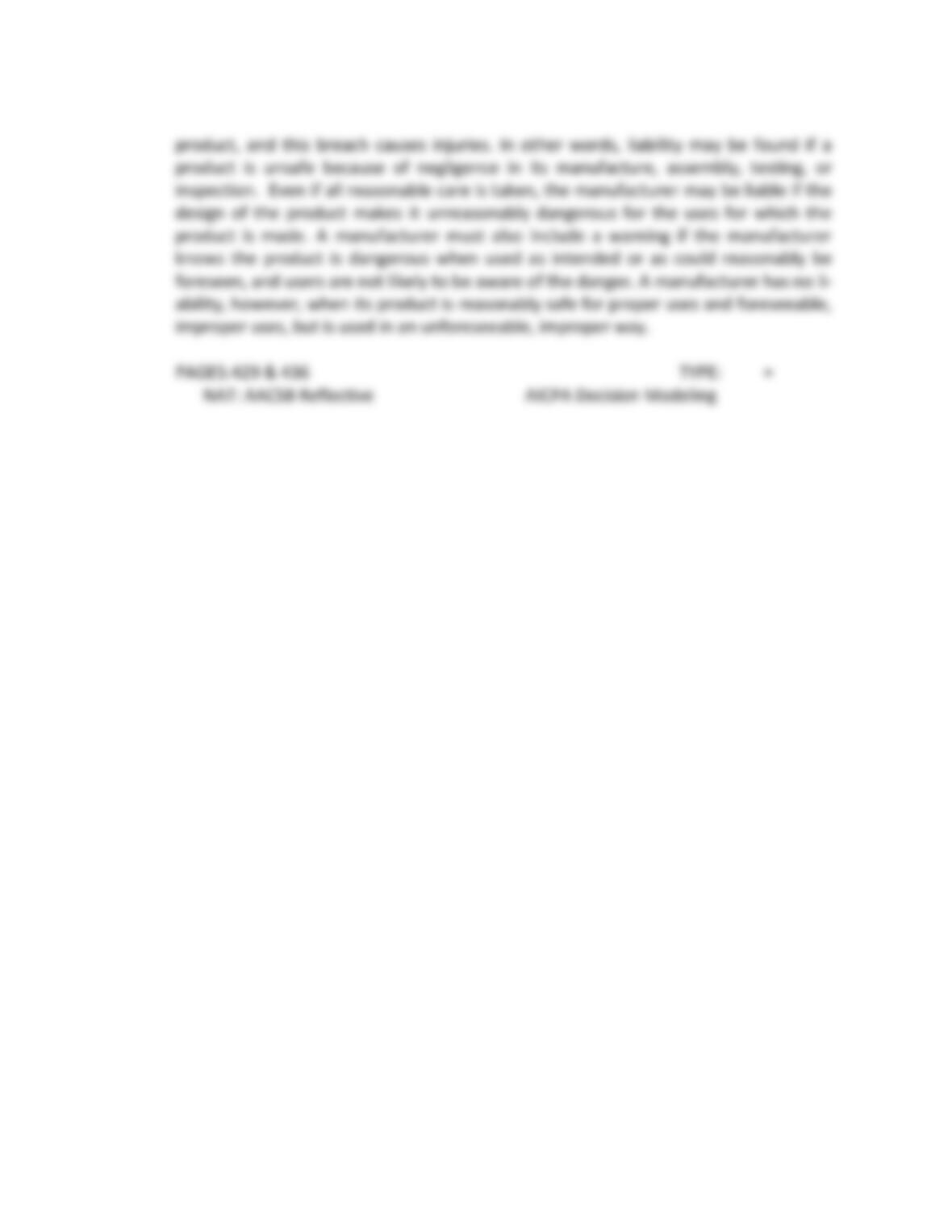
A2. Delta Company makes and sells table saws, which are designed to be safe if used
properly. Erin buys a Delta saw and lends it to her neighbor Frank. To reach a toolbox
on a high shelf in his garage, Frank props the saw at an angle against a cabinet and
climbs onto the saw. Frank loses his footing, slips off the saw, falls on the blade, and is
injured. He files a product liability suit against Delta, on the ground of negligence. On
what basis could Delta prevail?
272 TEST BANK A—UNIT 4: DOMESTIC & INT’L SALES & LEASE CONTRACTS