Chapter 2
Constitutional Law
N.B.: TYPE indicates that a question is new, modified, or unchanged, as
follows.
N A question new to this edition of the Test Bank.
+ A question modified from the previous edition of the Test Bank,
= A question included in the previous edition of the Test Bank.
TRUE/FALSE QUESTIONS
1. A confederal form of government is a confederation of independent states with
a central government of very limited powers.
2. In a country with a federal form of government, the national government and
the states share sovereign power.
3. All powers not specifically delegated to the federal government are reserved to
the states.
4. The checks and balances in the U.S. Constitution prevent any one branch of
government from exercising too much power.
5. Under the Constitution, the judicial branch interprets the laws.
6. Under the Constitution, the judicial branch is responsible for foreign affairs.
7. The President determines the jurisdiction of the federal courts.
8. The President appoints federal judges with the advice and consent of the
Senate.
9. The judicial branch has the power to hold actions of the other branches of
government unconstitutional.
10. Article I, Section 8, of the U.S. Constitution permits Congress to regulate
interstate commerce.
11. At least in theory, Congress can regulate every commercial enterprise in the
United States.
12. Under their police powers, states can regulate only public activities, such as
political demonstrations.
13. When there is a direct conflict between a federal and a state law, the state law
is rendered invalid.
14. Preemption occurs when Congress chooses to act exclusively in a concurrent
area and a valid federal statue or regulation takes precedence over a
conflicting state or local law.
15. The Second Amendment to the U.S. Constitution reserves all powers not
delegated to the national government to the states.
16. The Bill of Rights protects individuals against types of interference by the
federal government.
17. The Fifth Amendment prohibits unreasonable searches and seizures of
persons or property.
18. The Eighth Amendment prohibits excessive bail and fines, as well as cruel and
unusual punishment.
19. Symbolic speech is defined as nonverbal expressions of belief and is protected
by the First Amendment.
20. A restriction on commercial speech is valid as long as it forbids only the
expression of views on controversial issues.
21. The First Amendment protects corporate political speech.
22. The First Amendment protects defamatory speech.
23. The Children’s Internet Protection Act requires public schools and libraries to
use filtering software to block children’s access to adult contact on Web sites.
24. The First Amendment requires a complete separation of church and state.
25. The establishment clause of the U.S. Constitution prohibits the federal
government from establishing a state-sponsored religion.
26. A law that has any impact on religion is unconstitutional.
27. The Fourteenth Amendment guarantees a right to due process of law.
CHAPTER 2: CONSTITUTIONAL LAW 5
28. Procedural due process requires that any government decision to take a
person’s property must be made fairly.
29. Substantive due process focuses on the substance of legislation.
30. The terms “due process” and “equal protection” mean the same thing.
31. A law that limits only some persons’ exercise of a fundamental right is valid
under any circumstances.
32. A law that limits the liberty of all persons may violate substantive due process.
33. A law that restricts people of a certain national origin from doing something will
be carefully examined to make sure it promotes a compelling government
interest before it is allowed to stand.
34. Because the Constitution does not specifically a right to privacy, this right is
denied to people.
35. Individuals have a right to obtain access to information about them collected in
government files.
6 UNIT ONE: THE LEGAL ENVIRONMENT OF BUSINESS
MULTIPLE-CHOICE QUESTIONS
1. The Financial Institutions Association would like a certain law enacted,
administered, interpreted, and enforced in the best interest of its members,
which include banks. Under the Constitution, Congress
a. administers the laws.
b. enforces the laws.
c. interprets the laws.
d. makes the laws.
2. The Constitution sets out the authority and the limits of the branches of the
government. The term checks and balances means that
a. Congress writes checks and the other branches balance the budget.
b. each branch has some power to limit the actions of the others.
c. the courts balance their authority to the other branches’ checklists.
d. the president “checks” the courts, which “balance” the laws.
3. Antonin, a federal judge, retires. The vacant position will be filled by a judge
a. appointed by the United States Supreme Court.
b. elected by voters.
c. appointed by the President.
d. appointed by Congress.
4. The commerce clause of the U.S. Constitution is found in
a. Article I, Section 8.
b. Article I, Section 2.
c. Article VIII, Section 1.
d. Article II, Section 8.
5. South Dakota, like other states, may regulate private activities to protect or
promote the public order, health, safety, and general welfare under
a. the state’s police powers.
b. the dormant commerce clause.
c. the due process clause.
d. the free exercise clause.
6. Tami’s Tasty Tacos, a fast food outfit, files a suit against the state of Texas,
claiming that a Texas state law violates the commerce clause. The court will
agree if the statute imposes a substantial burden on
a. a local government.
8 UNIT ONE: THE LEGAL ENVIRONMENT OF BUSINESS
b. interstate commerce.
c. noneconomic activity.
d. the state.
7. The commerce clause’s express grant of exclusive authority to regulate
commerce that substantially affects trade and commerce among states is
referred to as the
a. dormant aspect of the commerce clause.
b. positive aspect of the commerce clause.
c. negative aspect of the commerce clause.
d. exclusive aspect of the commerce clause.
8. Congress enacts a law that sets out a rigorous medical-device premarket
approval process for the U.S. Food and Drug Administration to follow. The law
includes a preemption provision. Moe is injured by a device that underwent the
process and files a claim under New Hampshire state law to recover for the
injury. The court will most likely rule that
a. Moe’s state law claim preempts the federal law.
b. the federal law and state law claim are concurrent.
c. the federal and state law claim cancel each other out.
d. the federal law preempts Moe’s state law claim.
9. Savers Mart, Inc., distributes its merchandise to retail outlets on an interstate
basis. Under the commerce clause, Congress has the power to regulate
a. any commercial activity in the United States.
b. only activities that are in intrastate commerce.
c. only activities that are in local commerce.
d. only activities that are not in commerce.
10. Congress enacts a law prohibiting toys made in China from being sold in the
United States. The Hawaii state legislature enacts a law allowing the sale of
Chinese-made toys. Hawaii’s law will most likely be struck down under
a. the commerce clause.
b. the equal protection clause.
c. the due process power.
d. the supremacy clause.
11. Don, a U.S. citizen, is the owner of Egrets Unlimited, Inc. Egret’s competitors
include Feathered Friends Company (FFC), which is owned by Greg and Huey.
The Bill of Rights embodies a series of protections for Don against types of
interference by
a. FFC and its other competitors only.
b. FFC, Greg, Huey, others, and the government.
c. Greg, Huey, and other private individuals only.
d. the government only.
12. A federal law regarding the labeling of pesticides directly conflicts with a state
law. The state law will be rendered invalid due to the
a. the supremacy clause.
b. the commerce clause.
c. the federal spending power.
d. the First Amendment.
13. Martin, a U.S. citizen, feels that a recently enacted federal law is unfair. He
assembles a group of friends and they write a petition to the government.
Martin and friends then stand quietly in front of the White House with signs
declaring their belief that the law is unfair. Under the First Amendment, Martin
has a right to
a. petition the government, but not to assemble a group peaceably.
b. assemble peaceably, but not to petition the government.
c. both petition the government and assemble peaceably.
d. neither petition the government nor assemble peaceably.
14. The police obtain a search warrant and search Dave’s apartment. After yelling
obscenities at the officers, Dave confesses to a crime and implicates his
friends. The Constitution protects against
a. obscene speech only.
b. others’ implication only.
c. unreasonable searches only.
d. obscene speech, others’ implication, and unreasonable searches.
15. Bailey, the president of Carmichael Commodities Company, claims that certain
actions by the federal government and by the state of Delaware infringe on
rights guaranteed by the Bill of Rights. All of these rights limit
a. neither Delaware nor the federal government.
b. the federal government only.
c. Delaware and the federal government.
d. Delaware only.
16. Mary creates a t-shirt design that expresses her support for a presidential
candidate and distributes t-shirts to all her friends. The t-shirts are an example
of
a. unprotected speech.
b. controlled speech.
c. symbolic speech.
d. illegal speech.
17. Serenity City enacts an ordinance that bans the use of “sound amplifying
systems” on public streets. Tyler wants to campaign for a seat on the city
council by broadcasting his message through speakers mounted on a truck. In
Tyler’s suit against the city, a court would likely hold the ordinance to be
a. an unconstitutional restriction of speech.
b. constitutional under the First Amendment.
c. justified by the need to protect individual rights.
d. necessary to protect national interests.
18. George burns an American flag in his backyard. He films his actions and posts
the video on YouTube.com. George’s actions are
a. expressly prohibited by the U.S. Constitution.
b. protected by the First Amendment of the U.S. Constitution.
c. considered to be a form of treason.
d. illegal in some states.
19. Beachside City enacts an ordinance that bans the distribution of all printed
materials on city streets. Carl opposes the city’s latest “revenue–enhancing”
measure and wants to protest by distributing handbills. In his suit against the
city, a court would likely hold the printed-materials ban to be
a. an unconstitutional restriction of speech.
b. constitutional under the First Amendment.
c. justified by the need to protect individual rights.
d. necessary to protect national interests.
20. Reusable Energy Corporation regularly expresses opinions on political issues.
Under the First Amendment, corporate political speech is
a. discouraged.
b. forbidden.
c. protected.
d. required.
21. California enacts a statute to ban advertising in “bad taste.” This statute would
likely be held by a court to be
a. an unconstitutional restriction of speech.
b. constitutional under the First Amendment.
c. justified by the need to protect individual rights.
d. necessary to protect national interests.
22. Machismo Motor Sales Corporation regularly advertises its off-the-road vehicles, all-
terrain vehicles, and other products. Under the First Amendment, these ads and
other commercial speech are given
a. less extensive protection than noncommercial speech.
b. more extensive protection than symbolic speech.
c. no protection.
d. the same protection as defamatory speech.
23. ViolentVideoGames, Inc. markets a variety of shooting, fighting and hunting
video games. A state statue is enacted that requires all video game
manufacturers to label any games with an option to kill something as
“excessively violent.” A court would likely hold this regulation to be
a. an unconstitutional restriction of speech.
b. constitutional under the First Amendment.
c. justified by the need to protect individual rights.
d. necessary to protect national interests.
24. In 2013, Congress enacts the Act to Restrict Commercial Speech (ARCS). The
ARCS will be considered valid if it directly advances a substantial government
interest
a. but goes no further than necessary to achieve its purpose.
b. without regard to how “far” it goes.
c. and the parties affected by it can elect how “far” to go in applying it.
d. and goes further than necessary to ensure full coverage.
25. Julia is a U.S. citizen. She establishes a website that posts threatening
messages about celebrities. Her website is
a. protected by the First Amendment.
b. not protected by the First Amendment.
c. protected by the Fifth Amendment.
d. protected by the Tenth Amendment.
26. Brad stands in front of Rooster’s Round–Up Café, shouting “fighting words” that are
likely to incite Rooster’s patrons to respond violently. The First Amendment protects
such speech
a. all of the time.
b. none of the time.
c. only if it is noncommercial.
d. only if it is symbolic.
27. Adult Shoppe in Bay City sells a variety of publications, including child
pornography. Bay City enacts an ordinance prohibiting the sale of such
materials. This ordinance is most likely
a. an invalid restriction of individuals’ privacy.
b. an unconstitutional restriction of speech.
c. a violation of adults’ rights to enjoy certain privileges.
d. constitutional under the First Amendment.
28. Which of the following does not necessarily make material obscene?
a. The average person finds that it violates contemporary community
standards.
b. The work taken as a whole appeals to a prurient interest in sex.
c. The work shows patently offensive sexual conduct.
d. The work shows animals mating.
29. Oklahoma enacts a law requiring all businesses in the state to donate 10 per–
cent of their profits to Protestant churches that provide certain services to
persons whose income is below the poverty level. PriceLess Stores files a suit
to block the law’s enforcement. The court would likely hold that this law violates
a. no clause in the U.S. Constitution.
b. the establishment clause.
c. the free exercise clause.
d. the supremacy clause.
30. Marie claims that a Nebraska state statute infringes on her “procedural due
process” rights. This claim focuses on
a. procedures used in making decisions to take life, liberty, or property.
b. the content of the statute.
c. the similarity of the treatment of similarly situated individuals.
d. the steps to be taken to protect Marie’s privacy.
31. A Massachusetts state statute imposes a prison term, without a trial, on all
street performers who operate in certain areas. A court would likely review this
statute under the principles of
a. the commerce clause.
b. the equal protection clause.
c. the due process clause.
d. the First Amendment.
32. Orin claims that a Pennsylvania state statute infringes on his “substantive due
process” rights. This claim focuses on
a. procedures used to make decisions to take life, liberty, or property.
b. the content of the statute.
c. the similarity of the treatment of similarly situated individuals.
d. the steps to be taken to protect Orin’s privacy.
33. Justice For All, a political organization, files a claim to challenge a Colorado
statute that limits the liberty of all persons to broadcast “annoying” radio
commercials. This claim is most likely based on the right to
a. equal protection of the law.
b. indictment.
c. procedural due process.
d. substantive due process.
34. To reduce traffic, Harbor Town enacts an ordinance that allows only a few
street vendors to operate in certain areas. A court would likely review this
ordinance under the principles of
a. the commerce clause.
b. the equal protection clause.
c. the due process clause.
d. the First Amendment.
35. Jon, a law enforcement official, monitors Kelsey’s Internet activities—e-mail
and Web site visits—to gain access to her personal financial data and student
information. This may violate Kelsey’s right to
a. equal protection of the law.
b. privacy.
c. procedural due process.
d. substantive due process.
18 UNIT ONE: THE LEGAL ENVIRONMENT OF BUSINESS
ESSAY QUESTIONS
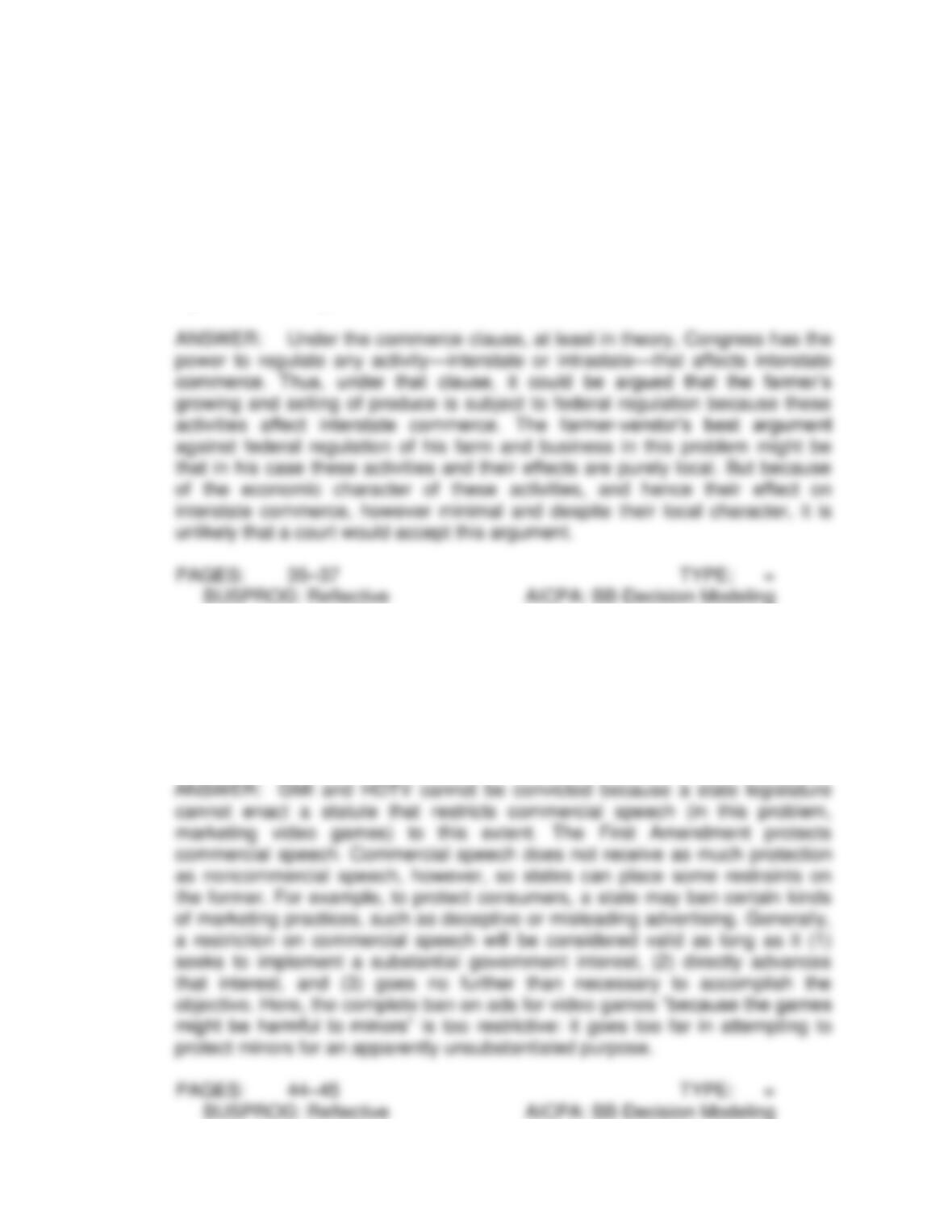
1. Jim operates Jim’s Fruits & Vegetables, a small market stocked entirely with
produce grown on his adjacent farm. Under what clause of the Constitution can
the federal government regulate Jim’s activities? What is Jim’s best argument
against federal regulation of his farm and business?
2. The Arkansas state legislature enacts a statute that prohibits the advertising of
video games “because the games might be harmful to minors.” Despite this
new statute, the president of Games Marketing, Inc. (GMI), orders GMI
marketers to place ads in various media. When a GMI ad appears on HDTV, a
local television station, GMI and HDTV are charged with violating the statute.
What is the defendants’ best defense against a conviction?