229
Chapter 19
The Formation of
Sales and Lease Contracts
N.B.: TYPE indicates that a question is new, modified, or unchanged, as follows.
N A question new to this edition of the Test Bank.
+ A question modified from the previous edition of the Test Bank.
= A question included in the previous edition of the Test Bank.
TRUE/FALSE QUESTIONS
B1. To the extent that it has not been modified by the UCC, the common law of contracts
applies to sales contracts.
B2. Under the UCC, a sale is the passing of title from a seller to a buyer for a price payable
in cash only.
B3. A contract for a sale of growing crops or timber to be cut is a contract for a sale of
goods.
230 TEST BANK B—UNIT 4: DOMESTIC & INT’L SALES & LEASE CONTRACTS
B4. Intangible property does not come under Article 2.
B5. A contract in which goods and services are combined never falls within the scope of
UCC Article 2.
B6. The UCC imposes special business standards on merchants because of their relatively
high degree of commercial expertise.
B7. Article 2A of the UCC does not cover subleases of goods.
B8. A lessee is a party who transfers a right to the possession and use of goods under a
lease.
B9. Under a finance lease, the lessee can stop performing and making lease payments if
the leased equipment turns out to be defective.
B10. Under the UCC, good faith means devoutly religious.
B11. When no delivery terms are specified in a contract for a sale of goods, there is no
basis for enforcing it.
CHAPTER 19: THE FORMATION OF SALES AND LEASE CONTRACTS 231
B12. Under the UCC, a contract for a sale of goods that does not include the quantity is an
output contract.
B13. Under the UCC, a firm offer for a sale or lease of goods made by a merchant can be
revoked at any time before acceptance.
B14. Under the UCC, an offeree can accept an offer to buy goods by a prompt promise to
ship the goods.
B15. Under the UCC, an offeror must be notified within a reasonable time that the offeree
has accepted.
B16. Under the UCC, an agreement modifying a contract needs new consideration to be
binding.
B17. All oral contracts are enforceable under the UCC.
B18. Under the UCC, the meaning of any agreement must be interpreted in light of
commercial practices.
232 TEST BANK B—UNIT 4: DOMESTIC & INT’L SALES & LEASE CONTRACTS
B19. An unconscionable contract is one that is so unfair and one sided that it would be
unreasonable to enforce it.
B20. Like the UCC, the United Nations Convention on Contracts for the International Sale of
Goods (CISG) applies to consumer sales.
MULTIPLE CHOICE QUESTIONS
B1. Stardust Coffee Company is a Texas-based firm that does business throughout the
world. Stardust manages retail and wholesale operations, buys and sells commercial
venues, undeveloped land, and coffee beans, and other goods. Stardust has had to
deal with employee and customer theft. With respect to these circumstances, the
Uniform Commercial Code (UCC) provides a framework for
a. commercial transactions for the sale of and payment for goods.
b. international distribution agreements.
c. domestic and foreign transactions in real estate.
d. prosecuting crimes against business interests.
B2. Discount Mart, Inc., is an East Coast-based firm that does business throughout the
United States. With respect to this circumstance, the UCC has been adopted by, and
applies in,
a. all of the states, in whole or in part.
b. most of the states on the Atlantic and Pacific coasts.
c. none of the states, to date.
d. only the states on the Mississippi, Missouri, and Ohio Rivers.
CHAPTER 19: THE FORMATION OF SALES AND LEASE CONTRACTS 233
B3. Over the course of a year, Mom’s Appliance Company sells its wares to customers to
whom it extends credit. Mom’s orders the appliances from NET Appliance Depot’s
warehouse, from which the items are shipped via common carrier to Mom’s
customers. Article 2 of the UCC governs
a. all of the parties’ sales of the goods.
b. Mom’s extension of credit.
c. NET’s storage of the goods.
d. the common carrier’s delivery of the goods.
B4. Cotton Brokers, Inc., enters into a contract to sell denim clothing to Delite Natural
Fashion store, which in turn sells a pair of jeans to Esmé, a consumer. In comparison
to standards that apply to consumers, the UCC imposes on merchants
a. less strict legal standards.
b. special business standards.
c. stricter ethical standards.
d. the same overall standards.
B5. Excel Autos & Trucks, Inc., contracts to sell five trucks to First Leasing Corporation,
which contracts to lease the trucks to General Delivery Company. Article 2A of the
UCC applies to
a. neither the lease nor the sale.
b. the lease and the sale.
c. the lease only.
d. the sale only.
234 TEST BANK B—UNIT 4: DOMESTIC & INT’L SALES & LEASE CONTRACTS
B6. Rikki and Sid enter into a sales contract for tennis equipment. With respect to the
specific contractual provisions set out in the UCC, Rikki and Sid may
a. agree to different terms only to a reasonable extent.
b. agree to different terms unless they “get caught.”
c. agree to whatever terms they wish.
d. not agree to different terms.
B7. Radiant Phone Company and Precision Works, Inc. (PWI), enter into a contract for the
sale of a certain quantity of cell-phone parts, with PWI to determine the price. The
price must be set according to
a. the concept of good faith.
b. the principle of fair trade.
c. the predominant-factor test.
d. the doctrine of unconscionability.
B8. Crafted Countertops, Inc., and Kitchen Design Corporation enter into a contract that
does not specify the payment terms. Payment may be made in
a. any commercially normal or acceptable means except credit card.
b. cash only.
c. any commercially normal or acceptable means.
d. cash or check only.
CHAPTER 19: THE FORMATION OF SALES AND LEASE CONTRACTS 235
B9. GR*Tech Company agrees to sell computer equipment to Home Office Stores, Inc., to
market to its customers. Normally, their contract would not be enforceable unless it
includes
a. the duration of the deal.
b. the price of the goods.
c. the quantity of the goods.
d. the shipping arrangements.
B10. Doctors Medical Clinic orders 1,000 bandages from Emergency Supplies Company but
fails to specify the sizes. The bandages are delivered in an assortment of sizes. Doctors
Medical Clinic may
a. accept the bandages “as is” only.
b. accept the bandages “as is” or reject the entire shipment only.
c. accept only the bandages that it wants and reject the rest.
d. reject the entire shipment only.
B11. Charcoal Briquettes, Inc., is the offeror and Dante’s Firewood Company is the offeree
under a unilateral sales contract in which Ember’s Kindling & Tinder Company is also
interested. Charcoal is not notified of Dante’s performance within a reasonable time.
Charcoal
a. may treat the offer as having lapsed.
b. must assume that Dante has started to perform.
c. must contact Dante.
d. must make an offer to Ember.
236 TEST BANK B—UNIT 4: DOMESTIC & INT’L SALES & LEASE CONTRACTS
B12. Readymade Construction Corporation offers to buy from Set-Still Cement Company a
certain quantity of cement for a certain price. Set-Still can accept the offer by
a. a material alteration of the terms within a reasonable time.
b. a promise to ship or a prompt shipment of the cement.
c. a prompt shipment of the cement only.
d. a shipment of nonconforming goods with a notice of accommodation.
B13. Equipment Rental Corporation and Family Farm, Inc., are parties to an oral agreement
for a lease of farm equipment with payments in excess of $10,000. They may satisfy
the Statute of Frauds by
a. mutually agreeing not to commit fraud.
b. repeating the terms in a phone call.
c. setting out the terms in a memo.
d. shaking hands on the deal.
B14. Resource Remarketers, Inc., offers to buy crude oil from Petro Producers, Inc. The
parties later dispute the deal in court. Petro’s claim that Resource ordered 10,000
gallons and Resource’s testimony that it ordered only 1,000 gallons
a. prevents the enforcement of any contract between these parties.
b. supports an enforceable contract for 10,000 gallons.
c. supports an enforceable contract for 5,500 gallons.
d. supports an enforceable contract for 1,000 gallons.
CHAPTER 19: THE FORMATION OF SALES AND LEASE CONTRACTS 237
B15. Recreation Supplies, Inc. (RSI), and Sam, the owner of a Tourist Time shop, orally
agree to a sale of beach balls and seashells for $1,000. Sam gives RSI a check for $400
as a partial payment. This contract is
a. enforceable to the extent of $400.
b. fully enforceable because it is for specially made goods.
c. fully enforceable because it is oral.
d. not enforceable.
Fact Pattern 19-B1 (Questions B16–B18 apply)
Fruits & Vegetables, Inc., and Grover’s Market enter into a contract for the delivery of locally
grown produce. The parties use a standard Fruits & Vegetables form that contains some of
the terms the parties agree on but not others. Some of the produce spoils before it can be
sold. Grover’s refuses to pay for the spoiled goods.
B16. Refer to Fact Pattern 19-B1. Fruits & Vegetables files a suit against Grover’s, claiming
that the buyer assumed the risk of the spoilage of the unsold produce. The court may
allow evidence of this term if it finds that the parties’ contract is
a. fully integrated.
b. not fully integrated.
c. not supported by consideration.
d. a complete and final statement of their agreement.
B17. Refer to Fact Pattern 19–B1. Grover’s contends that the practice in the grocery trade
with respect to payment for spoiled produce justifies its refusal to pay. Grover’s is
arguing that the court should take into account
a. the course of dealing.
b. the course of performance.
c. the usage of trade.
d. a rule of construction.
238 TEST BANK B—UNIT 4: DOMESTIC & INT’L SALES & LEASE CONTRACTS
B18. Refer to Fact Pattern 19-B1. Fruits & Vegetables responds that it did not waive
payment for spoiled produce in the parties’ previous transaction. Fruits & Vegetables
is arguing that the court should take into account
a. the course of dealing.
b. the course of performance.
c. the usage of trade.
d. a rule of construction.
B19. Tom’s Timber Outlet and Olivia, a consumer, enter into a contract for a sale of
plywood. If the contract includes a clause that is perceived as grossly unfair to Olivia,
its enforcement may be challenged under
a. the mirror image rule.
b. the principle of fair trade.
c. the predominant-factor test.
d. the doctrine of unconscionability.
B20. Rodeo, S.A., which is based in Spain, enters into a contract for the sale of seven
hydraulic lifts to Tonnage Shipping Company, which is based in the United States. This
contract is governed by
a. Spanish law.
b. the provisions in the laws of both countries that are similar.
c. the Uniform Commercial Code.
d. the United Nations Convention on Contracts for the International Sale of
Goods.
ESSAY QUESTIONS
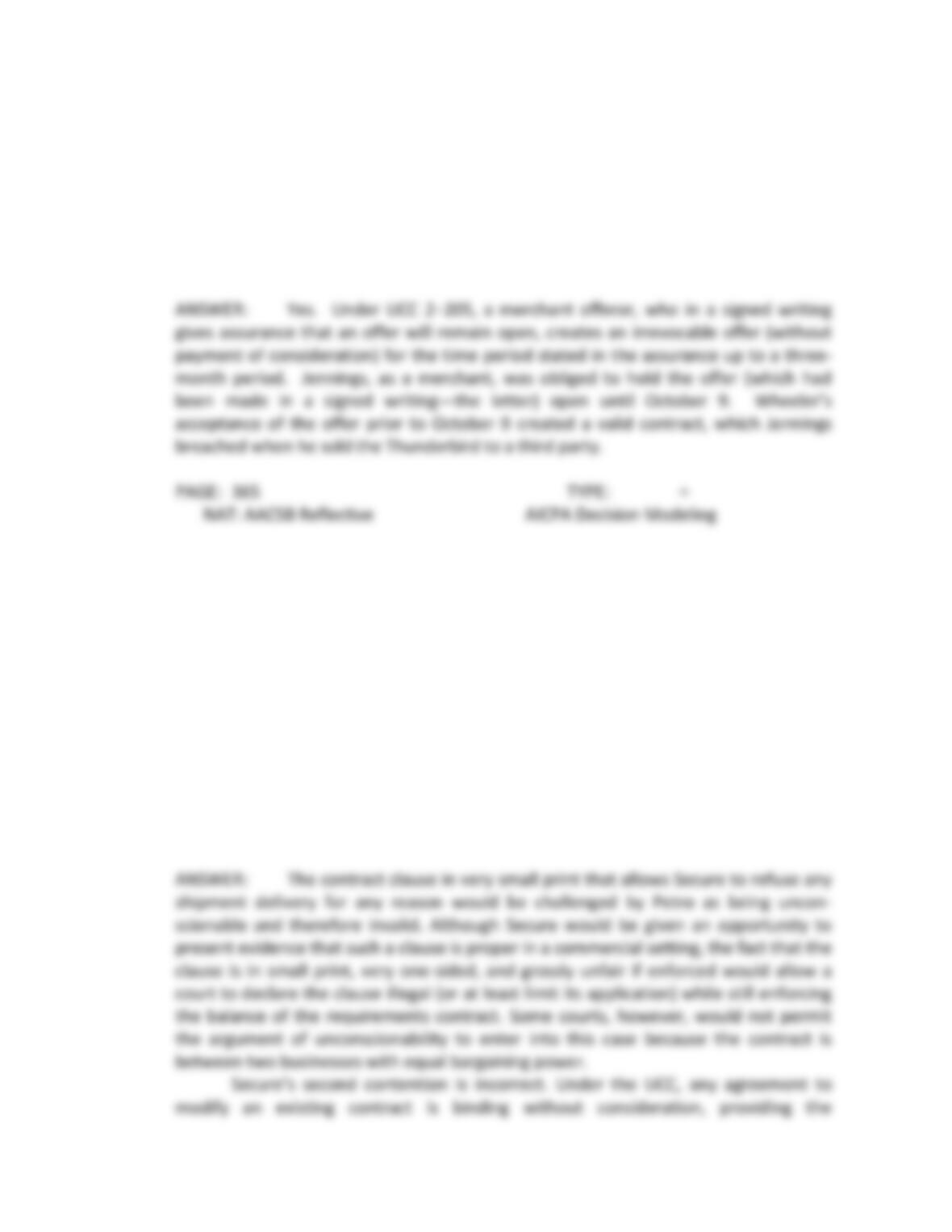
B1. On September 1, Jennings, a used-car dealer, wrote a letter to Wheeler in which he
stated, “I have a 1955 Thunderbird convertible in mint condition that I will sell you for
CHAPTER 19: THE FORMATION OF SALES AND LEASE CONTRACTS 239
$13,500 at any time before October 9. [Signed] Jennings.” By September 15, having
heard nothing from Wheeler, Jennings sold the Thunderbird to another party. On
September 29, Wheeler told Jennings that he accepted the offer and tendered
$13,500. When Jennings told Wheeler he had sold the car to another party, Wheeler
claimed Jennings had breached their contract. Is Jennings in breach? Explain.
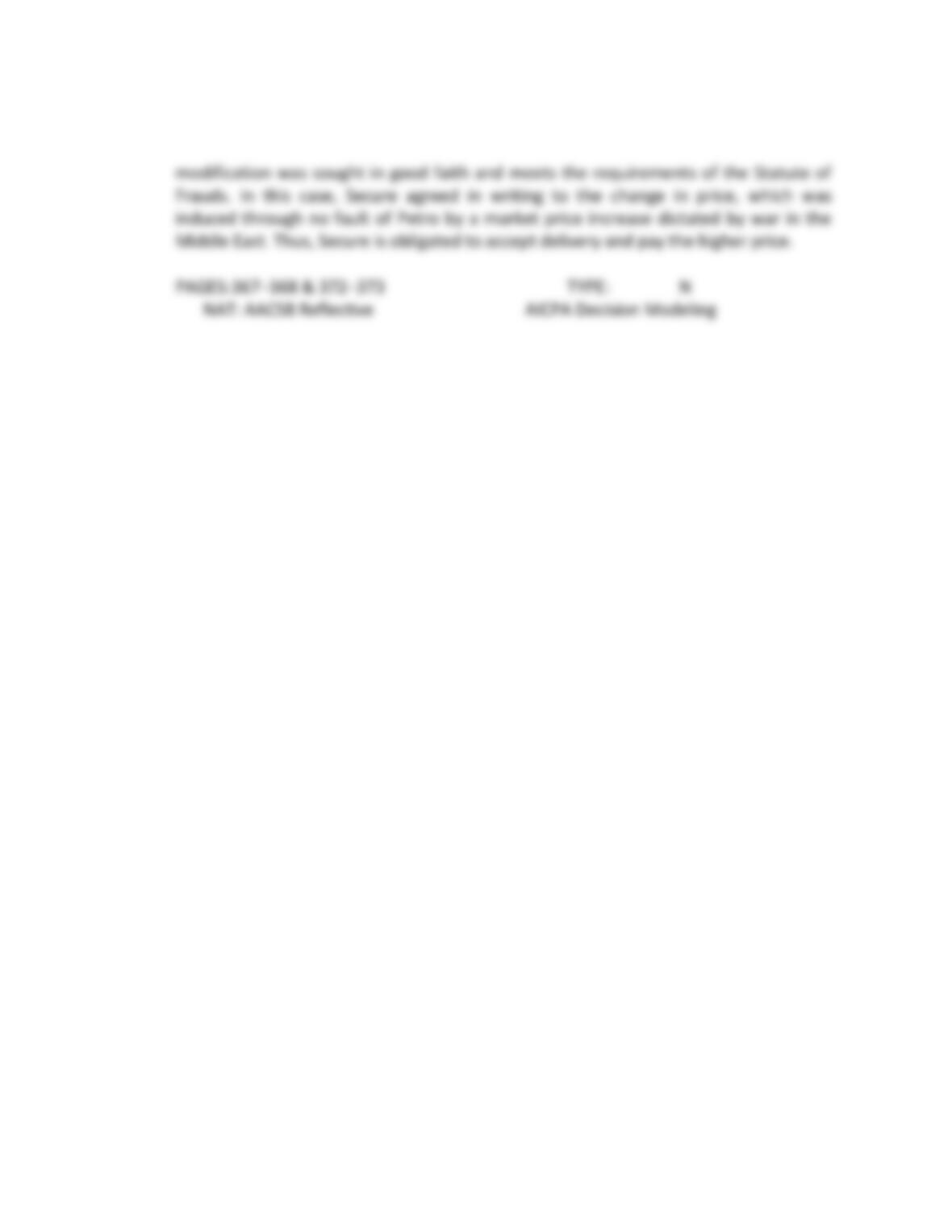
B2. Secure Courier, Inc., has a requirements contract with Petro Distribution Corporation
that obligates Petro to supply Secure with all the gasoline it needs for its delivery
vehicles for one year at $2.30 per gallon. A clause inserted in small print in the
contract by Secure, and not noticed by Petro, states, “The buyer reserves the right to
reject any shipment for any reason without liability.” For six months, Secure orders
and Petro delivers under the contract without any controversy. Then, because of a
war in the Middle East, the price of gasoline to Petro increases substantially. Petro
tells Secure it cannot possibly fulfill their contract unless Secure agrees to pay $2.50
per gallon. Secure, in need of the gasoline, agrees in writing to modify the contract.
Later that month, Secure learns it can buy gasoline at $2.40 per gallon from Refined
Oil Company. Secure refuses delivery of its most recent order from Petro, claiming,
first that the contract allows it to do so without liability, and second, that it is required
to pay only $2.30 per gallon if it accepts the delivery. Discuss Secure’s contentions.
240 TEST BANK B—UNIT 4: DOMESTIC & INT’L SALES & LEASE CONTRACTS