57) Sheila and Rob mutually decide to start a business together. Being close friends, they do not
enter into a written agreement and agree to split all responsibilities and profits equally. However,
Sheila soon finds herself saddled with more than her share of work. She now resents splitting the
profits equally since her contribution to the business is more. This has affected Rob and Sheila’s
friendship. What form of business organization is followed by Rob and Sheila? What should they
have done to prevent any misunderstandings between themselves? Can Sheila legally claim a
greater share of profits?
58) Explain the duties and rights of partners in a general partnership.
59) Discuss the items included in partnership agreements.
60) Explain the differences between general partnerships and limited partnerships.
61) Which of the following is not a specialized form of business association?
A) joint stock company
B) syndicate
C) joint venture
D) racket
62) Which of the following is an incorrect statement regarding a joint stock company?
A) Members of a joint stock company own shares that are transferable.
B) The joint stock company is treated as a partnership.
C) In a joint stock company, all goods are held in the name of the partners.
D) A joint stock company is an S corporation.
63) A ________ is a partnership agreement in which members of the organization own shares
that are transferable, but all goods are held in the name of the members, who assume partnership
liability.
A) joint stock company
B) syndicate
C) joint venture
D) franchise
64) A ________ is an investment group that privately agrees to come together for the purpose of
financing a large commercial project that none of the members could finance alone.
A) joint stock company
B) syndicate
C) joint venture
D) franchise
65) Which of the following is an incorrect statement regarding a syndicate?
A) A syndicate is an investment group.
B) A syndicate comes together for the purpose of financing a large commercial project.
C) The advantage of a syndicate is that members are not liable to third parties for project failure.
D) The advantage of a syndicate is that it can raise large amounts of capital quickly.
66) Alexis Corporation (Alexis) decided to finance the construction of a large hotel. Two months
after the project started, financial difficulties forced the firm to call the project to a halt. The
construction company decided to sue Alexis for breach of agreement. Alexis decided to
collaborate with Excalibur Industries and Phantasy, Inc. to complete the project. In this scenario,
the three firms have decided to form a ________.
A) general partnership
B) franchise
C) joint venture
D) syndicate
67) A ________ is a relationship between two or more persons or corporations set up for a
specific business undertaking or a limited time period.
A) general partnership
B) joint venture
C) syndicate
D) franchise
68) Which of the following is an incorrect statement regarding a joint venture?
A) Partnerships can form a joint venture.
B) Corporations cannot form a joint venture.
C) Individuals can form a joint venture.
D) Joint ventures are a popular way for developing nations to attract foreign capital.
69) A commercial agreement between a party that owns a trade name or trademark and a party
that sells or distributes goods or services using that trade name or trademark is known as a
________.
A) joint venture
B) joint stock company
C) franchise relationship
D) syndicate
70) The ________ is the party in a franchise relationship who owns a trade name or trademark.
A) franchisee
B) franchisor
C) delegator
D) delegatee
71) The ________ is the party in a franchise relationship who sells or distributes goods using the
trade name or trademark.
A) franchisee
B) franchisor
C) delegator
D) delegatee
72) Which of the following is true of a franchising relationship?
A) A franchisor pays a percentage of the gross sales to a franchisee.
B) Usually, a franchisee is a foreign national whom a franchisor supplies with goods.
C) A franchisee sells or distributes goods using a trade name or trademark owned by a
franchisor.
D) Federal law allows franchisors to terminate franchise agreements without any cause in order
to protect their patent rights.
73) The Franchising Rule was promulgated by the ________ in 1979.
A) Federal Communications Commission
B) Securities and Exchange Commission
C) Federal Trade Commission
D) Consumer Financial Protection Bureau
74) Which of the following federal laws requires a franchisor to disclose all material facts to a
franchisee before entering into a franchise agreement?
A) the Franchise Rule
B) the Uniform Franchise Law
C) the Uniform Franchise Offering Circular
D) the Federal Franchise Law
75) Which of the following topics of a franchise agreement refers to the franchisor’s right to
make periodic inspections of the franchisee’s premises and operations?
A) quality-control standards
B) training requirements
C) covenant not to compete
D) arbitration clause
76) Which of the following topics is covered under the “other terms” of a franchise agreement?
A) the franchisor’s right to make periodic inspections of the franchisee’s premises
B) the duration of training programs either on site or at the franchisor’s training facilities
C) the restrictions on use of the franchisor’s trade name
D) the claim or controversy arising from the franchise agreement or an alleged breach
77) Which of the following is a fee for advertising and promotional campaigns and
administrative costs billed to franchisees either as a flat monthly or annual fee or as a percentage
of gross sales?
A) assessment fee
B) initial license fee
C) royalty fee
D) lease fee
78) Which of the following holds true for the royalty fee paid by a franchisee?
A) It is a lump-sum payment for the privilege of being granted a franchise.
B) It is a fee for promotional campaigns and administrative costs.
C) It is a fee for the continued use of a franchisor’s trade name.
D) It is a payment for any land or equipment leased from a franchisor.
79) Which of the following pieces of information is required to be disclosed under the Uniform
Franchise Offering Circular (UFOC)?
A) the list of competitors within the same industry
B) the material terms of the franchise agreement
C) the age of all owners of the trademark
D) the nationality of all the employees of the franchise
80) A ________ clause included in a franchise agreement is violated when the franchisee uses an
Internet website to market products worldwide.
A) privacy
B) marketing
C) commercial
D) territorial area
81) A joint stock company is a partnership agreement in which members agree to stock
ownership in exchange for partnership liability.
82) A joint stock company is treated as a partnership because its members own shares that are
nontransferable.
83) A syndicate is an investment group that makes a private agreement to come together for the
purpose of financing a large commercial project that the individual members could not finance
alone.
84) A disadvantage of a syndicate is that it cannot raise large amounts of capital quickly.
85) A franchisor owns a trade name or trademark, and a franchisee sells or distributes goods
using the trade name or trademark.
86) The Franchise Rule promulgated by the Federal Trade Commission requires a franchisor to
disclose all material facts to a franchisee before entering into a franchise agreement.
87) A franchisee pays a royalty fee for the continued use of a franchisor’s trade name, property,
and assistance.
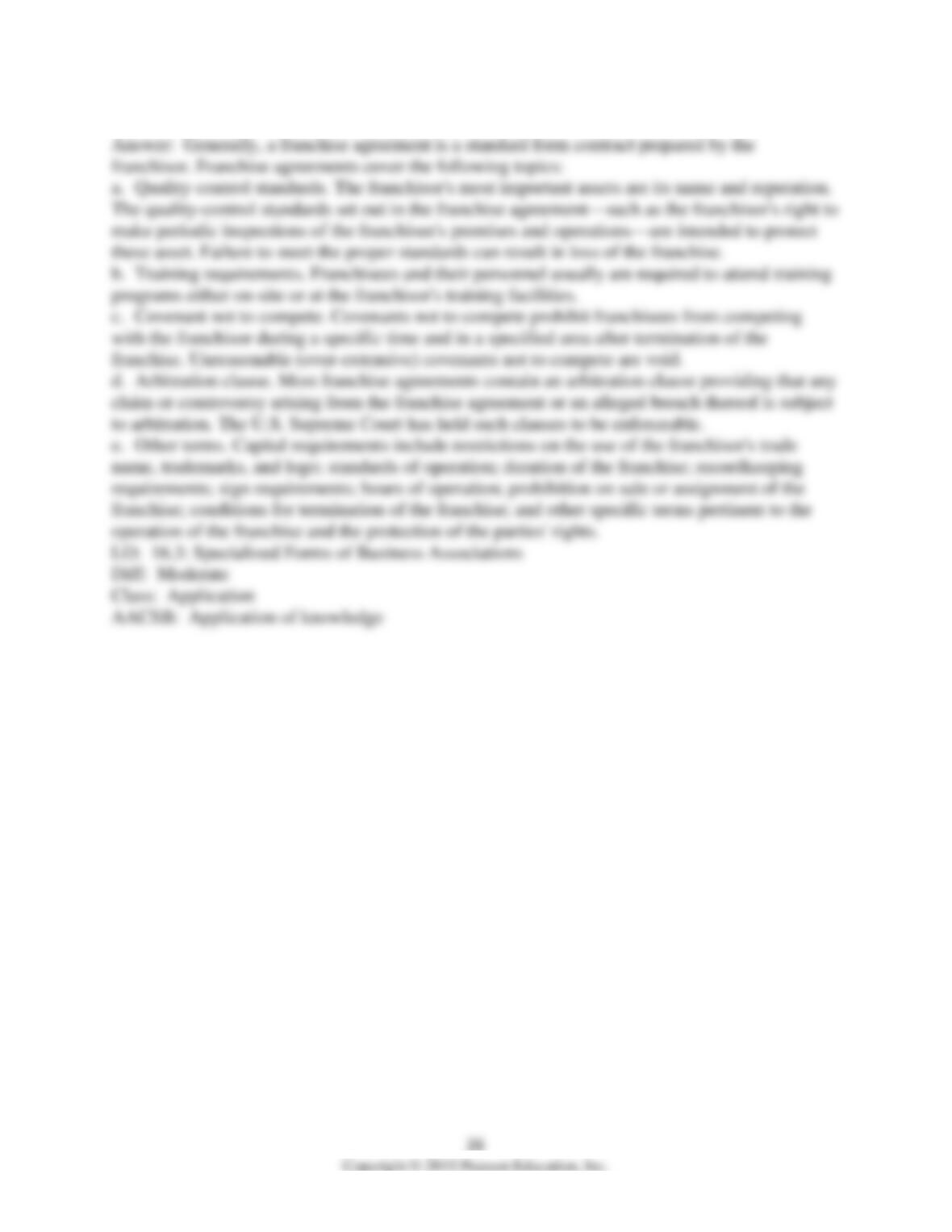
88) Discuss the terms of a franchise agreement.
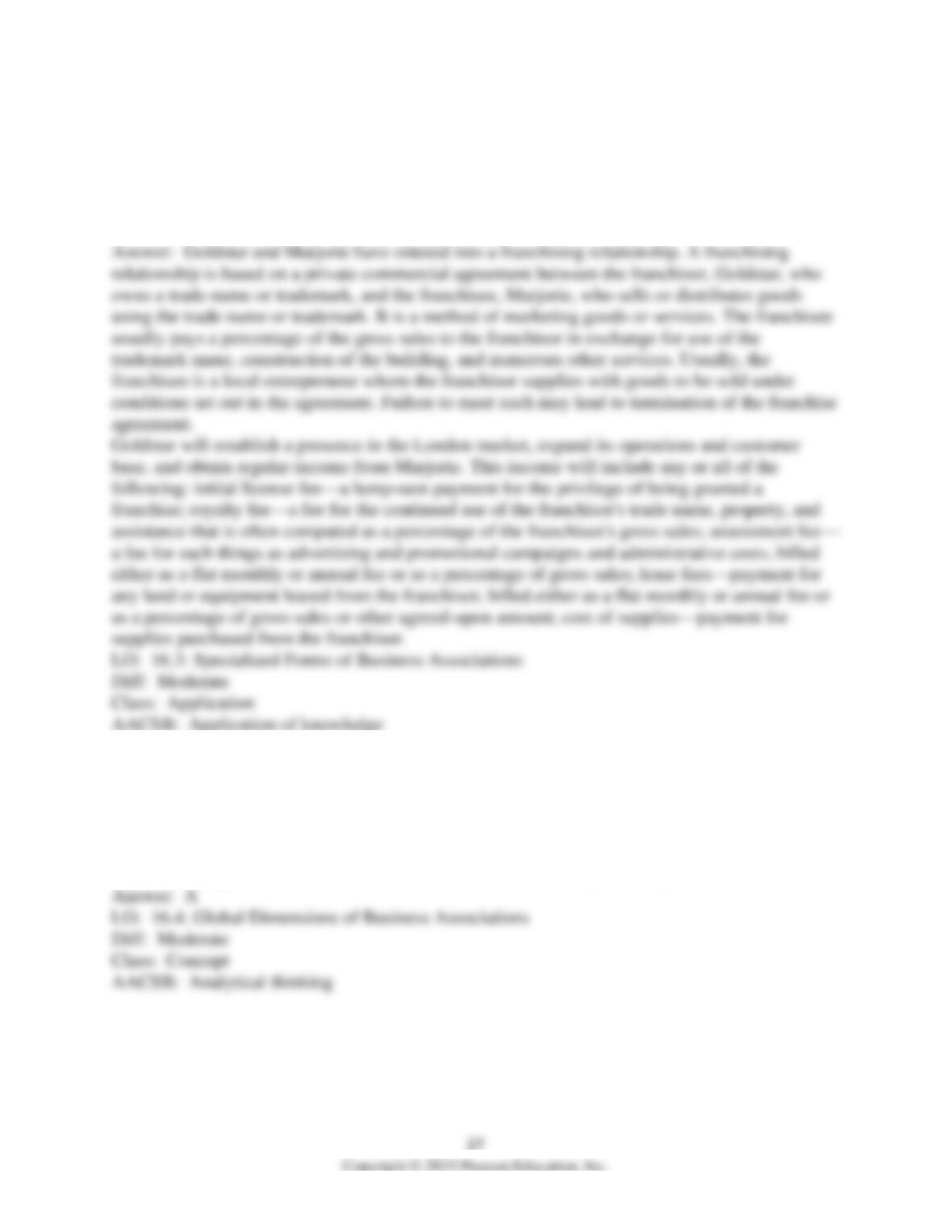
89) Goldstar Hair Fashions, Inc. (Goldstar), a famous beauty salon chain based in the United
States, plans to expand its business overseas. It decides to open a salon in London. Due to the
prohibitive costs of doing so, it allows a local entrepreneur, Marjorie, to provide beauty services
under its trade name. However, any failure to conform to Goldstar’s standards of services on the
part of Marjorie will result in termination of the agreement. Identify the type of agreement
between Goldstar and Marjorie. How will Goldstar benefit from this agreement?
90) Which of the following is not a pertinent question in deciding whether to expand a business
internationally?
A) Can the United States’ power of eminent domain be exercised in the host country?
B) Is there a demand for the product in the targeted country or countries?
C) Are there legal obstacles in the targeted country that should be carefully considered?
D) Is managing an international business at a distance a realistic possibility for the firm?
91) Which of the following is not a pertinent question in deciding whether to expand a business
internationally?
A) Will management be able to deal successfully with currency fluctuations?
B) Is the risk of political interference by the target country’s government too great to make doing
business in that country worthwhile?
C) Is there a serious risk of nonperformance, nonpayment, or loss of property or freight in the
country or region the firm is considering entering?
D) Does the Privileges and Immunities Clause of the U.S. Constitution apply to the subject
expansion, and if so, to what extent?
92) If management should decide to expand its business internationally, it should determine the
optimal level of global involvement by answering all but which of the following questions?
A) Should the firm directly export to another firm in the target country, or should it hire an
export trading company to market its products?
B) Should the firm license the use of it products under an international licensing agreement?
C) Should the firm go international by joint venture, merger, or acquisition?
D) Should the firm exercise its power of condemnation, and if so, to what extent?
93) ________ franchising is a form of licensing in which franchisees in the targeted countries are
allowed to use the franchisor’s name in exchange for a percentage of the gross profits.
A) Profit-sharing
B) Targeted
C) International
D) Multinational
94) The increase in ________ of manufacturing jobs brought into focus a dilemma for private-
and public-sector companies in developed nations worldwide: the advantage of cost-savings on
goods and services versus the disadvantage of the loss of domestic jobs.
A) outsourcing
B) in-sourcing
C) elasticity
D) obsolescence
95) Which of the following parties in the United States would be most likely to favor
outsourcing?
A) a registered Democrat
B) a union member
C) a multinational corporation
D) a manufacturing worker
96) Which of the following is a problem posed by outsourcing to private-sector companies?
A) loss of jobs in domestic market
B) increased interference of politicians because of their support
C) increased cost of manufacturing goods
D) decreased exports to developing countries
97) Targeted franchising is a form of licensing in which franchisees in the targeted countries are
allowed to use the franchisor’s name in exchange for a percentage of the gross profits.
98) In deciding whether to take the “plunge” into international “waters,” managers of businesses
need to ask whether they will be able to deal successfully with currency fluctuations.
99) What initial questions are relevant in terms of deciding whether to “take the plunge” into
international “waters”; in other words, what are the relevant preliminary inquiries to make in
deciding whether to expand internationally?
100) Explain the dilemmas faced by businesses with regard to outsourcing.