Chapter 14
Mistakes, Fraud, and
Voluntary Consent
N.B.: TYPE indicates that a question is new, modified, or unchanged, as follows.
N A question new to this edition of the Test Bank.
+ A question modified from the previous edition of the Test Bank.
= A question included in the previous edition of the Test Bank.
TRUE/FALSE QUESTIONS
B1. A mistake of fact cannot be bilateral.
B2. Only a mistake in value will make a contract voidable.
B3. Even if an obvious, significant clerical error exists in a written contract, the contract is
enforceable.
B4. A unilateral mistake occurs when only one contracting party is mistaken about a
material fact.

B5. Generally, a unilateral mistake affords the mistaken party a right to relief from the
contract.
B6. If the subject matter of a contract turns out to be more valuable than one of the
parties believed it would be, that party can rescind the contract.
B7. An innocent party can rescind a fraudulent contract.
B8. An innocent party may seek damages for a fraudulent contract.
B9. To recover for fraud, a plaintiff must be under twenty-one years of age.
B10. To reform a contract is to rescind it.
B11. Reliance on an “expert’s” statement of opinion may be the basis for an action based
on fraud.
B12. A seller’s failure to disclose a serious defect about a product for sale may give rise to
an action for fraud.
B13. Misrepresentation of a material fact can occur through conduct alone.
B14. Misrepresentation of a material fact cannot occur by silence.
B15. Scienter refers to a material fact’s scientific basis.
B16. An innocent misrepresentation is not a basis for rescinding a contract.
B17. Justifiable reliance is an element of fraud.
B18. A contract entered into under undue influence is voidable.
B19. Forcing someone to enter into a contract through fear created by threats is undue
influence.
B20. A contract is termed an adhesion contract when both parties adhere to it.
MULTIPLE CHOICE QUESTIONS
B1. Rowan, a famous chef, sells to Patricia a restaurant that Rowan closed years ago.
Patricia discovers in the restaurant a collection of Rowan’s recipes, which are
considered valuable. In a suit to obtain the recipes, Rowan will likely
a. lose because he should have known the recipes were in the restaurant.
b. lose because the sale of a restaurant includes everything in it.
c. win because there was no voluntary consent to the sale of the recipes.
d. win because the sale of a restaurant includes nothing in it.
Fact Pattern 14-B1 (Questions B2–B3 apply)
Gert contracts to sell two tracts of land to Hank. Both parties believe that the two tracts are
adjacent, but in fact they are not. Gert is still willing to sell the land, but under these
circumstances the deal would adversely affect Hank.
B2. Refer to Fact Pattern 14-B1. The parties’ belief about the adjacency of the property is
a. a bilateral mistake.
b. a fraudulent misrepresentation.
c. a unilateral mistake.
d. unconscionable.
B3. Refer to Fact Pattern 14–B1. Because of the parties’ belief about the adjacency of the
property, their contract is
a. unavoidable.
b. unconscionable.
c. unenforceable.
d. voidable.
B4. Urban City and Thru-way Construction Company enter into a contract that includes
calculations. Urban, whose engineer, Sergei, compiled the figures, discovers later that
some numbers were added incorrectly, but Thru-way refuses to make changes. Urban
can
a. not rescind the contract.
b. rescind the contract on the basis of fraud.
c. rescind the contract on the basis of mistake.
d. rescind the contract on the basis of economic duress.
Fact Pattern 14-B2 (Questions B5-B6 apply)
Nano Corporation offers to sell a robotic device to Motor Assembly, Inc., but mistakenly
transposes some of the digits in the price so that $15,400 appears in the offer as $14,500.
Motor accepts the written offer.
B5. Refer to Fact Pattern 14-B2. Motor’s best argument in favor of enforcement of the
contract is that
a. a bilateral mistake does not afford relief from a contract.
b. a mistake of value does not afford relief from a contract.
c. a unilateral mistake does not afford relief from a contract.
d. the price was below the prices of comparable devices.
B6. Refer to Fact Pattern 14-B2. Nano’s best defense against enforcement of the contract
is that Opal knew
a. a bilateral mistake supports the cancellation of a contract.
b. a mistake of value supports the cancellation of a contract.
c. a unilateral mistake supports the cancellation of a contract.
d. the price was below the prices of comparable devices.
B7. At an auction for the first time, Max bids on an object, believing that it is worth more
than the price asked. When the item proves to be less valuable, Max is
a. liable on the bid.
b. not liable on the bid because Max misestimated the value.
c. not liable on the bid because the auctioneer misstated the value.
d. not liable on the bid because the object was probably overpriced.
B8. Lew believes an old comic book he owns has little value, but Murray is convinced it is
a valuable collector’s item. Lew sells it to Murray for $10 before learning it is worth
$1,000. Lew can
a. not rescind the contract.
b. rescind the contract on the basis of fraud.
c. rescind the contract on the basis of mistake.
d. rescind the contract on the basis of puffery.
B9. Genie.com initiates an online dating service. To attract subscribers and encourage
participation, Genie.com creates and posts profiles of fictitious persons and
exaggerated profiles of actual users. Fooled by the false profiles, Ham buys a
subscription. He is most likely a victim of
a. undue influence.
b. fraud.
c. mistake.
d. nothing.
B10. Cooper offers to sell Gable his sport utility vehicle (SUV) and says that it has never
been in an accident. Relying on Cooper’s statement, Gable buys the SUV. Later, when
it develops mechanical problems, Gable can
a. not rescind the contract.
b. rescind the contract on the basis of fraud.
c. rescind the contract on the basis of mistake.
d. rescind the contract on the basis of puffery.
B11. Kurt persuades Leo to buy his bicycle by telling Leo that the bike rides “like the wind.”
Kurt’s statement is
a. duress.
b. fraud.
c. puffery.
d. undue influence.
B12. Roc buys a farm from Steve, who claims that it would be a prime site for a housing
subdivision. Roc later learns that the law does not permit the land to be used for
housing. Roc may
a. not rescind the contract.
b. rescind the contract only if Roc did not know the law before the deal.
c. rescind the contract only if Steve knew about the law before the deal.
d. rescind the contract only if the law is not common knowledge.
B13. Yvon, a golf pro, convinces Zach, who has no athletic ability, that he has considerable
talent and induces him to pay Yvon $10,000 for golf lessons. When Zach realizes the
truth, he files a suit against Yvon. Zach is most likely to recover on the basis of
a. duress.
b. misrepresentation.
c. unconscionability.
d. none of the choices.
B14. Flem sells an all-terrain, off-road vehicle to Esteban without disclosing that the
odometer, which reads 30,000 miles, was disconnected 50,000 miles ago. Flem is
most likely liable for
a. duress.
b. fraud.
c. mistake.
d. nothing.
Fact Pattern 14-B3 (Questions B15–B16 apply)
In selling a house, Robin tells Destry that the wiring and plumbing are of a certain quality.
Robin knows nothing about the quality, but it is not as she specifies. Destry buys the house.
B15. Refer to Fact Pattern 14-B3. On learning the truth, Destry confronts Robin, who says
she was not trying to fool him—she was only trying to make a sale. This is
a. a mistake of value.
b. fraud.
c. innocent misrepresentation.
d. unconscionable.
B16. Refer to Fact Pattern 14-B3. Under these circumstances, Destry’s best course of action
is most likely to
a. scam Robin.
b. induce Robin to give him the commission on her next sale.
c. recover damages or rescind the contract to buy the house.
d. sabotage Robin’s career with bad publicity.
B17. Dale files a suit against Eve, alleging her fraud in entering into a contract with him.
Proof of an injury is required
a. to recover damages.
b. to rescind the contract.
c. to undo Eve’s influence.
d. under no circumstances.
B18. Safron threatens physical harm—“you don’t want anything to happen to you or your
family”—to force Tivoli to sell his business, Umbrellas Unlimited, Inc., to Safron for a
below-market price. This is
a. a mistake of value.
b. duress.
c. fraud.
d. undue influence.
Fact Pattern 14-B4 (Questions B19-B20 apply)
Pete, the owner of Quality Orchards, contracts to sell fruit to Ripe Produce, Inc. When Pete
refuses to perform, Ripe Produce files a suit to enforce the contract.
B19. Refer to Fact Pattern 14-B4. To defend successfully on the ground of uncon-
scionability, Pete must show that enforcement of the contract would be
a. economically meaningless.
b. legally worthless.
c. manifestly unfair or oppressive.
d. undeniably valuable.
B20. Refer to Fact Pattern 14-B4. If Pete and Ripe Produce are in a state that does not
recognize the doctrine of unconscionability, to defend successfully against enforce-
ment of the contract on similar grounds, Pete might rely on traditional notions of
a. fraud.
b. materiality.
c. mistake.
d. unconscionability.
ESSAY QUESTIONS
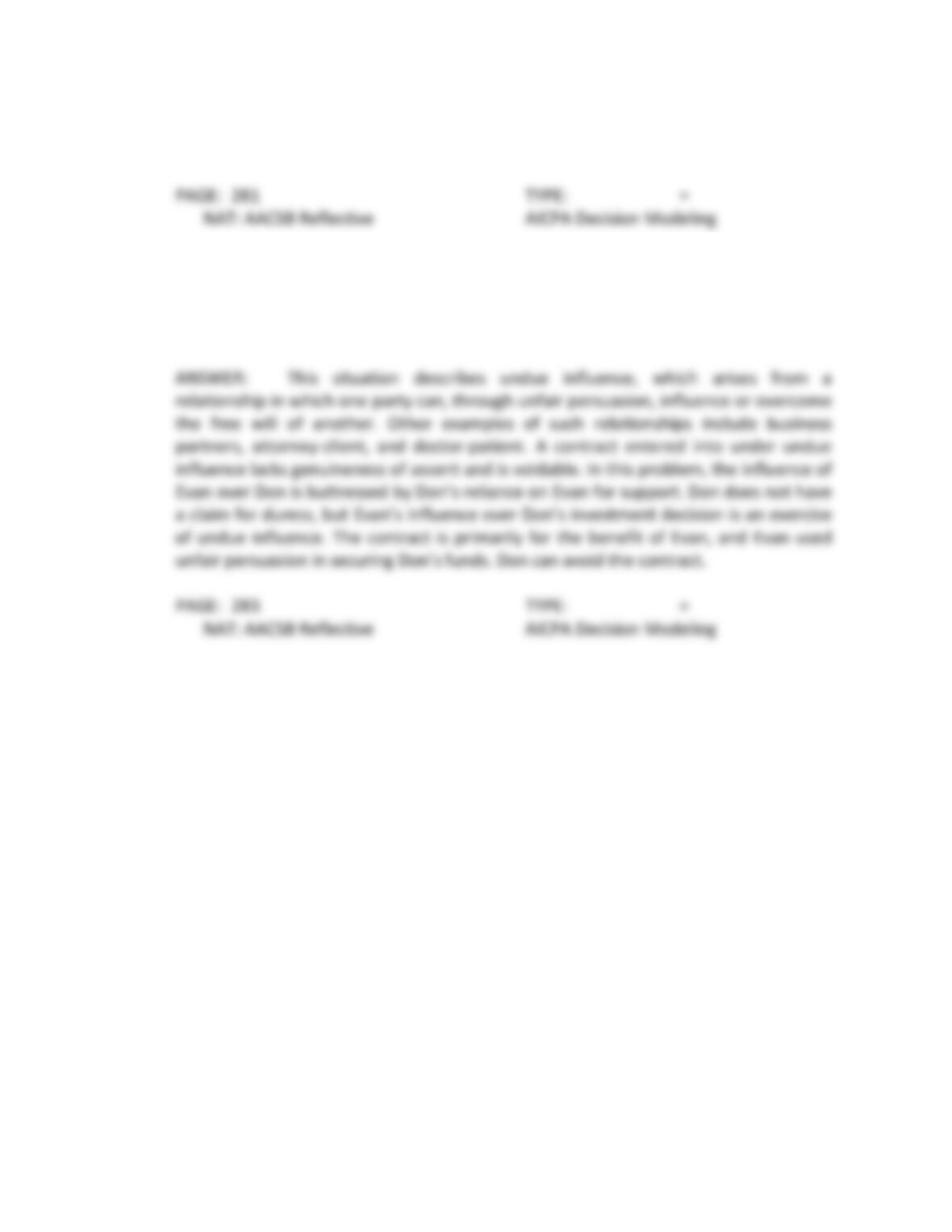
B1. Ben, an accountant, certifies several audit reports on Corporate Business, Inc. (CBI),
Ben’s client, knowing that CBI intends to use the reports to borrow money from Delta
Credit Company. Ben believes that the reports are true and does not intend to deceive
Delta, but does not check the reports before certifying them. Can Ben be held liable to
Delta?
B2. Don is an elderly man who lives with his nephew Evan. Don is dependent on Evan for
support. Evan advises Don to “invest” in Evan’s “professional gambling” venture, or
Evan will no longer support him. Don liquidates his other investments and signs a
contract with Evan, to whom Don gives the funds. Can Don set aside this contract?