Chapter 14
Mistakes, Fraud, and
Voluntary Consent
N.B.: TYPE indicates that a question is new, modified, or unchanged, as follows.
N A question new to this edition of the Test Bank.
+ A question modified from the previous edition of the Test Bank.
= A question included in the previous edition of the Test Bank.
TRUE/FALSE QUESTIONS
A1. If the parties to a contract attach materially different meanings to a contract term, the
contract cannot be rescinded.
A2. A contract is always enforceable even if one party is aware that the other party made
a mistake of fact.
A3. If a price quotation contains a mistake in the adding of a number of figures, the
contract may not be enforceable.
A4. A mistake of fact cannot be unilateral.
A5. Overestimating the value of an object is a mistake for which a court will normally
provide relief.
A6. An innocent party can enforce a fraudulent contract.
A7. Misrepresentation of a material fact is an element of fraud.
A8. A statement of opinion is generally subject to a claim of fraud.
A9. Reliance on a non-expert’s statement of opinion will not normally entitle a party to
relief.
A10. Reformation is a remedy in which the terms of a contract are altered to reflect the
true intentions of the parties.
A11. An expert’s false statement to a naive buyer about a technical detail will not usually
entitle the buyer to rescind a contract.
A12. Misrepresentation of a material fact cannot occur through words alone.
A13. Misrepresentation of a material fact cannot occur through conduct alone.
A14. Intent to deceive is an element of fraud.
A15. In effect, negligent misrepresentation is treated as fraudulent misrepresentation.
A16. Reliance on a misrepresentation is justified if the misrepresentation is an obviously
extravagant statement.
A17. To rescind a contract for fraud, a plaintiff must prove an injury.
A18. Forcing someone to enter into a contract through fear created by threats is duress.
A19. Economic need generally is sufficient to constitute duress.
A20. A contract written exclusively by one party and presented to the other party on a
take-it-or-leave-it basis is an adhesion contract.
MULTIPLE CHOICE QUESTIONS
A1. Jill and Karl contract for the sale of Jill’s horse for $1,000. Unknown to either party,
the horse has died. Karl is
a. entitled to another horse of equivalent value.
b. not required to pay due to the mutual mistake.
c. not required to pay due to the unilateral mistake.
d. required to pay because she assumed the risk the horse might die.
Fact Pattern 14–A1 (Questions A2–A3 apply)
Linea, an employee of Hard Labor Industries (HLI), is injured in a work-related accident. Based
on the diagnosis of Newt, a doctor, Linea accepts $50,000 from HLI and waives the right to
future claims. Newt’s diagnosis later proves to have been wrong.
A2. Refer to Fact Pattern 14-A1. In terms of the impact on Linea’s agreement with HLI,
Newt’s misdiagnosis is
a. a mistake of fact.
b. an expert’s puffery.
c. innocent misrepresentation.
d. negligent misrepresentation.
A3. Refer to Fact Pattern 14-A1. Most likely, Linea may
a. obtain damages from HLI.
b. obtain damages from Newt.
c. recover nothing.
d. set aside the settlement with HLI.
A4. Danton, a popular performer, dies. His spouse Caitlin sells their house to Buck. Un–
known to Caitlin or Buck, in one of the closets is the master recording of an
unreleased album. With respect to this recording, Buck can
a. keep it because Caitlin should have known about it.
b. keep it because the sale of a house includes everything in it.
c. not keep it because there was no voluntary consent to its sale.
d. not keep it because the sale of a house includes nothing in it.
Fact Pattern 14–A2 (Questions A5–A6 apply)
Moore Properties, Inc., offers in writing to sell to New Development Corporation (NDC) a
certain half-acre of land for “$112,000.” After New Development signs the offer in
acceptance and returns it, Moore discovers that the price should have been stated as
“$121,000.”
A5. Refer to Fact Pattern 14-A2. Moore’s misstatement of the price is
a. a bilateral mistake.
b. a fraudulent misrepresentation.
c. a unilateral mistake.
d. unconscionable.
A6. Refer to Fact Pattern 14-A2. The effect of Moore’s misstatement of the price will most
likely fall on
a. Moore and NDC, who must split the difference.
b. Moore only.
c. NDC only.
d. neither Moore nor NDC.
A7. Crosscreek County and Bridgework Corporation enter into a construction contract that
includes mathematical specifications. Later Crosscreek, whose engineer, Damon,
compiled the specs, learns that some of the dollar figures are incorrect. Bridgework
refuses to agree to changes. A court would most likely
a. award damages to both parties for the mistakes.
b. order Damon to be discharged for fraud.
c. enforce the contract without requiring changes.
d. reform the contract to reflect the figures accurately.
A8. Sylvia creates a profile for Today’s Date, Inc., an online dating service. She exaggerates
her appealing features and posts a photo of her friend Uva, whom Sylvia thinks is
prettier. Enticed by the profile, Van subscribes to the service so that he can contact
Sylvia. Van is most likely a victim of
a. undue influence.
b. fraud.
c. mistake.
d. nothing.
A9. May is a stockbroker. Due to May’s statements, Nora believes that the price of OK
Goods, Inc. (OKGI), a widely traded stock, is going to increase substantially. Nora buys
500 shares of OKGI at $10 per share, but the price soon drops to $2. Nora can
successfully recover
a. nothing.
b. the amount of the purchase price.
c. the amount of the purchase price plus the expected increase.
d. the amount of the purchase price plus the unexpected decrease.
A10. Gina induces Hu to enter into a contract for the purchase of a condominium about
which Gina knowingly misrepresents a number of material features. When Hu
discovers the truth, Hu can
a. not rescind the contract.
b. rescind the contract on the basis of fraud.
c. rescind the contract on the basis of mistake.
d. rescind the contract on the basis of undue influence.
A11. In selling paving stones to Yard & Garden Supply, Trey tells Yard & Garden’s buying
representative that the stones are “soft as carpet.” This is
a. adhesion.
b. fraud.
c. mistake.
d. puffery.
A12. Olin, a professional artist and art teacher, convinces Plato, who has no artistic ability,
that he has considerable talent and induces him to pay Olin $10,000 for art lessons.
When Plato realizes the truth, he files a suit against Olin. Plato is most likely to recover
on the basis of
a. fraud.
b. mistake.
c. undue influence.
d. none of the choices.
A13. Bret is convicted of arson for burning down his warehouse to collect the insurance. On
an application for insurance from Cover-All Insurance Company on a new building, in
answer to a question about prior convictions, Bret does not disclose his conviction.
This makes the contract
a. binding because the omission is immaterial to Cover-All’s decision to issue
coverage.
b. binding due to Cover-All’s failure to discover Bret’s conviction.
c. voidable by Bret because the omission is immaterial to Cover–All’s decision to
issue coverage.
d. voidable by Cover-All because the omission is material to its decision to issue
coverage.
A14. Nero makes an honest but erroneous statement that misrepresents a material fact in
a contractual transaction with Odell. Nero is guilty of
a. a unilateral mistake.
b. duress.
c. fraud.
d. innocent misrepresentation.
A15. Veronica offers to sell Rowena her luxury sedan and says that it has never been in an
accident. Rowena hires Laszlo, a mechanic, to appraise the vehicle. Laszlo says that it
most likely has been in an accident. In spite of this information, Rowena buys the car.
Later, when it develops mechanical problems, she can
a. not rescind the contract.
b. rescind the contract on the basis of fraud.
c. rescind the contract on the basis of mistake.
d. rescind the contract on the basis of unconscionability.
Fact Pattern 14–A3 (Questions A16–A17 apply)
Flip, an accountant, certifies an audit for Erstwhile Corporation, Flip’s client, knowing that
Erstwhile will use the audit to obtain a loan from Deepwater Bank. Flip believes that the audit
is true and does not intend to deceive the bank, but does not check the audit before
certifying it.
A16. Refer to Fact Pattern 14-A3. On learning the truth, Deepwater’s chief loan officer
confronts Flip, who says, “I didn’t know.” This is
a. a mistake of value.
b. innocent misrepresentation.
c. negligent misrepresentation.
d. unconscionable.
A17. Refer to Fact Pattern 14-A3. Under these circumstances, Deepwater’s best course of
action is most likely to
a. exert economic duress on Flip to retire from accounting.
b. rescind the loan on the ground of unconscionability.
c. recover damages from Flip for any loss on the loan.
d. undercut Flip’s career with negative puffery.
A18. Cartier, an accountant, convinces his client Bianca to sign a contract to invest her
savings in a nonexistent social-networking Web site. When Bianca learns the truth,
she can
a. impose her own scam on Cartier without liability.
b. induce Cartier to give her his other clients’ funds without recourse.
c. rescind the contract to invest in the Web site.
d. sabotage Cartier’s career in any way possible.
A19. Gary threatens physical harm to force Hugh to sell his business, Imports from Asia,
Inc., to Gary for a below-market price. This is
a. duress.
b. fraud.
c. puffery.
d. undue influence.
A20. Sam uses duress to force Tanya to agree to pay him for protecting her retail store—
Tanya’s Trends—against vandalism and destruction. Tanya may
a. avoid the contract or choose to carry it out.
b. do nothing once she has agreed to pay.
c. recover from her insurer for the cost
d. recover from the local police for a failure to protect her store.
ESSAY QUESTIONS
A1. Alpha Investments, Inc., offers to buy Beta Computer Corporation. On May 1, Beta
gives Alpha copies of Beta’s financial statements for the previous year. The
statements show an inventory of $1 million. On May 15, Beta discovers that the
previous year’s inventory is overstated by $500,000, but does not inform Alpha. On
June 1, Alpha, relying on the financial statements, buys Beta. On June 10, Alpha
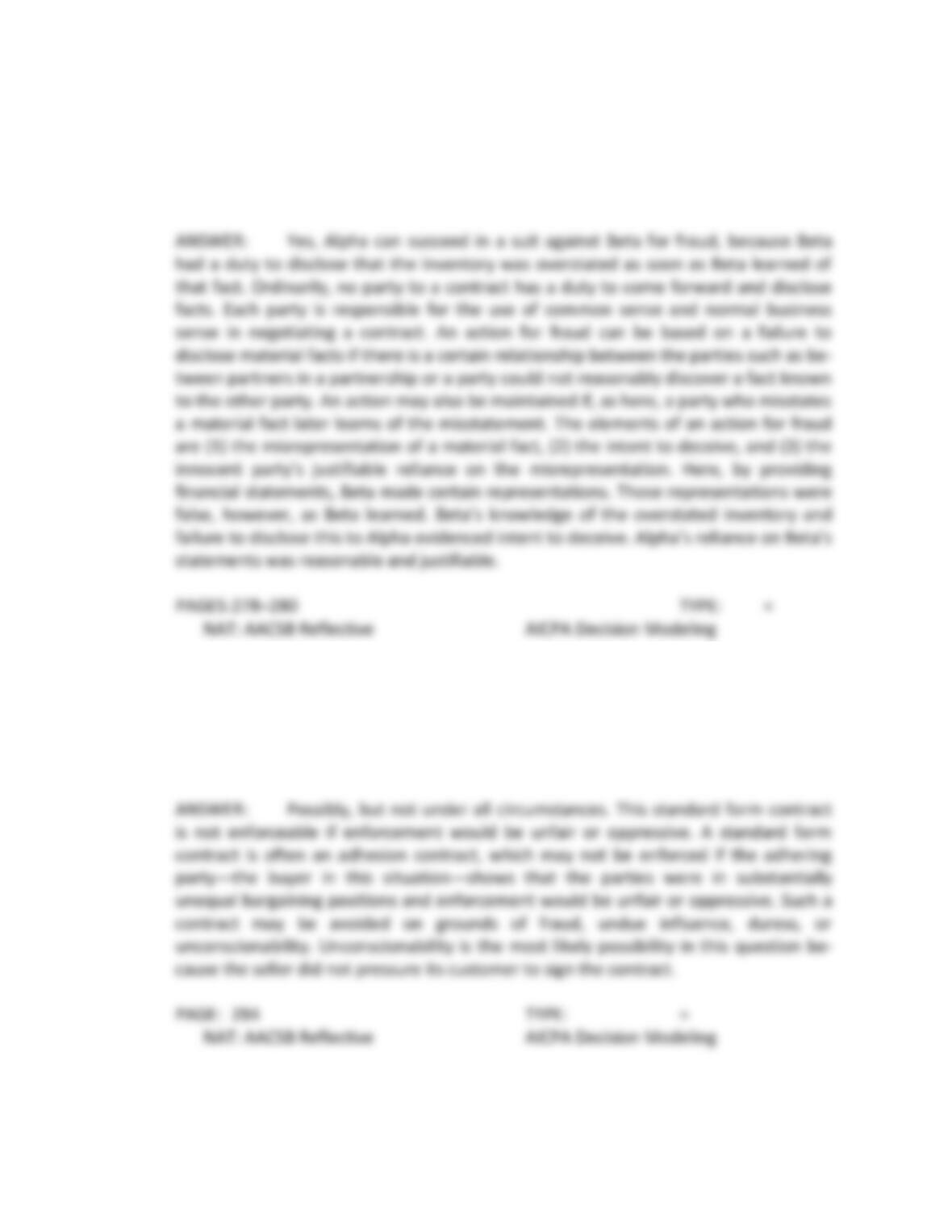
discovers the inventory overstatement. Can Alpha succeed in a suit against Beta for
fraud?
A2. Eagle Properties, a real estate investment and sales firm, presents a form contract to
its customer Floyd, who wants to buy a certain quarter acre of land in a proposed
housing subdivision that Eagle is marketing. Eagle does not pressure Floyd to sign a
contract, but offers its form on a take–it–or-leave basis. If Floyd signs the form, is it
enforceable?