
Chapter 12: Structuring the Deal:
Tax and Accounting Considerations
Answers to End of Chapter Discussion Questions
12.1 When does the IRS consider a transaction to be non-taxable to the target firm’s shareholders? What is the
justification for the IRS’ position?
12.2 What are the advantages and disadvantages of a tax-free transaction for the buyer? Be specific.
12.3 Under what circumstances can the assets of the acquired firm be increased to fair market value when the
transaction is deemed a taxable purchase of stock?
12.4 What is goodwill and how is it created?

12.5 Under what circumstances might an asset become impaired? How might this event affect the way in which
acquirers bid for target firms?
12.6 Why do boards of directors of both acquiring and target companies often obtain so–called “fairness
opinions” from outside
investment advisors or accounting firms? What valuation methodologies might be employed in
constructing these opinions? Should stockholders have confidence in such opinions? Why/why not?
12.7 Archer Daniel Midland (ADM) wants to acquire AgriCorp to augment its ethanol manufacturing capability.
AgriCorp wants the transaction to be tax–free for its shareholders. ADM wants to preserve AgriCorp’s
significant investment tax credits and tax loss carryforwards so that they transfer in the transaction. Also,
ADM plans on selling certain unwanted AgriCorp assets to help finance the transaction. How would you
structure the deal so that both parties’ objectives could be achieved?
12.8 Tangible assets are often increased to fair market value following a transaction and depreciated faster than
their economic lives. What is the potential impact on post-transaction EPS, cash flow, and balance sheet?
12.9 Discuss how the form of acquisition (i.e., asset purchase or stock deal) could impact the net present value or
internal rate of return of the deal calculated post-closing.
12.10 What are some of the important tax-related issues the boards of the acquirer and target companies may need
to address prior to entering negotiations? How might the resolution of these issues impact the form of
payment and form of acquisition?
Solutions to Practice Problems and Exercises
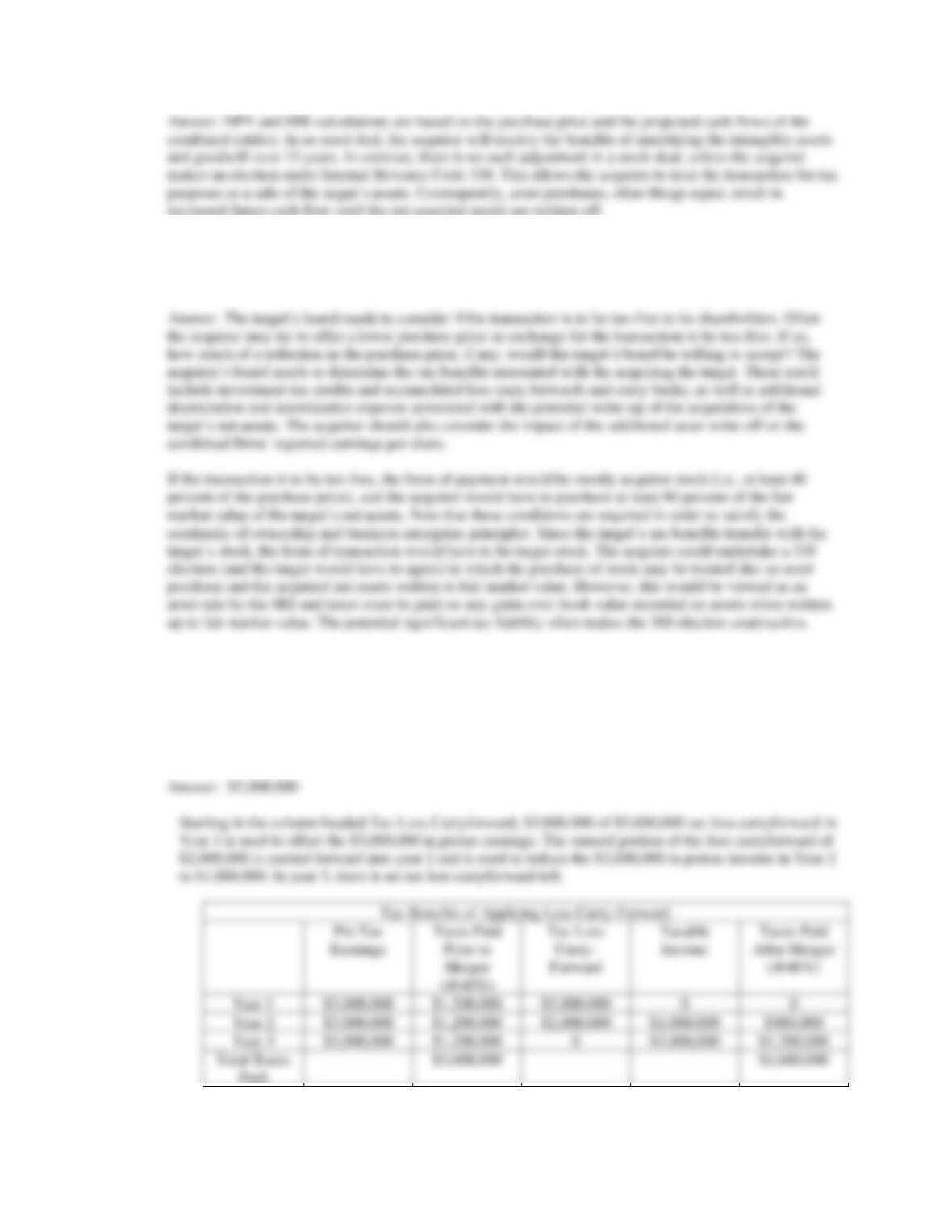
12.11 Target Company has incurred $5,000,000 in losses during the past 3 years; Acquiring Company anticipates
pre-tax earnings of $3,000,000 in each of the next 3 years. What is the difference between total taxes that
would have been paid before the merger compared to actual taxes paid by the Acquiring Company after the
merger assuming a marginal tax rate of 40 percent? Show your work.

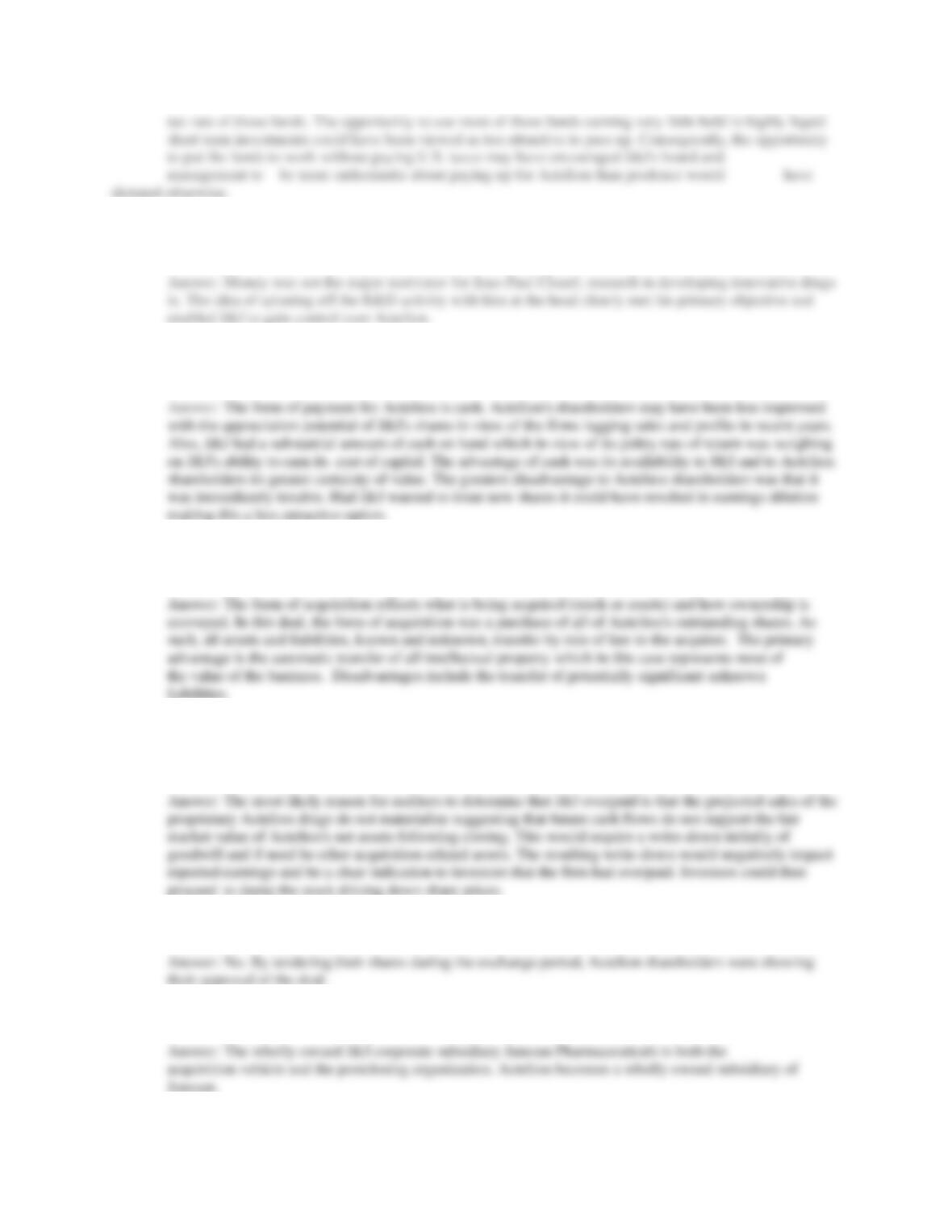
12.12 Acquiring Company buys 100% of Target Company’s equity for $5,000,000 in cash. As an analyst, you
are given the following pre-merger balance sheets for the two companies. Assuming plant and equipment
is
revalued upward by $500,000, what will be the combined companies’ shareholders’ equity plus total
liabilities? What is the difference between Acquiring Company’s shareholders’ equity and the shareholders’
equity of the combined companies? Show your work.
Balance Sheets (Dollars)
Acquiring Company
Target Company
Current Assets
600,000
800,000
Plant and Equipment
1,200,000
1,500,000
Total Assets
1,800,000
2,300,000
Long-Term Debt
500,000
300,000
Shareholders’ Equity
1,300,000
2,000,000
Shareholders’ Equity +
Total
Liabilities
1,800,000
2.300,000
Solutions to Chapter Case Study Questions
Johnson & Johnson Places a Big Bet on Biopharmaceutical Company Actelion
Discussion Questions and Answers:
1. Speculate as to how J&J’s overseas cash hoard may have influenced the purchase price paid for Actelion.
Balance Sheets (Dollars)
Current Assets
Plant and Equipment
Goodwill
Total Assets
Debt
Equity
2. How did the deal structure involving a spin-off of the Actelion‘s R&D organization make the takeover of
Actelion possible?
3. What is the form of payment in this deal? Why might this form have been selected? What are the
advantages and disadvantages of the form of payment used in this deal?
4. What is the form of acquisition used in this deal? Why might this form have been chosen? What are the
advantages and disadvantages of the form of acquisition?
5. Assume it is determined by auditors during the next several years that J&J overpaid significantly for
Actelion. What is the most likely reason this determination could happen? How could this impact the firm’s
reported earnings per share and in turn its share price? Be specific.
6. Did the sale of Actelion require a vote by the firm’s shareholders? Explain your answer.
7. What are the acquisition vehicle and postclosing organization in this transaction?

1. Taxes are an important consideration in almost any transaction, and they are often the primary motivation
for an acquisition.
True or False
2. From the viewpoint of the seller or target company shareholder, transactions may be tax–free or entirely or
partially taxable.
True or False
3. The sale of stock, rather than assets, is generally preferable to the target firm shareholders to avoid double
taxation, if the target firm is structured as a limited liability company.
True or False
4. A transaction generally will be considered non–taxable to the seller or target firm’s shareholder if it
involves the purchase of the target’s stock or assets for substantially all cash, notes, or some other
nonequity consideration. True or False
5. In a triangular cash merger, the target firm may either be merged into an acquirer’s operating or shell
acquisition subsidiary with the subsidiary surviving or the acquirer’s subsidiary is merged into the target
firm with the target surviving.
True or False
6. A transaction is usually taxable to the target firm’s shareholders, if the acquirer’s stock is used to purchase
at least 30% of the target firm’s stock or assets. True or False
7. The major advantages of using a triangular structure are limitations of the voting rights of acquiring
shareholders and that the acquirer gains control of the target through a subsidiary without being directly
responsible for the target’s known and unknown liabilities. True or False
8. It is seldom important that the buyer and seller agree on the allocation of the sales price among the assets
being sold, since the allocation will determine the potential tax liability that would be incurred by the seller
but that could by passed on to the buyer through to terms of the sales contract. True or False
8. The form of payment does not affect whether a transaction is taxable to the seller’s shareholders. True or
False
10. If a transaction involves a cash purchase of target stock, the target company’s tax cost or basis in the
acquired stock or assets is increased or “stepped up” automatically to their fair market value (FMV), which
is equal to the purchase price paid by the acquirer.
True or False
11. In a cash purchase of assets. the target’s shareholders could be taxed twice, once when the firm pays taxes
on any gains and a second time when the proceeds from the sale are paid to the shareholders either as a
dividend or distribution following liquidation of the corporation.
True or False

12. Empirical studies generally show that the tax shelter resulting from the ability of the acquiring firm to
increase the value of acquired assets to their FMV is a highly important motivating factor for a takeover.
True or False
13. Taxable transactions usually involve the purchase of the target’s voting stock, because the purchase of
assets automatically will trigger a taxable gain for the target if the fair market value of the acquired assets
exceeds the target firm’s tax basis in the assets.
True or False
14. In a taxable purchase of target stock with cash, the target firm does not restate (i.e., revalue) its assets and
liabilities for tax purposes to reflect the amount that the acquirer paid for the shares of common stock.
Rather, the tax basis (i.e., their value on the target’s financial statements) of assets and liabilities of the
target before the acquisition carries over to the acquirer after the acquisition.
True or False
15. According to Section 338 of the U.S. tax code, a purchaser of 80% or more of the assets of the target may
elect to treat the acquisition as if it were an acquisition of the target’s assets for tax purposes.
True or False
16. The IRS generally views forward triangular cash mergers as a purchase of target stock followed by a
liquidation of the target for which target shareholders will recognize a taxable gain or loss as if they had
sold their shares.
True or False
17. Under purchase accounting, the difference between the combined firm’s shareholders’ equity immediately
following closing and the acquiring firm’s shareholders’ equity equals the purchase price paid for the target
firm.
True or False
18. Under purchase price accounting, the excess of the purchase price paid over the book value of equity of the
target firm is assigned only to the tangible assets up to their fair market value or to goodwill. True or False
19. Purchase accounting affects only the cash flow of the combined firms but not the reported net income.
True or False
20. As a general rule, a transaction is taxable to the target company shareholders if they receive the acquiring
firm’s stock and non-taxable if they receive cash. True or False
21. Tax free reorganizations generally require that all or substantially all of the target company’s assets or
shares be acquired in order to ensure that the acquiring firm has a continuing ownership interest in the
combined firms. True or False
22. Tax benefits that result from an acquisition should always be considered as among the most important
justification for paying a very high premium for the target firm. True or False

23. In a forward triangular merger, the target firm’s tax attributes in the form of any tax loss carry forwards or
carrybacks or investment tax credits carry over to the acquirer because the target ceases to exist. True or
False
24. The IRS treats the reverse triangular cash merger as a purchase of target shares, with the target firm,
including its assets, liabilities, and tax attributes, ceasing to exist. True or False
25. If the acquirer invokes a 338 election no taxes will have to be paid on any gains on assets written up to their
fair market value. True or False
26. With the purchase of target stock, the acquirer retains the target’s tax attributes, but there is no step up in
the basis of the acquired assets unless the acquirer adopts a 338 election. True or False
27. As a result of a 338 election, the IRS treats the purchase of target shares as a taxable purchase of assets
which can be stepped up to fair market value. Only the buyer has to agree to the 338 election. True or
False
28. In a purchase of assets, the buyer retains the target’s tax attributes. True or False
29. In a statutory merger, the buyer retains the target’s tax attributes. True or False
30. In a reverse triangular merger, the acquirer retains the target’s tax attributes. True or False
31. In a tax-free reorganization, the buyer is never required to get shareholder approval. True or False
32. Transactions may be partially taxable if the target shareholders receive some nonequity consideration, such
as cash or debt, in addition to the acquirer’s stock. True or False
33. Acquirers and targets planning to enter into a tax-free transaction seldom seek to get an advance ruling
from the IRS to determine its tax-free status. True or False
34. If the transaction is tax-free, the acquiring company is able to transfer or carry over the target’s tax basis to
its own financial statements. True or False
35. The tax-free structure is generally not suitable for the acquisition of a division within a corporation. True or
False.
36. To demonstrate continuity of interests (COI), target shareholders must continue to own a substantial part of
the value of the combined target and acquiring firms. True or False

37. Nontaxable transactions also are called tax-free reorganizations. True or False
38. Tax-free reorganizations generally require that all or substantially all of the target company’s assets or
shares be acquired. True or False
39. A buyer may divest a significant portion of the acquired company immediately following closing without
jeopardizing the tax-free status of the transaction. True or False
40. Tax-free reorganizations require that substantially all of the consideration received by the target’s
shareholders be paid in cash. True or False
41. Tax-free reorganizations require that substantially all of the consideration received by the target’s
shareholders be paid in common or preferred stock. True or False
42. Since the IRS requires that target shareholders continue to hold a substantial equity interest in the acquiring
company, the tax code defines what constitutes a substantial equity interest. True or False
43. Triangular mergers are rarely used for tax-free transactions. True or False
44. To qualify for a Type A reorganization, the transaction must be either a merger or a consolidation. True or
False
45. Type A reorganizations are generally viewed as the least flexible of the various types of tax-free
reorganizations. True or False
46. The acquirer must be careful that not too large a proportion of the purchase price be composed of cash,
because this might not meet the IRS’s requirement for continuity of interests of the target shareholders and
disqualify the transaction as a Type A reorganization. True or False
47. In a type B stock-for-stock reorganization, the acquirer must purchase an amount of voting stock that
comprises at least 50% of the voting power of all of the target’s voting stock outstanding. True or False
48. A type C reorganization is a stock-for-assets reorganization with the requirement that at least 50% of the
FMV of the target’s assets, as well as the assumption of certain specified liabilities, are acquired solely in
exchange for voting stock. True or False
49. The Type C reorganization is used when it is essential for the acquirer not to assume any undisclosed
liabilities. True or False
50. A forward triangular merger is the most commonly used form of reorganization for tax-free stock
acquisitions in which the form of payment is acquirer stock. It involves three parties: the acquiring firm,
the target firm, and a shell subsidiary of the target firm. True or False

51. Asset sales by the target firm just prior to the transaction may threaten the tax-free status of the deal.
Moreover, tax-free deals are disallowed within ten-years of a spin-off. True or False
52. The disadvantages of the forward triangular merger may include the requirement of the buyer to get
shareholder approval. True or False
53. A section of the U.S. tax code known as 1031 forbids investors to make a “like kind” exchange of
investment properties. True or False
54. To qualify for a 1031 exchange, the property must be an investment property or one that is used in a trade
or business (e.g., a warehouse, store, or commercial office building). True or False
55. Although NOLs represent a potential source of value, their use must be monitored carefully to realize the
full value resulting from the potential for deferring income taxes. True or False
56. Subchapter S Corporation shareholders, and LLC members, are taxed at their personal tax rates. True or
False
57. So-called Morris Trust transactions tax code rules restrict how certain types of corporate deals can be
structured to avoid taxes. True or False
58. Goodwill no longer has to be amortized over its projected life, but it must be written off if it is deemed to
have been impaired. Impairment reviews are to be taken annually or whenever the firm has experienced an
event which materially affects the value of its assets. True or False
59. For tax purposes, goodwill created after July 1993 may be amortized up to 15 years and is tax deductible.
Goodwill booked before July 1993 is also tax deductible. True or False
60. The sale of assets by a target firm will result in a taxable gain if the fair market value is less than the book
value? True or False
Multiple Choice (Circle only one)
1. Which of the following is not true about mergers and acquisitions and taxes?
a. Tax considerations and strategies are likely to have an important impact on how a deal is
structured by affecting the amount, timing, and composition of the price offered to a target firm.
b. Tax factors are likely to affect how the combined firms are organized following closing, as the tax
ramifications of a corporate structure are quite different from those of a limited liability company
or partnership.
c. Potential tax savings are often the primary motivation for an acquisition or merger.
d. Transactions may be either partly or entirely taxable to the target firm’s shareholders or tax-free.
b. None of the above
2. Which of the following is not true about purchase accounting?

a. For financial reporting purposes, all M&As must be recorded using the purchase method of
accounting.
b. Under the purchase method of accounting, the excess of the purchase price over the target’s net
asset value is treated as goodwill on the combined firm’s balance sheet.
c. Goodwill may be amortized up to 40 years.
d. If the fair value of the target’s net assets later falls below its carrying value, the acquirer must
record a loss equal to the difference.
e. None of the above
3. Which of the following is true about purchase accounting?
a. Cash and accounts receivable, reduced for bad debt and returns, are valued at their values on
the books of the target before the acquisition..
b. Marketable securities are valued at their realizable value after transactions costs.
c. Property, plant and equipment are valued at fair market value.
d. Intangible assets are booked at their appraised values.
e. All of the above.
4. Which of the following is not true about goodwill ?
a. Goodwill must be written off over 20 years.
b. Goodwill must be checked for impairment at least annually.
c. The loss of key customers could impair the value of goodwill.
d. Goodwill does not have to be amortized.
e. Goodwill is shown as an asset on the balance sheet.
5. Which of the following are not true of net operating loss carrybacks and carryforwards?
a. Net operating loss carrybacks enable firms to recover previous taxes paid.
b. Net operating loss carryforwards enable firms to shelter future taxable income.
c. Net operating loss carryforwards may be applied to income up to 5 years into the future.
d. Loss corporations” cannot use a net operating loss carry forward unless they remain viable and in
essentially the same business for at least 2 years following the closing of the acquisition.
e. None of the above
6. Which of the following is not considered a tax-free reorganization?
a. Type A transactions
b. Type B transactions
c. Type C Transactions
d. Forward triangular merger
e. Cash purchase of assets
7. Which of the following is not true of a 338 election ?
a. It applies to asset purchases only.
b. It applies to stock purchases only.
c. It allows a purchase of stock to be treated as an asset purchase for tax purposes.
d. The buyer must adopt the 338 election.
e. The seller must agree with the adoption of the 338 election.
8. Which of the following is not true of a forward triangular cash merger?
a. It is considered by the IRS as a purchase of target assets.
b. It is generally followed by a liquidation of the target firm.
c. Target shareholders must recognize a gain or loss as if they had sold their shares.

d. The target’s tax attributes carry over to the buyer.
e. Taxes are paid by the target firm on any gain on the sale of its assets and again by shareholders
who receive a liquidating dividend.
9. Which of the following is not true of purchase accounting?
a. Total purchase price paid for the target firm is reflected on the books of the combined companies
b. All liabilities are transferred at the NPV of their future cash payments
c. The cost of the acquired entity becomes the new basis for recording the acquirer’s investment in
the assets of the target company.
d. Goodwill equals the difference between the purchase price paid for the target firm and the book
value of acquired assets.
e. Goodwill must be reduced if it is believed to be impaired.
10. Which of the following is not true of taxable asset purchases?
a. Net operating losses carry over to the acquiring firm
b. The acquiring firm may step up its basis in the acquired assets.
c. The target firm is subject to recapture of tax credits and excess depreciation
d. Target firm shareholders’ are subject to a potential immediate tax liability
e. Target firm net operating losses and tax credits cannot be transferred to the acquiring firm
11. Which of the following is not true of a taxable purchase of stock?
a. Taxable transactions usually involve the purchase of the target’s voting stock with acquirer stock.
b. Taxable transactions usually involve the purchase of the target’s voting stock, because the
purchase of assets automatically will trigger a taxable gain for the target if the fair market value of
the acquired assets exceeds the target firm’s tax basis in the assets.
c. All stockholders are affected equally in a taxable purchase of assets.
d. The target firm does not pay any taxes on the transaction.
e. The effect of the tax liability will vary depending on the individual shareholder’s tax basis.
12. The tax status of the transaction may influence the purchase price by
a. Raising the price demanded by the seller to offset potential tax liabilities
b. Reducing the price demanded by the seller to offset potential tax liabilities
c. Causing the buyer to reduce the purchase price if the transaction is taxable to the target firm’s
shareholders
d. Forcing the seller to agree to defer a portion of the purchase price
e. Forcing the buyer to agree to defer a portion of the purchase price
13. Which of the following represent taxable transactions?
a. Purchase of assets with cash
b. Purchase of stock with cash
c. Purchase of stock or assets with cash
d. Statutory cash merger or consolidation
e. All of the above
14. Which of the following are true?
a. Taxes are important in any transaction.
b. Taxes should never be the overarching reason for the transaction.
c. Tax savings accruing to the buyer should simply reinforce the decision to acquire.
d. The sale of stock, rather than assets, is generally preferable to the target firm shareholders to avoid
double taxation, if the target firm is structured as a C corporation.

e. All of the above.
15. Which of the following are non-taxable transactions?
a. Statutory stock merger or consolidation
b. Stock for stock merger
c. Stock for assets merger
d. Triangular reverse stock merger
e. All of the above
16. Which of the following are required for an acquisition to be considered tax–free?
a. Continuity of interest
b. A legitimate business purpose other than tax avoidance
c. The use of predominately acquirer shares to buy the target’s shares
d. An all cash acquisition of the target firm’s shares
e. A, B, and C only
17. Which one of the following statements is true?
a. Target firm shareholders may accept cash or acquirer stock in exchange for their shares for the
transaction to be considered tax free
b. To be tax free, the target firm shareholders must receive acquirer firm shares for all of the target
firm’s shares outstanding
c. At least one-half of the assets of the target firm are recorded on the balance sheet of the acquirer at
their book rather than market value in a tax free transaction
d. If the assets of a firm are written up to fair market value as part of the transaction, the increase in
value is considered a taxable gain
e. Target firm shareholders are required by law to pay taxes on any writeup of the firm’s assets to
fair market value
18. Purchase accounting requires that
a. The excess amount paid for the target firm be recorded as an intangible asset on the books of the
acquirer and immediately written off
b. Target firm assets must be recorded on the acquirer’s balance sheet at their fair market value
c. The excess of the purchase price of the purchase price of the target firm must be recorded as asset
and expensed over a period of 10 years
d. Goodwill once established is never written off
e. Target firm liabilities are recorded on the balance sheet of the acquirer at their book value
19. For financial reporting purposes, goodwill resulting from an acquisition
a. Must equal the fair market value of the target firm’s assets
b. Immediately impacts the acquirer’s profits
c. Is expensed over 20 years
d. Is reviewed annually or whenever there is reason to believe it has lost value and amortized to the
extent its value has declined
e. Never affects the profits of the acquirer
Case Study Short Essay Examination Questions
INSIDE M&A: THE PLANNED PFIZER AND ALLERGAN MERGER
THWARTED BY CHANGING TAX REGULATIONS

_____________________________________________________________________________
Key Points:
• Different corporate tax rates among countries can distort the global M&A market.
• Frequent regulatory changes to close “loop holes” that should be done legislatively impede investment by
creating uncertainty in corporate boardrooms.
_____________________________________________________________________________________
While M&As rarely are undertaken solely for potential tax benefits, tax laws can sometimes distort the underlying
economic motives for doing deals. Tax laws (and regulations) distort corporate decision making. Current U.S.
corporate tax rates, the highest in the world, encourage U.S. corporations to relocate to countries offering
substantially more favorable tax rates. Corporations viewing taxes as any other operating expense have a fiduciary
responsibility to shareholders to pare costs to remain competitive.
According to the US Congressional Budget Office “The current (U.S.) tax system provides incentives for U.S.
firms to locate their production facilities in countries with low taxes…. (and) reduce economic efficiency …because
the firms are not allocating resources to their most productive use. Those responses also reduce the income of
shareholders and employees in the United States, and they lead to a loss of federal tax revenue…in the long run,
total compensation for U.S. workers is lower, and employment may be concentrated in different industries and
regions (even though total employment is not significantly affected.”1
On April 5, 2016, the Treasury announced new regulations, more far reaching than previous regulatory changes
in 2014 and 2015, aimed at “serial inverters” (i.e., companies that have grown through a succession of acquisitions
resulting in inversions). The new regulations consisted of two parts. First, the government would disregard U.S.
assets acquired by a foreign firm over the previous three years in determining the size of the firm. Second, the
government would have more leeway in determining whether moving cash within a consolidated company would be
viewed as intercompany lending or simply a transfer of equity. The government’s new rules would apply to all deals
that close after April 6, 2016 and all intercompany loans after that date. Companies that have already closed
inversion deals will be unaffected by the three-year rule, though transferring earnings from their U.S. subsidiaries to
their foreign parents could become less attractive.
The first part of the new rules deals with the determination of whether or not a firm engaging in a corporate
inversion can indeed be taxed at the lower foreign rate under current U.S. law. As of 2015, the U.S. Treasury
regulations applying to U.S. acquirers of foreign targets implementing corporate inversions focused on the
continuing percentage ownership stake of the acquirer’s shareholders following closing. If the continuing stake is
80% or more, earnings from U.S. operations are taxed at U.S. rates; between 60% and 80%, some portion of the
earnings are taxed at U.S. rates; below 60%, earnings are taxed at the foreign parent’s rate.
The second part is designed to reduce the attractiveness of what is often called “earnings stripping.” Foreign
parents can lend money to their U.S. subsidiary in a transaction that has no effect on the consolidated company’s
financial statements. However, interest paid by the subsidiary to the parent is tax deductible by the subsidiary,
reducing the subsidiary’s taxable income. This has the effect of transferring monies earned by the subsidiary to the
foreign parent to be counted as income to the parent and taxed at the parent’s lower tax rate. The new rules would
give the government more authority to treat those interest payments as dividend payments, which are not tax
deductible under U.S. law. The anti-earnings stripping rules aren’t just limited to inverted companies, but could hit
all companies based outside the U.S. that have operations inside the country.
What seems to have prompted the new regulations is one of the biggest takeovers in U.S. history. U.S.
based pharmaceutical giant Pfizer announced a planned merger with Dublin, Ireland based Allergan, the
maker of Botox, in late 2015. This megamerger would have been the biggest example an American
company shedding its U.S. corporate residence to lower its tax burden. From a business perspective, Pfizer
was the acquirer since it was clearly in control of the combined firms. Why? It was the larger of the two
firms with a market value exceeding $200 billion compared to Allergan’s $125 billion, its CEO retained that
position in the combined firms, the new board would be dominated by former Pfizer directors, and Allergan
shareholders received a premium for their shares. However, with Allergan designated as the acquirer for tax
1 US Congressional Budget Office, January 8, 2013 https://www.cbo.gov/publication/43764

filing purposes Pfizer would have been able to take advantage of the more favorable Irish corporate tax
rates.
Incorporating the combined Pfizer and Allergan in Ireland, Allergan’s country of residence, offered sizeable tax
savings for Pfizer. Pfizer’s effective tax rate averaged 25% in 2015 compared to Allergan’s 15% rate. Combining
the two firms was expected to generate more than $2 billion annually in cost related synergies three years after
closing by eliminating duplicate overhead and negotiating lower prices paid to suppliers. The new firm would have
had an effective tax rate of 17-18% by the first full year after closing and no impact on EPS in 2017 before adding to
EPS in later years. The firm’s global operating headquarters was to remain in New York, but its principal executive
offices were to be moved to Ireland.
In the wake of the new rules, Pfizer announced on April 7, 2016 that it would pay a termination fee of as much as
$400 million to withdraw from the merger. Why? Merging with Allergan would no longer provide the anticipated
tax savings. Allergan, perhaps the poster company for inversions, is a result of a string of cross-border deals. The
first inversion started in 2013 with Ireland based Warner Chilcott being acquired by Actavis Inc., a small New
Jersey based drug maker, with Actavis subsequently reincorporating in Ireland. What followed was a number of
ever-larger deals, culminating in Actavis’s $66 billion takeover of U.S.-based Allergan Inc. in 2015. Under the new
Treasury regulations, those deals would be disregarded for the purposes of determining Allergan’s size under the tax
law. The three–year window would cover the 2015 merger of Actavis and Allergan, Actavis’ $25 billion purchase of
Forest Laboratories Inc. in 2014, and the original $5 billion Warner Chilcott deal. Deducting those deals from
Allergan’s market capitalization made it too small to serve as Pfizer’s inversion partner and still qualify to have
income generated by its U.S. operations taxed at Irish corporate tax rates.
While both Pfizer and Allergan argued that the Treasury had overstepped its authority by changing rapidly tax
laws and applying them retroactively, neither was willing to sue the government in federal courts due to the prospect
of lengthy litigation and an uncertain outcome. Moreover, while the new regulations severely hamper large U.S.
firms in buying foreign entities and then inverting, it continues to appear that foreign acquirers of U.S. firms can
have earnings from these operations taxed at the parent’s more favorable rate.
By changing the rules so frequently and unexpectedly in such a far-reaching way, the U.S. Treasury added to an
already uncertain economic environment and potentially discouraged corporate fixed capital investment. Congress
must accept some degree of responsibility for the Treasury‘s actions due to its inaction on an overhaul of the highly
dysfunctional U.S. tax system. Finally, the Pfizer board and its CEO Ian Read showed excessive hubris in engaging
in such a high stakes and very complicated deal driven largely by the desire to avoid taxes amidst the upheaval of a
contentious U.S. election.
ABBVIE PLACES A BIG BET ON CANCER DRUG MAKER PHARMCYCLICS
____________________________________________________________________________
Case Study Objectives: To illustrate
• Form of payment and of acquisition;
• The application of common takeover tactics;
• Tax and accounting considerations; and
• The importance of discipline during negotiations
______________________________________________________________________________
Successful takeovers require a sound business strategy, an intelligent takeover plan, unwavering discipline during
the negotiations, and excellent postmerger execution. The AbbVie business strategy seems to have consisted of
placing a high risk bet on a single drug intended to restore and sustain the firm’s growth in revenue and profits. Prior
failed takeover attempts may have made AbbVie an undisciplined bidder contributing potentially to overpaying for
the target. In this case study, we discuss the circumstances leading up to the deal, how they may have affected the
deal, and tactics common to transactions of this type.
Pharmaceutical company AbbVie, a leading supplier of cancer fighting drugs, had been on the hunt for growth as
its top-selling drug Humira, a treatment for rheumatoid arthritis, faced patent expiration in 2016, a dilemma faced by
most major pharmaceutical firms. Humira accounted for about 56% of AbbVie’s total $22.33 billion in 2014 sales.
Illustrating its dependence on Humira, Abbvie’s next biggest drug, Androgel, generated only 4% of its annual

revenue. The firm’s earnings had been deteriorating for several years as generic drug makers cut into the firm’s
market share. The day of reckoning was fast approaching.
AbbVie had been frustrated in its attempt to acquire U.K.-based Shire for $54 billion in 2014. The takeover
would have enabled AbbVie to diversify its pharmaceutical offering and to reincorporate overseas to lower its tax
bill in a “tax inversion.” When U.S. regulatory authorities changed tax rules to make such strategies less attractive,
AbbVie withdrew its bid.
Against this backdrop, AbbVie moved aggressively in a bidding war to acquire Pharmacyclics, challenging
Johnson & Johnson (J&J) and Novartis for the right to acquire the target, eventually winning out in mid-2015. What
made Pharmacyclics attractive was its blood cancer drug called Imbruvica, the only drug Pharmcyclics sells. What
makes Imbruvica so valuable is its future cash flow generation potential. In 2014, the drug brought in $492.4 million
in sales, which AbbVie expects to double to about $1 billion in 2015 and to top $3.5 billion by 2018.
J&J already owns 50% of Imbruvica via a manufacturing partnership through its Janssen Biotech subsidiary. J&J
was edged out of the bidding after it offered $261 per share, slightly below AbbVie’s winning bid of $261.25 per
share consisting of $58% in cash and the rest in stock. The AbbVie bid valued Pharmacyclics at more than $21
billion and represented a 39% premium over Pharmacyclics’s closing price on February 29, 2015 when the bidding
war began.
AbbVie’s board and management in justifying the price paid argued that the companies’ shared expertise,
combined with AbbVie’s five late-stage oncology drugs in its development pipeline set to launch during the next
several years, has the potential to transform cancer treatment protocols and improve patient outcomes and quality of
life. Pharmacyclics’ Imbruvica has been approved in 50 countries for mid–to-late stage cancers and offers broad
international expansion.
The risk to AbbVie is clear. Can it earn enough from Imbruvica to enable it to earn back the hefty premium paid
for Pharmacyclics and still earn its cost of capital? Some analysts question whether Imbruvica can reach the lofty
sales goals, unless the drug can prove effective against other kinds of tumor types and different diseases. Failure to
reach these ambitious sales goals could result in substantial future write-offs. But the real risk may have been one of
entering into a deal when you are feeling desperate.
An important objective for AbbVie was to gain complete control of Pharmacyclics through a tender offer to gain
initially majority control followed by a backend merger to “squeeze out” any remaining target firm shareholders. A
tender offer consisting of both cash and stock was used to broaden the appeal of the proposed bid to Pharmacyclics
shareholders. Deal terms also included a termination fee and a fixed value collar.
AbbVie’s tender offer consisted of three options for Pharmacyclics shareholders. They could choose to receive
all-cash, all-stock, or a combination for their shares. AbbVie sought to acquire all of the outstanding shares of
Pharmacyclics through the tender offer that ended on May 22, 2015. By the end of the period, 87% of
Pharmacyclics’ outstanding shares had been tendered. Of those tendered, 24.1 million made an election to receive
mixed consideration (both cash and stock), 14 million made an election to receive the all-cash option, and 29.3
million chose to receive all-stock.
The transfer of ownership was accomplished through successive mergers involving two AbbVie wholly-owned
subsidiaries: Merger Sub 1 and Merger Sub 2. The tender offer was the first step in AbbVie’s plan to acquire a
controlling interest and ultimately all outstanding shares of Pharmacyclics. Once the exchange offer was completed,
Merger Sub 1 was merged into Pharmacyclics with Pharmacyclics surviving. As permissible under Delaware
Corporation Law (AbbVie was incorporated in Delaware), all Pharmacyclics common shares not tendered in the
share exchange were cancelled and converted into the right to exercise the same options offered in the tender offer.
Immediately following the first merger, the surviving corporation (Pharmacyclics) was merged into Merger Sub 2,
with Merger Sub 2 surviving the merger as a wholly owned subsidiary of AbbVie.
The tender offer qualified as a tax-free reorganization. Shareholders receiving stock will incur a taxable gain or
loss only when they sell their shares, while those receiving cash will incur an immediate taxable event.
Pharmacyclics would have had to pay a termination fee of 3% of the transaction value if the merger agreement were

terminated because Pharmacyclics board accepted a better offer. The equity portion of the purchase price involved
an exchange ratio subject to a “collar” in which the value of AbbVie’s share price could fluctuate up or down by
10% without changing the value of the offer price. To secure financing for the cash portion of the deal and for
anticipated working capital requirements, AbbVie obtained an $18 billion 364 day senior unsecured bridge loan
commitment from a consortium of major banks. The firm had the option to obtain permanent (long-term) financing
during this period but chose not to do so.
Discussion Questions & Answers:
1. What is the form of payment used in this deal? Why might this form have been selected? What are the
advantages and disadvantages of the form of payment used in this deal?
2. What is the form of acquisition used in this deal? Why might this form have been chosen? What are the
advantages and disadvantages of the form of acquisition?
3. Would you characterize this as a reverse or forward merger? Based on your answer why might this type of
reorganization have been selected by AbbVie?
4. How would the fixed value collar arrangement work to fix the value of the offer price? How would this affect
AbbVie and Pharmacyclics shareholders?
5. How would this deal be treated for financial reporting purposes? Briefly describe how the methodology you
have
6. Assume it is determined by auditors during the next several years that AbbVie overpaid significantly for
Pharmacyclics. What is the most likely reason this determination could happen? How might this impact the
firm’s reported earnings per share and in turn its share price? Be specific.
7. What is the purpose of a termination fee in these types of deals?
8. Did the sale of Pharmacyclics require a vote by the firm’s shareholders? Explain your answer.
Johnson & Johnson Uses Financial Engineering to Acquire Synthes Corporation
_____________________________________________________________________________
Key Points:
While tax considerations rarely are the primary motivation for takeovers, they make transactions more attractive.
Tax considerations may impact where and when investments such as M&As are made.
Foreign cash balances give multinational corporations flexibility in financing M&As.
_____________________________________________________________________________________
U.S.–based Johnson & Johnson (J&J), the world’s largest healthcare products company, employed creative tax
strategies in undertaking the biggest takeover in its history. When J&J first announced that it would acquire Swiss
medical device maker Synthes for $19.7 million in stock and cash, the firm indicated that the deal would dilute its
current shareholders due to the need for J&J to issue 204 million new shares to pay for the stock portion of the
purchase price. Investors expressed their dismay by pushing the firm’s share price down immediately following the
announcement. J&J looked for a way to make the deal more attractive to investors while preserving the composition
of the purchase price paid to Synthes’ shareholders (two-thirds stock and the remainder in cash). They could defer
the payment of taxes on that portion of the purchase price received in J&J shares until such shares were sold;
however, they would incur an immediate tax liability on any cash received.
Having found a loophole in the IRS’s guidelines for utilizing funds held in foreign subsidiaries, J&J was able to
make the deal’s financing structure accretive to earnings following closing. In 2011, the IRS had ruled that cash held
in foreign operations repatriated to the United States would be considered a dividend paid by the subsidiary to the
parent, subject to the appropriate tax rate. Because the United States has the highest corporate tax rate among
developed countries, U.S. multinational firms have an incentive to reinvest earnings of their foreign subsidiaries
abroad.
With this in mind, J&J used the foreign earnings held by its Irish subsidiary to buy 204 million of its own shares,
valued at $12.9 billion, held by Goldman Sachs and JPMorgan, which had previously acquired J&J shares in the

open market. The buyback of J&J shares held by these investment banks increased the consolidated firm’s earnings
per share. These shares, along with cash, were exchanged for outstanding Synthes’ shares to fund the transaction,
eliminating the need to issue new J&J shares. J&J also avoided a hefty tax payment by not repatriating these
earnings to the United States, where they would have been taxed at a 35% corporate rate rather than the 12% rate in
Ireland. Investors reacted favorably, boosting J&J’s share price by more than 2% in mid-2012, when the firm
announced the deal would be accretive rather than dilutive.
Softbank Places a Big Bet on the U.S. Telecom Market
____________________________________________________________________________
Case Study Objectives: To illustrate
• Form of payment and of acquisition.
• Complex deal and financial structures, and
• Tax and accounting considerations.
______________________________________________________________________________
As the third largest wireless telecom company in the U.S., Sprint-Nextel (Sprint) had been recovering from its 2005
buyout of Nextel and its ongoing spending of billions on building a Long-Term Evolution (LTE) network to
compete against its bigger rivals. Sprint has not shown an annual profit since 2006 following its 2005 takeover of
Nextel. While well-ahead of T-Mobile (the fourth largest U.S. telecom provider) in terms of constructing its “next
generation” network, it is well behind number one Verizon and number two AT&T. With the completion of the T–
Mobile and MetroPCS merger on May 1, 2013, Sprint faced increased competition with a tougher competitor in the
lower priced cellphone service market. Laboring under $21 billion in debt assumed to finance the Nextel takeover,
Sprint faced a financial crossroads as a major portion of the debt was coming due in late 2013.
Softbank began as a software firm in 1981 before successfully moving into Internet services, eventually boasting
a market value of $180 billion. With the bursting of the dot-com bubble in 2000, the firm’s capitalization collapsed
to as little as $20 billion. Since then the firm has recovered its lost ground as Japan’s only service provider offering
the IPhone and a voice and data plan with a pricing structure that appealed to Japanese subscribers. Softbank also
has invested heavily in developing a LTE high speed network to support the increasing popularity of smartphones.
SoftBank entered the mobile services business in 2006 by buying Vodafone’s operations in Japan, making it the
third largest telecom firm in Japan. This investment and the acquisition of several smaller Japanese rivals caused
the firm’s debt to balloon to $13 billion. With the announcement of the takeover of Sprint, Japanese investors
expressed their concern about the firm’s ability to reduce its debt load by pushing down Softbank shares by more
than 5% on the day of the announcement of the Sprint investment, and 17% from a week earlier level.
In buying a majority interest in Sprint, Softbank, was betting that it could turnaround the struggling firm. The
deal enables Softbank, as one of the largest mobile Internet firms in the world, to leverage its expertise in
smartphone and next generation mobile networks in assisting Sprint in rolling out its LTE network in the U.S. By
entering the larger U.S. telecom market, SoftBank could use Sprint as a springboard to buy other U.S. telecom
companies. SoftBank hopes to acquire wireless service providers having significant unused spectrum (wireless
bandwidth) and other operators to build on Sprint’s spectrum position, while hoping that the further consolidation of

the industry will firm pricing. While limited, potential synergies could include volume discounts on handsets and
telecommunications equipment purchased by the combined firms. SoftBank’s founder and CEO, Masayoshi Son’s
stated goal in buying Sprint was to create the biggest and fastest wireless network in the U.S., the same strategy it is
pursuing in japan aimed at attracting smart phone users. The deal will delay SoftBank’s paying off its existing $13
billion in pre-transaction debt.
Clearwire, another financially troubled wireless network operator, in which Sprint had a 47% stake, saw its
shares rise sharply immediately following the SoftBank-Sprint announcement. Investors believed Sprint may move
to acquire a controlling interest to be able to fully utilize the firm’s substantial wireless spectrum to build out its
LTE data network. Two days after the SoftBank announcement, Sprint announced that it had gained a 50.8%
controlling stake in Clearwire by acquiring the interest held by Craig McCaw’s Eagle River Holdings for $100
million. While SoftBank’s investment in Sprint was not contingent on Sprint taking control of Clearwire, it made the
investment in Sprint more attractive.
Figure 12.7 illustrates the transaction’s timeline from Sprint’s pre-transaction ownership through a series of steps
culminating in the transfer of 70% of the firm’s ownership to SoftBank. These steps are described in more detail
below.
Step 1: Immediately following the announced agreement between SoftBank and Sprint, SoftBank invested $3.1
billion in Sprint in exchange for a newly issued convertible bond having a 1% coupon, 7 year maturity, and
convertible (if the merger is or is not completed) at $5.25 per share into newly issued Sprint shares. The newly
issued shares would be equivalent to 16.2% of outstanding Sprint common shares. The intent of the bond was to
“lock up” a sizeable portion of Sprint’s stock in an effort to discourage others from making a bid for Sprint. If
another bidder were successful in acquiring Sprint, the “lock up” would ensure that SoftBank could profit from the
deal when the other bidder paid a premium for Sprint shares. Alternatively, SoftBank could remain a large minority
investment in Sprint attempting to influence strategies enacted by the new owner. The convertible debt was in fact
converted into Sprint common shares prior to closing increasing the number of Sprint common shares outstanding
from 3.0 billion pre-transaction to 3.6 billion.
The Sprint post-transaction ownership consisted of 3.2 billion of Sprint shares owned by SoftBank, equivalent to
70% of Sprint’s 4.6 billion fully diluted outstanding common shares. The remaining 30% or 1.4 billion Sprint
common shares were held by former pre-transaction Sprint common shareholders. Table 12.7 shows how SoftBank’
ownership stake increased over time. Note that the tender offer is for 55% of Sprint’s pre-transaction outstanding
common shares (1,663 billion shares to be purchased under the tender offer/3,042 billion shares outstanding before
the deal was completed). However, former Sprint shareholders end up with only 30% of the firm due to the dilution
resulting from the new shares issued by Sprint to SoftBank. Steps 2A and 2B refer to those illustrated in Figure 12.7.
Step 2C refers to the conversion warrants issued to SoftBank to buy 55 million in new Sprint shares.
the remaining $17.0 billion, of which $4.9 billion is retained by Sprint and $12.1 billion is used to acquire Sprint