
CHAPTER 8: THE IMPACT OF INFORMATION TECHNOLOGY ON
1. The standard of living varies greatly among groups within a country as well as from nation to nation.
a. True
b. False
2. Productivity in a factory is measured by the annual revenue an employee generates divided by the employee’s
annual salary.
a. True
b. False
3. In the early days of IT in the 1960s, productivity improvements were difficult to measure.
a. True
b. False
4. Since businesses implemented automated payroll systems, fewer accounting employees are needed.
a. True
b. False
5. It usually takes less than two years for IT investment to result in a significant increase in productivity in large firms.
a. True
b. False
6. Telework increases ad hoc work requests and disruptions from fellow workers.
a. True
b. False
7. The digital divide cannot exist within countries.
a. True
b. False
8. Mastering the use of cell phones has a significant learning curve.
a. True
b. False

Chapter 8: The Impact of Information Technology on Productivity and Quality of Life
9. The OLPC XO-4 runs a Windows-based operating system.
a. True
b. False
10. There are roughly 2.4 billion Internet users worldwide.
a. True
b. False
11. The healthcare industry was slow to implement IT solutions to improve productivity and efficiency.
a. True
b. False
12. A patient who doesn’t have to pay for a medical test or procedure is probably more likely to consider its
cost-to-benefit ratio.
a. True
b. False
13. A disadvantage of teleworking is that the contributions of teleworkers may not be fully recognized and
credited.
a. True
b. False
14. A Sensis Consumer Report found that the majority of teleworkers reported a negative impact of teleworking
on their lives.
a. True
b. False
15. A University of Chicago study found no evidence that the E-Rate program had any effect on students’
performance on any of the six subjects covered in the Stanford Achievement Test.
a. True
b. False

Chapter 8: The Impact of Information Technology on Productivity and Quality of Life
16. Some industry observers identify personal computers as an important first step in bridging the digital divide
in many countries.
a. True
b. False
17. It is relatively easy to pull together the paper trail created by a patient’s interactions with various healthcare
entities to create a clear, meaningful, consolidated view of that person’s health history.
a. True
b. False
18. Cell phones come in a wide range of capabilities and costs.
a. True
b. False
19. It is difficult to quantify how much the use of IT has contributed to worker productivity due to the fact that
many other factors influence worker productivity.
a. True
b. False
20. Bank of America, Best Buy, and Yahoo! are some of the organizations that encourage telework.
a. True
b. False
21. The cost of the necessary equipment and communication services for telework is usually negligible.
a. True
b. False
22. Allowing employees to telework can improve morale and reduce turnover.
a. True
b. False

Chapter 8: The Impact of Information Technology on Productivity and Quality of Life
23. Informal, spontaneous meetings become easier to handle with telework.
a. True
b. False
24. Telework increases the potential for lost or stolen equipment.
a. True
b. False
25. Health, crime, and other emergencies could be resolved more quickly if a person in trouble had easy access
to a communications network.
a. True
b. False
26. A disadvantage of the E-Rate program is that it is vulnerable to fraud.
a. True
b. False
27. Medical information Web sites are intended to be substitutes for professional medical advice.
a. True
b. False
28. Online tools offered by medical insurers enable patients to compare the quality, safety, and cost
information on hospitals nationwide.
a. True
b. False
29. Patient involvement with remote doctors may have a positive effect on the local doctors’ relationships with
their
patients.
a. True
b. False

Chapter 8: The Impact of Information Technology on Productivity and Quality of Life
30. Doctors were among the first large groups to start using personal digital assistants (PDAs) on the job.
a. True
b. False
31. The Bureau of Labor Statistics tracks U.S. productivity on a(n) basis.
a. monthly b. annual
c. semiannual d. quarterly
32. The is a term used to describe the gulf between those who do and those who don’t have access to
modern
information and communications technology.
a. communication rift b. digital divide
c. achievement gap d. glass ceiling
33. An advantage of teleworking is that .
a. it ensures the security of organizational data
b. it is easier to monitor the quantity and quality of the work performed by teleworkers
c. planning required by managers is significantly reduced
d. business operations can be continued even in the event of disaster
34. The is a low-cost laptop introduced by Intel and Lenovo designed for use in kindergarten through high
school classrooms in developing countries.
a. Raspberry Pi b. OLPC XO
c. Classmate+ d. Simputer
35. Some industry observers identify the increasing use of as an important first step in bridging the digital
divide in many countries.
a. electronic health records b. cell phones
c. personal digital assistants d. laptop computers
36. The is a low-cost computer that runs a Linux-based operating system and comes with a suite of
300 or so learning applications called Sugar.
a. Raspberry Pi b. OLPC XO-4
c. Simputer d. Classmate+

Chapter 8: The Impact of Information Technology on Productivity and Quality of Life
37. An electronic health record includes .
a. a patient’s Medicare reimbursements b. inpatient codes
c. audit trails of patient health information d. a patient‘s immunization records
38. involves acquiring data, sound, images, and video from a patient and then transmitting everything to a
medical specialist for later evaluation.
a. Live telemedicine b. Remote monitoring
c. Store-and-forward telemedicine d. Inpatient consultation
39. requires the presence of patients and healthcare providers at different sites at the same time
and often involves a videoconference link between the two sites.
a. Store-and-forward telemedicine b. Live telemedicine
c. Electronic consultation d. Remote monitoring
40. The contents of are for informational purposes only and not intended to be substitutes for professional
medical advice, diagnosis, or treatment.
a. store-and-forward telemedicine b. electronic health records
c. live telemedicine d. medical information Web sites
41. enable patients to use the Internet to compare the quality, safety, and cost information on hospitals
nationwide.
a. Electronic health records b. Inpatient codes
c. Medical information Web sites d. Remote monitoring telemedicine systems
42. It can take for IT investment to result in a significant increase in productivity.
a. less than three years b. more than 10 years
c. five to seven years d. only a few months
43. It is difficult to quantify how much the use of IT has contributed to worker productivity because .
a. many other factors influence worker productivity rates besides IT
b. organizational efficiency tends to decrease despite increased investments in IT
c. all IT investments produce intangible benefits that cannot be analyzed
d. workers merely use the time provided by IT implementationto do some small tasks

Chapter 8: The Impact of Information Technology on Productivity and Quality of Life
44. is a work arrangement in which an employee works away from the office.
a. Telehealth b. Telecommuting
c. Outsourcing d. Flextime work
45. Which of the following factors has increased the prevalence of telework?
a. Reduced levels of traffic congestion b. Lack of broadband connections in homes and retail
locations
c. Reduced need for employees to take time
off d. Highly trained workers demanding flexible work
arrangements
46. The country with the lowest Internet penetration in Asia is .
a. Myanmar b. India
c. China d. South Korea
47. The Health Information Technology for Economic and Clinical Health Act is intended to increase the use of
health information technology by .
a. requiring the government to develop individual standards for records in each medical organization
b. providing incentives to encourage doctors and hospitals to pull together the paper trail of a person’s medical
history and immunization records
c. saving the government $10 billion through improvements in the quality of care, care
coordination,reductions in medical errors, and duplicate care
d. allowing everyone free access to a patient‘s medical history and identifiable health information
a. increasing the amount of input required to produce a given output
b. selling smaller quantities of goods to decrease capacity
c. decreasing the value of the output produced by a given amount of input
d. consolidating operations to better leverage economies of scale

Chapter 8: The Impact of Information Technology on Productivity and Quality of Life
49. is the country in Europe with the highest Internet penetration.
a. Monaco b. Spain
c. Sweden d. Germany
50. In 2006, introduced a low-cost laptop called the Classmate PC.
a. IBM b. Apple
c. Intel d. Microsoft
51. The is a small, inexpensive computer with either 256 MB or 512 MB of RAM, a 700 MHz processor, one or
two USB ports, and an Ethernet port—but no case and no monitor.
a. OLPC XO b. Raspberry Pi
c. Simputer d. Classmate PC
52. Compared to personal computers, cell phones .
a. are more expensive b. are less portable
c. require a steeper learning curve to master their use d. come with an extended battery life
53. The program in Nepal started in 2008 as a small pilot project in two schools.
a. HITECH b. E-Rate
c. telework d. OLPC
54. The full name of the E-Rate program is .
a. National School Lunch Program b. Health Information Technology Program
c. Schools and Libraries Program of the
Universal Service Fund d. One Laptop per Child Program
55. The PricewaterhouseCoopers LLP Health Research Institute estimated that a 500–bed hospital could receive
in HITECH incentives to purchase, deploy, and maintain an EHR system.
a. $6.1 million b. $296,000
c. $3.2 million d. $800 billion

Chapter 8: The Impact of Information Technology on Productivity and Quality of Life
56. Oil companies are increasingly relying on to connect a nurse or EMT on an oil platform to emergency
physicians at a major medical center.
a. electronic consultation b. remote monitoring
c. store-and-forward telemedicine d. live telemedicine
57. Remote monitoring is also known as .
a. real-time telehealth b. home monitoring
c. telenursing d. live telemedicine
58. One common use of wireless technology in the healthcare field is to .
a. provide the public access to a patient’s medical
history b. provide access to Medicare and Medicaid
reimbursements
c. provide a means to access and update EHRs d. increase chances of duplicate care
59. helps physicians keep tabs on patients prone to life-threatening health crises.
a. Inpatient codes b. Medical information Web sites
c. Remote monitoring d. SMS texts
60. The medical information Web sites are intended to be .
a. substitutes for paper documentation of a patient’s
medical history
c. substitutes for professional diagnosis and
treatments
b. sources of professional medical advice for illnesses
d. sources of reliable and objective information on
medical-related topics
61. The most widely used measurement of the material standard of living is .

Chapter 8: The Impact of Information Technology on Productivity and Quality of Life
62. is defined as the amount of output produced per unit of input.
63. is a work arrangement in which an employee works away from the office.
64. Telework allows for the in the event of a local or national disaster and supports national pandemic-
preparedness planning.
65. The program helps schools and libraries obtain broadband Internet services to advance the availability of
educational and informational resources.
66. The nonprofit organization has a goal of providing children around the world with low-cost laptop computers to
aid in their education.
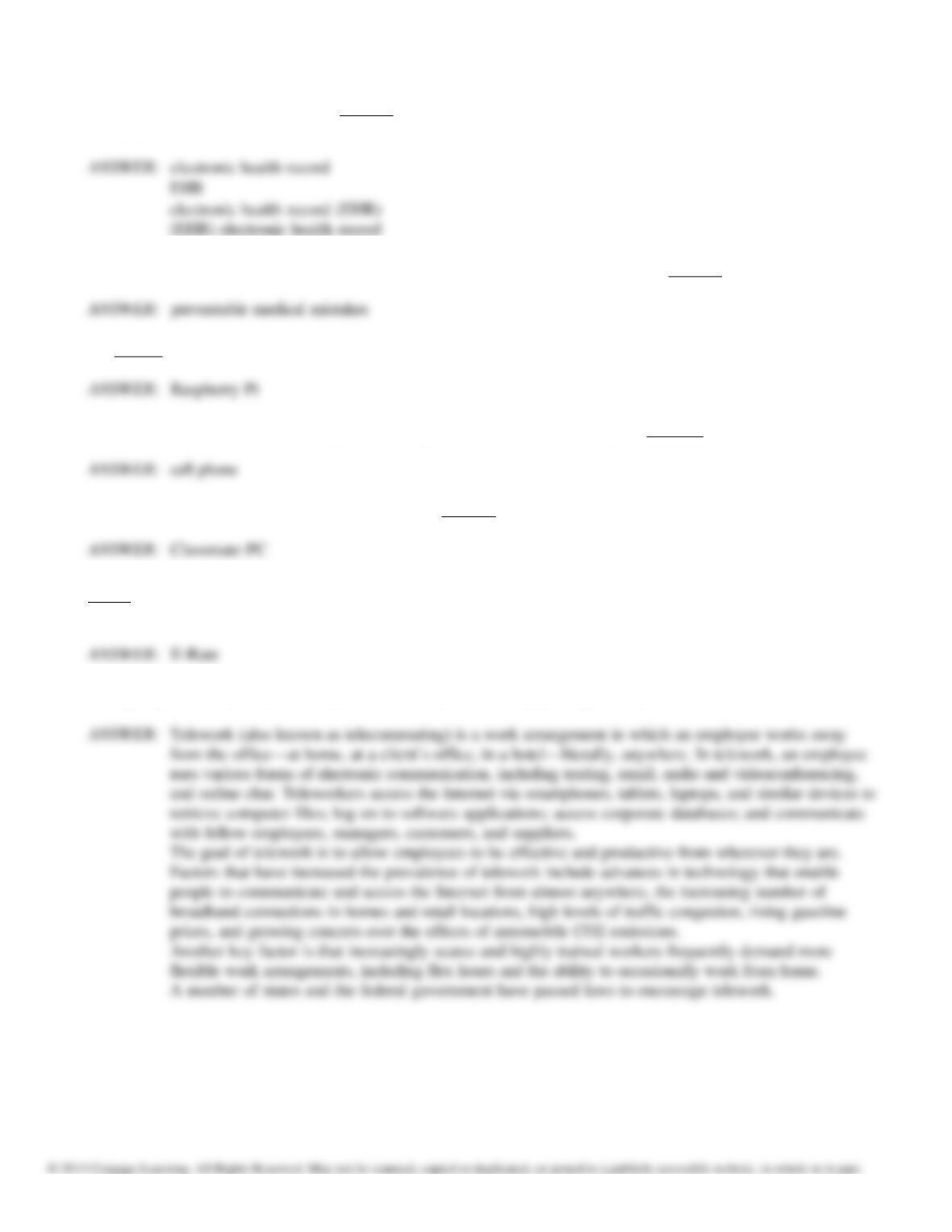
67. A(n) is a computer-readable record of health-related information on an individual.
68. employs electronic information processing and telecommunications to support at-a–distance health care,
provide professional and patient health-related training, and support healthcare administration.
69. Laypeople can access reliable and objective information on a wide range of medical topics on .
70. Acquiring data, sound, images, and video from a patient and then transmitting everything to a medical specialist for
later evaluation constitute .

Chapter 8: The Impact of Information Technology on Productivity and Quality of Life
71. requires the presence of patients and healthcare providers at different sites at the same time and often
involves a videoconference link between the two sites.
72. Patient involvement with remote doctors may have a effect on the local doctors’ relationships with their
patients and could adversely affect patient care.
73. Live telemedicine usually involves a to establish connection between a patient and healthcare providers at
different sites.
74. Some critics believe that the use of EHR may actually have contributed to healthcare costs by making it
easier to bill for patient services.
75. The was passed as part of the $787 billion 2009 American Recovery and Reinvestment Act economic
stimulus plan.
76. The Joint Commission on Accreditation of Healthcare Organizations has stated that it is not acceptable for medical
professionals to communicate with patients via .
77. reduces the need for patients to travel for treatment and allows healthcare professionals to serve more
patients in a broader geographic area.
78. Although slow to invest in IT, the industry was actually a leader in adopting mobile and wireless technology.
79. The attempts to improve federal privacy and security measures safeguarding health information.
Chapter 8: The Impact of Information Technology on Productivity and Quality of Life
80. Healthcare professionals can use a(n) to generate a complete electronic record of a clinical patient
encounter.
81. Some studies have estimated that over 98,000 people die in hospitals each year due to .
82. The is an inexpensive computer about the size of a credit card.
83. There are essentially no technical-support challenges to overcome when using a(n) .
84. In 2006, Intel introduced a low-cost laptop called the .
85. reimburses telecommunications, Internet access, and internal connections providers for discounts on eligible
services provided to schools and libraries.
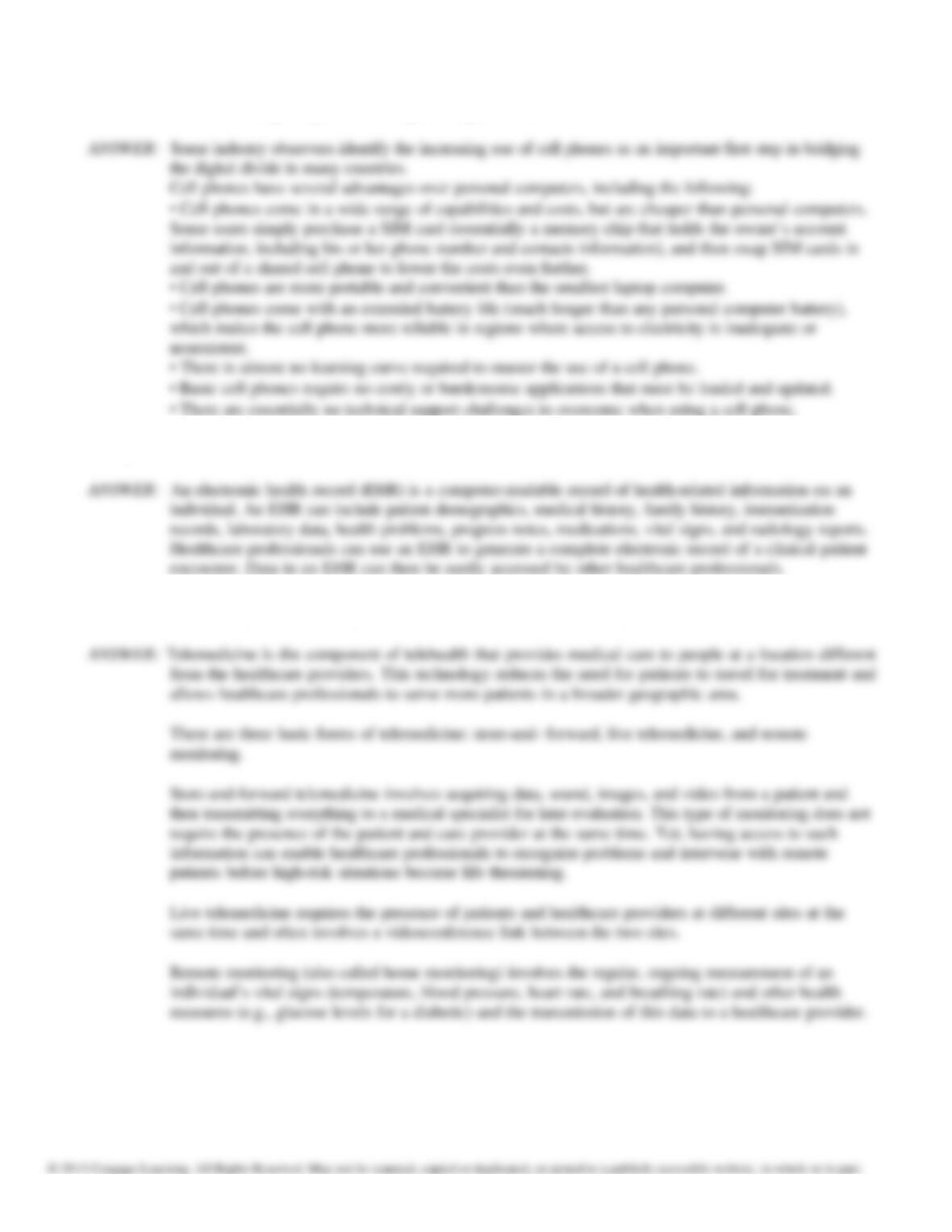
86. Briefly explain the term telework and the factors that have increased its prevalence.
Chapter 8: The Impact of Information Technology on Productivity and Quality of Life
87. Discuss the benefits of using cell phones to bridge the digital divide.
88. Briefly describe electronic health records (EHR) and their uses.
89. Define the term telemedicine and briefly describe the various forms of telemedicine.
Chapter 8: The Impact of Information Technology on Productivity and Quality of Life
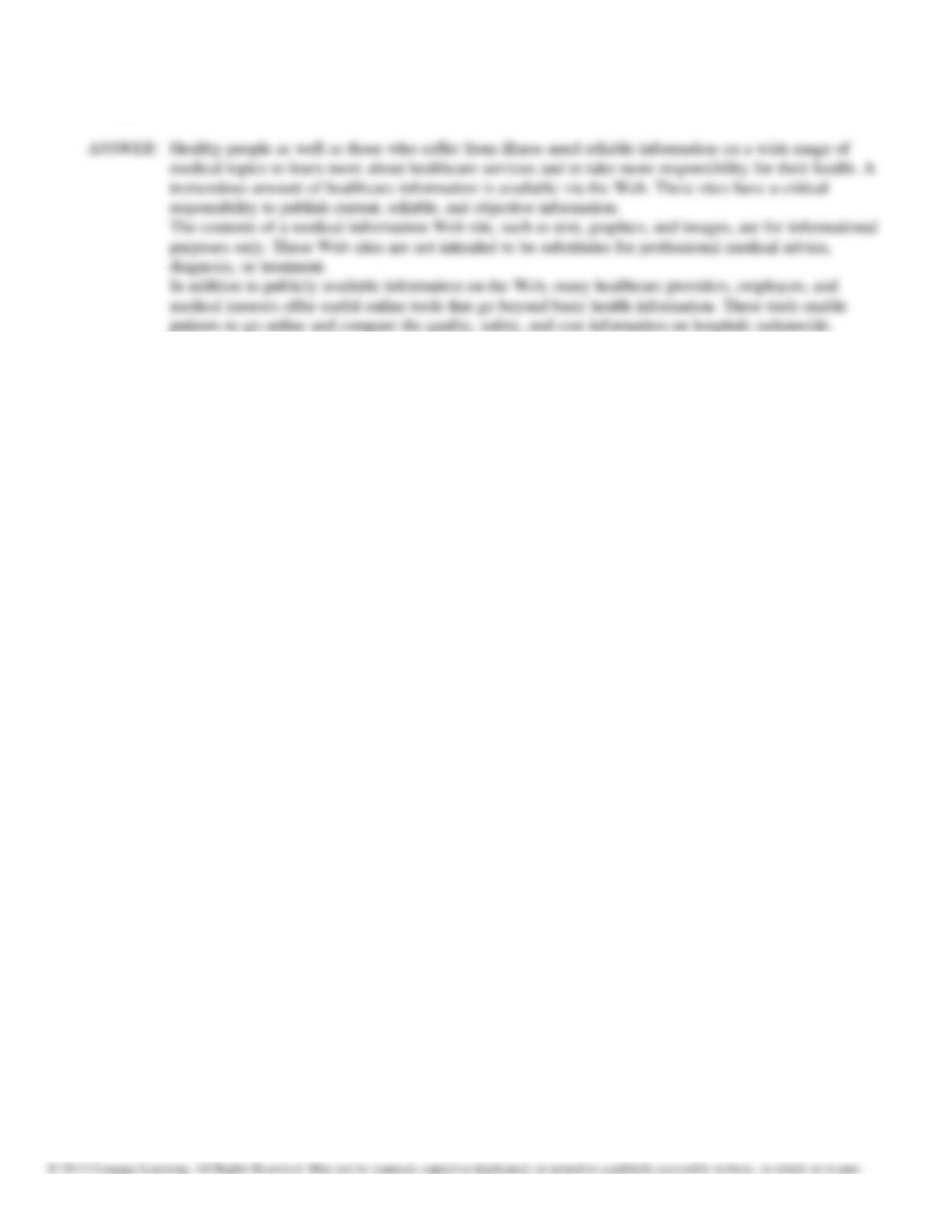
90. Briefly discuss the need of medical information Web sites.