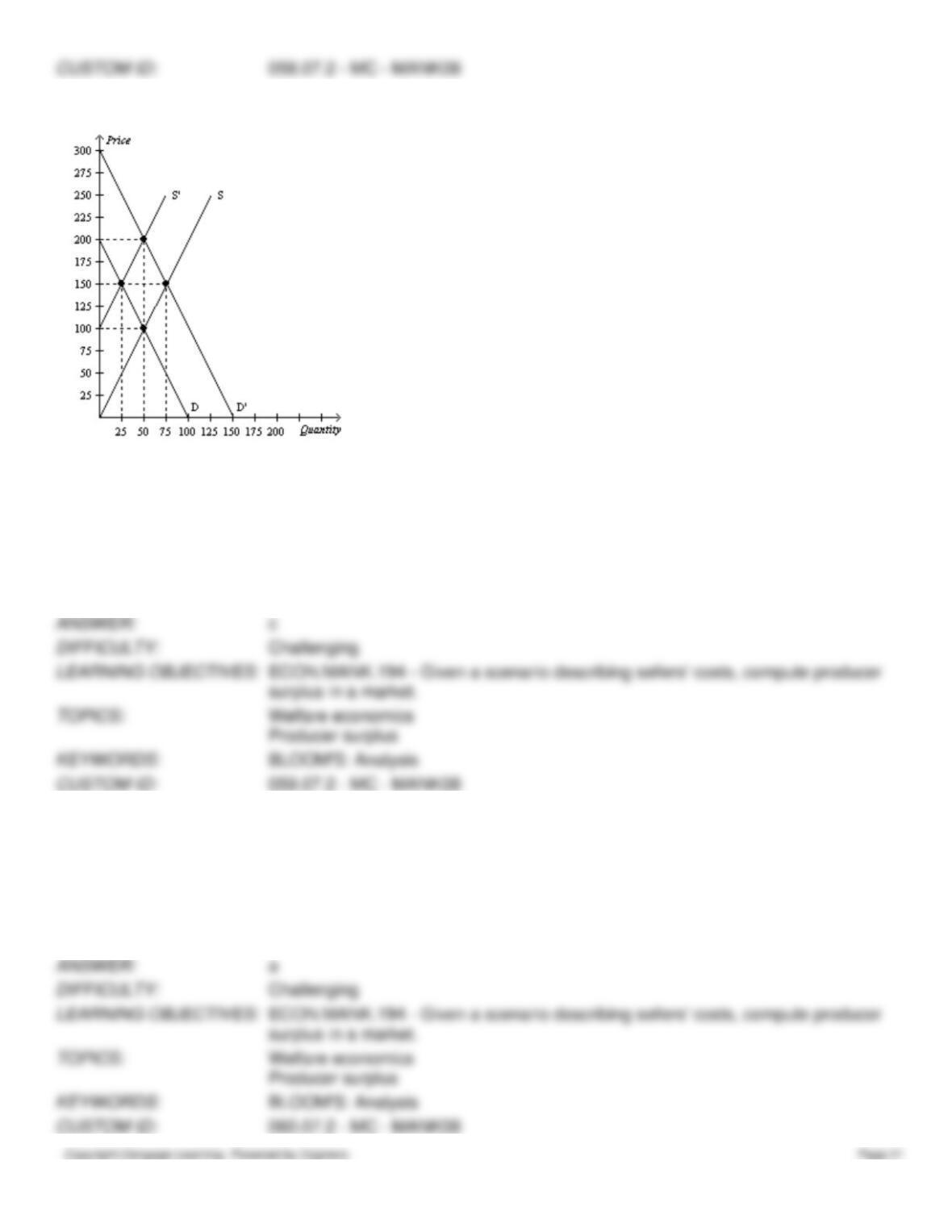
Figure 7-11
59. Refer to Figure 7-11. If the supply curve is S, the demand curve is D, and the equilibrium price is $100, what is the
producer surplus?
a.
$625
b.
$1,250
c.
$2,500
d.
$5,000
60. Refer to Figure 7-11. If the supply curve is S’, the demand curve is D, and the equilibrium price is $150, what is the
producer surplus?
a.
$625
b.
$1,250
c.
$2,500
d.
$5,000
61. Refer to Figure 7-11. If the demand curve is D and the supply curve shifts from S’ to S, what is the change in
producer surplus?
a.
Producer surplus increases by $625.
b.
Producer surplus increases by $1,875.
c.
Producer surplus decreases by $625.
d.
Producer surplus decreases by $1,875.
62. Refer to Figure 7-11. If the supply curve is S and the demand curve shifts from D to D’, what is the change in
producer surplus?
a.
Producer surplus increases by $3,125.
b.
Producer surplus increases by $5,625.
c.
Producer surplus decreases by $3,125.
d.
Producer surplus decreases by $5,625.
63. Refer to Figure 7-11. If the supply curve is S and the demand curve shifts from D to D’, what is the increase in
producer surplus to existing producers?
a.
$625
b.
$2,500
c.
$3,125
d.
$5,625
64. Refer to Figure 7-11. If the supply curve is S and the demand curve shifts from D to D’, what is the increase in
producer surplus due to new producers entering the market?
a.
$625
b.
$2,500
c.
$3,125
d.
$5,625
Table 7-15
The following table represents the costs of five possible sellers.
Seller
Cost ($)
Quentin
10
Ruby
30
Sandra
60
Thomas
100
Ursula
150
65. Refer to Table 7-15. If each producer has one unit available for sale, and if the market equilibrium price is $80 per
unit, how much is the total producer surplus in this market?
a.
$90
b.
$110
c.
$130
d.
$140
66. Refer to Table 7-15. If each producer has one unit available for sale, and if the market equilibrium price is $70, how
much is the combined total cost of all participating sellers in the market?
a.
$100
b.
$150
c.
$250
d.
$350
67. Refer to Table 7-15. Suppose each of the five sellers can supply at most one unit of the good. At which of the
following prices would the market quantity supplied be exactly three units?
a.
$20
b.
$50
c.
$90
d.
$120
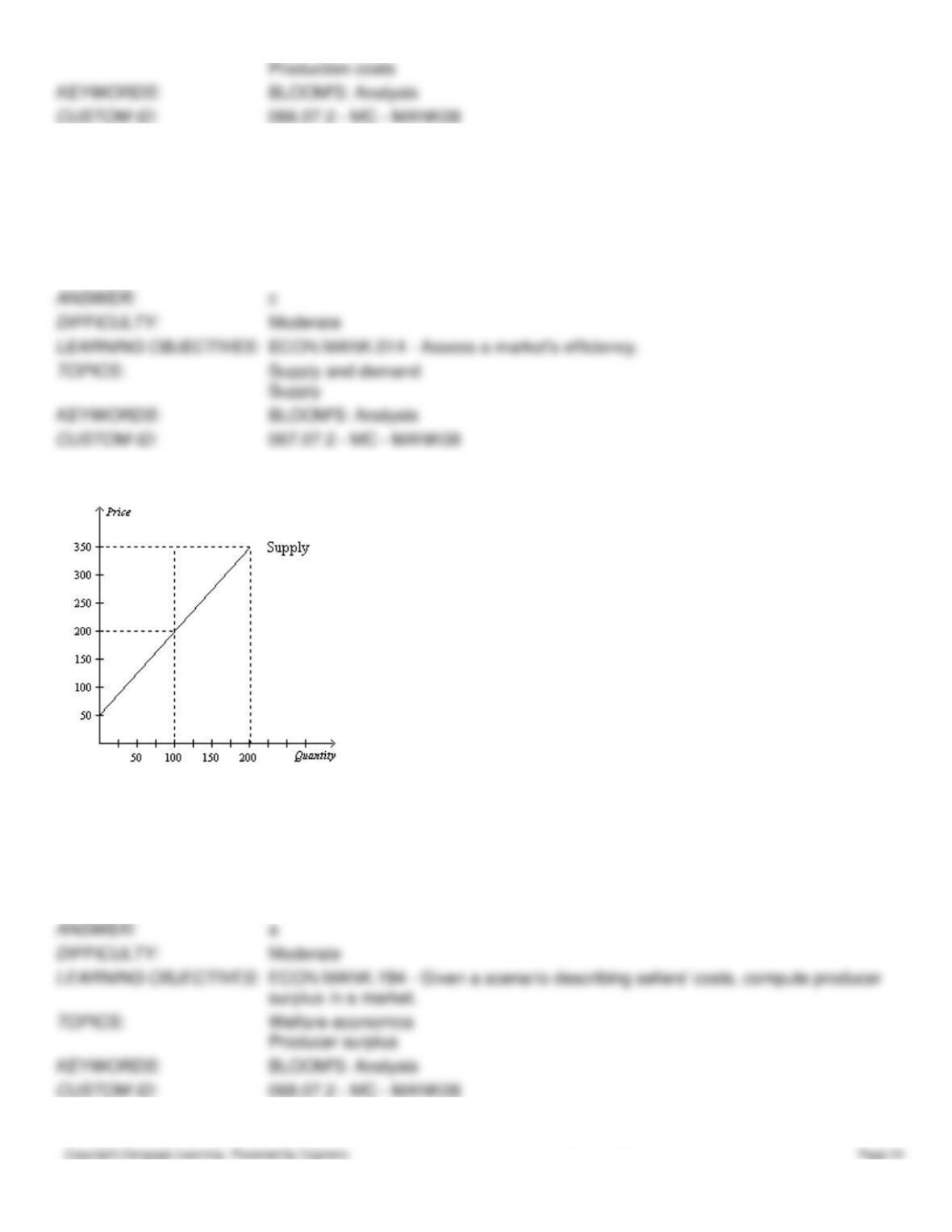
Figure 7-12
68. Refer to Figure 7-12. If the equilibrium price is $200, what is the producer surplus?
a.
$7,500
b.
$3,750
c.
$10,000
d.
$15,000
69. Refer to Figure 7-12. If the equilibrium price is $350, what is the producer surplus?
a.
$60,000
b.
$15,000
c.
$30,000
d.
$70,000
70. Refer to Figure 7-12. If the equilibrium price rises from $200 to $350, what is the additional producer surplus to
initial producers?
a.
$15,000
b.
$3,750
c.
$7,500
d.
$30,000
71. Refer to Figure 7-12. If the equilibrium price rises from $200 to $350, what is the producer surplus to new producers?
a.
$15,000
b.
$3,750
c.
$7,500
d.
$30,000
Figure 7-13
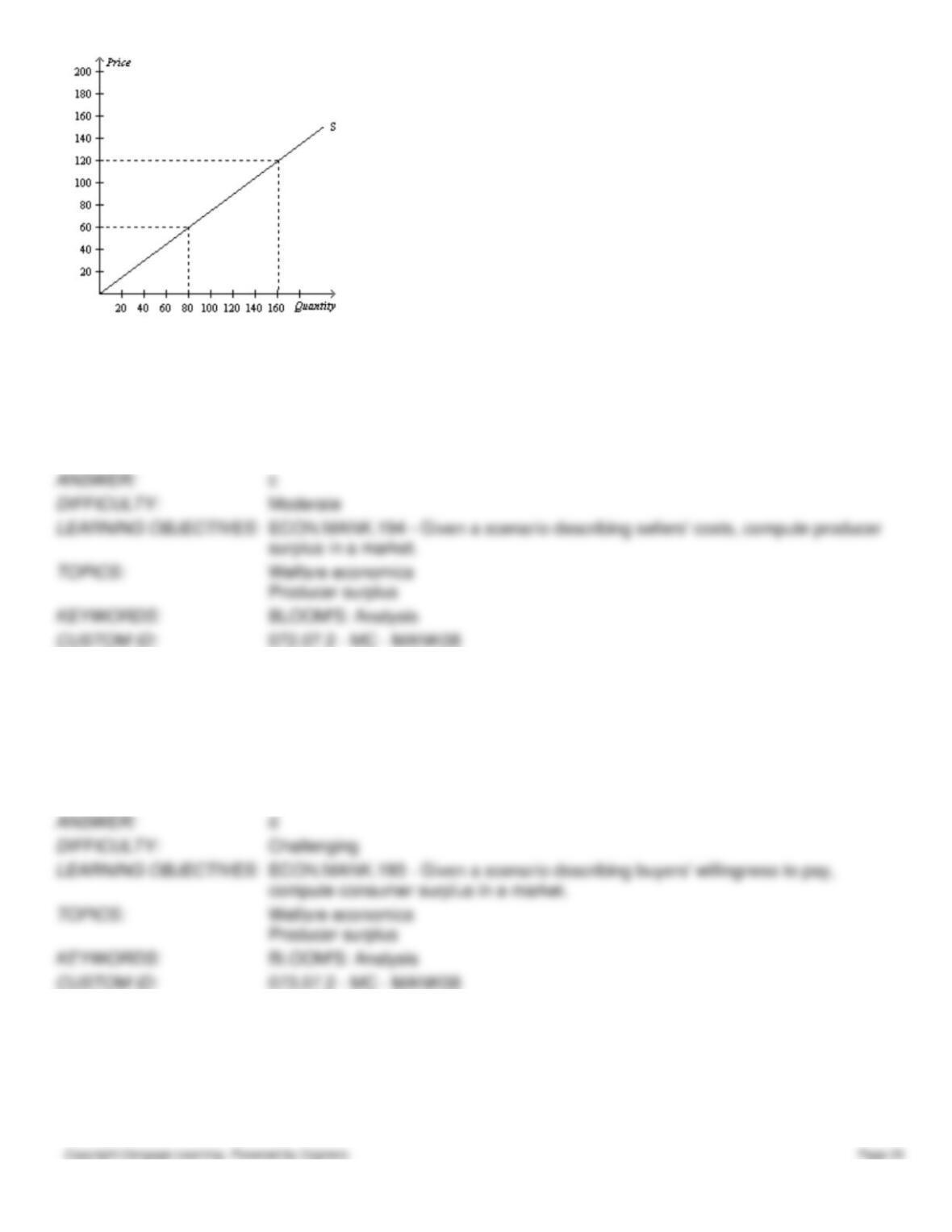
72. Refer to Figure 7-13. If the equilibrium price is $60, what is the producer surplus?
a.
$600
b.
$1,200
c.
$2,400
d.
$4,800
73. Refer to Figure 7-13. If the equilibrium price rises from $60 to $120, what is the additional producer surplus to initial
producers in the market?
a.
$1,200
b.
$2,400
c.
$3,600
d.
$4,800
74. Refer to Figure 7-13. If the equilibrium price rises from $60 to $120, what is the producer surplus to new producers
in the market?
a.
$1,200
b.
$2,400
c.
$3,600
d.
$4,800
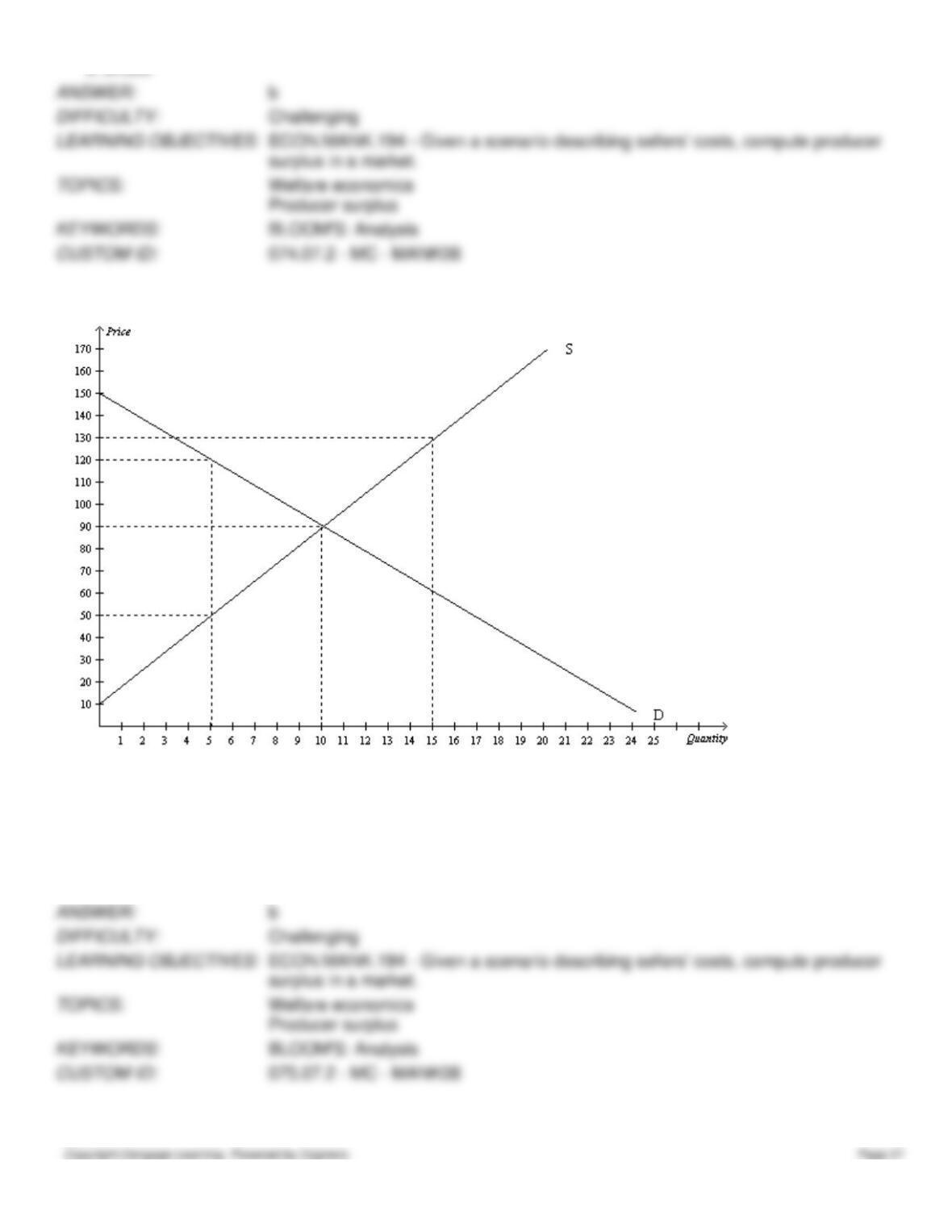
Figure 7-14
75. Refer to Figure 7-14. At the equilibrium price, producer surplus is
a.
$800.
b.
$400.
c.
$450.
d.
$900.
76. Refer to Figure 7-14. If the government imposes a price ceiling of $50 in this market, then the new producer surplus
will be
a.
$200.
b.
$100.
c.
$125.
d.
$250.
77. Refer to Figure 7-14. If the government imposes a price ceiling of $50 in this market, then producer surplus will
decrease by
a.
$325.
b.
$100.
c.
$300.
d.
$200.
78. Refer to Figure 7-14. If the market price increases to $130 due to an increase in demand, then producer surplus is
a.
$1,800.
b.
$900.
c.
$975.
d.
$1,950.
Figure 7-15
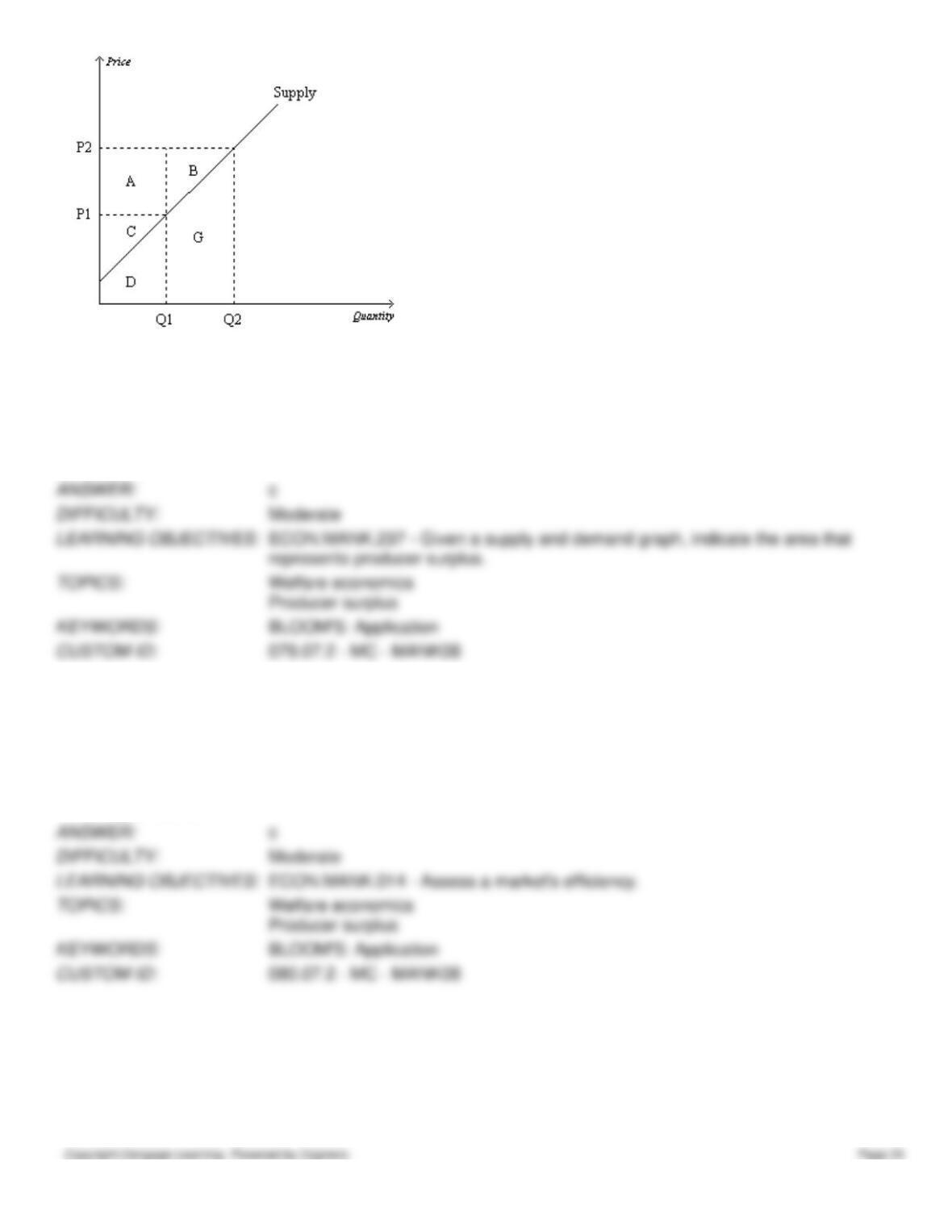
79. Refer to Figure 7-15. When the price is P2, producer surplus is
a.
A.
b.
A+C.
c.
A+B+C.
d.
D+G.
80. Refer to Figure 7-15. Suppose producer surplus is larger than C but smaller than A+B+C. The price of the good must
be
a.
lower than P1.
b.
P1.
c.
between P1 and P2.
d.
higher than P2.
81. Refer to Figure 7-15. When the price is P1, producer surplus is
a.
A.
b.
C.
c.
A+B.
d.
C+D.
82. Refer to Figure 7-15. When the price falls from P2 to P1, producer surplus
a.
decreases by an amount equal to C.
b.
decreases by an amount equal to A+B.
c.
decreases by an amount equal to A+C.
d.
increases by an amount equal to A+B.
83. Refer to Figure 7-15. When the price rises from P1 to P2, what area represents the increase in producer surplus?
a.
A
b.
A+B
c.
A+B+C
d.
G
84. Refer to Figure 7-15. When the price rises from P1 to P2, which area represents the increase in producer surplus to
existing producers?
a.
A
b.
A+B
c.
A+B+C
d.
G
85. Refer to Figure 7-15. When the price rises from P1 to P2, which area represents the increase in producer surplus due
to new producers entering the market?
a.
A
b.
B
c.
A+B
d.
G
86. Refer to Figure 7-15. Area A represents
a.
producer surplus to new producers entering the market as the result of an increase in price from P1 to P2.
b.
the increase in consumer surplus that results from an upward-sloping supply curve.
c.
the increase in total surplus when sellers are willing and able to increase supply from Q1 to Q2.
d.
the increase in producer surplus to those producers already in the market when the price increases from P1 to
P2.
87. Refer to Figure 7-15. Area B represents
a.
the combined profits of all producers when the price is P2.
b.
the increase in producer surplus to all producers as the result of an increase in the price from P1 to P2.
c.
producer surplus to new producers entering the market as the result of an increase in the price from P1 to P2.
d.
that portion of the increase in producer surplus that is offset by a loss in consumer surplus when the price
increases from P1 to P2.
88. Refer to Figure 7-15. When the price falls from P2 to P1, which of the following would not be true?
a.
The sellers who still sell the good are worse off because they now receive less.
b.
Some sellers leave the market because they are not willing to sell the good at the lower price.
c.
The total cost of what is now sold by sellers is actually higher than it was before the decrease in the price.
d.
Producer surplus would fall by area A + B.
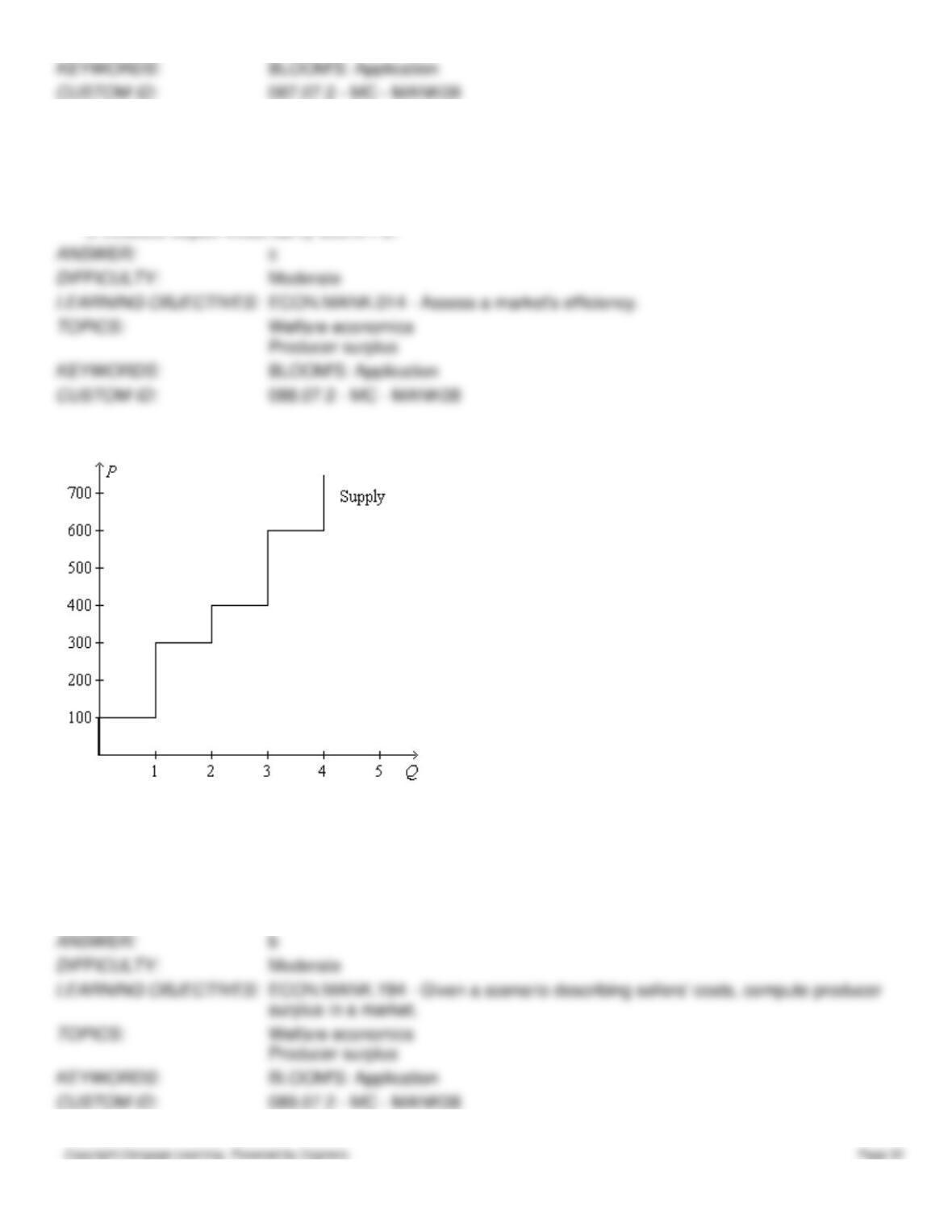
Figure 7-16
89. Refer to Figure 7-16. If the price of the good is $300, then producer surplus amounts to
a.
$100.
b.
$200.
c.
$300.
d.
$400.