CUSTOM ID:
130.06 – TF – MANK08
131. Buyers and sellers always share the burden of a tax equally.
a.
True
b.
False
CUSTOM ID:
131.06 – TF – MANK08
132. Buyers and sellers rarely share the burden of a tax equally.
a.
True
b.
False
CUSTOM ID:
132.06 – TF – MANK08
133. Who bears the majority of a tax burden depends on whether the tax is placed on the buyers or the sellers.
a.
True
b.
False
CUSTOM ID:
133.06 – TF – MANK08
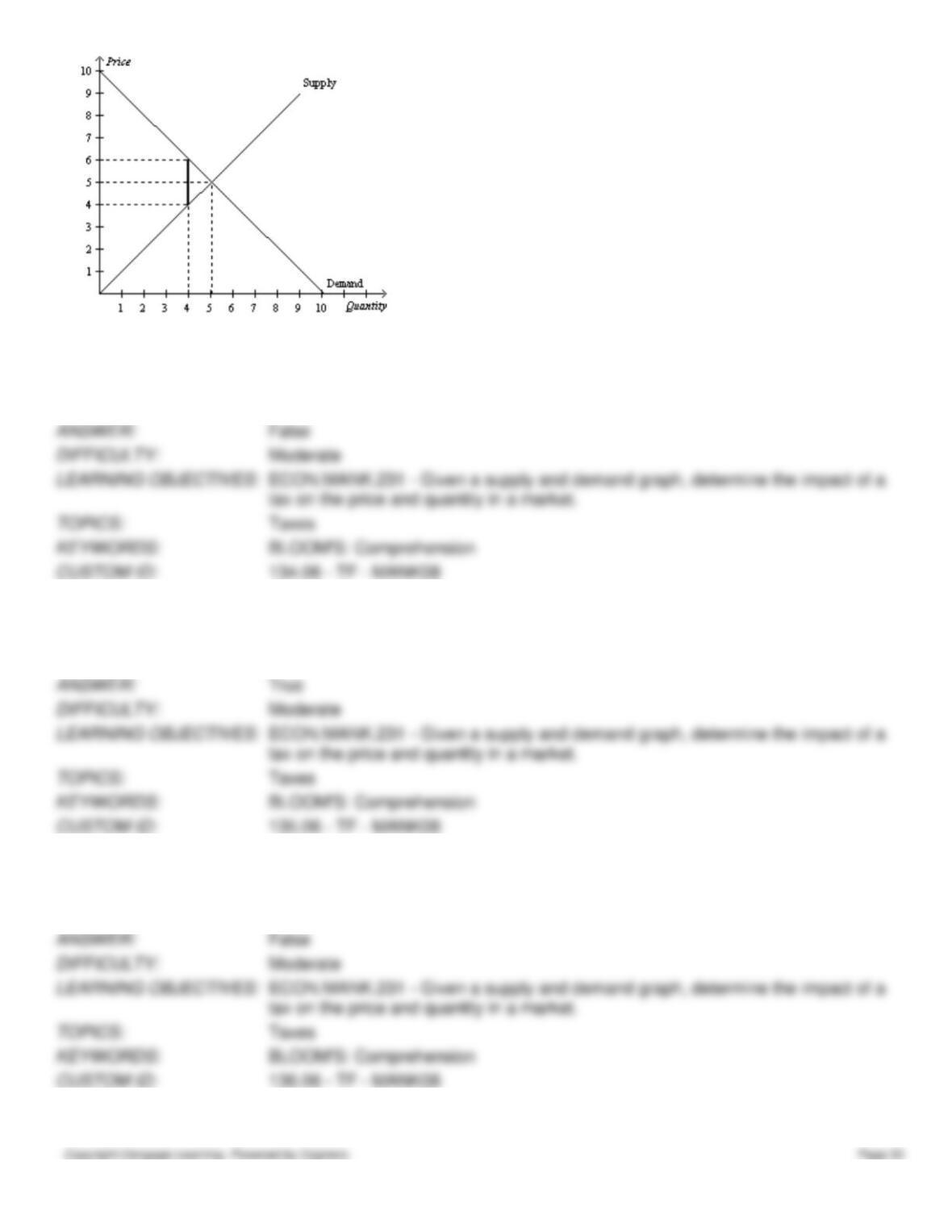
134. Refer to Figure 6-36. If the government places a $2 tax in the market, the buyer pays $4.
a.
True
b.
False
135. Refer to Figure 6-36. If the government places a $2 tax in the market, the buyer pays $6.
a.
True
b.
False
136. Refer to Figure 6-36. If the government places a $2 tax in the market, the seller receives $6.
a.
True
b.
False
137. Refer to Figure 6-36. If the government places a $2 tax in the market, the seller receives $4.
a.
True
b.
False
138. Refer to Figure 6-36. If the government places a $2 tax in the market, the buyer bears $2 of the tax burden.
a.
True
b.
False
139. Refer to Figure 6-36. If the government places a $2 tax in the market, the buyer bears $1 of the tax burden.
a.
True
b.
False
140. Refer to Figure 6-36. If the government places a $2 tax in the market, the seller bears $2 of the tax burden.
a.
True
b.
False
141. Refer to Figure 6-36. If the government places a $2 tax in the market, the seller bears $1 of the tax burden.
a.
True
b.
False
142. Most labor economists believe that the supply of labor is much more elastic than the demand.
a.
True
b.
False
143. FICA is an example of a payroll tax, which is a tax on the wages that firms pay their workers.
a.
True
b.
False
144. Since half of the FICA tax is paid by firms and the other half is paid by workers, the burden of the tax must fall
equally on firms and workers.
a.
True
b.
False
145. Workers, rather than firms, bear most of the burden of the payroll tax.
a.
True
b.
False
146. Who bears the majority of a tax burden depends on the relative elasticity of supply and demand.
a.
True
b.
False
147. If the demand curve is very elastic and the supply curve is very inelastic in a market, then the sellers will bear a
greater burden of a tax imposed on the market, even if the tax is imposed on the buyers.
a.
True
b.
False
148. If the demand curve is very inelastic and the supply curve is very elastic in a market, then the sellers will bear a
greater burden of a tax imposed on the market, even if the tax is imposed on the buyers.
a.
True
b.
False
149. A tax burden falls more heavily on the side of the market that is less elastic.
a.
True
b.
False
150. The tax burden falls more heavily on the side of the market that is more inelastic.
a.
True
b.
False
151. A tax on a market with elastic demand and elastic supply will shrink the market more than a tax on a market with
inelastic demand and inelastic supply will shrink the market.
a.
True
b.
False
152. The true burden of a payroll tax has nothing to do with the percentage of the tax that employers are required to pay.
a.
True
b.
False
153. Even though federal law mandates that workers and firms each pay half of the total FICA tax, the tax burden may not
fall equally on workers and firms.
a.
True
b.
False
154. Most of the burden of a luxury tax falls on the middle class workers who produce luxury goods rather than on the
rich who buy them.
a.
True
b.
False
155. The burden that results from a tax on yachts falls more heavily on the buyers of yachts than on the sellers of yachts.
a.
True
b.
False
156. The burden of a luxury tax most likely falls more heavily on sellers because demand is more elastic and supply is
more inelastic.
a.
True
b.
False
157. Price ceilings are never binding when set above the equilibrium price.
a.
True
b.
False
158. Rent controls only affect the demand side of the rental market.
a.
True
b.
False
159. Since one effect of rent controls is to reduce the supply of available rental properties,rent controls can contribute to
the problems of homelessness in cities with rent controls.
a.
True
b.
False
160. Long lines and gasoline shortages during the 1970’s can be attributed completely to the decision by OPEC to raise
crude oil prices.
a.
True
b.
False
161. Whether the minimum wage is a binding price floor always depends upon whether the economy is in a recession.
a.
True
b.
False
162. The distribution of the burden of a tax depends strictly on the elasticity of demand.
a.
True
b.
False
163. The distribution of the burden of a tax depends strictly on the elasticity of supply.
a.
True
b.
False
164. To determine the incidence of a tax, it is necessary to have information on both the elasticity of demand and the
elasticity of supply.
a.
True
b.
False
165. Since a tax imposed on buyers of a product only affects demand, such a tax has no impact on sellers in that market.
a.
True
b.
False
166. Since the FICA tax is split equally between employers and employees, we can conclude that the incidence of this tax
is also equally shared.
a.
True
b.
False