1. If a country raises its budget deficit, then its
a.
net capital outflow and net exports rise.
b.
net capital outflow rises and net exports fall.
c.
net capital outflow falls and net exports rise.
d.
net capital outflow and net exports fall.
2. Because a government budget deficit represents
a.
negative public saving, it increases national saving.
b.
negative public saving, it decreases national saving.
c.
positive public saving, it increases national saving.
d.
positive public saving, it decreases national saving.
3. If a government has a budget surplus, then public saving
a.
is positive and increases national saving.
b.
is positive but decreases national saving.
c.
is negative and decreases national saving.
d.
is negative but increases national saving.
4. When a government increases its budget deficit, then that country’s
a.
supply of loanable funds shifts right.
b.
supply of loanable funds shifts left.
c.
demand for loanable funds shifts right.
d.
demand for loanable funds shifts left.
5. If a country raises its budget deficit then
a.
both its supply of and demand for loanable funds shift.
b.
its supply of but not its demand for loanable funds shifts.
c.
its demand for but not its supply of loanable funds shifts.
d.
neither its supply nor its demand for loanable funds shift.
6. A rise in the budget deficit
a.
shifts both the supply of loanable funds in the market for loanable funds and the supply of dollars in the
market for foreign-currency exchange right.
b.
shifts both the supply of loanable funds in the market for loanable funds and the supply of dollars in the
market for foreign-currency exchange left.
c.
shifts both the demand for loanable funds in the market for loanable funds and the demand for dollars in the
market for foreign-currency exchange right.
d.
shifts both the demand for loanable funds in the market for loanable funds and the demand for dollars in the
market for foreign-currency exchange left.
7. Suppose that India has a government budget surplus, and then goes into deficit. This change would
a.
increase India’s national saving and shift its supply of loanable funds left.
b.
increase India’s national saving and shift its demand for loanable funds right.
c.
decrease India’s national saving and shift its supply of loanable funds left.
d.
decrease India’s national saving and shift its demand for loanable funds right.
8. An increase in the budget deficit makes domestic interest rates
a.
rise because the supply of loanable funds shifts left.
b.
fall because the supply of loanable funds shifts left.
c.
rise because the demand for loanable funds shifts right.
d.
fall because the demand for loanable funds shifts right.
9. If a country went from a government budget deficit to a surplus, national saving would
a.
increase, shifting the supply of loanable funds right.
b.
increase, shifting the supply of loanable funds left.
c.
decrease, shifting the demand for loanable funds right.
d.
decrease, shifting the demand for loanable funds left.
10. An increase in the U.S. government budget deficit shifts the
a.
demand for loanable funds right and decreases investment spending.
b.
supply of loanable funds right and increases investment spending.
c.
supply of loanable funds left and decreases investment spending.
d.
None of the above is correct.
11. An increase in a country’s budget surplus shifts its
a.
demand for loanable funds right and decreases investment spending.
b.
supply of loanable funds right and increases investment spending.
c.
supply of loanable funds left and decreases investment spending.
d.
None of the above is correct.
12. An increase in the budget deficit causes domestic interest rates
a.
and investment to rise.
b.
to rise and investment to fall.
c.
to fall and investment to rise.
d.
and investment to fall.
13. A decrease in the budget deficit causes domestic interest rates
a.
and investment to rise.
b.
to rise and investment to fall.
c.
to fall and investment to rise.
d.
and investment to fall.
14. An increase in the budget deficit
a.
reduces investment because the interest rate rises.
b.
reduces investment because the interest rate falls.
c.
raises investment because the interest rate rises.
d.
raises investment because the interest rate falls.
15. An increase in the budget deficit causes domestic interest rates
a.
and net capital outflow to rise.
b.
to rise and net capital outflow to fall.
c.
to fall and net capital outflow to rise.
d.
and net capital outflow to fall.
16. A rise in the government budget deficit
a.
increases the interest rate so in the market for foreign-currency exchange, supply shifts right.
b.
increases the interest rate so in the market for foreign-currency exchange,supply shifts left.
c.
decreases the interest rate so in the market for foreign-currency exchange, supply shifts left.
d.
decreases the interest rate so in the market for foreign-currency exchange supply shifts right.
17. An increase in the budget deficit causes net capital outflow to
a.
rise, because the supply of loanable funds shifts right.
b.
rise, because the demand for loanable funds shifts right.
c.
fall, because the supply of loanable funds shifts left.
d.
fall, because the demand for loanable funds shifts right.
18. An increase in the budget deficit
a.
reduces net capital outflow and domestic investment.
b.
reduces net capital outflow and raises domestic investment.
c.
raises net capital outflow and domestic investment
d.
raises net capital outflow and reduces domestic investment.
19. If the budget deficit increases, then
a.
an increase in the interest rate increases net capital outflow.
b.
an increase in the interest rate decreases net capital outflow.
c.
a decrease in the interest rate increases net capital outflow.
d.
a decrease in the interest rate decreases net capital outflow.
20. If the budget deficit increases, then
a.
U.S. residents will want to purchase more foreign assets and foreign residents will want to purchase more U.S.
assets
b.
U.S. residents will want to purchase more foreign assets and foreign residents will want to purchase fewer
U.S. assets
c.
U.S. residents will want to purchase fewer foreign assets and foreign residents will want to purchase more
U.S. assets
d.
U.S. residents will want to purchase fewer foreign assets and foreign residents will want to purchase fewer
U.S. assets
21. An increase in a country’s budget deficit
a.
increases net capital outflow, so the demand for its currency in the market for foreign-currency exchange shifts
right.
b.
increases net capital outflow, so the supply of its currency in the market for foreign-currency exchange shifts
right.
c.
decreases net capital outflow, so the demand for its currency in the market for foreign-currency exchange
shifts left.
d.
decreases net capital outflow, so the supply of its currency in the market for foreign-currency exchange shifts
left.
22. If the Canadian government raises it budget deficit, then Canada’s net capital outflows will
a.
increase, so its exchange rate will rise.
b.
increase, so its exchange rate will fall.
c.
decrease, so its exchange rate will rise.
d.
decrease, so its exchange rate will fall.
23. If a country raises its budget deficit, then in the market for foreign-currency exchange
a.
supply shifts left.
b.
supply shifts right.
c.
demand shifts left.
d.
supply shifts right.
24. If a country raises its budget deficit, then net capital outflow
a.
rises, so the supply of its currency shifts right in the market for foreign-currency exchange.
b.
rises, so the demand for its currency shifts right in the market for foreign-currency exchange.
c.
falls, so the supply of its currency shifts left in the market for foreign-currency exchange.
d.
falls, so the demand for its currency shifts right in the market for foreign-currency exchange.
25. If a country’s budget deficit increases, then in the market for foreign-currency exchange,
a.
the supply of its currency shifts right, so the exchange rate falls.
b.
the demand for its currency shifts right, so the exchange rate rises.
c.
the supply of its currency shifts left, so the exchange rate rises.
d.
the demand for its currency shifts left.so the exchange rate falls.
26. When a country’s government budget deficit increases,
a.
the real exchange rate of its currency and its net exports increase.
b.
the real exchange rate of its currency and its net exports decrease.
c.
the real exchange rate of its currency increases and its net exports decrease.
d.
the real exchange rate of its currency decreases and its net exports increase.
27. When a country’s government budget deficit decreases,
a.
the real exchange rate of its currency and its net exports increase.
b.
the real exchange rate of its currency and its net exports decrease.
c.
the real exchange rate of its currency increases and its net exports decrease.
d.
the real exchange rate of its currency decreases and its net exports increase.
28. If a country’s budget deficit decreases, then the exchange rate
a.
rises, which raises net exports.
b.
rises, which reduces net exports.
c.
falls, which raises net exports.
d.
falls, which reduces net exports.
29. If a country’s budget deficit rises, then its exchange rate
a.
rises, so its imports rise.
b.
rises, so its imports fall.
c.
falls, so its imports rise.
d.
falls so its imports fall.
30. If the Japanese government raised its budget deficit, then the yen would
a.
depreciate and Japanese net exports would rise.
b.
depreciate and Japanese net exports would fall.
c.
appreciate and Japanese net exports would rise.
d.
appreciate and Japanese net exports would fall.
31. If the U.S. government went from a budget deficit to a budget surplus then
a.
the interest rate and the real exchange rate would increase.
b.
the interest rate and the real exchange rate would decrease.
c.
the interest rate would increase and the real exchange rate would decrease.
d.
the interest rate would decrease and the real exchange rate would increase.
32. If the U.S. government increased its deficit, then
a.
U.S. bonds would pay higher interest but a dollar would purchase fewer foreign goods.
b.
U.S. bonds would pay higher interest and a dollar would purchase more foreign goods.
c.
U.S. bonds would pay lower interest and a dollar would purchase fewer foreign goods.
d.
U.S. bonds would pay lower interest but a dollar would purchase more foreign goods.
33. An increase in the budget deficit
a.
raises net exports and domestic investment.
b.
raises net exports and reduces domestic investment.
c.
reduces net exports and raises domestic investment.
d.
reduces net exports and domestic investment.
34. An increase in the budget surplus
a.
raises net exports and domestic investment.
b.
raises net exports and reduces domestic investment.
c.
reduces net exports and raises domestic investment.
d.
reduces net exports and domestic investment.
35. A government budget deficit
a.
increases both net capital outflow and net exports.
b.
decreases both net capital outflow and net exports.
c.
increases net capital outflow and decreases net exports.
d.
decreases net capital outflow and increases net exports.
36. If a government increases its budget deficit, then interest rates
a.
rise and the real exchange rate appreciates.
b.
fall and the real exchange rate depreciates.
c.
rise and the real exchange rate depreciates.
d.
fall and the real exchange rate appreciates.
37. A firm produces construction equipment, some of which it exports. Which of the following effects of an increase in
the government budget deficit would likely reduce the quantity of equipment it sells?
a.
the change in the interest rate and the change in the exchange rate
b.
the change in the interest rate but not the change in the exchange rate
c.
the change in the exchange rate but not the change in the interest rate
d.
neither the change in the interest rate nor the change in the exchange rate
38. If a government increases its budget deficit, then domestic interest rates
a.
and net exports rise.
b.
rise and net exports fall.
c.
fall and net exports rise.
d.
and net exports fall.
39. If a government increases its budget deficit, then the real exchange rate
a.
and domestic investment rise.
b.
and domestic investment fall.
c.
rises and domestic investment falls.
d.
falls and domestic investment rises.
40. If the government of a country with a zero trade balances increases its budget deficit, then interest rates
a.
rise and the trade balance moves to a surplus.
b.
rise and the trade balance moves to a deficit.
c.
fall and the trade balance moves to a surplus.
d.
fall and the trade balance moves to a deficit.
41. If a government of a country with a zero trade balance increases its budget deficit, then the real exchange rate
a.
appreciates and there is a trade surplus.
b.
appreciates and there is a trade deficit.
c.
depreciates and there is a trade surplus.
d.
depreciates and there is a trade deficit.
42. If a government started with a budget deficit and moved to a surplus, domestic investment
a.
and the real exchange rate would rise.
b.
and the real exchange rate would fall.
c.
would rise and the real exchange rate would fall.
d.
would fall and the real exchange rate would rise.
43. If the government of Canada increased its budget deficit, then domestic investment
a.
and net exports would rise.
b.
would rise and net exports would fall.
c.
would fall and net exports would rise.
d.
and net exports would fall.
44. If the government of a country with a zero trade balance started with a budget deficit and moved to a budget surplus,
domestic investment would
a.
rise and there would be a trade surplus.
b.
rise and there would be a trade deficit.
c.
fall and there would be a trade surplus.
d.
fall and there would be a trade deficit.
45. Which of the following would not be a consequence of an increase in the U.S. government budget deficit?
a.
U.S. interest rates rise
b.
U.S. net capital outflow falls
c.
the real exchange rate of the U.S. dollar depreciates
d.
the U.S. supply of loanable funds shifts left
46. Which of the following would not be a consequence of an increase in the U.S. government budget deficit?
a.
the U.S. trade balance rises
b.
the U.S. interest rate rises
c.
domestic investment in the U.S. falls
d.
the real exchange rate of the U.S. dollar appreciates
47. In the open-economy macroeconomic model which of the following falls if there is an increase in the budget deficit?
a.
the interest rate
b.
net exports
c.
the exchange rate
d.
All of the above are correct.
48. Which of the following is the most likely result from an increase in a country’s government budget surplus?
a.
higher interest rates
b.
lower imports
c.
lower net capital outflows
d.
lower domestic investment
49. If the French government increases its expenditures and reduces taxes, then France’s interest rate
a.
and its exchange rate rise.
b.
rises and its exchange rate falls.
c.
falls and its exchange rate rises.
d.
and its exchange rate fall.
50. Which of the following contains a list only of things that increase when the budget deficit of the U.S. increases?
a.
U.S. supply of loanable funds, U.S. interest rates, U.S. domestic investment
b.
U.S. imports, U.S. interest rates, the real exchange rate of the dollar
c.
U.S. interest rates, the real exchange rate of the dollar, U.S. domestic investment
d.
the real exchange rate of the dollar, U.S. net capital outflow, U.S. net exports
51. Which of the following contains a list only of things that increase when the budget deficit of the U.S. decreases?
a.
U.S. supply of loanable funds, U.S. net capital outflow, U.S. domestic investment
b.
U.S. supply of loanable funds, U.S. exports, the real exchange rate of the dollar
c.
U.S. interest rates, the real exchange rate of the dollar, U.S. domestic investment
d.
the real exchange rate of the dollar, U.S. net capital outflow, U.S. net exports
52. Which of the following contains a list only of things that decrease when the budget deficit of the U.S. increases?
a.
U.S. net exports, U.S. domestic investment, U.S. net capital outflow
b.
U.S. supply of loanable funds, U.S. interest rates, U.S. domestic investment
c.
U.S. imports, U.S. interest rates, the real exchange rate of the dollar
d.
None of the above is correct.
53. From 1980 to 1987, U.S. net capital outflows decreased. According to the open-economy macroeconomic model,
which of the following could have caused this?
a.
an increase in the demand for U.S. currency in the market for foreign-currency exchange
b.
a decrease in the demand for U.S. currency in the market for foreign-currency exchange
c.
an increase in the supply of loanable funds
d.
a decrease in the supply of loanable funds
54. In the United States in the early 1980s, there was a government budget
a.
surplus and a trade surplus.
b.
deficit and a trade deficit.
c.
surplus and a trade deficit.
d.
deficit and a trade surplus.
55. In the 1980s, the U.S. government budget deficit rose. At the same time the U.S. trade deficit grew larger, the real
exchange rate of the dollar appreciated, and U.S. net capital outflow decreased. Which of these events is contrary to what
the open-economy macroeconomic model predicts concerning the effects of an increase in the budget deficit?
a.
the U.S. trade deficit grew
b.
the real exchange rate of the dollar appreciated
c.
U.S. net capital outflow fell
d.
None of the above is contrary to the predictions of the model.
56. From 2001 to 2004 the U.S. budget went from surplus to deficit. According to the open economy macroeconomic
model, this change should have
a.
increased U.S. interest rates and increased the real exchange rate of the dollar.
b.
increased U.S. interest rates and decreased the real exchange rate of the dollar.
c.
decreased U.S. interest rates and increased the real exchange rate of the dollar.
d.
decreased U.S. interest rates and decreased the real exchange rate of the dollar.
57. From 2001 to 2004, the U.S. government went from a budget surplus to a budget deficit. According to the open-
economy macroeconomic model, this should have decreased
a.
both the supply of loanable funds and the supply of dollars in the market for foreign-currency exchange.
b.
neither the supply of loanable funds nor the supply of dollars in the market for foreign-currency exchange.
c.
the supply of loanable funds but not the supply of dollars in the market for foreign-currency exchange.
d.
the supply of dollars in the market for foreign-currency exchange, but not the supply of loanable funds.
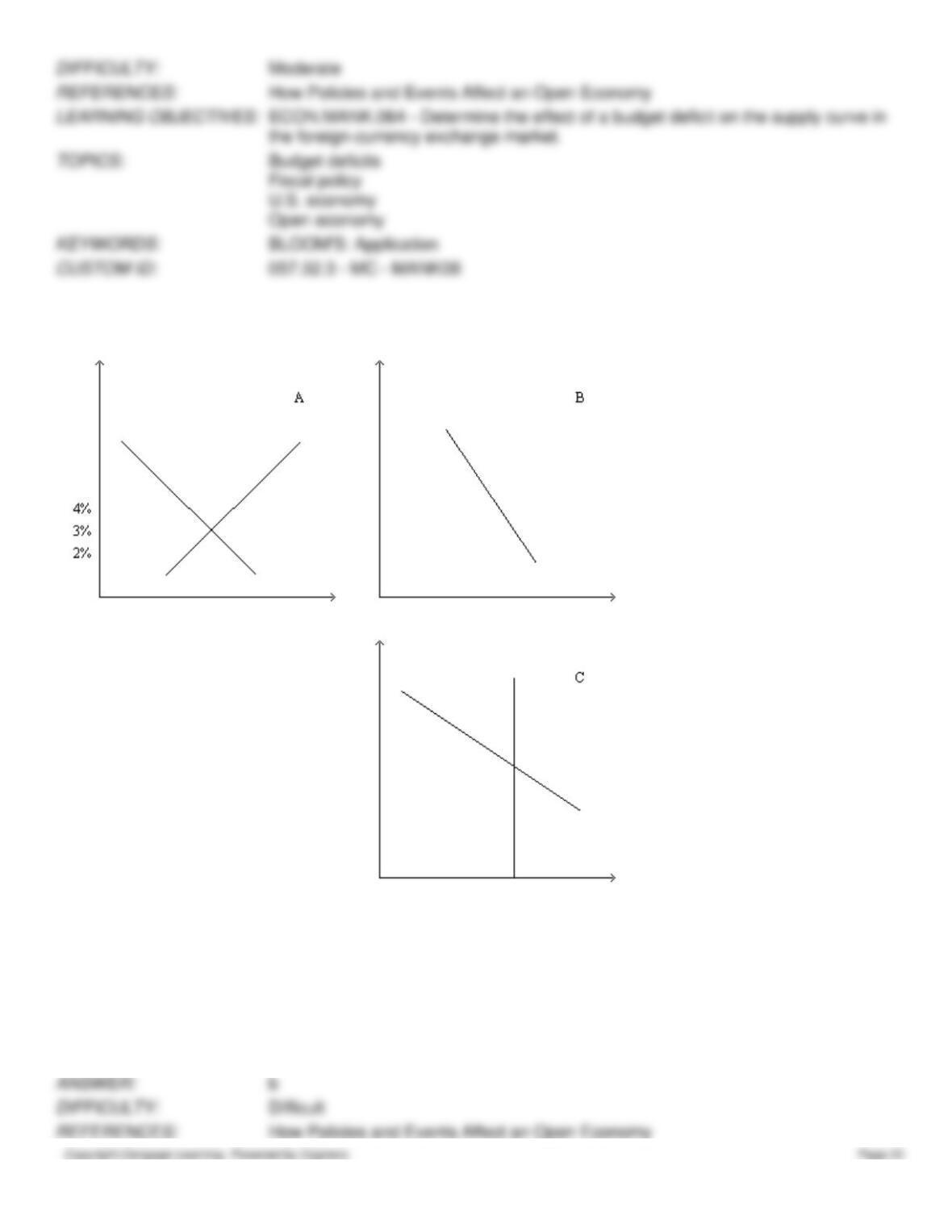
Figure 32-4
Refer to this diagram of the open-economy macroeconomic model to answer the questions below.
58. Refer to Figure 32–4. Suppose that U.S. firms desire to purchase more equipment and build more factories and stores
in the U.S. The effects of this are illustrated by
a.
shifting the demand curve in panel a to the right and the demand curve in panel c to the left.
b.
shifting the demand curve in panel a to the right and the supply curve in panel c to the left.
c.
shifting the supply curve in panel a to the right and the demand curve in panel c to the left.
d.
shifting the supply curve in panel a to the right and the supply curve in panel c to the right.