1. You use U.S. currency to pay the owner of a restaurant for a delicious meal. The currency
a.
has no intrinsic value. The exchange is an example of barter.
b.
has no intrinsic value. The exchange is not an example of barter.
c.
has intrinsic value. The exchange is not an example of barter.
d.
has intrinsic value. The exchange is not an example of barter.
2. Which of the following is an example of barter?
a.
A parent gives a teenager a $10 bill in exchange for her babysitting services.
b.
A homeowner gives an exterminator a check for $50 in exchange for extermination services.
c.
A barber gives a plumber a haircut in exchange for the plumber fixing the barber’s leaky faucet.
d.
All of the above are examples of barter.
3. A double coincidence of wants
a.
is required when there is no item in an economy that is widely accepted in exchange for goods and services.
b.
is required in an economy that relies on barter.
c.
is a hindrance to the allocation of resources when it is required for trade.
d.
All of the above are correct.
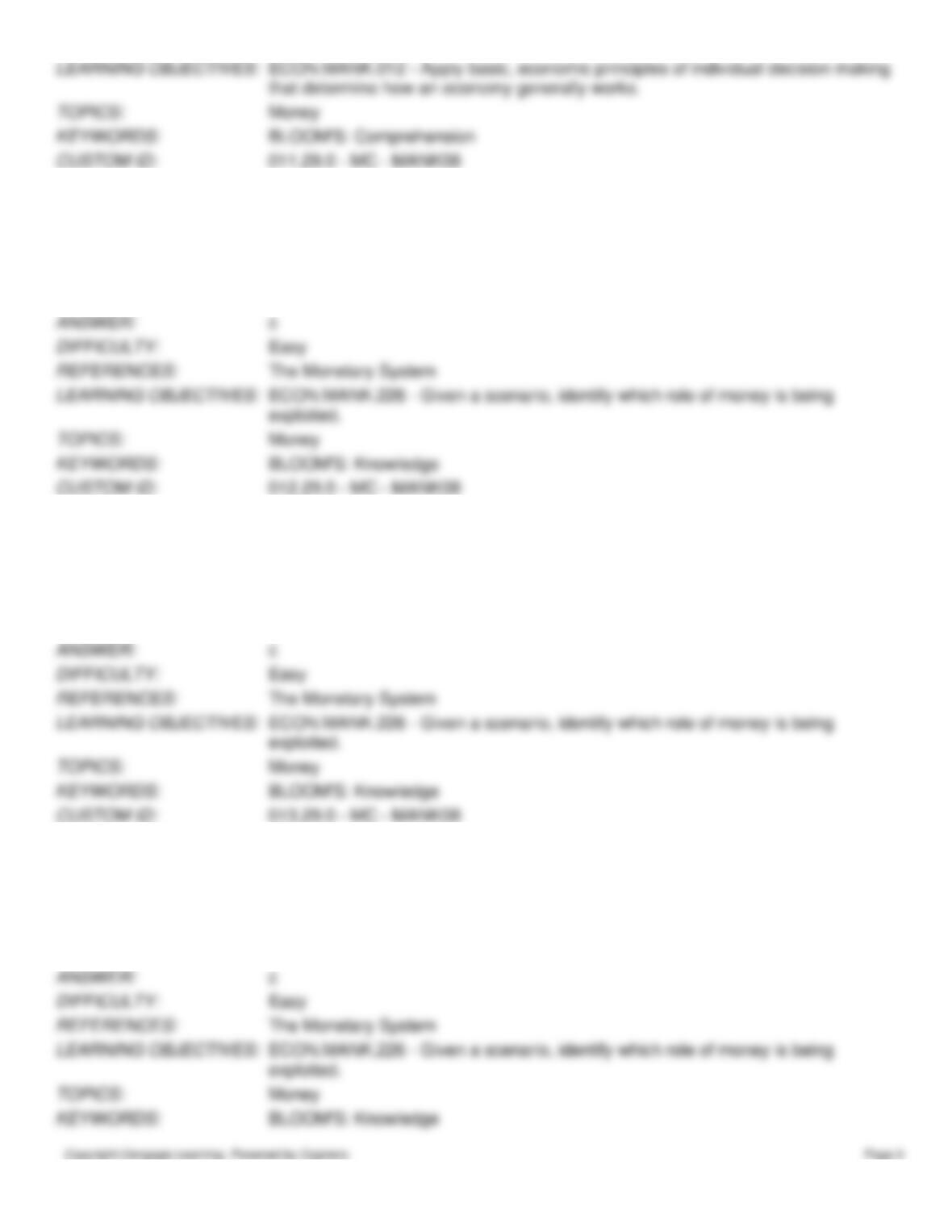
4. Consider the following traders who meet.
Bill
has an eggplant
wants a head of cabbage
Tim
has a head of lettuce
wants a cucumber
Mike
has a tomato
wants an eggplant
Amy
has a cucumber
wants a head of lettuce
Which, if any, pairs of traders has a double coincidence of wants?
a.
Bill with Mike
b.
Tim with Amy
c.
Bill with Mike, and Tim with Amy
d.
Bill with Tim, and Mike with Amy
5. Consider four survivors on an island.
Ron
has a cooking pot
wants a machete
Alice
has a machete
wants a fishing spear
Raymond
has a machete
wants a cooking pot
Lee
has a fishing spear
wants a coconut
Which of the following pairs of survivors has a double-coincidence of wants?
a.
Ron with Alice, and Ron with Lee
b.
Alice with Lee
c.
Ron with Raymond
d.
None of the above are correct.
6. Consider five individuals with different occupations.
Allen
prepares taxes
wants ribs
Betty
does dry cleaning
wants computer fixed
Calvin
fixes computers
wants bread
Diedre
bakes bread
wants taxes prepared
Eric
barbecues ribs
wants dry cleaning
In a barter system which of the following pairs has a double coincidence of wants?
a.
Allen and Eric
b.
Diedre and Calvin
c.
Both A and B are correct.
d.
None of the above are correct.
7. Consider five individuals with different occupations.
Allen
prepares taxes
wants ribs
Betty
does dry cleaning
wants computer fixed
Calvin
fixes computers
wants bread
Diedre
bakes bread
wants taxes prepared
Eric
barbecues ribs
wants dry cleaning
If this economy has money
a.
Allen will buy from Betty
b.
Betty will buy from Calvin
c.
Eric will buy from Allen
d.
None of the above are correct.
8. Consider five high school students working on homework in study hall.
Rosie
has math homework
wants science homework
Bob
has English homework
wants history homework
Piper
has math homework
wants science homework
Dewey
has science homework
wants English homework
Molly
has science homework
wants math homework
Which of the following pairs of students has a double coincidence of wants?
a.
Rosie and Piper
b.
Piper and Molly
c.
Dewey and Molly
d.
Bob and Dewey
9. Consider five individuals with different occupations.
Mary
provides legal advice
wants knives sharpened
Clark
grows tomatoes
wants legal advice
Nathan
styles hair
wants tomatoes
Polly
brews beer
wants knives sharpened
Paul
sharpens knives
wants beer
Which of the following pairs of individuals has a double coincidence of wants?
a.
Mary and Clark
b.
Clark and Nathan
c.
Nathan and Polly
d.
Polly and Paul
10. Money
a.
is more efficient than barter.
b.
makes trades easier.
c.
allows greater specialization.
d.
All of the above are correct.
11. In an economy that relies upon barter,
a.
trade does not require a double coincidence of wants.
b.
scarce resources are allocated just as easily as they are in economies that do not rely upon barter.
c.
there is no item in the economy that is widely accepted in exchange for goods and services.
d.
All of the above are correct.
12. The existence of money leads to
a.
greater specialization in production, but not to a higher standard of living.
b.
a higher standard of living, but not to greater specialization.
c.
greater specialization and to a higher standard of living.
d.
neither greater specialization nor to a higher standard of living.
13. As opposed to a payments system based on barter, a payments system based on money
a.
requires a double coincidence of wants.
b.
leads to less specialization.
c.
makes trades less costly.
d.
None of the above is correct.
14. When we say that trade is roundabout we mean that
a.
people sometimes trade goods for goods.
b.
trades require a double coincidence of wants.
c.
currency is accepted primarily to make further trades.
d.
people must spend time searching for the products they wish to purchase.
15. The existence of money
a.
reduces specialization.
b.
makes trade easier.
c.
allows for barter.
d.
hinders production.
16. You write a check to your landlord to pay the rent on your apartment. To your landlord, your check represents
a.
a claim to goods and services in the future.
b.
a good with intrinsic value.
c.
a double coincidence of wants.
d.
a good with immediate value.
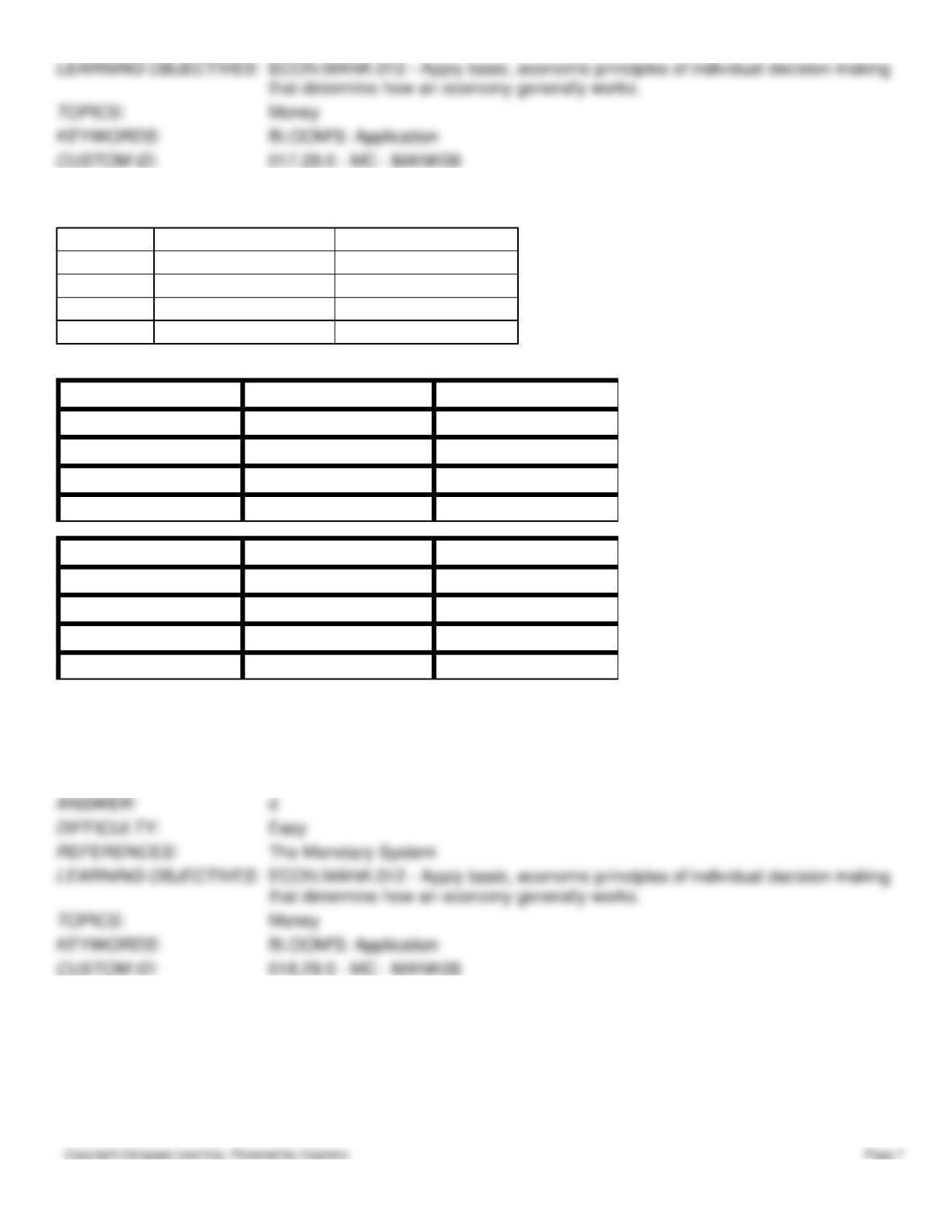
17. Consider five firms that produce different goods and services using different inputs.
Moo Farms
produces cows and
fertilizer
uses corn
Burger Shack
produces hamburgers
uses cows
Carne Castle
produces steaks
uses cows
Corny Farms
produces corn
uses fertilizer
Biomass Corp.
produces ethanol
uses corn
Which of the following pairs of firms has a double coincidence of wants?
a.
Moo Farms and Burger Shack
b.
Corny Farms and Biomass Corp.
c.
Moo Farms and Corny Farms
d.
Carne Castle and Moo Farms
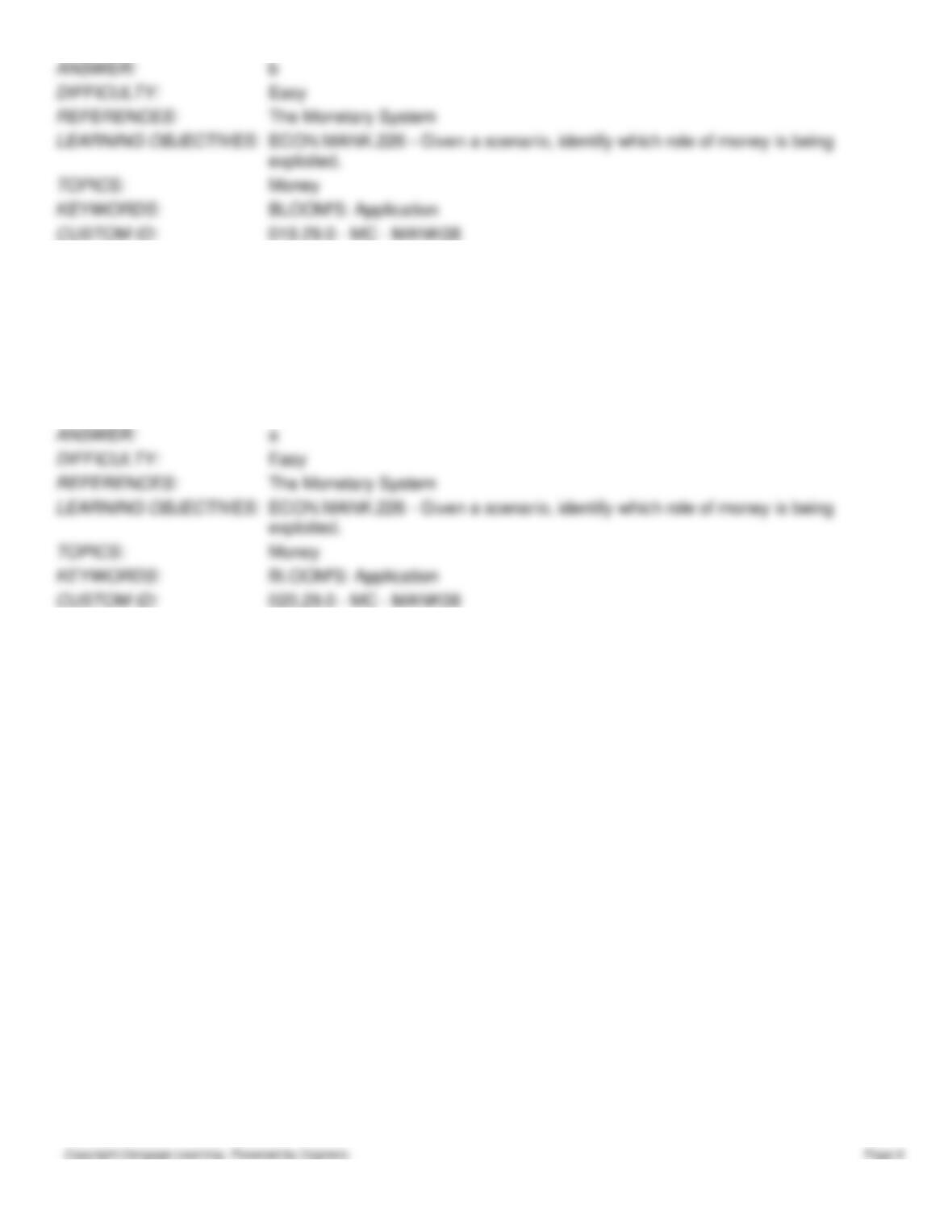
18. Consider five vendors at a swap meet.
Christine
selling blankets
buying sunglasses
Dyanne
selling sunglasses
buying socks
Eric
selling pillows
buying sneakers
German
selling socks
buying blankets
Amanda
selling sneakers
buying pillows
Which of the following pairs of vendors has a double coincidence of wants?
Moo Farms
produces cows, fertilizer
uses corn
Burger Shack
produces hamburgers
uses cows
Carne Castle
produces steaks
uses cows
Corny Farms
produces corn
uses fertilizer
Biomass Corp.
produces ethanol
uses corn
Moo Farms
produces cows, fertilizer
uses corn
Burger Shack
produces hamburgers
uses cows
Carne Castle
produces steaks
uses cows
Corny Farms
produces corn
uses fertilizer
Biomass Corp.
produces ethanol
uses corn
a.
Christine and Dyanne
b.
Eric and German
c.
Dyanne and Amanda
d.
Amanda and Eric
19. David and Asher buy the same pair of sneakers, but each in the wrong size. David proposes a size swap with Asher.
This is an example of
a.
barter, since the sneakers in the correct size represent a medium of exchange.
b.
barter, since the sneakers in the correct size have intrinsic value to both David and Asher.
c.
money, since the sneakers in the correct size do not have any intrinsic value.
d.
money, since the sneakers in the correct size represent a medium of exchange.
20. Diana tutors Tiago for two hours before his economics final exam. Tiago pays Diana through a direct transfer from his
bank on a payment app. Diana then uses her debit card to buy pizza for dinner from the local pizza parlor. This is an
example of
a.
the exchange of money facilitating production and trade.
b.
trade between two people who each have a good or service that the other wants.
c.
an inefficient allocation of scarce resources.
d.
the creation of money through monetary policy.