Subjective Short Answer
1. An important determinant of a country’s standard of living is the amount of __________ it typically experiences.
2. Some degree of unemployment is __________ in a complex economy.
3. Define the natural rate of unemployment and cyclical unemployment.
4. How does the government measure the economy’s rate of unemployment?
5. Compare the 2014 unemployment rates and labor-force participation rates of whites, blacks, adults of prime working
age (ages 25-54), and teenagers (ages 16-19).
6. Discuss the labor-force participation trends for men and women since 1950.
7. What problems arise in interpreting unemployment data?
8. Almost half of all spells of unemployment end when the unemployed person __________.
9. How are discouraged workers counted in the unemployment rate?
10. Explain how the following apparently contradictory statement can be true: Most spells of unemployment are short, and
most unemployment observed at any given time is long-term.
11. List the four ways to explain unemployment in the long run.
12. Write the formula for calculating the unemployment rate.
13. Write the formula for calculating the labor force participation rate.
Table 28-9
The table below lists the number of people by labor force classification for the country of Shelbyville.
Employed
80 million
Unemployed
20 million
Not in the Labor Force
60 million
14. Refer to Table 28-9. What is the size of the labor force, and the size of the adult population?
The labor force is 100 million, and the adult population is 160 million.
15. Refer to Table 28-9. What is the unemployment rate?
20%.
16. Refer to Table 28-9. What is the labor force participation rate?
62.5%.
17. The adult non-institutionalized population in the town of Bedrock is 75 thousand. Within Bedrock, 5 thousand are
unemployed, and 40 thousand are employed. Calculate the number of people not in the labor force.
30 thousand
18. In the town of Gotham the adult population is 560 thousand, the number unemployed is 25 thousand, and 185
thousand are not in the labor force. Calculate the unemployment rate.
6.7%
Table 28–10
The table below lists the number of people by labor force classification for the country of Springfield.
Employed
78 million
Part-time employed
22 million
Unemployed
12 million
Marginally attached
3 million
Not in the Labor Force
30 million
Discouraged
4 million
19. Refer to Table 28–10. Calculate the number in the labor force, and the unemployment rate.
The labor force is 90 million, and the unemployment rate is 13.3%.
20. Refer to Table 28–10. Calculate the number in the adult population, and the labor force participation rate.
The adult population is 120 million, and the labor force participation rate is 75%.
21. Refer to Table 28–10. Calculate the U-4 unemployment rate.
22. Refer to Table 28–10. Calculate the U-5 unemployment rate.
16.1%
23. Provide a definition of the natural rate of unemployment.
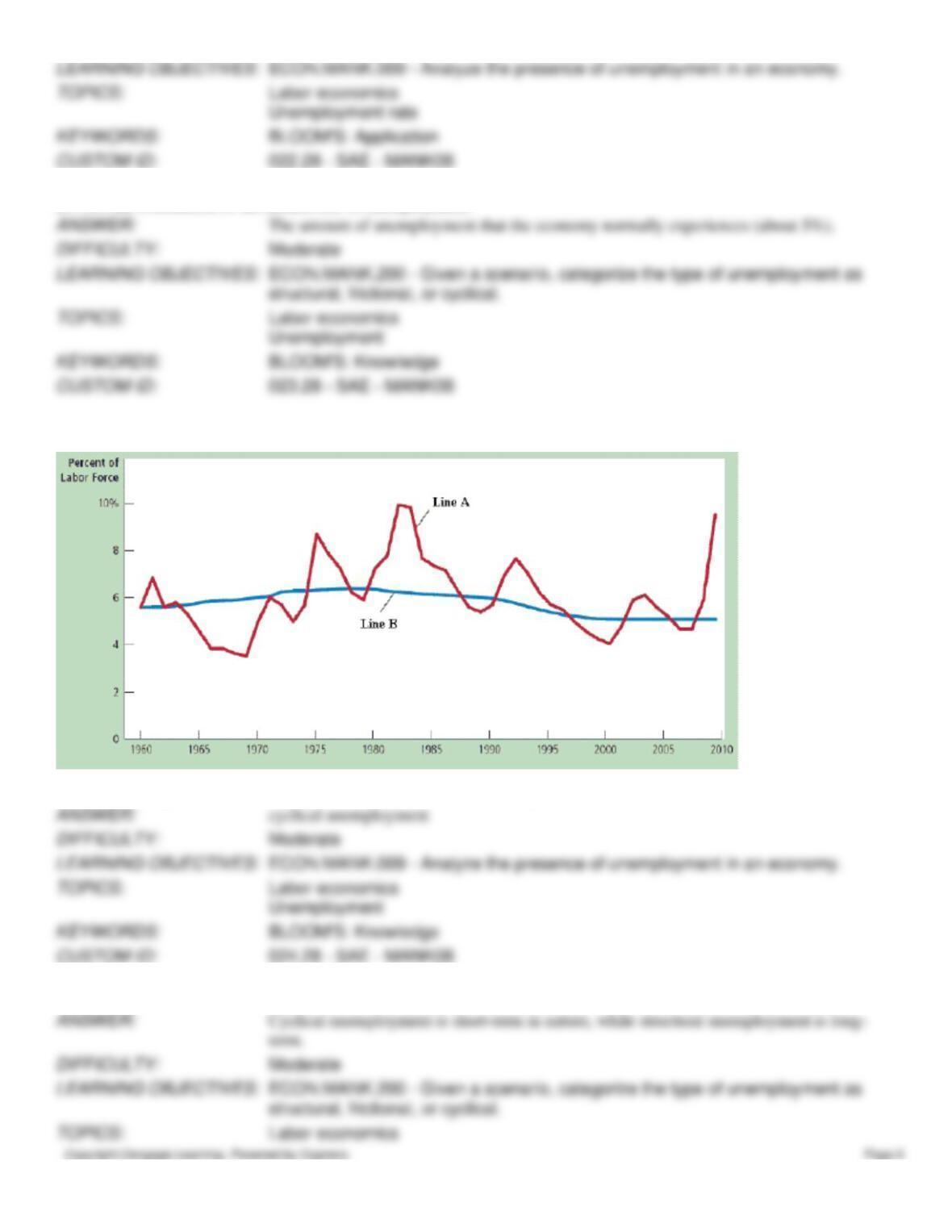
Figure 28-6
24. Refer to Figure 28-6. What type of unemployment is measured by the differences between lines A and B?
25. In terms of duration, how does cyclical unemployment differ from structural unemployment?
26. Minimum wage laws, labor unions, and efficiency wages all generate unemployment by what common mechanism?
27. Give a few examples of how sectoral shifts temporarily cause unemployment.
28. The Internet may reduce frictional unemployment because it __________.
29. Unemployment insurance __________ the amount of unemployment.
30. Briefly summarize the advantages and disadvantages of unemployment insurance.
31. Ignoring the differences across states, explain the benefit provided to the typical worker in the United States from
unemployment insurance.
32. List a few of the characteristics of workers who typically earn at or below the minimum wage.
33. Briefly compare the structural unemployment that arises from minimum-wage laws to the frictional unemployment
that arises from the process of job search.
Figure 28-7
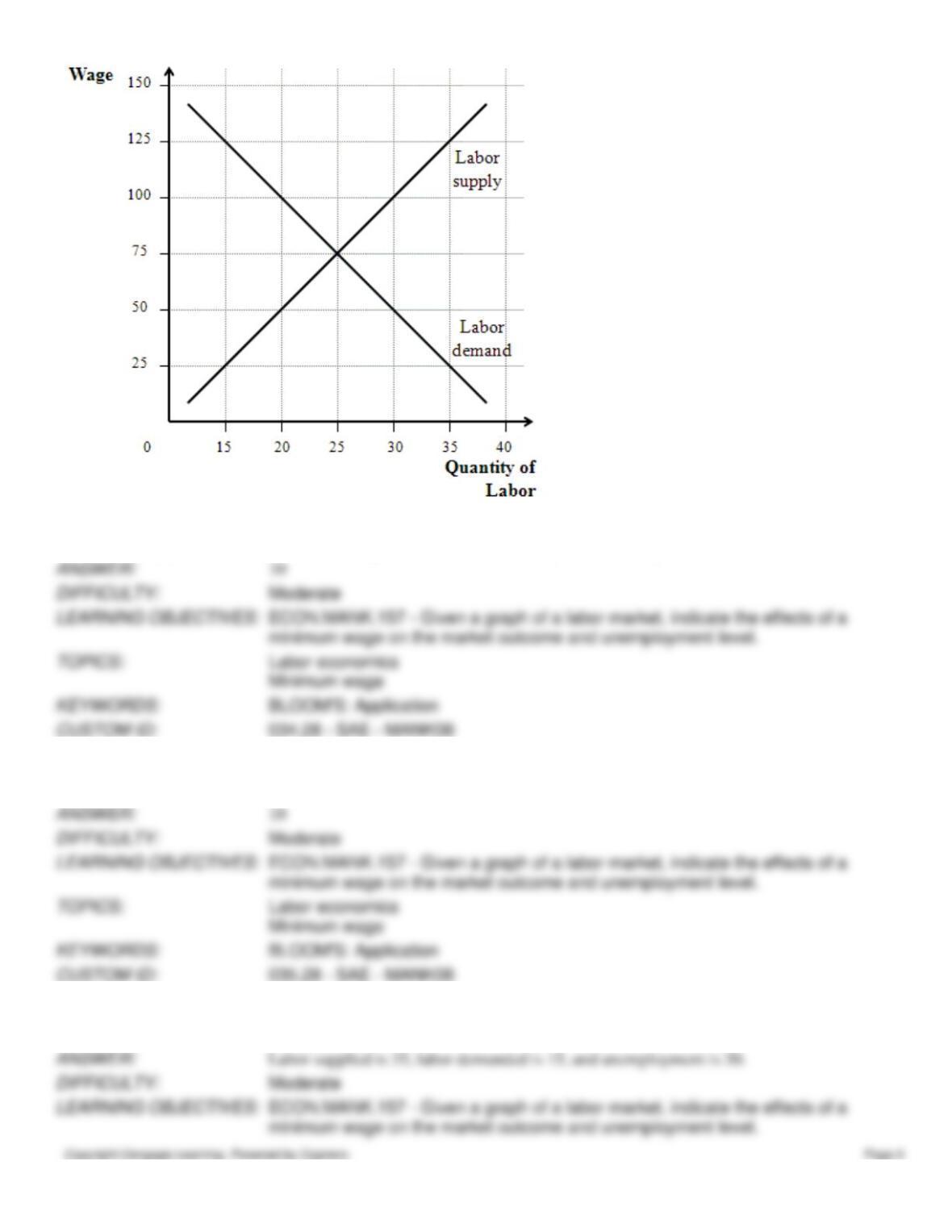
34. Refer to Figure 28-7. If the minimum wage is set at $100, how many will be unemployed?
35. Refer to Figure 28-7. If the minimum wage increases from $100 to $125, how many additional workers will be
unemployed?
36. Refer to Figure 28-7. If the minimum wage is equal to $125, what is the quantity of labor supplied, the quantity of
labor demanded, and number unemployed?
37. Refer to Figure 28-7. Without a minimum wage, what is the equilibrium level of employment? Explain what happens
to the level of employment if the minimum wage is equal to $125.
10 to a level of 15.
38. Refer to Figure 28-7. At a minimum wage of $125, how much is the surplus of labor?
20
39. A labor union is similar to a __________.
40. List the main employment characteristics over which a labor union negotiates for its workers.
41. Briefly describe how labor unions can affect wages in non-unionized industries.
42. Do economists believe that labor unions are good or bad for the U.S. economy?
43. Explain how the actions of labor unions generate greater unemployment.
44. Explain the effect of right-to-work laws on the collective bargaining power of labor unions.
45. List the four types of efficiency-wage theory.
46. Briefly explain the four rationales for efficiency wages.
47. Define efficiency wages.
48. Give an historical example of an efficiency wage that was considered by the firm to be “one of the finest cost-cutting
moves we ever made.”
49. Following the recession of 2001, there was a month in which employment and the unemployment rate both rose.
Assuming the computations were correct, how is it possible for both to have increased?
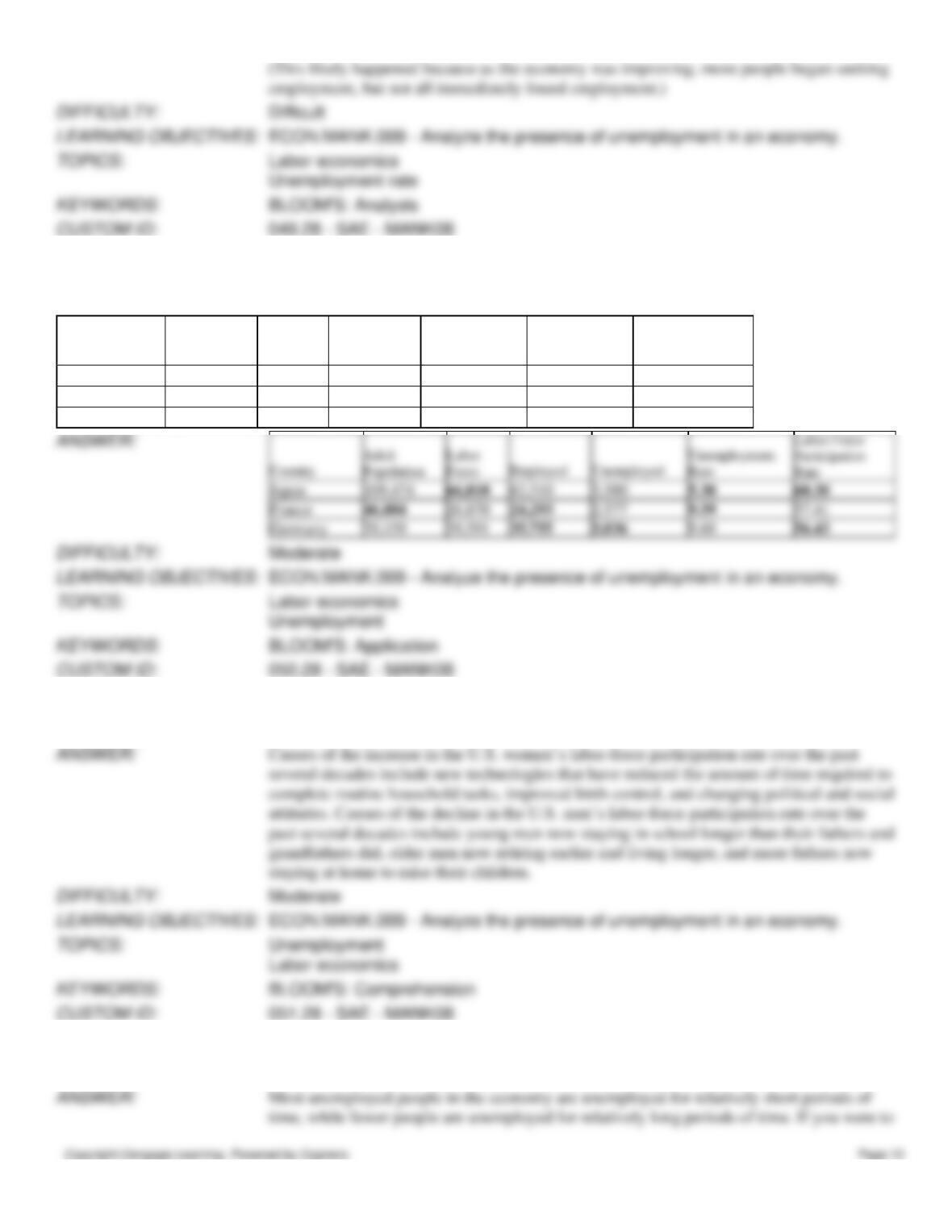
50. The table below uses data for the year 2003 provided by the Bureau of Labor Statistics and adjusted to be comparable
to U.S. data. All values are in thousands. Fill in the blank entries in the table.
Country
Adult
Population
Labor
Force
Employed
Unemployed
Unemployment
Rate
Labor-Force
Participation
Rate
Japan
109,474
62,510
3,500
France
26,870
2,577
57.41
Germany
70,159
39,591
9.69
Population
Force
Rate
Participation
51. Why have labor-force participation rates for women in the United States increased since World War II while labor-
force participation rates for men have decreased?
52. Most spells of unemployment are short, and most unemployment observed at any given time is long term. How can
this be?
53. Why might a favorable change in the economy, such as technological improvement or a decrease in the price of
imported oil, be associated with an increase in frictional unemployment?
54. Teenage unemployment is higher than unemployment of people ages 20 and over. Explain why economists would
attribute at least part of this difference to minimum-wage laws.
55. Since unemployment rates are consistently higher in Canada and some Western European countries than in the United
States, it appears that the natural rate of unemployment is lower in the United States. What might explain this difference?
56. Suppose that there is an excess supply of economics professors. Should universities necessarily reduce salaries? What
does standard economic theory suggest? What does efficiency-wage theory suggest?
57. What is the theory of efficiency wages? Provide four reasons that employers might pay efficiency wages.
58. What is the theory of efficiency wages? Provide four reasons that employers might pay efficiency wages.