Subjective Short Answer
1. For the economy as a whole, how does income compare to expenditures? Explain.
2. In the circular flow diagram what are the three types of payments from firms to factors of production? Is the sum of
these payments greater than, less than, or equal to GDP?
Figure 23–2.
3. Refer to Figure 23-2. Identify the location for markets for factors of production and markets for goods and services.
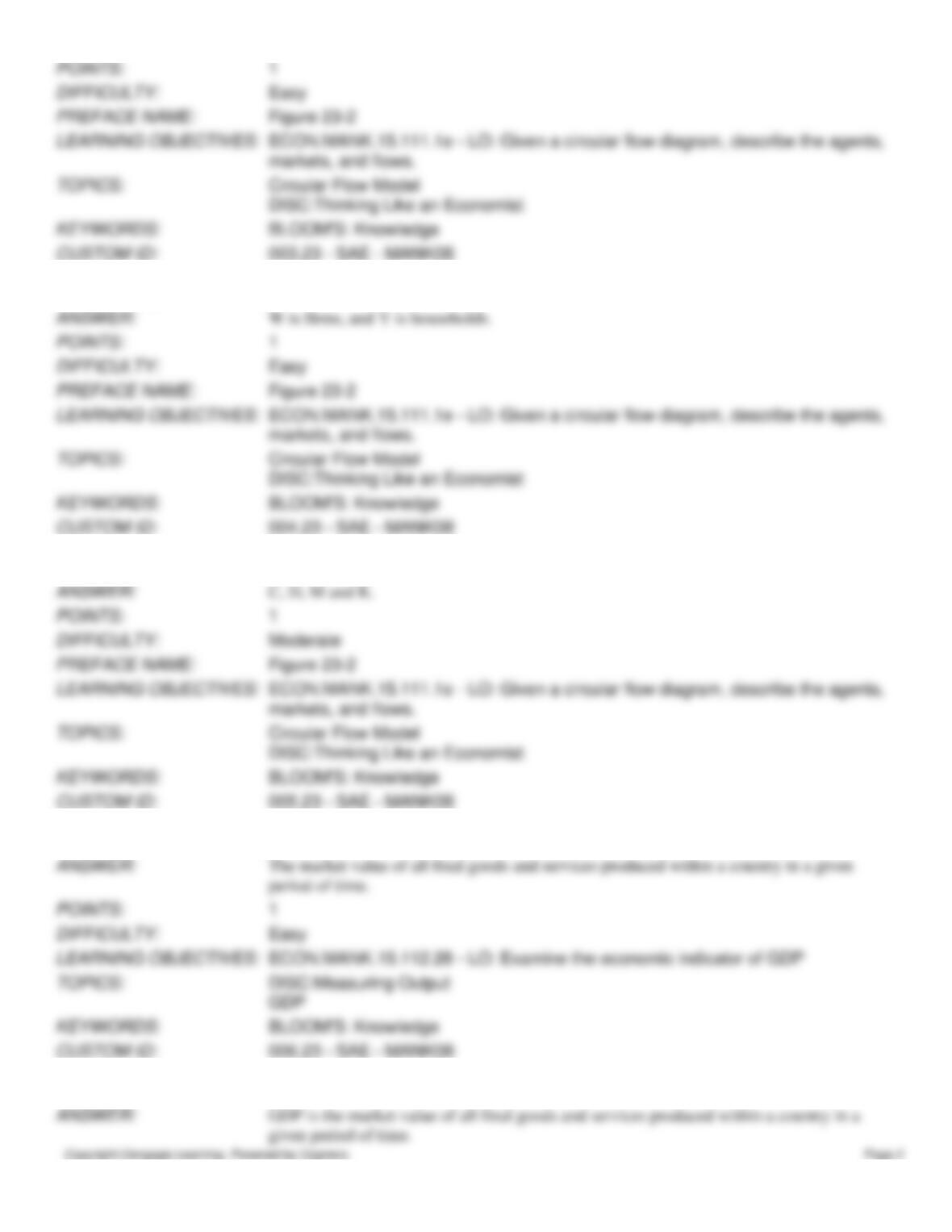
4. Refer to Figure 23-2. Identify the location of firms and households.
5. Refer to Figure 23-2. List the locations associated with the flow of inputs and outputs.
6. Define gross domestic product.
7. Define GDP. Remember to be specific about what it includes.
8. GDP excludes most of two types of production. List one.
9. Are sales of used goods included in GDP? Explain why or why not. Hint: Remember how GDP is defined.
10. Alexandria, a British citizen, owns and manages a fish and chips shop in Washington, D.C.
She buys fresh food produced by U.S. workers, pays utilities to a U.S. company, and employs only U.S. citizens. What
part, if any, of the restaurant’s production is included in U.S. GDP? What part, if any, of the restaurant’s production is
included in U.S. GNP?
11. A farmer sells sugar to a candy producer for $150. If the producer uses this sugar to make candy that sells for $200,
what is the total contribution to GDP from these transactions?
12. How frequently is U.S. GDP reported? Is GDP adjusted for seasonality?
13. Explain how GNP differs from GDP.
14. List the four components of GDP.
15. What are exports, and how are they different from imports?
16. Identify the largest and smallest components of GDP.
17. Which component of GDP includes spending on new structures and equipment?
18. What are transfer payments, and how do they affect the calculation of GDP?
19. Consumption is $5.5 trillion, investment is $1 trillion, government expenditures are $1.5 trillion, transfer payments are
$.5 trillion, exports are $.75 trillion and imports are $1.25 trillion. What is GDP?
20. Consumption is $7 trillion, investment is $1.5 trillion, government expenditures are $2 trillion, government transfer
payments are $1 trillion, exports are $1.50 trillion and imports are $1.25 trillion. What is GDP?
trillion
= $10.75 trillion
21. Calculate GDP for a country with investment of $2 trillion, government purchases of $3 trillion, capital depreciation
of $1.5 trillion, consumption of $10 trillion, exports of $3.4 trillion, and imports of $3.9 trillion.
$14.5 trillion
22. Calculate GDP for an economy with exports of $5 trillion, investment of $1.5 trillion, consumption spending of $11
trillion, imports of $6 trillion, and government purchases of $3 trillion.
$14.5 trillion
23. What three types of goods are included in investment spending?
capital equipment, inventories, and structures which includes residential construction
24. Last quarter Newton computers produced 3,000 computers. Two thousand of these computers were sold to
households, 750 were sold to businesses, and 250 were added to Newton’s inventory. How many of the computers should
have been included in last quarter’s GDP?
25. Identify which of the following are included in the government purchases component of GDP.
the salary paid to a state court judge
unemployment insurance benefits
the payment made by the federal government for a jet fighter
social security payments
a county builds a jail building
26. Foreign countries buy $1.2 trillion of U.S. goods and services. U.S. residents purchase $1.8 trillion of foreign goods
and services. What is net exports?
27. The U.S. buys $500 billion of goods and $250 billion of services from foreign countries. Foreign countries buy $250
billion of goods and $300 billion of services from the U.S. What is net exports?
28. Java Hut, a U.S. coffee retailer, buys $10 million worth of coffee beans from Colombia. It also pays $5 million for
paper cups and utilities, all produced in the U.S. It sells the coffee it produces using the above inputs to U.S. consumers
for $50 million. Overall how do these expenditure affect net exports? How do these expenditures effect U.S.
consumption?
29. A U.S.-owned automobile factory uses $50 million worth of materials produced in the U.S. and $10 million worth of
material purchased from foreign countries to produce $100 million of automobiles. $70 million worth of these
automobiles are purchased by U.S. consumers, $25 million are sold in foreign countries, and $5 million are added to
inventory. How much of this production is included in U.S. GDP? By how much do these transactions alone affect U.S.
net exports?
$90 million is included in U.S. GDP. These transactions raise net exports by $15 million.
30. Explain how real GDP differs from nominal GDP.
31. What measure of GDP shows the value of goods and services produced if we valued these good and services at the
prices that prevailed in some specific year in the past?
32. Write the formula for calculating a GDP deflator using only nominal and real GDP.
33. Write the formula for calculating a country’s inflation rate using the GDP deflator.
34. Calculate the inflation rate for a country where the GDP deflator rises from 120 to 165.
35. Nominal GDP is $15 trillion and real GDP is $10 trillion. What is the GDP deflator? Show your work.
36. Nominal GDP is $12 trillion and real GDP is $15 trillion. What is the GDP deflator? Show your work.
37. In 2012 a country had a real GDP $15.4 trillion and GDP deflator of 125. If that country’s GDP deflator equals 115 in
2013, what is the rate of inflation in 2013?
38. In 2011 a country had a real GDP of $13.89 trillion and GDP deflator of 110. In 2012 it had a nominal GDP of $17.8
trillion and real GDP of 14.24 trillion. What is the rate of inflation in 2012?
39. In 2010 a country had nominal GDP of 6 trillion euro and real GDP of 5 trillion euro. In 2011 it had nominal GDP of
6.5 trillion euro and real GDP of 5.2 trillion euro. What was its inflation rate in 2011? Show your work.
The GDP deflator for 2011 was 100 x 6.5/5.2 = 125.
The inflation rate was (125-120)/120 = 5/120 = 4.167.
Table 23–11
The country of Batavia produces only chocolates and watches. Below is a table with recent information on Batavia
production and prices. The base year is 2009.
Prices and Quantities
Year
Price of A Box of
Chocolates
Boxes of
Chocolates
Price of Watches
Quantity of
Watches
2008
$4
100
$50
10
2009
$5
90
$50
15
2010
$5
100
$60
15
2011
$6
80
$65
12
40. Refer to Table 23–11.
What was nominal GDP, real GDP, and the GDP deflator for 2008?
41. Refer to Table 23–11.
What was nominal GDP, real GDP, and the GDP deflator for 2009? Show your work.
42. Refer to Table 23–11.
What was nominal GDP, real GDP, and the GDP deflator for 2010? Show your work.
43. Refer to Table 23–11.
What was nominal GDP, real GDP, and the GDP deflator for 2011? Show your work.
44. Refer to Table 23–11.
What was the inflation rate for 2010? Show your work.
45. Refer to Table 23–11.
What was the inflation rate for 2011? Show your work.
Table 23–12
A country produces only ice cream and cake in the quantities and prices listed below. Use 2011 as the base year.
Year
Price of Ice
Cream
Quantity of Ice
Cream
Price of Cake
Quantity of
Cake
2011
$2.00
200
$10
40
2012
$2.30
250
$14
50
2013
$2.75
280
$18
80
46. Refer to Table 23–12. Calculate real and nominal GDP for the year 2012.
47. Refer to Table 23–12. Calculate real and nominal GDP for the year 2013.
48. Refer to Table 23–12. Calculate the GDP deflator for 2012 and 2013.
49. Refer to Table 23–12. Calculate the rate of inflation for 2012.
27.5%
50. Explain the pattern seen between GDP per person and quality of life measures such as life expectancy, literacy, and
Internet usage.
51. GDP is defined as the market value of all final goods and services produced within a country in a given period of time.
In spite of this definition, some production is left out of GDP. Explain why some final goods and services are not
included.
52. Explain why it is the case that the value of intermediate goods produced and sold during the year is not included
directly as part of GDP, but the value of intermediate goods produced and not sold is included directly as part of GDP.
53. Since it is counted as investment, why doesn’t the purchase of earthmoving equipment from China by a U.S.
corporation increase U.S. GDP?
the value of the equipment in investment is canceled by subtracting its value as an import.
54. Identify the immediate effect of each of the following events on U.S. GDP and its components.
a.
James receives a Social Security check.
b.
John buys an Italian sports car.
c.
Henry buys domestically produced tools for his construction company.
c.
This increases the investment component of GDP and so increases GDP.
55. Between 1929 and 1933, NNP measured in current prices fell from $96 billion to $48 billion. Over the same period,
the relevant price index fell from 100 to 75.
a.
What was the percentage decline in nominal NNP from 1929 to1933?
b.
What was the percentage decline in real NNP from 1929 to 1933? Show your work.
$64 b. Real NNP fell from $96 billion to $64 billion, a decline of 33 percent.
56. You find that your paycheck for the year is higher this year than last. Does that mean that your real income has
increased? Explain carefully.
57. U.S. real GDP is substantially higher today than it was 60 years ago. What does this tell us, and what does it not tell
us, about the well-being of U.S. residents?