Page 1
1.
Which of the following mistakes did McDonald’s make when it printed takeout bags
decorated with flags from around the world?
A)
The bags showed a pair of hands holding a flag in a way that customers in some
cultures would interpret as an obscene gesture.
B)
The bags showed a Saudi flag, which depicts holy scripture from the Koran. The
Saudis were offended because these bags would be thrown out.
C)
The writing on the bags was in English, which offended numerous nonnative
speakers.
D)
All responses are correct.
2.
According to Chapter 5, what should you do once you have analyzed your audience and
purpose?
A)
Begin drafting.
B)
Conduct research.
C)
Get management’s approval.
D)
Outline the document.
E)
Complete an audience profile.
3.
Which terms below are used in Chapter 5 to describe types of audiences? (Select both
answers.)
A)
supplemental
B)
primary
C)
secondary
D)
fundamental
4.
Chapter 5 identifies seven categories of cultural variables “on the surface.” One category
is political. Which of these is NOT a category of surface cultural variables?
A)
economic
B)
social
C)
religious
D)
philosophical
E)
technological
5.
Chapter 5 suggests that you consider five other individual characteristics of readers in
addition to education. Which two of the following characteristics does the chapter
suggest you consider? (Select both answers.)
A)
the reader’s professional experience
B)
the reader’s gender
C)
the reader’s temperament
D)
the reader’s job responsibility
E)
None of the above responses are correct.
Page 2
6.
Why should you use an audience profile sheet for a writing project?
A)
It prompts you to ask questions about your target audience.
B)
It helps you remember what you’ve learned about your target audience.
C)
It helps you realize when you need to learn more about your target audience.
D)
All responses are correct.
7.
Which of these is a cultural variable “on the surface” that is easily observed?
A)
tolerance of uncertainty
B)
distance between ranks
C)
distance between business and private life
D)
prevalence of religion
8.
Which of these is NOT a variable “beneath the surface” of daily life in a culture?
A)
distance between ranks
B)
need to spell out details
C)
prevalence of technology
D)
distance between business and private life
9.
According to Chapter 5, which approach is best when writing for multiple audiences?
A)
a linear approach
B)
an experiential approach
C)
a modular approach
D)
an attitudinal approach
10.
Your supervisor might have several purposes in mind as he or she reads your
documents. Which of the following describes one possible purpose?
A)
to determine whether you should be assigned to this kind of project in the future
B)
to determine the current status of the project you are describing
C)
to evaluate part of your job performance
D)
All responses are correct.
Page 3
11.
Which of the factors listed below did the writer of the following memo fail to take into
account?
TO: University Faculty Advisers
FROM: David Gates, Ph.D., Department of Psychology
SUBJECT: New course offered—PSYC 499, Self-Fulfillment in a Global Society
Enclosed is a flyer briefly describing PSYC 499. After you read through the flyer, post
it in a conspicuous place, e.g., on your door. Or, better yet, make copies and hand it out
in your class. The course will explore how our society can maintain a sense of self in
these increasingly uncertain times. So tell students in your courses and your advisees
about this new timely course.
A)
reader’s attitude toward the writer
B)
reader’s attitude toward the subject
C)
reader’s expectations about the subject
D)
reader’s expectations about the document
E)
All responses are correct.
12.
Your company has completed an audience analysis for the manual you are writing for
users of a new accounting system. The manual will be given to the 750 employees in the
company’s accounting department. Some members of the audience are experienced
accountants and others are not; some have MBA degrees and others have bachelor’s or
associate’s degrees; some were recently hired and some are long-term employees; some
are managers and some are bookkeepers. How might you best accommodate your
audiences?
A)
Include different sections for the different audiences.
B)
Write the manual to the lowest level of the audience.
C)
Write the manual to the highest level of the audience.
D)
Prepare an audience profile sheet.
13.
You are writing a report advocating that your company increase its use of social media.
Your manager has said several times that she does not like to mix social media and
business. She has pointed out several social-media problems that other companies have
created for themselves. Which purpose statement would be best for a report to your
manager?
A)
The purpose of this report is to show how the coolest social-media apps can deliver
content to a hip, urban audience.
B)
The purpose of this report is to prove that social-media disasters rarely happen and
that social media are the wave of the future.
C)
The purpose of this report is to demonstrate how the speed and flexibility of social
media can help our company reach a growing audience of young adults with
controlled, targeted messaging.
D)
The purpose of this report is to show how our company can get on the social-media
bandwagon before it is too late.
Page 4
14.
You are writing a proposal to restructure your department’s organizational chart. Your
manager was a member of the committee that originally set up the department’s current
structure. Which purpose statement would be best for a proposal to your manager?
A)
The purpose of this proposal is to show how we can reorganize our department to
improve our efficiency while keeping intact the values that have allowed us to
succeed to this point.
B)
The purpose of this proposal is to show how to solve all of our productivity
problems and remove all the barriers to effective communication.
C)
The purpose of this proposal is to show why it’s time for “out with the old and in
with the new.”
D)
The purpose of this proposal is to explain why we have no choice but to scrap our
ineffective organizational structure.
15.
Which phrase best defines the purpose of a workplace document?
A)
what you want to accomplish with the document you are producing
B)
what you propose to do when you receive permission
C)
what you want to display in words or images
D)
what you want to document for clarity
16.
Which of these is an example of a workplace document?
A)
a podcast about Internet servers
B)
an oral presentation about selecting appropriate insurance coverage
C)
a video describing how a piece of equipment works
D)
All responses are correct.
17.
You are writing a report about new regulations that affect your company. Your primary
audience of company executives is very busy and will read your report quickly, but
secondary- and tertiary-audience members are likely to read more slowly and carefully.
Which of the following options is most appropriate for your situation?
A)
Include detailed footnotes on each page.
B)
To save time, omit the executive summary and put more details in the body of your
report.
C)
Follow the patterns of writing that were successful for you in college English and
history classes.
D)
Break your report into modules and put highly detailed information in an appendix.
Page 5
18.
Chapter 5 discusses certain variables that lead to differences among cultures. Which of
these statements about cultural variables is true?
A)
Different organizations within the same culture can vary greatly.
B)
Cultural variables line up in clear, predictable patterns.
C)
Each variable represents a small number of attitudes.
D)
An organization’s cultural attitudes tend to be static over time.
19.
One way to learn about the primary reader of your document is to interview people who
know him or her. Which of these questions is NOT likely to help you learn useful
information about your primary reader?
A)
Does this person prefer to read hard-copy documents or electronic documents?
B)
Does this person prefer to read detailed information or a summary that provides a
big picture?
C)
Does this person tend to review the sources listed in a bibliography after reading a
report?
D)
Does this person attend chapter meetings of professional associations?
20.
You work for a semiconductor manufacturer. You are writing a quarterly report on the
activities within your section of the company. One of the people who will read your
report is Lila Waltman, divisional vice president. You search online for information
about her. Which piece of information is most likely to help you as you write the report?
A)
Lila is an active member of the local chapter of IEEE, a professional society for the
electronics industry.
B)
Lila is an active member of the local chapter of her university’s alumni association.
C)
Lila is an active member of the community board for a local animal shelter.
D)
Lila is an active member of a distance-running group.
21.
According to Chapter 5, a good way to learn about your readers’ preferences is to read
documents they have written.
A)
True
B)
False
22.
The following passage would be appropriate for a document aimed at a multicultural
audience:
Two companies found themselves in the financial equivalent of sudden-death overtime.
The first to raise the necessary capital would be the one to survive.
A)
True
B)
False
Page 6
23.
According to Chapter 5, if you think your document will have a number of readers, you
should consider writing a variety of documents addressed to different kinds of readers.
A)
True
B)
False
24.
In considering your audience’s education, you should focus primarily on the types of
academic degrees readers have earned.
A)
True
B)
False
25.
Although many aspects of private life and community life differ from culture to culture,
in most developed countries business is conducted in more or less the same way.
A)
True
B)
False
26.
The point of learning about your audience is to use that information to tailor a document
to fit the audience’s needs.
A)
True
B)
False
27.
Interviews are great for learning from your audience but not for learning about your
audience.
A)
True
B)
False
28.
In some cultures, it would be considered rude to create a document that contains
information the audience already knows.
A)
True
B)
False
29.
When working with a reader who is hostile to your subject or to your approach to the
subject, you should first state your position, followed by your rationale for that position.
A)
True
B)
False
Page 7
30.
Social-media activities can provide an organization with signficant information about
members of their target audiences.
A)
True
B)
False
31.
As you complete assignments, why should you consider not only your instructor’s
expectations but also the audience and purpose specified in those assignments?
32.
Chapter 5 lists three specific reasons a writer should analyze his or her audience during
the planning phase. One is so that the document appeals to the audience’s interests and
needs. What are the other two reasons?
33.
Chapter 5 describes three categories of audience. What are they?
34.
What mistake did McDonald’s make when it printed takeout bags decorated with flags
from around the world?
35.
Chapter 5 suggests that, in addition to education, you should consider five other
individual characteristics of readers. What is one other individual characteristic listed in
the chapter?
36.
Chapter 5 lists seven categories of cultural variables that lie “on the surface.” Two of
these categories of variables are political and economic. Name two more.
37.
Why are LinkedIn profiles a particularly useful resource for learning about one’s
audience?
38.
According to Chapter 5, for what primary purpose do private companies use
social-media data?
39.
According to Chapter 5, how do public agencies use social-media data?
40.
Why are graphics especially useful when communicating with people from other
cultures?
Page 8
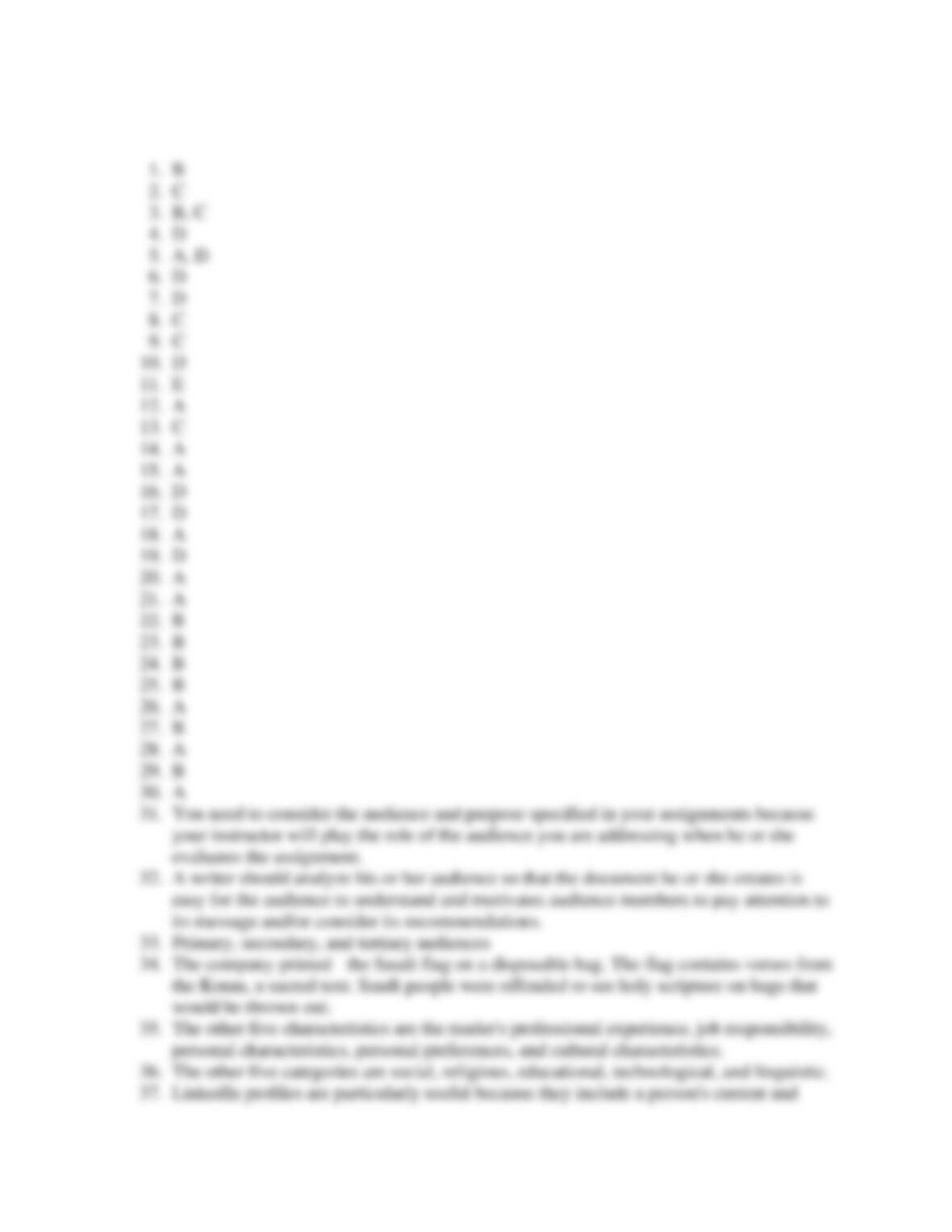
Answer Key
Page 9