Page 1
1.
Chapter 4 discusses five aspects of conducting meetings, one of which is setting your
team’s agenda. What are two of the other aspects? (Select both answers.)
A)
minimizing scheduling conflicts
B)
creating a style sheet
C)
defining tasks for each member
D)
none of the above
2.
According to the research cited in Chapter 4, which two of the following behaviors
might students from other cultures exhibit? (Select both answers.)
A)
unwillingness to respond with a definite “no”
B)
reluctance to initiate new tasks or perform creatively
C)
unwillingness to meet at certain times
D)
routinely arriving late for team meetings
3.
According to Chapter 4, one way to listen more effectively is to pay attention to the
speaker. What are two other ways? (Select both answers.)
A)
Listen for main ideas.
B)
Take notes while the speaker is speaking.
C)
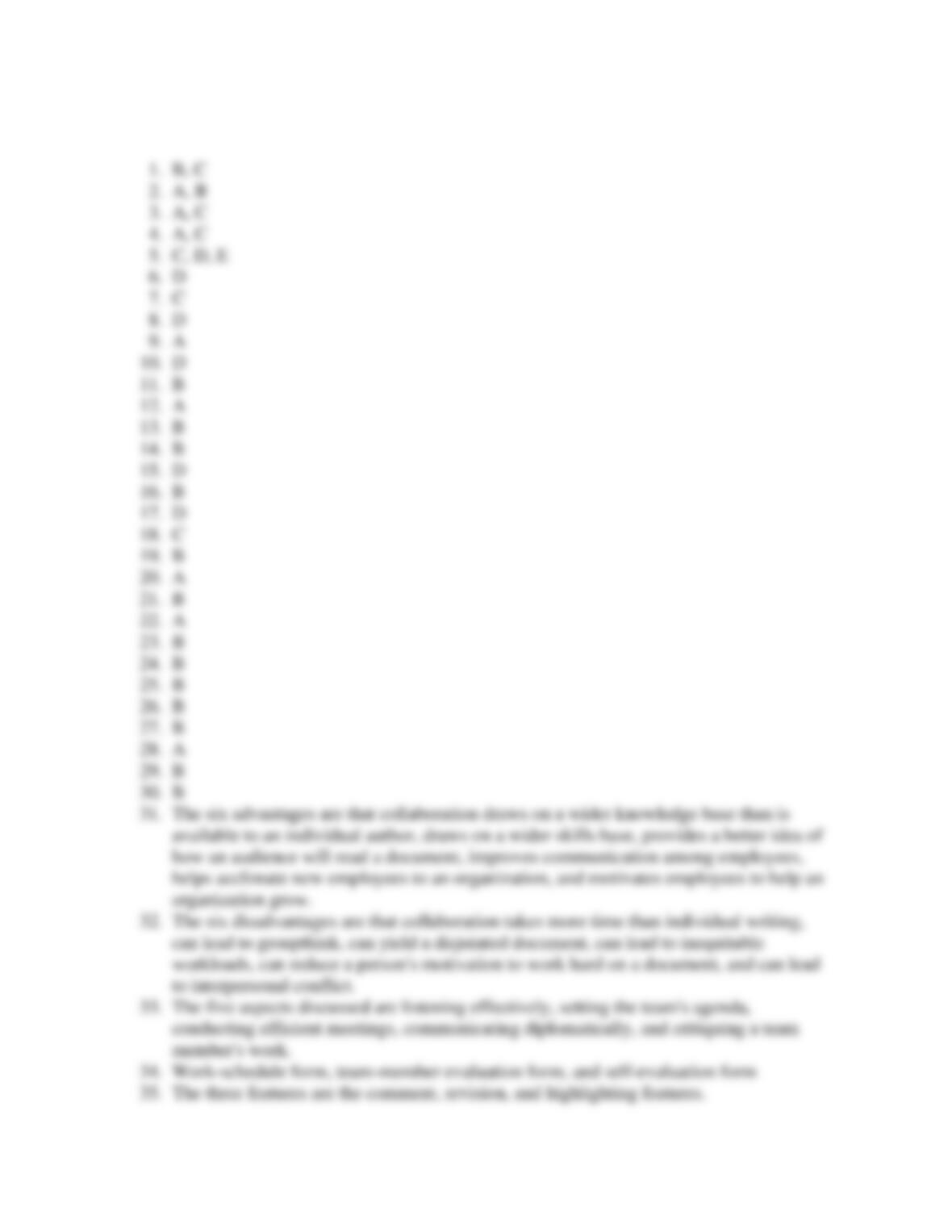
Avoid getting emotionally involved with the speaker’s ideas.
D)
Tape-record what the speaker is saying.
4.
Which three of the following forms are discussed in Chapter 4 as tools to help ensure
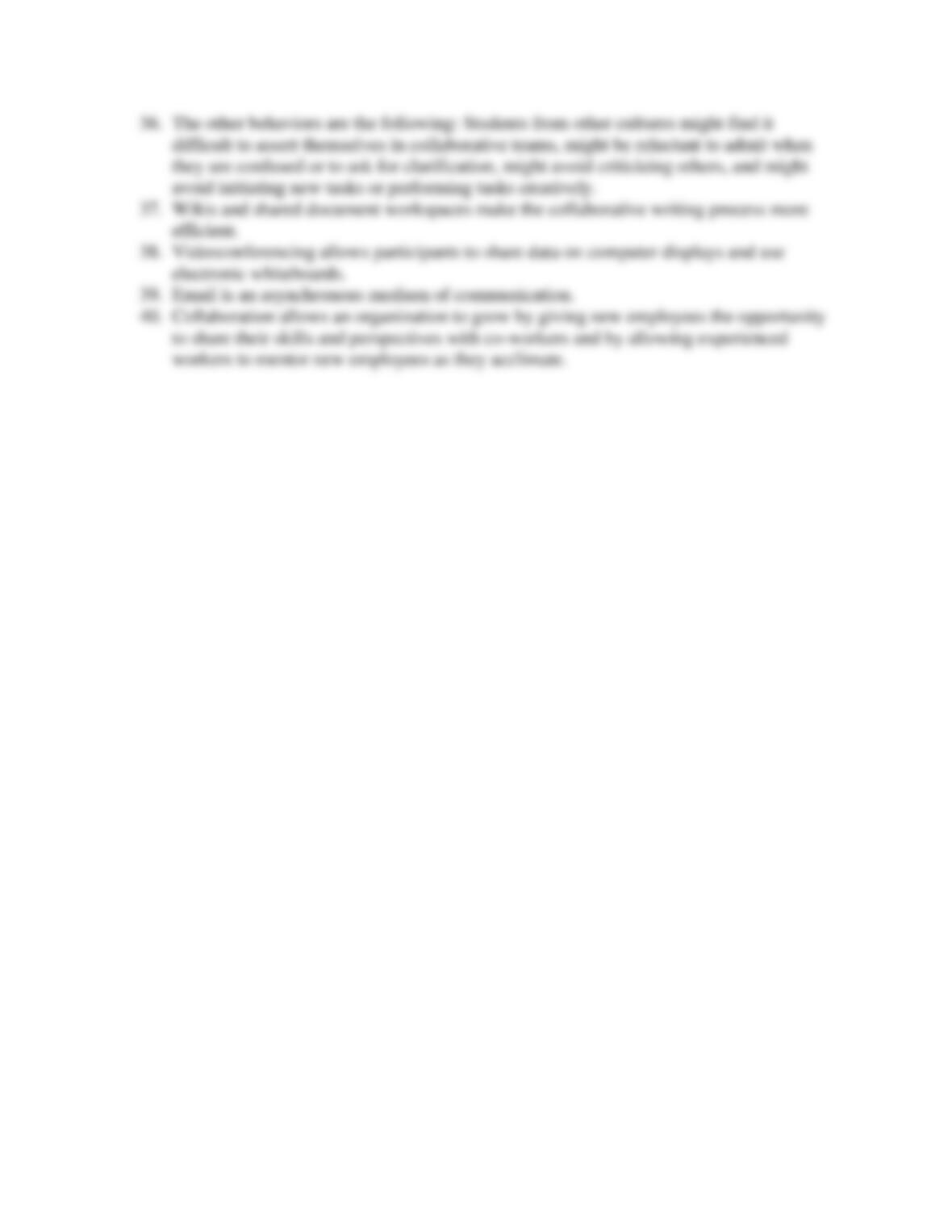
that a team’s efforts will be successful? (Select the three that apply.)
A)
work-schedule form
B)
task-deadline form
C)
self-evaluation form
D)
team-member evaluation form
5.
According to Chapter 4, which three of the following features of word-processing
software are particularly useful in collaboration? (Select the three that apply.)
A)
thesaurus feature
B)
spell-checker feature
C)
revision feature
D)
comment feature
E)
highlighting feature
Page 2
6.
Chapter 4 offers seven suggestions for managing projects. Which of the following is
NOT a suggestion from the chapter?
A)
Break a large project into several smaller tasks.
B)
Put your decisions in writing.
C)
Monitor the project regularly.
D)
Follow your original schedule strictly to avoid falling behind.
7.
Chapter 4 offers several suggestions for conducting efficient meetings. Which of these
is NOT a suggestion from the chapter?
A)
Be aware of group members’ body language and nonverbal communication.
B)
Have one team member write down the decisions made at each meeting.
C)
Avoid a formal schedule and make sure each team member gets to say whatever is
on his or her mind.
D)
Summarize the major decisions and assign tasks to finish before the next meeting.
8.
Chapter 4 offers seven suggestions for communicating diplomatically. Which of these is
a suggestion from the chapter?
A)
Avoid qualifier statements such as “I think . . . .” or “It seems to me . . . .”
B)
Use strong language—it is better to appear overbearing than to appear weak and
indecisive.
C)
Follow your emotions if someone opposes you.
D)
Ask pertinent questions.
9.
Which of these statements about working with someone from another culture is true?
A)
A topic of discussion that is common in one culture might be considered highly
personal in another culture.
B)
People from other cultures are likely to find it easy to participate actively in group
projects.
C)
People from other cultures have a knack for delivering criticism to teammates.
D)
People from other cultures are likely to find it easy to ask for help on a project.
10.
Chapter 4 offers six suggestions for participating in a videoconference. Which of these
is NOT a suggestion from the chapter?
A)
Practice using the videoconferencing system.
B)
Dress as you would for a face-to-face meeting.
C)
Arrange for technical support for all participants.
D)
Speak louder than usual.
Page 3
11.
Which of the following is likely to cause a team writing collaboratively to produce an
inferior document?
A)
The team shares a common goal.
B)
The team avoids conflict.
C)
Team members act as the audience for the document.
D)
Team members divide up the workload.
12.
A project manager is using a word processor to review an electronic file of a document
written by a team member, and she does not understand the meaning of a term used in
the document. What should the project manager do?
A)
Use the comment feature to ask “Will the reader understand this term?”
B)
Delete the term using the revision feature.
C)
Check the change bar for an explanation.
D)
Use the highlighting feature to call the writer’s attention to the term.
13.
A team of writers is just beginning a new documentation project. The client for the
team’s last project complained that the completed document kept switching from active
to passive voice and that the design of the headings was not visually consistent. Which
of the following is the team’s best approach to avoiding such problems on the current
project?
A)
Discuss cultural differences.
B)
Create a style sheet.
C)
Create a document template.
D)
Establish clear work procedures.
14.
A writer is commenting on a first draft of a technical report written by another team
member. Which of the following comments is most appropriate?
A)
“You’ve really improved your editing skills, Brian. Your writing would be less
confusing if you used more active voice. Similarly, your report would be even
better if you used some bulleted lists to break up some of your longer paragraphs.”
B)
“Section 3 does a great job of making a case for the importance of our usability
testing. Perhaps we should also include a graph showing a decrease in
customer-service calls since we started testing. We may also want to add a section
on user feedback.”
C)
“I’m working on several different projects right now. I’ve been able to proof the
document. However, I leave it to you to check its organization. Also, I feel you
didn’t sell me on the benefits of usability testing.”
D)
“Use Arial Bold for all headings. Change on-line to online. Delete section 4. Add a
map of the site in section 2. Otherwise, you are on the right track. Good work,
Kathy.”
Page 4
15.
Which of these guidelines is NOT likely to help your team work effectively and
efficiently?
A)
Choose a team leader.
B)
Establish procedures for resolving conflict productively.
C)
Establish a work schedule.
D)
Let team members assign themselves tasks.
16.
Which of these guidelines will help you listen effectively?
A)
Write down everything the speaker says.
B)
Ask questions to clarify what the speaker said.
C)
Keep your eyes down and avoid distracting the speaker.
D)
Allow your mind to wander and trust that you will be able to refocus.
17.
How can a team benefit from members who come from different cultures?
A)
Team members can provide a broader understanding of how members of the
audience will respond to a document.
B)
A cross-cultural team can view a problem from more perspectives than a
mono-cultural team.
C)
A cross-cultural team can help create products and services that are better suited
for markets around the world.
D)
All responses are correct.
18.
Which of these comments about a team member’s report draft is the least diplomatic?
A)
I like the statistics that you provide in the introduction. I wonder if the audience
will recognize these sources you consulted.
B)
This introduction shows a lot of hard work. Perhaps an additional example would
make your point even stronger.
C)
You did not write this introduction very well. You left out a lot of important
background information.
D)
I know the proposal reviewers have very high standards. I think we all will benefit
from improving our proofreading skills.
19.
Which of the following does NOT overstate the speaker’s position?
A)
I know one of the members of the review panel, and I am positive that he will stick
up for us when they pick their finalists.
B)
We prepared our document carefully, and I think we have highlighted our strengths
successfully.
C)
We’re the indisputable leaders in this market niche. There’s no way anyone can
offer better features than we do.
D)
It is not possible that anyone is more qualified for this job than we are.
Page 5
20.
What is an advantage of collaboratively creating a document in a shared workspace
rather than working collaboratively on a document via email?
A)
A shared workspace will create an archive of all the changes made by all team
members.
B)
A shared workspace ensures that only one person can read a document at a time.
C)
A shared workspace will create backup files once per day.
D)
A shared workspace ensures that only one format of a file will be available.
21.
According to Chapter 4, the differences in behavior between two men or between two
women are likely to be fewer and less pronounced than the differences between men and
women in general.
A)
True
B)
False
22.
According to Chapter 4, one advantage of collaboration is that it helps acclimate new
employees to an organization.
A)
True
B)
False
23.
According to Chapter 4, one advantage of collaboration is that it can yield a more
coherent document.
A)
True
B)
False
24.
According to Chapter 4, one of the disadvantages of collaboration is that it is likely to
lead to charges of sexual harassment, sexual discrimination, or both.
A)
True
B)
False
25.
All of the participants in a video conference must be in dedicated conference rooms with
sophisticated cameras and microphones.
A)
True
B)
False
26.
Communicating diplomatically involves a critical tone.
A)
True
B)
False
Page 6
27.
Employees rarely use social media and personal electronics to complete work tasks.
A)
True
B)
False
28.
Companies sometimes use virtual worlds, such as Second Life, to conduct meetings and
conferences.
A)
True
B)
False
29.
Differences between the ways men and women work in teams are hard to notice.
A)
True
B)
False
30.
When critiquing the work of a team member, save a big compliment for the last
comment in order to end on a positive note.
A)
True
B)
False
31.
What is one of the advantages of collaboration mentioned in Chapter 4?
32.
What is one of the disadvantages of collaboration mentioned in Chapter 4?
33.
Chapter 4 discusses five aspects of conducting meetings, a crucial component of
collaboration. What are two of those aspects?
34.
Chapter 4 contains examples of three forms that collaborative teams can use to help
ensure that the team’s efforts will be successful. List the forms.
35.
Chapter 4 discusses three features of word-processing software that are particularly
useful in collaboration. Name one feature.
36.
According to the research cited in Chapter 4, students from other cultures may be
unwilling to respond with a definite “no” in a collaborative setting. What is one other
behavior that students from other cultures might exhibit in a collaborative setting?
Page 7
37.
What two technologies make the collaborative writing process more efficient?
38.
Videoconferencing allows two or more people in separate locations to see and hear
each other simultaneously. What other two activities does videoconferencing allow
participants to perform?
39.
Is email a synchronous or an asynchronous medium of communication?
40.
In what way does collaboration allow an organization to grow?
Page 8
Answer Key
Page 9