Chapter 3: Perception of Self and Others
Multiple Choice Questions
1. Cameron asks you to share one of the four sources for the development of self-concept.
b) your shoe size
c) your age
d) the car you drive
2. Network spread is __________.
a) how many social network sites you are on
b) how many stations your television receives signals for
c) your number of friends on Facebook
d) how many electronic devices you own
3. Your self-concept develops from at least three of the following sources: __________.
a) books you read, your parents, and your own evaluations within your culture
b) comparisons with others, others images of you, and your own evaluations within your
culture
c) others images of you, movies/films/pictures, and comparisons with others
d) your own cultural interpretations, social comparisons with others, and physical
activities
4. Social networking sites allow us to compare ourselves to others through __________.
a) Twitter activities
b) Myers-Briggs
c) Nielsen ratings
d) LexisNexis
5. The Johari window has four quadrants containing four different selves. They are
__________.
a) hidden, blind, social, open
b) open, hidden, unknown, social
c) unknown, blind, hidden, open
d) unknown, social, blind, aware
6. Which self in the Johari model represents all the things about yourself that others know
but of which you are ignorant?
a) unknown
b) blind
c) open
d) hidden
7. Which self in the Johari model represents all the things that characterize you that both
you and others know?
a) hidden
b) social
c) blind
d) open
8. Which self in the Johari model represents all that you know about yourself that you
keep secret from others?
a) open
b) unknown
c) blind
d) hidden
9. Which self in the Johari model represents truths that exist but that neither you nor
others know?
a) unknown
b) hidden
c) blind
d) social
37
10. Asking yourself about yourself is __________.
a) egocentric
b) a way to increase your open self
c) a way to increase self-awareness
d) counterproductive
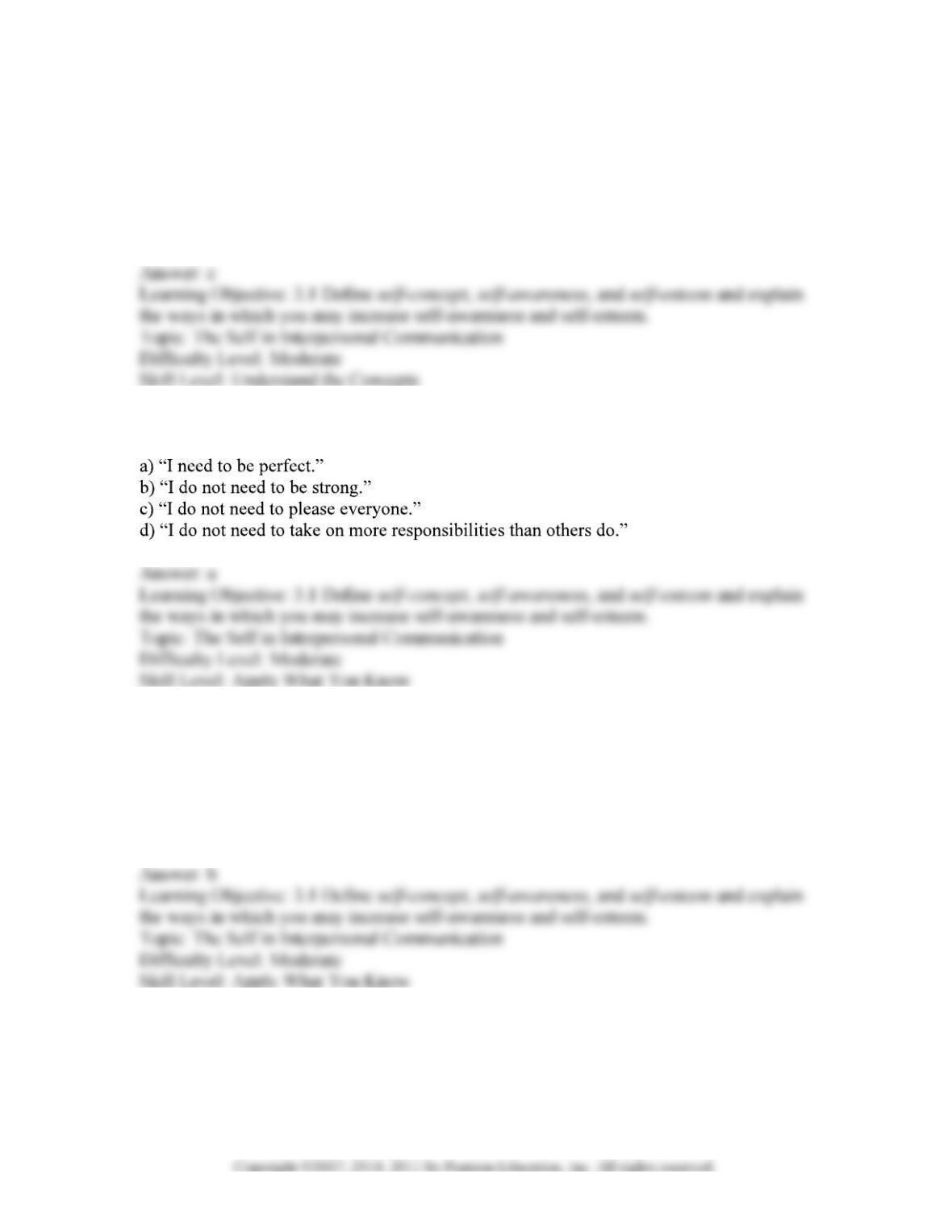
11. A self-destructive belief would be __________.
12. To increase his self-esteem, Richard should __________.
a) continue to relive his past mistakes
b) work on projects that will result in success
c) seek out noxious people
d) point out the mistakes of others
13. Which of the following is healthy for your self-esteem?
a) Seeking out negative people.
b) Seeking out nourishing people.
c) Seeking out sad people.
d) Seeking out confused people.
14. Which of the following is beneficial for your self-esteem?
a) Reminding yourself of your successes.
b) Reminding yourself of your failures.
c) Engaging in destructive relationships.
d) Engaging in self-doubt.
15. Which of the following is an example of an affirmation?
a) I am a responsible person.
b) I would do better in class if the teacher were nicer.
c) I flunked the test because the test was too hard.
d) I could be a better partner if my significant other were kinder to me.
16. Which of the following is one of the five stages of interpersonal perception?
a) stimulation
b) affirmation
c) visualization
d) self-awareness
17. A(n) __________ is a prediction that comes true because you act on it as if it were
true.
a) impression formation
b) self-fulfilling prophecy
c) halo effect
d) primacy effect
18. According to personality theory, which of the following characteristics best
completes this sentence: Anil is smart, good-looking, and __________.
a) likable
b) snobby
c) unfriendly
d) shy
19. The idea that first impressions are likely to be the most important can be attributed to
__________.
a) the halo and reverse halo effects
b) attribution of control
c) the primacy effect
d) consistency theory
20. Which of the following statements supports consistency theories?
a) I expect a person that I like to like me.
b) I expect my friend to dislike my friends.
c) I expect my friend to like my enemies.
d) I expect a person I dislike to like me.
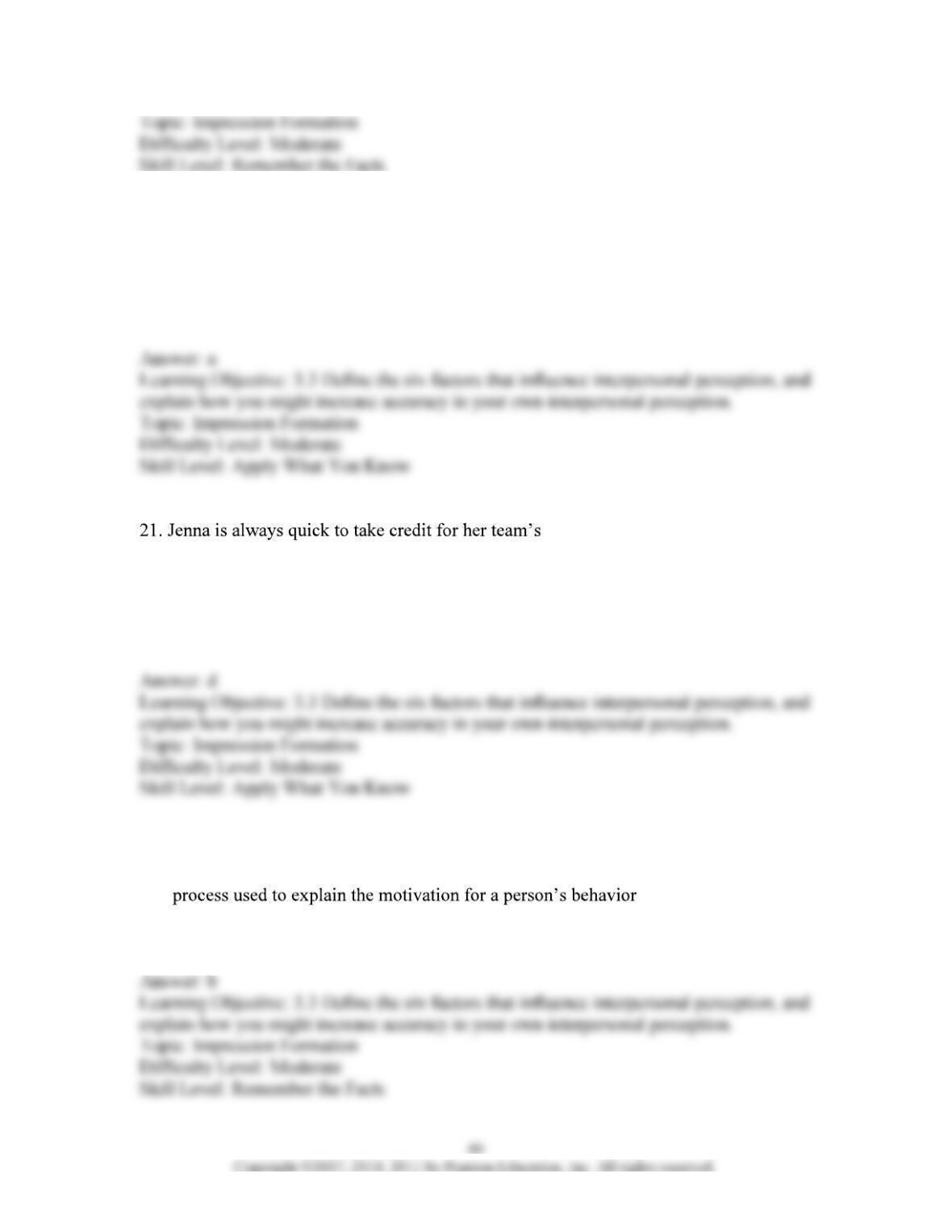
accomplishments, but is equally
quick to deny any involvement in its failures. This is an example of __________.
a) fundamental attribution error
b) overattribution
c) inconsistency
d) self-serving bias
22. Attribution is __________.
a) giving someone credit for the work they have done
b) a
c) a method to cite sources in research papers
d) taking credit for work you have done
23. Kara is a single mother who comes to work looking disheveled and unorganized. If
a) fundamental attribution error
b) overattribution
c) inconsistency
d) self-serving bias
24. Strategies people use to make others like them are __________.
a) justification
b) affinity-seeking
c) positive tone
d) reciprocity
25. __________ is the desire to be viewed positively and thought of favorably by others.
a) Halo effect
b) Influencing strategy
c) Negative face
d) Positive face
42
True/False Questions
26. The blind self quadrant of the Johari window contains all that you know of yourself
but that you keep to yourself.
27. The unknown self quadrant of the Johari window represents all the things about
yourself that others know but of which you are ignorant.
28. To each person who knows you, you are a somewhat different person.
29. When you recall information, you may recall it with a variety of inaccuracies.
30. The halo effect means that if someone has some positive qualities, you are likely to
associate him/her with other positive qualities.
31. Perceptual accentuation leads you to see what you expect or want to see.
32. If what comes first exerts the most influence, you have a recency effect.
33. Overattribution occurs when we overanalyze a communication situation because of
our low self-esteem.
34. Impression management refers to the process you go through to create the impression
you want others to have of you.
35. Self-handicapping strategies are used to attack difficult tasks.
Fill-in-the-Blank Questions
36. The Johari window is a model of the four __________.
37. Self-awareness allows you to identify your __________ and __________ so that you
can focus on them appropriately.
38. Actively seek out information to reduce your __________ self.
45
39. Self-esteem is a measure of how _________ you think you are.
40. __________ is the tendency to single out one or two obvious characteristics of a
person and believe that everything about the person is due to those characteristics.
41. Cultural awareness will help you exercise caution in __________ the nonverbal
behaviors of others.
42. We form __________ based on what people post on their social networking sites.
43. A(n) __________ strategy for impression mana
Facebook.
44. __________ is the desire to be autonomous.
45. Politicians want people to vote for them. Therefore, part of their impression
management strategy involves attempts to establish their __________.
Essay Questions
46. Explain how the four quadrants of the Johari window relate to each other.
47. Give three examples from the textbook of strategies for increasing your self-
awareness, and apply them to particular situations you personally have experienced.
47
48. Describe what makes a self-destructive belief unproductive, and provide an example.
49. Describe a situation in which you had a self-fulfilling prophecy. What was the
prophecy, and what was the result of the situation?
50. Think of a situation in which you helped someone maintain positive face during a
conversation. How did you exhibit this positive behavior?