Page 1
1.
Chapter 2 lists four factors governing the fair-use exemption, which allows you to use
copyrighted material without permission under certain conditions. One factor is the
nature and purpose of the copyrighted work. What is another factor?
A)
the effect of the use on the potential market for the copyrighted work
B)
the degree of difficulty you might encounter if you did seek permission to use the
copyrighted work
C)
whether the copyrighted work was published on the Internet, in which case it can
be considered to be in the public domain
D)
whether you intended to cause the copyright holder any harm—financial or
otherwise—by using the copyrighted material
2.
Chapter 2 lists four ways you can help protect your client’s or your employer’s
trademark. One is to use the trademark symbol. Which one of the following methods is
also listed in the chapter?
A)
Distinguish trademarks from other material, perhaps by setting the trademark in a
different typeface or by using boldface type for emphasis.
B)
Use the trademarked item in various grammatical forms, including as an adjective
(Xerox® copiers), a noun (Xeroxes®), and a verb (Xerox 500 copies).
C)
Use the plural form (Xeroxes) or the possessive form (Xerox’s quality) of the term
whenever possible.
D)
Include a prominent warning about the civil and criminal penalties for infringing
on the protections afforded by trademark law, similar to the FBI warning about
copyright that appears at the beginning of rental movies.
3.
According to Chapter 2, saying that a recently fired employee was “offered an
alternative career opportunity” would be an example of which of the following?
A)
exaggeration
B)
euphemism
C)
legalistic construction
D)
none of the above
4.
The standard of utility is concerned with which of the following?
A)
the relationships we have with other individuals
B)
whether the positive and negative effects of an action or a policy will be distributed
fairly among a group
C)
the positive and negative effects that an action or a policy has, will have, or might
have on others
D)
the basic needs and welfare of individuals
Page 2
5.
Chapter 2 lists four areas of law relevant to ethical issues in technical communication.
One is copyright law. What are two others? (Select both answers.)
A)
trademark law
B)
international law
C)
contract law
D)
criminal law
E)
martial law
6.
What does the symbol ® indicate about a word, phrase, or symbol?
A)
It has been registered for trademark protection under the Regency d’Internationale
Agreement of 1996.
B)
It has been registered for trademark protection with the U.S. Patent and Trademark
Office.
C)
It has been registered for trademark protection with the U.S. Patent and Trademark
Office, but with “reserved” status.
D)
none of the above
7.
According to Chapter 2, ethicists such as Manuel Velasquez (2011) argue that
whistle-blowing is justified if three conditions are satisfied. One condition is that there
is strong evidence that the organization is doing something that is hurting or will hurt
other parties. What are the other two conditions? (Select both answers.)
A)
The employee has made a serious but unsuccessful attempt to resolve the problem
through internal channels.
B)
Whistle-blowing is reasonably certain to prevent or stop the wrongdoing.
C)
The employee has suffered personal harm as a result of the wrongdoing, such as
the loss of a promotion, a substantial decrease in salary, or physical injury.
D)
The wrongdoing involves members of a minority group or affects individuals
granted specific rights under the Americans with Disabilities Act.
8.
Which of the following is NOT a guideline for using social media ethically and legally,
according to Chapter 2?
A)
Keep your private social-media accounts separate from those at work.
B)
Avoid revealing unauthorized news about your own company.
C)
Work efficiently by repurposing pieces of content you wrote for other workplace
documents.
D)
Avoid false endorsements.
Page 3
9.
What does liability law have to do with technical communication?
A)
Liability law regulates the words and pictures available for use in sets of
instructions.
B)
Liability law says that a manufacturer or seller of a product is liable for injuries or
damages caused by the use of that product.
C)
Liability law puts the responsibilty for product safety onto consumers.
D)
Liability law requires instructions to fit on a single printed page.
10.
Which of these resources is likely to be available to employees of a company with a
strong ethical culture?
A)
a code of conduct or a code of ethics
B)
a way to submit ethics concerns anonymously
C)
an ethics office or an ombudsperson
D)
All responses are correct.
11.
Which of the following preferences does Creative Commons NOT give copyright
owners a means to control?
A)
whether their work can be shared only in noncommercial environments
B)
whether users of the work must attribute it
C)
whether the copyright will expire after a fixed amount of time
D)
whether others may alter or build on the existing work
12.
A writer preparing an electrician’s manual is considering inserting company-designed
danger symbols to denote the potential for electrocution. In deciding whether to do so,
what should the writer’s primary concern be?
A)
codes of conduct
B)
liability law
C)
copyright law
D)
whistle-blowing
13.
When your state’s revenues for the year are 40 percent below estimates, the state
legislature cuts education funds by 40 percent but reduces farmers’ subsidies by only 20
percent. Which moral standard does this action violate?
A)
care
B)
utility
C)
justice
D)
rights
Page 4
14.
Systems Software, Inc. is introducing a new piece of sophisticated graphics software. A
recently hired writer has been assigned to write the Getting Started manual for the
product. Being a novice, the writer first pages through similar manuals written by other
graphics software companies to get ideas about how to write the manual. Which of the
following statements is true?
A)
The writer has violated copyright law.
B)
The writer has ignored an express warranty.
C)
The writer has taken advantage of the fair-use concept.
D)
The writer has done nothing ethically wrong.
15.
You work for a pharmaceuticals company. During your lunch breaks, you have become
acquainted with one of the graphic artists at your company. He has just finished
designing a logo for a new product, and the logo is now on your company’s website. He
mentions that he created the new design by downloading a logo that he found on an
automaker’s website and changing it a little. Which of the following statements is true?
A)
Your company is protected by the fair-use concept because your company and the
other company are in different industries.
B)
Your company is protected by the work-made-for-hire concept.
C)
Your company has probably violated the automaker’s trademark.
D)
Your company is protected because there is no trademark or registered trademark
symbol after the logo on the automaker’s website.
16.
You are writing the second edition of a user manual to be included with software sold to
the general public. You want to reuse a portion of the introductory materials from the
first edition but cannot determine who wrote that section or what the contractual
conditions were. You know that your company has customarily required that freelance
writers sign work-made-for-hire agreements. What should you do?
A)
Rewrite the introductory materials yourself.
B)
State in a footnote that the excerpt was written under a work-made-for-hire
agreement.
C)
Register the work with the appropriate government agency.
D)
Include a disclaimer when you insert the materials from the first edition.
Page 5
17.
In one state, West County and East County share a border. The state capital is in East
County. Many residents of West County (almost half of all adults in the county)
commute to East County for work. East County has high levels of air pollution, and
residents there must get their car exhaust systems tested every two years. Although West
County has less air pollution than East, the pollution levels in West are rising. The state
Department of Environmental Regulation orders that residents of West County must
now get their car exhaust systems tested every two years as well. What moral standard
best explains this decision by the Department of Environmental Regulation?
A)
care
B)
utility
C)
rights
D)
clarity
18.
Steven is selling a used car that is 10 years old. He found a way to set the odometer back
50,000 miles, making his car appear more valuable than it actually is. A potential buyer
looks at the car and is amazed at the low mileage. He asks Steven if anyone has
tampered with the odometer. Steven replies, “Hey, that would be illegal. No one wants
to get caught doing something illegal.” What type of misleading statement did Steven
make in his reply?
A)
an exaggeration
B)
a euphemism
C)
a false implication
D)
a double negative
19.
Susan was assigned to analyze the process her company uses to write proposals. She
worked on her report for more than a month. Stacy in the marketing department and
John in the finance department gave Susan a lot of information and had several meetings
with her. Susan placed an acknowledgments section in her report, where she thanked
Stacy and John. What standard best explains Susan’s decision to provide
acknowledgments?
A)
justice
B)
rights
C)
utility
D)
care
Page 6
20.
Your company, Acme Co., is sponsoring a three-hour field day for children at a local
park, featuring games, sports, and snacks. Parents must sign up their children online.
Your company wants to take pictures of children at the event, but it needs parents’
permission. Which option below best describes an ethical way to get parents’
permission?
A)
Place a checkbox on the online form that reads “I agree to the terms and conditions
of the field day” and provide a link to a separate page of terms and conditions.
Design the form so that this checkbox is already checked when the parent gets to
that page.
B)
Provide a link to a separate page of terms and conditions. Have the company
lawyers write the terms and conditions in legal language and with citations of
relevant laws in case another lawyer reads them.
C)
Place a checkbox on the online form that reads “I agree to allow Acme Co. to take
pictures of my child or children to record and promote field-day activities.” Design
the form so that this checkbox is not checked when the parent gets to that page.
D)
All options are equally ethical.
21.
When exporting goods, U.S. companies can face ethical challenges that they do not face
when selling goods in the United States.
A)
True
B)
False
22.
Under the concept of work made for hire, anything written on the job by an employee
being paid by the organization is the property of the organization—provided that the
employee agrees after the document is written to surrender his or her copyright.
A)
True
B)
False
23.
Only professionals with management responsibilities have ethical responsibilities to the
environment.
A)
True
B)
False
24.
Plagiarism is a legal issue and not an ethical issue.
A)
True
B)
False
Page 7
25.
Contract law affects technical communication because technical documents sometimes
contain warranty statements.
A)
True
B)
False
26.
Fair-use guidelines apply to graphics just as they do to words.
A)
True
B)
False
27.
According to the principle of the moral minimum, it is permissible for companies to
passively reinforce patterns of discrimination in product information if the audience to
which the product is being sold practices that discrimination.
A)
True
B)
False
28.
To be effective, a code of conduct must stipulate penalties.
A)
True
B)
False
29.
When warning users about the dangers of products, writers should avoid using
mandatory language such as must and shall.
A)
True
B)
False
30.
Fair use is best described as a set of general guidelines on ways to use small parts of
someone else’s copyrighted material for purposes such as commentary, criticism, and
research.
A)
True
B)
False
31.
The standard of utility is concerned with what?
32.
Chapter 2 lists four areas of law relevant to ethical issues in technical communication.
One is copyright law. What are two others?
Page 8
33.
Chapter 2 lists four factors governing the fair-use exemption, which allows you to use
copyrighted material without permission under certain conditions. One factor is the
nature and purpose of the copyrighted work. What are the other three factors?
34.
What does the symbol ® stand for, and what rights does it grant a company?
35.
What advantage does using a trademark symbol confer upon an organization?
36.
An effective code of conduct has three characteristics. One is that it protects the public
rather than members of the organization or profession. What is one other characteristic
of an effective code of conduct?
37.
According to Chapter 2, what is the potential downside to whistle-blowing?
38.
According to Chapter 2, saying that a new line of air fresheners is “guaranteed to stave
off any and every odor that comes your house’s way” would be an example of what?
39.
Chapter 2 states that you have five obligations to your employer. One obligation is
honesty and candor. What are two of the other obligations?
40.
According to Chapter 2, using social media ethically entails avoiding false
endorsements. What are three other guidelines for the ethical use of social media?
Page 9
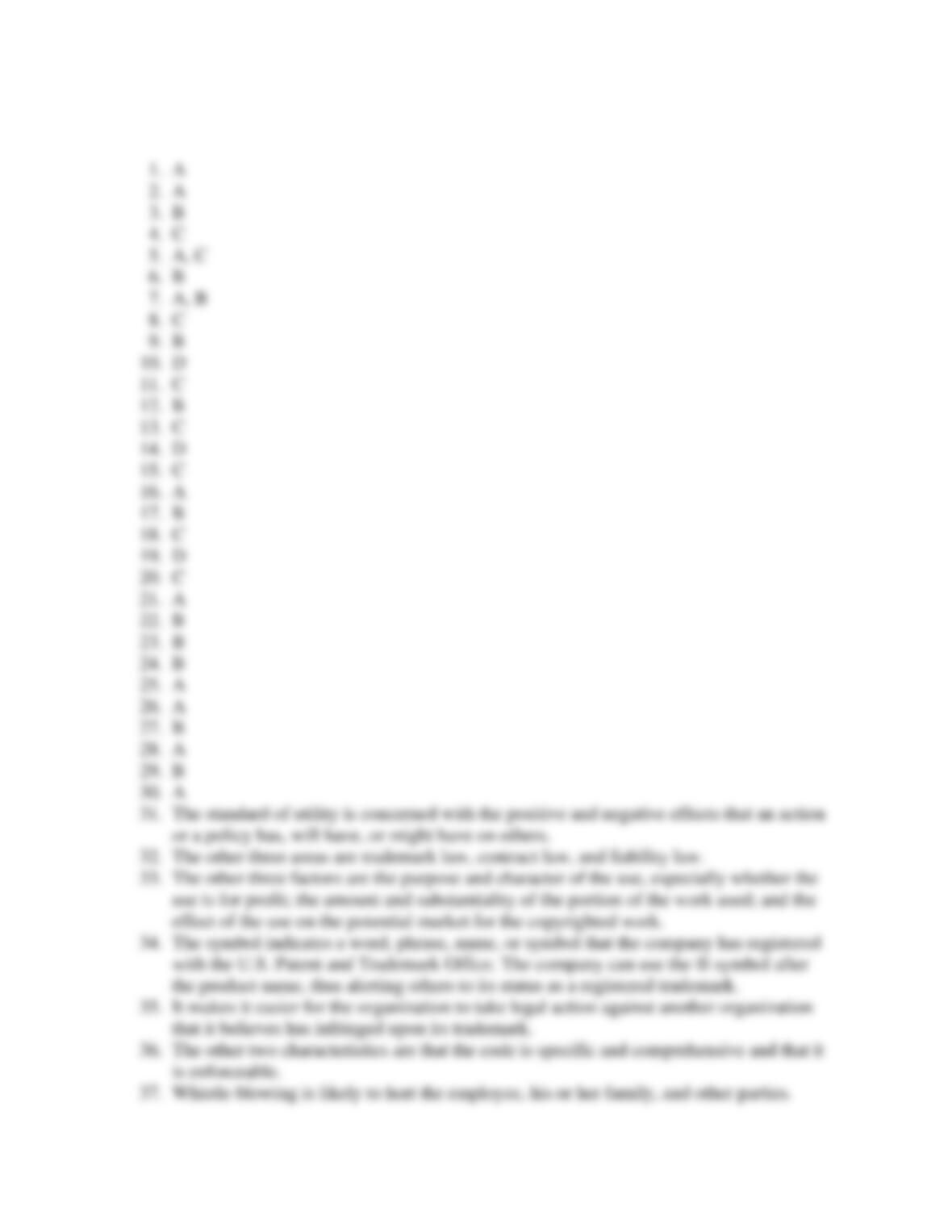
Answer Key
Page 10